
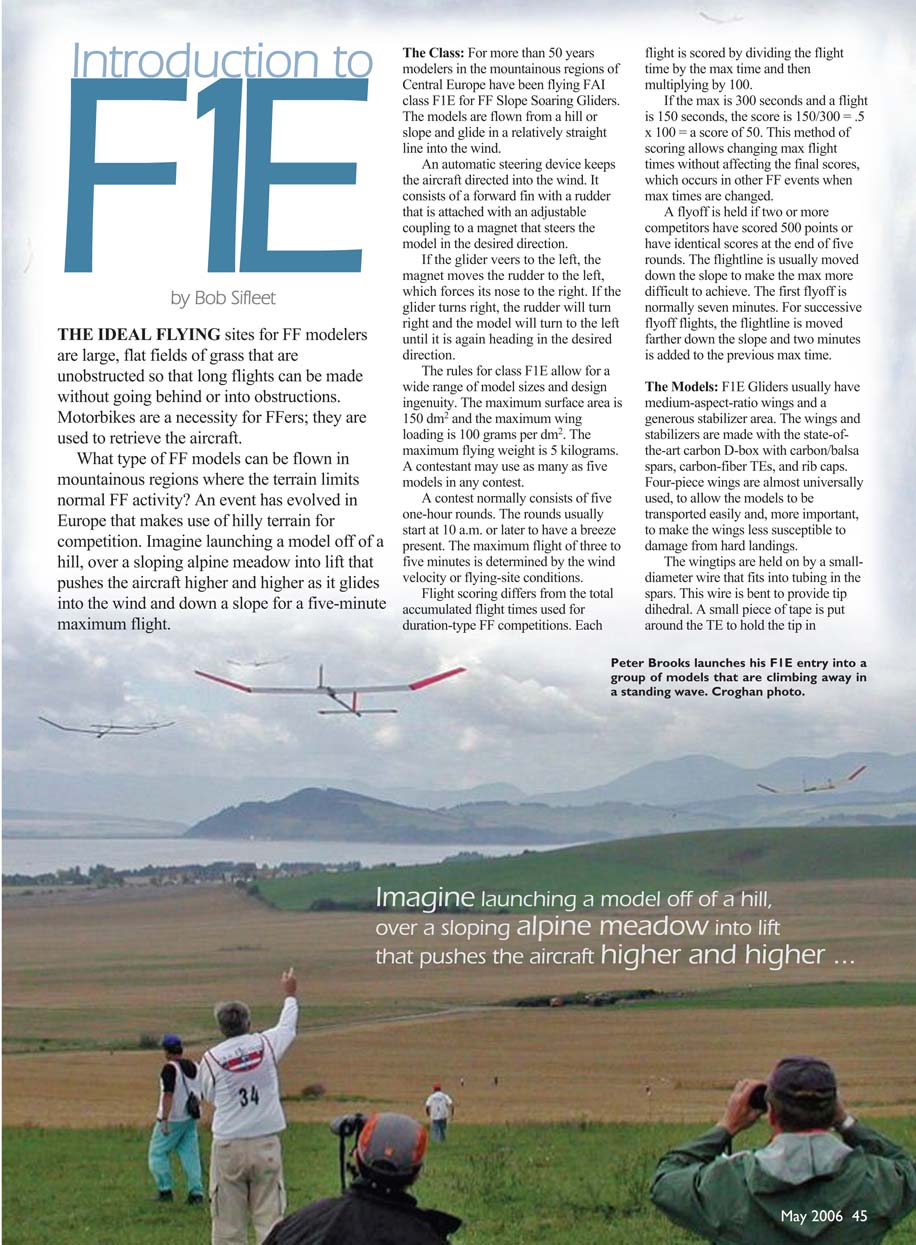
Introduction to F1E
by Bob Sifleet
The ideal flying sites for FF (free flight) modelers are large, flat fields of grass that are unobstructed so long flights can be made without going behind or into obstructions. Motorbikes are a necessity for FFers; they are used to retrieve the aircraft.
What type of FF models can be flown in mountainous regions where the terrain limits normal FF activity? An event evolved in Europe that makes use of hilly terrain for competition. Imagine launching a model off a hill, over a sloping alpine meadow into lift that pushes the aircraft higher and higher as it glides into the wind and down a slope for a five-minute maximum flight.
The Class
For more than 50 years, modelers in the mountainous regions of Central Europe have been flying FAI class F1E for FF slope-soaring gliders. The models are flown from a hill or slope and glide in a relatively straight line into the wind.
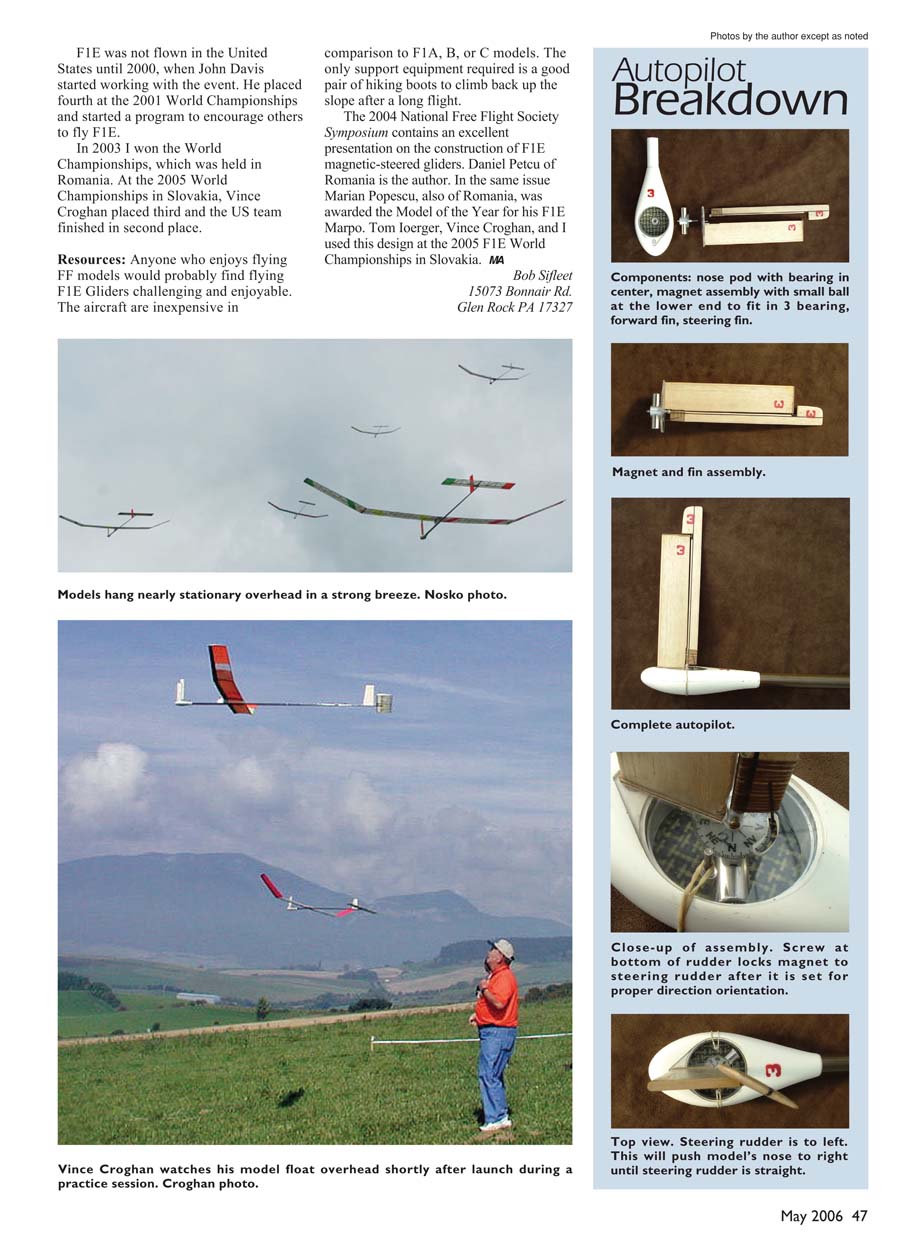
An automatic steering device keeps the aircraft directed into the wind. It consists of a forward fin with a hinged rudder that is attached via an adjustable coupling to a magnet that steers the model in the desired direction. A jewel bearing is located in the bottom center of the nose pod; a ball bearing or pointed shaft on the lower end of the magnet housing rests on that bearing.
- If the glider veers left, the magnet moves the rudder to the left, which forces the nose to the right.
- If the glider turns right, the rudder turns right and the model will turn left until it is again heading in the desired direction.
The rules for class F1E allow a wide range of model sizes and design ingenuity:
- Maximum surface area: 150 dm²
- Maximum wing loading: 100 g per dm²
- Maximum flying weight: 5 kg
- A contestant may use up to five models in any contest
Typical contest structure and scoring:
- A contest normally consists of five one-hour rounds. Rounds usually start at 10 a.m. or later to ensure a breeze.
- The maximum flight time (typically three to five minutes) is determined by wind velocity or flying-site conditions.
- Each flight is scored by dividing the flight time by the max time and multiplying by 100. Example: if the max is 300 seconds and a flight is 150 seconds, the score is 150/300 = 0.5 × 100 = 50.
- This scoring method allows changing max flight times without affecting relative final scores.
Flyoffs:
- A flyoff is held if two or more competitors have scored 500 points or have identical scores at the end of five rounds.
- The flightline is usually moved down the slope to make the max more difficult.
- The first flyoff is normally seven minutes. For successive flyoff flights the flightline is moved farther down the slope and two minutes is added to the previous max time.
The Models
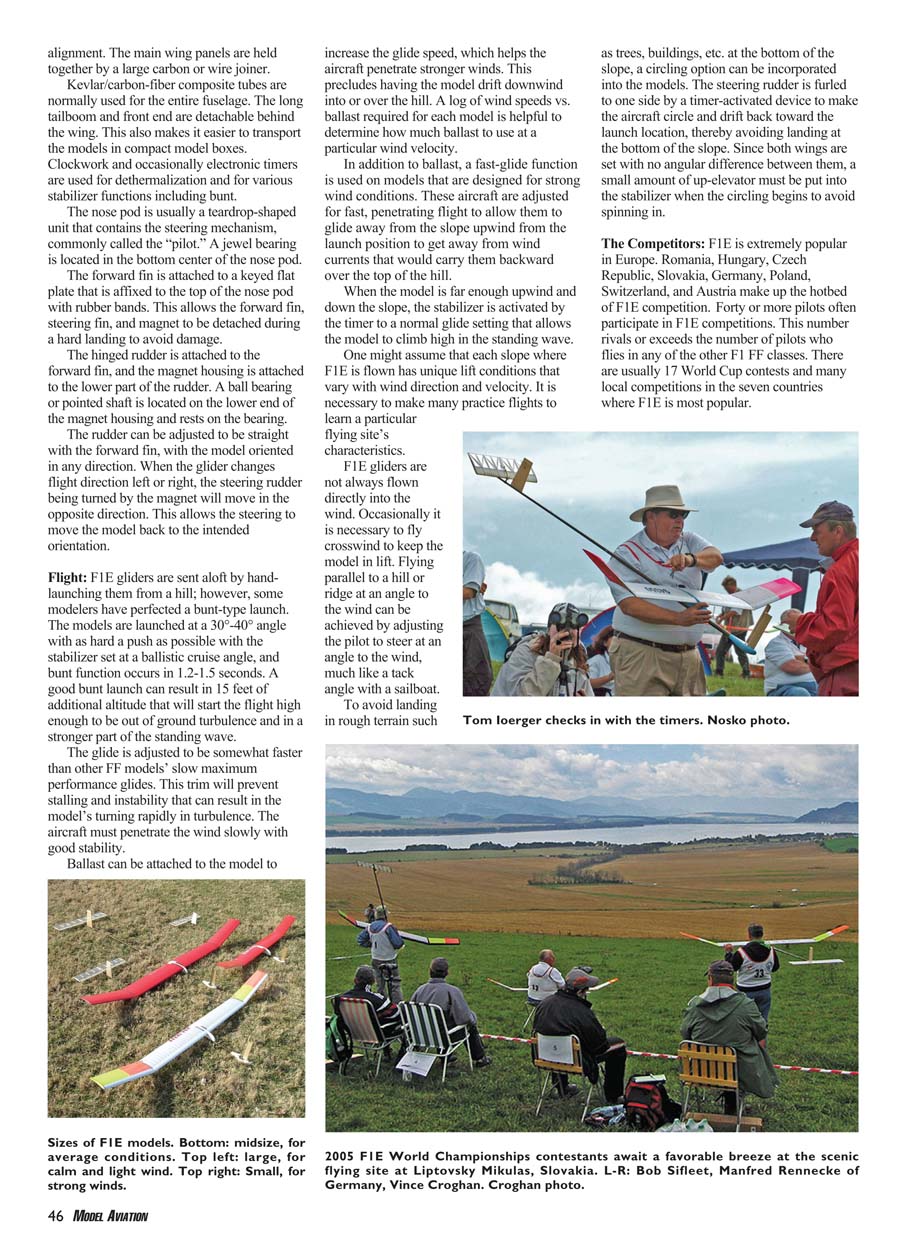
F1E gliders usually have medium-aspect-ratio wings and generous stabilizer area. Wings and stabilizers use state-of-the-art carbon D-box construction with carbon/balsa spars, carbon-fiber trailing edges, and carbon rib caps. Four-piece wings are almost universally used to allow easy transport and to reduce susceptibility to damage from hard landings.
- Wingtips are held on by small-diameter wire that fits into tubing in the spars. The wire is bent to provide tip dihedral; a small piece of tape around the trailing edge holds the tip in alignment.
- Main wing panels are joined by a large carbon or wire joiner.
- Kevlar/carbon-fiber composite tubes are normally used for the entire fuselage. The long tailboom and front end are detachable behind the wing, simplifying transport and packing.
- Clockwork and occasionally electronic timers are used for dethermalization and for various stabilizer functions, including bunt.
The nose pod is usually a teardrop-shaped unit that contains the steering mechanism, commonly called the "pilot." The forward fin is attached to a keyed flat plate affixed to the top of the nose pod with rubber bands. This allows the forward fin, steering fin, and magnet to detach during a hard landing to avoid damage. The hinged rudder is attached to the forward fin, and the magnet housing is attached to the lower part of the rudder.
The rudder can be adjusted to be straight with the forward fin, with the model oriented in any direction. When the glider changes flight direction left or right, the steering rudder—being turned by the magnet—will move in the opposite direction to return the model to the intended orientation.
Flight
F1E gliders are sent aloft by hand-launching from a hill; some modelers have perfected a bunt-type launch. Models are launched at a 30°–40° angle with as hard a push as possible, with the stabilizer set at a ballistic cruise angle; the bunt function occurs in about 1.2–1.5 seconds. A good bunt launch can yield roughly 15 feet of additional altitude, putting the flight above ground turbulence and into stronger parts of the standing wave.
Glide and trim:
- The glide is adjusted to be somewhat faster than other FF models' slow maximum-performance glides. This prevents stalling and instability that can result in rapid turning in turbulence.
- The aircraft must penetrate the wind slowly with good stability.
Ballast and fast-glide functions:
- Ballast can be attached to increase glide speed, helping the aircraft penetrate stronger winds and preventing drift downwind into or over the hill. A log of wind speeds vs. required ballast for each model is helpful.
- Some models have a fast-glide function for strong-wind conditions. These are adjusted for fast, penetrating flight to allow them to glide away from the slope upwind of the launch position, escaping wind currents that would carry them backward over the top of the hill.
- When the model is far enough upwind and down the slope, a timer activates the stabilizer to a normal glide setting that allows the model to climb high in the standing wave.
Site-specific flying:
- Each slope has unique lift conditions that vary with wind direction and velocity. Many practice flights are necessary to learn a particular site’s characteristics.
- F1E gliders are not always flown directly into the wind. Occasionally, flying crosswind or parallel to a hill at an angle to the wind keeps the model in lift. The pilot (magnetic steering) can be adjusted to steer at an angle to the wind, similar to tacking with a sailboat.
Circling option to avoid rough landings:
- To avoid landing in rough terrain (trees, buildings, etc.) at the bottom of the slope, a circling option can be used. A timer-activated device furles the steering rudder to one side to make the aircraft circle and drift back toward the launch location.
- Since both wings are set with no angular difference, a small amount of up-elevator must be put into the stabilizer when circling begins to avoid spinning.
The Competitors
F1E is extremely popular in Europe. Romania, Hungary, Czech Republic, Slovakia, Germany, Poland, Switzerland, and Austria form the hotbed of F1E competition. Forty or more pilots often participate in F1E contests—rivaling or exceeding numbers in other F1 FF classes. There are usually about 17 World Cup contests and many local competitions in the countries where F1E is most popular.
F1E was not flown in the United States until 2000, when John Davis began working with the event. He placed fourth at the 2001 World Championships and started a program to encourage others to fly F1E.
In 2003 I won the World Championships, held in Romania. At the 2005 World Championships in Slovakia, Vince Croghan placed third and the U.S. team finished in second place.
Resources
Anyone who enjoys flying FF models would likely find F1E gliders challenging and enjoyable. The aircraft are inexpensive compared with F1A, F1B, or F1C models. The only essential support equipment is a good pair of hiking boots to climb back up the slope after a long flight.
Recommended reading and references:
- The 2004 National Free Flight Society Symposium contains an excellent presentation on the construction of F1E magnetic-steered gliders by Daniel Petcu (Romania).
- Marian Popescu (Romania) was awarded Model of the Year for his F1E Marpo; Tom Ioerger, Vince Croghan, and I used this design at the 2005 F1E World Championships in Slovakia.
Bob Sifleet 15073 Bonnair Rd. Glen Rock, PA 17327
Transcribed from original scans by AI. Minor OCR errors may remain.

