
2007 F3D RC Pylon World Championships
By Michael Ramsey
Attending a contest is like reading a best-selling novel, except the story is live and there’s no way to peek at the last page to see how it all ends. The book of the 2007 F3D World Championships was written at the best place on earth to fly a model airplane: the International Aeromodeling Center at Muncie, Indiana.
Some have compared RC Pylon Racing to Formula 1 auto racing. When I prepared to attend the F3D World Championships, my first World Championships modeling event, it seemed reasonable to think that F3D had commonalities with the state-of-the-art open-wheel racing fanatics that national television covers.
Formula 1 and F3D fans are speed freaks with exacting tastes for the tiniest speed advantage. They exhibit a level of friendly professionalism and set the standard for sportsmanship that is a cut above — and sometimes even heroic. After spending the better part of a week in the field with them, June 20–28, it was my privilege to witness the Pylon community’s pride and passion for the sport. The pursuit pushes the envelope of speed and performance, and the pilots deserve our respect; they’ve earned mine.
Every country of the 16 that applied to compete was allowed three pilot/caller entries and as much pit crew, family, and management as they could afford to bring. Pilots raced to acquire the fewest points possible; points equaled seconds in lap time. Rather than try to cross the finish line first, the 43 pilots raced primarily against the clock during the 15 rounds of flying.
Each round included approximately 16 heats in which three aircraft were launched in a staggered fashion (spacing them out was a safety precaution). As a race progressed the aircraft typically bunched together for a few laps, which made the pilots and the audience anxious with intense anticipation. At those times the separation between the aircraft as they rounded the pylons was barely half a wing length.
It doesn't take an expert to appreciate Pylon Racing's entertainment value. Being a world-class event meant that everyone was awed by the exhilarating man-and-machine relationship RC Pylon racing offers its participants.
Each 10-lap race equaled a distance of close to 2.5 miles. It typically took these models 59–66 seconds to complete a race. The fastest official time on record is approximately 56.8 seconds, but the thick Muncie air wasn't going to allow that number to be beaten this year.
Days before the official program began, Event Director Wayne Yeager and his AMA staff catered to the teams as they arrived.
"It's like the park entrance to a five-star country club," said Russell Van Der Westhuizen of Team South Africa. His opinion of the facility was quite a compliment since he has attended all but one Pylon World Championships. Russell thought AMA's facility was world class when he attended the same event in Muncie 12 years ago, and it surprised him that it had been improved even further. No other nation's aeromodelling association compares to what AMA and its members have built. "They should all be very proud," he said.
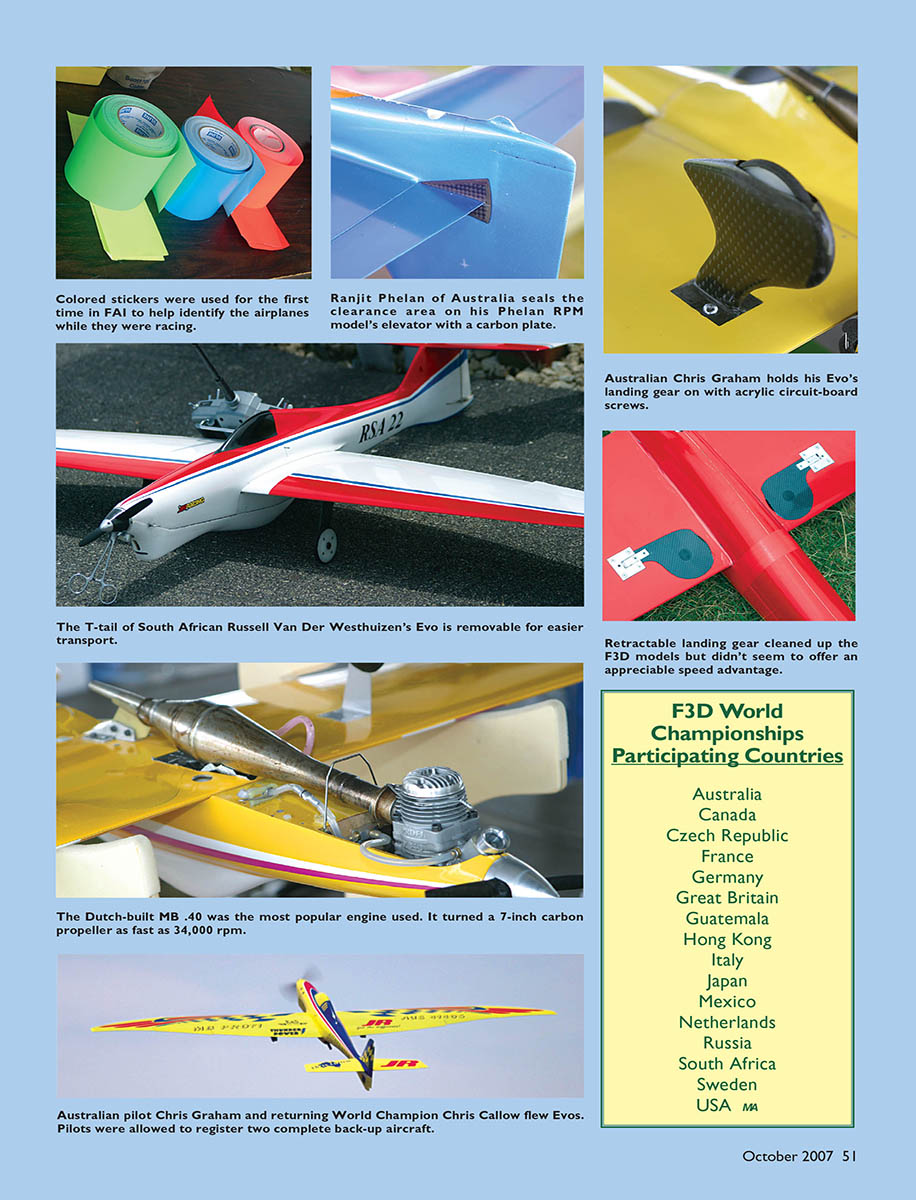
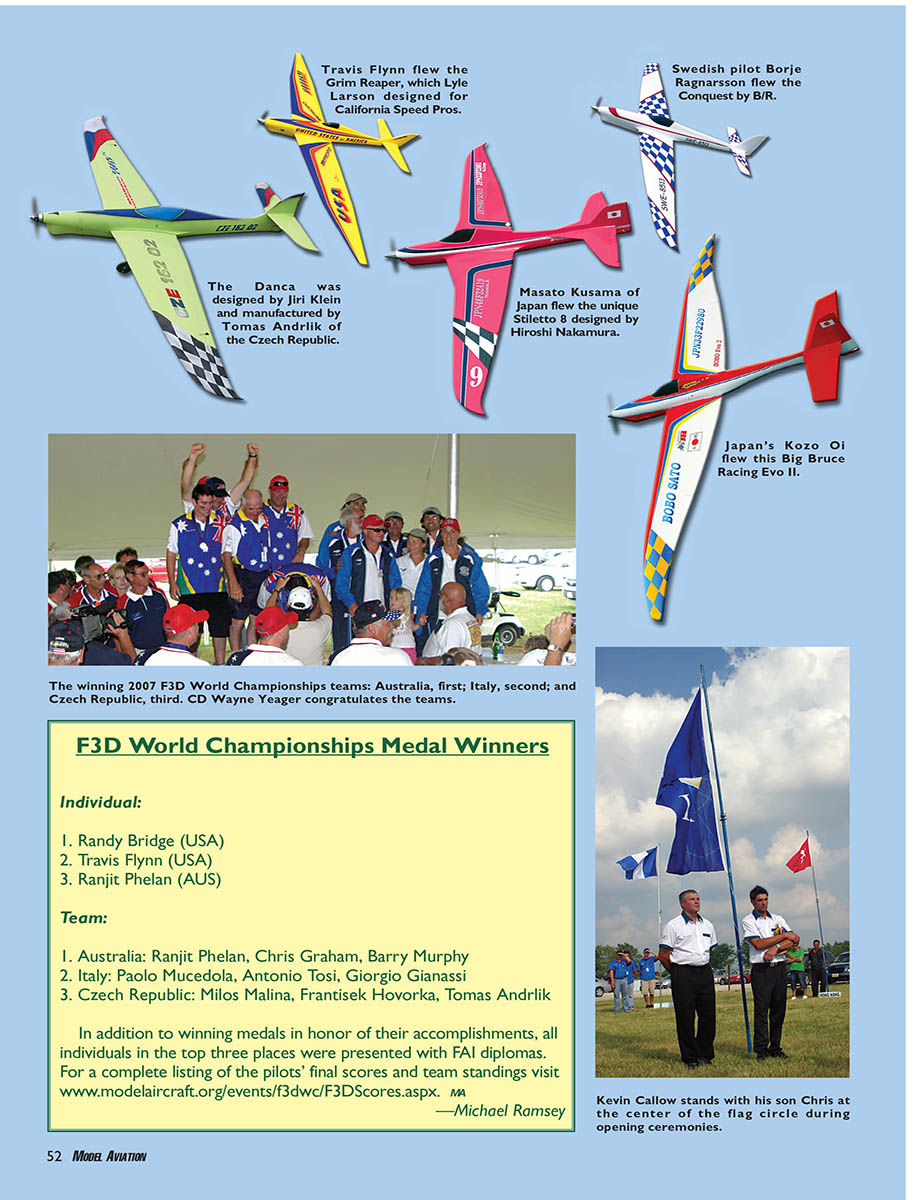
The aircraft flown in F3D have to meet certain specifications and use engines of an exact displacement. The most popular models by far were the Evo and family of variants from Big Bruce Racing and the Dago by Christian Wolf. There were many other unique and elegant airplanes from the Netherlands and the Czech Republic, which are often regarded as cutting edge in Pylon Racing.
Since the start of RC Pylon Racing more than 20 years ago, there have been many changes. "The aircraft being flown today are twice as fast as they were back then," said Team USA Manager Lyle Larson. Since competing at the world and local level, Lyle has applied his skill and experience to model-aircraft manufacturing. Because of his wealth of talent, two US team members flew Larson-built airplanes: the Grim Reaper and the Javelin.
F3D aircraft are relatively simple in nature to meet the 3.5-pound minimum weight, but some pilots employed retractable landing gear to offer the least amount of drag to the slipstream. Those aircraft didn't stand out as being faster than the fixed-gear monoplanes, but they definitely appeared sleeker.
The models were elegant despite strict conformity to the aircraft-dimension parameters, with outlines reminiscent of the Unlimited-class full-scale racers built in Reno, Nevada. To be as light as possible they departed from exact scale by featuring fuselages as narrow as possible. Their wings often differed radically in shape from full scale and appeared long and graceful.
Probably the most sophisticated features of the F3D aircraft were the airfoil design and state-of-the-art molded composite construction. After a brief inspection the wings appeared to have an average thickness of roughly 7% of the mean aerodynamic chord — that's pretty thin! All the aircraft were molded composite with the paint job applied in the layup process at the same time. That weight-saving technique also prevented the "bumpy" paint lines that can cause extra drag.
Every effort to reduce drag on the airframe is explored. At this level, even if the speed advantage equals only a half mile an hour or a tenth of a second on the lap time, it's all good because the effort repeated several times adds up. As in Formula 1 auto racing, everything that is cutting edge at this level will be common for the consumer down the road. Competitors are owed a debt of gratitude because they make this hobby more enjoyable for the average flier.
A benefit modelers currently see in the RTFs is the increasing use of composite materials. Fiberglass fuselages are now popular, as are composite accessories such as carbon-fiber spinners.
The most popular power plant is the Dutch-built MB .40 engine. Its rear-exhaust design accommodates a tuned pipe that promotes the highest possible output. The engines turn 7-inch propellers at 28,000–34,000 rpm with fuel that has no nitromethane.
Despite the MB's favorable reputation, the power system is finicky. Setting these engines takes the finesse of a concert musician. A needle setting that is just a click or two rich can add as much as 10 seconds to the course time or, worse, a setting that is too lean can cause the engine to flame out, carrying the pilot a 200-point penalty — a big blow!
RC Pylon Racing is very much a team operation, in which a pilot and a caller work together. The pilot guides the aircraft on the racecourse and the caller coaches the pilot on when to turn around the pylon and avoid other racers. The pilot's goal is to follow the racecourse by making the fewest corrections possible. Every control input the pilot makes equals drag, so the goal is to steer the course at a constant altitude and make heading adjustments only when absolutely necessary.
I can't give you blow-by-blow detail of how the race went from beginning to end. I quickly learned that all competing teams arrived at the World Championships already winners. Personal commitments and sacrifices were made before the team members ever set foot on AMA grounds. They came to have fun and represent their countries' honor.
Despite some language barriers I had a great time getting to know many people from around the world. Modeling seems to have a universal language. Even though I'm not a world-class pilot by any means, no one I talked to was unapproachable. David Axon, the colorful Australian team manager, was as proud of his team as he was of his sport of aeromodelling. "The atmosphere is electric!" he commented when asked about his favorite aspect of competition. David went on to mention that despite the competitive instinct, people from all countries are willing to help one another succeed. For instance, Lyle Larson helped the British team rebuild engines.
Of the 43 pilots who flew, 42 of them shared the same goal: to unseat three-time World Champion Chris Callow of Australia. At age 28, he's a young gun who shows how it's done with a gentleman's flair. If consistency is the main ingredient to winning, Chris must have it bottled. To see this drive his Evo I race around the pylons is like watching a slot car speed around the track at Mach 7. Chris positioned his airplane just a wing length above the pylons and didn't budge it until the checked flag dropped. "The air is much cleaner down there," he said.
Team USA arrived at the contest with both barrels loaded. None of the three pilots — Randy Bridge, Travis Flynn, or Fred Burgdorf — had ever competed in an F3D World Championships. What's more interesting is that F3D Pylon Racing isn't even practiced in the US, nor are there any contests except for the Team Trials. User-friendly and slower-flying Quarter 40 and Quickie 500 are the events these guys participated in to hone their skills.
These pilots met up regularly at Pylon events across the country, and flying together so often gave them an advantage. They got to know each other so well that they not only traded first-place standings from contest to contest, but they also began calling for each other. A friendship developed, which created a positive attitude among the group. Whereas other countries had pilot/caller sets, Team USA members pulled multiple duties as pilot, caller, and pit crew. They worked harder, but they developed familylike values that became the asset other teams were missing.
The success of the US team's effort was realized on the first day, when all three members showed up at the top of the scoresheet. Christopher Callow was right up there with them, and it looked like the defending World Champion was in strong contention for a fourth Gold Medal. The other Team Australia members were nipping at Christopher's heels. The Australians looked the winning part, and their proactive and positive attitudes seemed to be encouraged by the abundant group of people and family cheering them on during every minute of the contest.
Travis Flynn applied his experience as an F5D (RC Electric Pylon Racing) team member, and on Day Two he crept away from the pack, ending the day with a four-second lead in total lap time. That was a comfortable place to be in this competition. On the morning of the third and final day of the contest, a missed pylon changed Travis's fortune and that soft four-second pillow went uncomfortably flat. This upset put the first-place position well within the reach of seven major players. That's what the slightest mistake can mean.
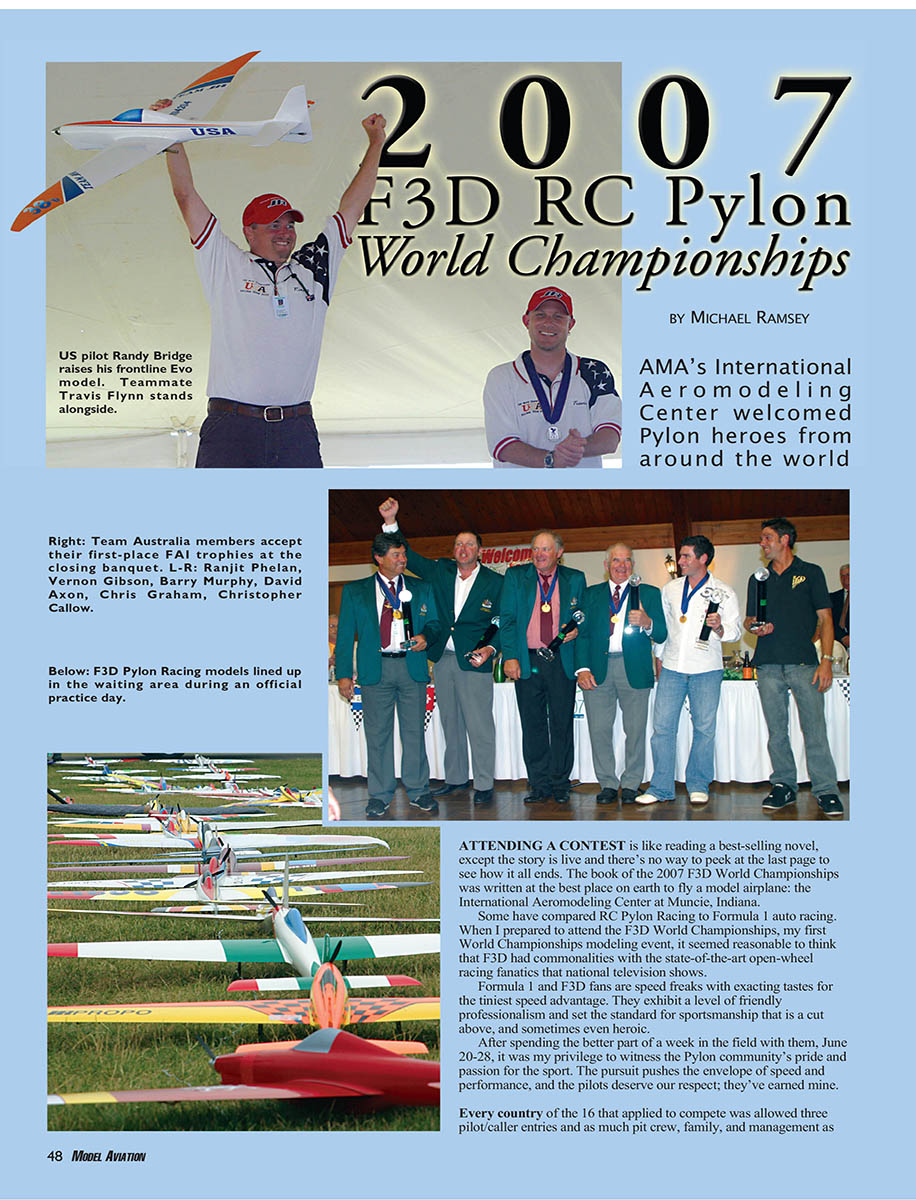
With just three rounds to go, Travis dug in and tightened his grip. He clawed his way back up into the top three, but Randy wasn't going to step out of the way. Remaining true sportsmen, however, neither teammate pulled any sucker punches. This was one of the finest examples of sportsmanship I've ever witnessed. Randy Bridge earned the top podium spot, but Travis was just a half second behind him. Their dual roles as pilot and caller earned them the honor to stand in the Gold and Silver medal spots. Just one second behind them was Australian Ranjit Phelan, followed by unseated World Champion Christopher Callow.
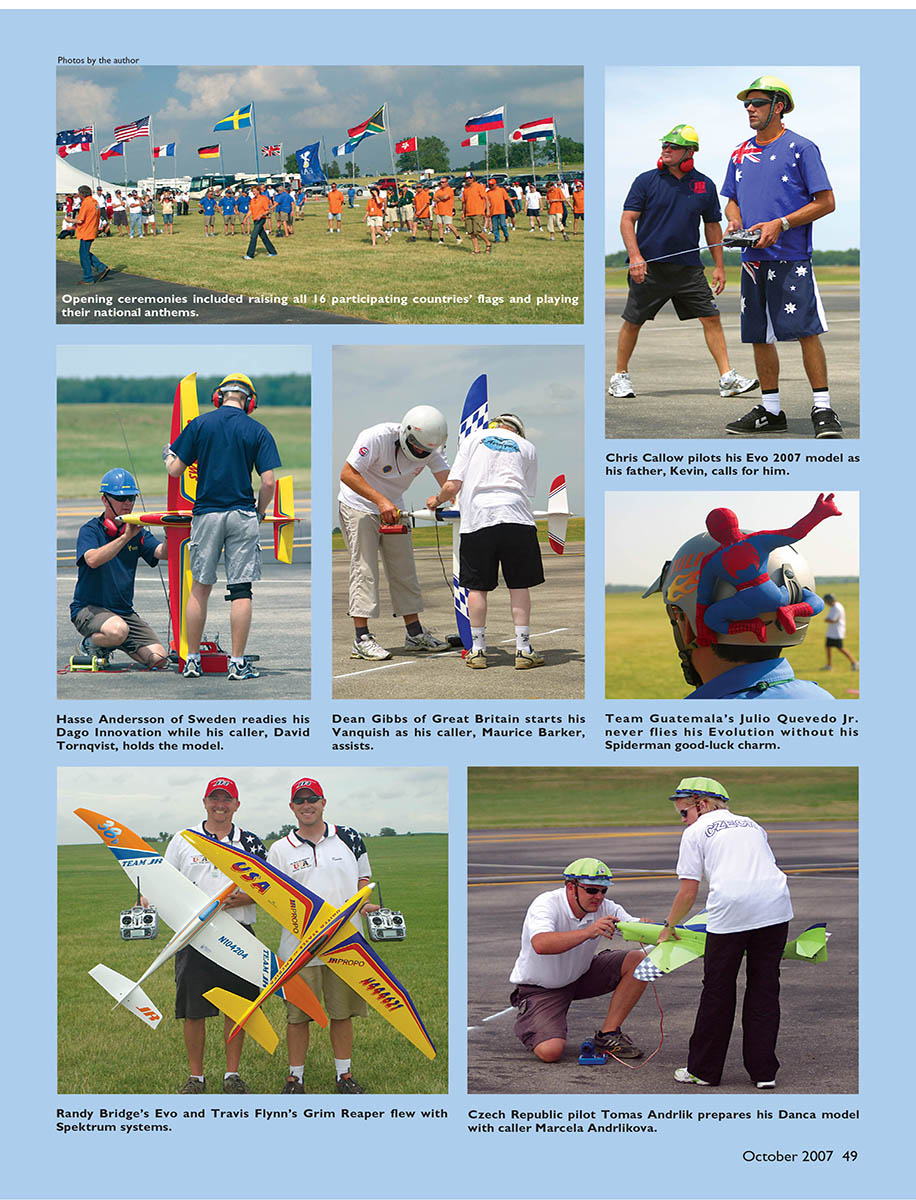
Equipment trouble plagued Fred Burgdorf on the second day and kept the US team from winning a podium seat. In keeping with its attitude and spirit, the Australian team earned the team Gold Medal. The Italian team followed in second place, with Team Czech Republic in the third spot. Both demonstrated an equal degree of stupendous sportsmanship.
Participating Countries
- Australia
- Canada
- Czech Republic
- France
- Germany
- Great Britain
- Guatemala
- Hong Kong
- Italy
- Japan
- Mexico
- Netherlands
- Russia
- South Africa
- Sweden
- USA
Medal Winners
Individual
- Randy Bridge (USA)
- Travis Flynn (USA)
- Ranjit Phelan (Australia)
In addition to medals, all individuals in the top three places were presented with FAI diplomas. For a complete listing of the pilots' final scores and team standings, visit www.modelaircraft.org/events/f3dwc/F3DScores.aspx.
Team
- Australia: Ranjit Phelan, Chris Graham, Barry Murphy
- Italy: Paolo Mucedola, Antonio Tosi, Giorgio Gianassi
- Czech Republic: Milos Malina, Frantisek Hovorka, Tomas Andrlik
My experience at this World Championships was unique. I'm sure many other stories are being shared in the other 15 countries whose teams participated. Every participant who competed in this contest came as a winner and hopefully felt as though he or she returned home even more so. Having witnessed the drama of this F3D World Championships, my pride in the modeling community is all that much stronger.
— Michael Ramsey [email protected]
Transcribed from original scans by AI. Minor OCR errors may remain.

