
2001 NEAT FAIR
by Bob Kopski
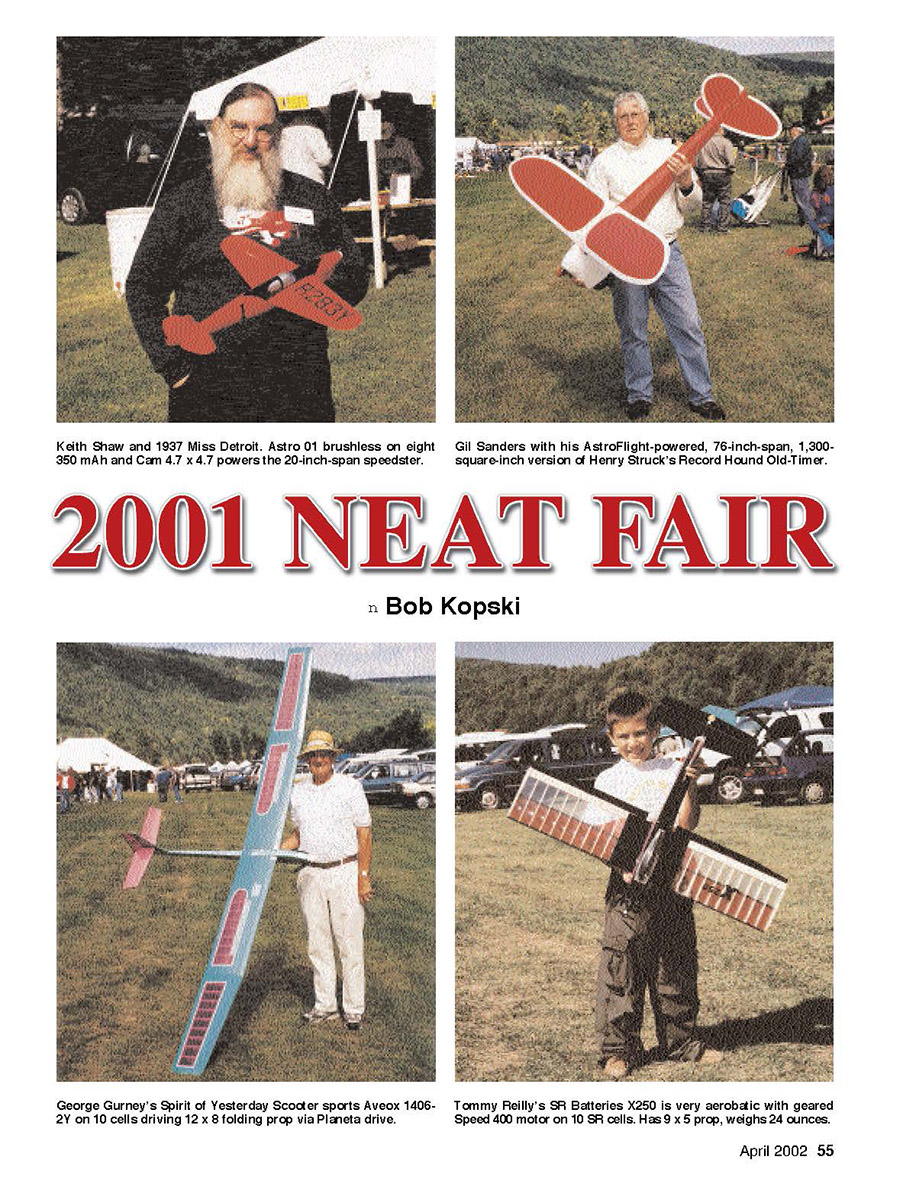
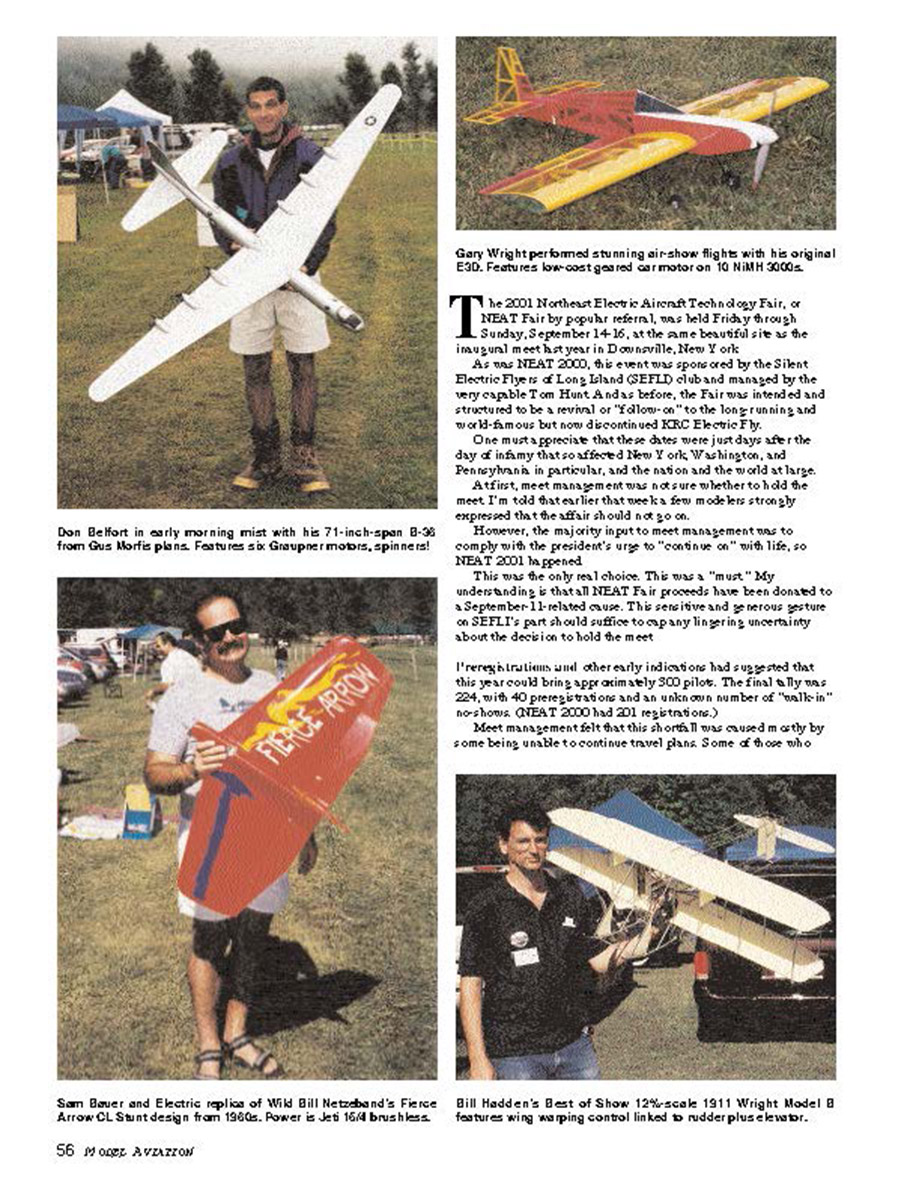
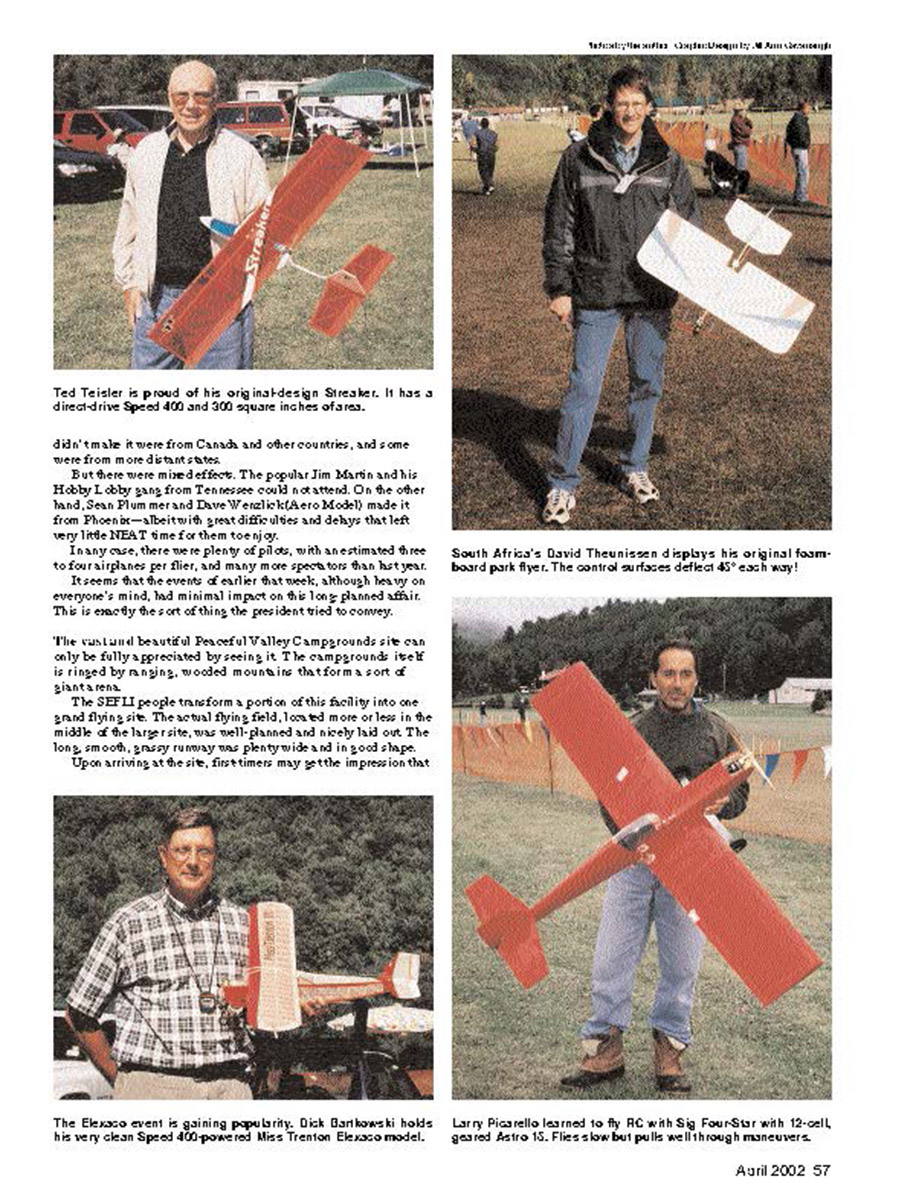
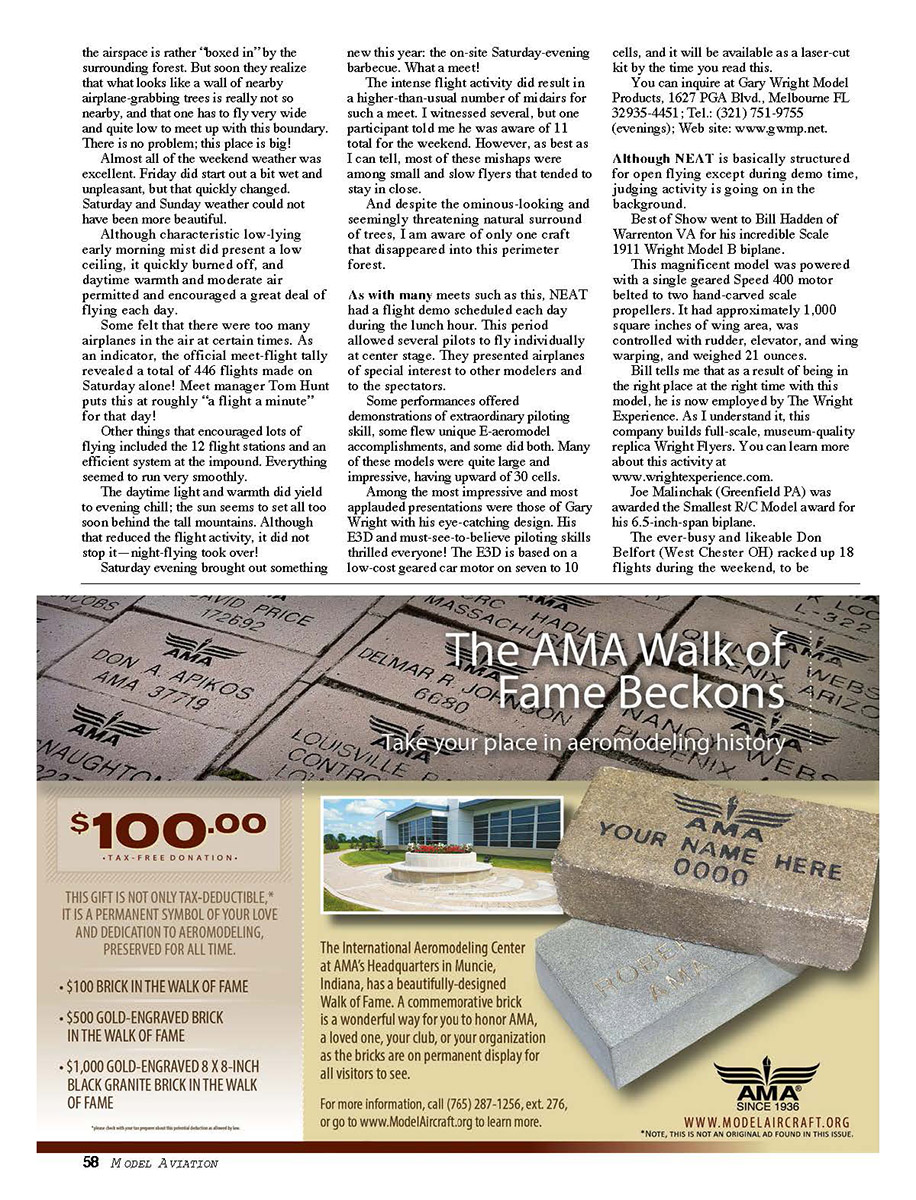
The 2001 Northeast Electric Aircraft Technology Fair, or NEAT Fair by popular referral, was held Friday through Sunday, September 14-16, at the same beautiful site as the inaugural meet that year in Dansville, New York.
As was NEAT 2000, this event was sponsored by the Silent Electric Flyers of Long Island (SEFLI) club and managed by the very capable Tom Hunt. And as before, the Fair was intended and structured to be a revival or "follow-on" to the long-running and world-famous but now discontinued KCRC Electric Fly.
One must appreciate that the dates were just days after the day of infamy that so affected New York, Washington, and Pennsylvania in particular, and the nation and the world at large.
At first, meet management was not sure whether to hold the meet. I'm told that earlier that week a few modelers strongly expressed that the affair should not go on.
However, the majority input to meet management was to comply with the president's urging to "continue on" with life, so NEAT 2001 happened.
This was the only real choice. This was a "must." My understanding is that all NEAT Fair proceeds have been donated to a September 11 related cause. This sensitive and generous gesture on SEFLI's part should suffice to tamp any lingering uncertainty about the decision to hold the meet.
Preregistrations and other early indications had suggested that this year could bring approximately 300 pilots. The final tally was 224, with 40 preregistrations and an unknown number of "walk-ins" (at NEAT 2000 had 201 registrations).
Meet management felt that this shortfall was caused mostly by some being unable to continue travel plans. Those who didn't make it were from Canada and other countries, and some were from more distant states.
But there were mixed effects. The popular Jim Martin and his Hobby Lobby gang from Tennessee could not attend. On the other hand, Sean Plummer and Dave Wenzlick (Aero Model) made it from Phoenix — albeit with great difficulties and delays that left very little NEAT time for them to enjoy.
In any case, there were plenty of pilots, with an estimated three to four airplanes per flier, and many more spectators than last year.
It seems that the events of earlier that week, although heavy on everyone's mind, had minimal impact on the long planned affair. This is exactly the sort of thing the president tried to convey.
The casual beauty of Peaceful Valley Campgrounds site can only be fully appreciated by seeing it. The campground itself is ringed by a hilly, wooded mountain that forms a sort of giant arena.
The SEFLI people transform a portion of this facility into one grand flying site. The actual flying field, located more or less in the middle of the large site, was well-planned and nicely laid out. The long, smooth, grassy runway was plenty wide and in good shape.
Upon arriving at the site, first-timers may get the impression that the airspace is rather "boxed in" by the surrounding forest. But soon they realize that what looks like a wall of nearby airplane-grabbing trees is really not so nearby, and that one has to be very wide and quite low to meet up with this boundary. There is no problem; this place is big!
Almost all of the weekend weather was excellent. Friday did start out a bit wet and unpleasant, but that quickly changed. Saturday and Sunday weather could not have been more beautiful.
Although characteristic low-lying early morning mist did present a low ceiling, it quickly burned off, and daytime warmth and moderate air permitted and encouraged a great deal of flying each day.
Some felt that there were too many airplanes in the air at certain times. As an indicator, the official meet-flight tally revealed a total of 446 flights made on Saturday alone! Meet manager Tom Hunt puts this at roughly "a flight a minute" for that day!
Other things that encouraged lots of flying included the 12 flight stations and an efficient system at the impound. Everything seemed to run very smoothly.
The daytime light and warmth did yield to evening chill; the sun seems to set all too soon behind the tall mountains. Although that reduced the flight activity, it did not stop it — night flying took over!
Saturday evening brought out something new this year: the on-site Saturday-evening barbecue. What a meet!
The intense flight activity did result in a higher-than-usual number of midairs for such a meet. I witnessed several, but one participant told me he was aware of 11 total for the weekend. However, as best as I can tell, most of these mishaps were among small and slow flyers that tended to stay in close.
And despite the ominous-looking and seemingly threatening natural surround of trees, I am aware of only one craft that disappeared into this perimeter forest.
As with many meets such as this, NEAT had a flight demo schedule each day during the lunch hour. This period allowed several pilots to fly individually at center stage. They presented airplanes of special interest to other modelers and to the spectators.
Some performances offered demonstrations of extraordinary piloting skill, some flew unique E-aeromodel accomplishments, and some did both. Many of these models were quite large and impressive, having upward of 30 cells.
Among the most impressive and most applauded presentations were those of Gary Wright with his eye-catching design. His E3D and must-see-to-believe piloting skills thrilled everyone! The E3D is based on a low-cost geared car motor on seven to 10 cells, and it will be available as a laser-cut kit by the time you read this.
You can inquire at Gary Wright Model Products, 1627 PGA Blvd., Melbourne FL 32935-4451; Tel: (321) 751-9755 (evenings). Web site: www.gwmp.net.
Although NEAT is basically structured for open flying except during demo time, judging activity is going on in the background.
Best of Show went to Bill Hadden of Warrenton VA for his incredible Scale 1911 Wright Model B biplane.
This magnificent model was powered with a single geared Speed 400 motor belted to two hand-carved scale propellers. It had approximately 1,000 square inches of wing area, was controlled with rudder, elevator, and wing warping, and weighed 21 ounces.
Bill tells me that as a result of being in the right place at the right time with this model, he now employed by The Wright Experience. As I understand it, this company builds full-scale, museum-quality replica Wright Flyers. You can learn more about this activity at www.wrightexperience.com.
Joe Malinchak (Greenfield PA) was awarded the Smallest R/C Model award for his 6.5-inch-span biplane.
The ever-busy and likeable Don Belfort (West Chester OH) racked up 18 flights during the weekend, to be recognized with the Most Flights award. Don is the bimonthly Flying Models Electrics columnist.
This year's field setup allowed a better mix of flightline and vendor activity, and the many providers present seemed busy all weekend. Business was — as good that one was heard to say he could have sold the tires off his truck.
This is the kind of thing that makes everybody happy: modelers easier to easily find and buy things they wanted and vendors able to satisfy this market.
In addition, there were the "just released" and "almost ready" E-products to be seen — the sort of things that excite individuals who are looking forward to "next season." It's hard to imagine a better setting for such happy exchanges.
I found myself experiencing a "kid in the candy store" sensation. There was so much going on and so much to see that it was difficult to meet, talk to, and take photos of all the models and their airplanes that I wanted to and this was despite the three days of opportunity.
Afterward, on my homeward trip, I agonized over the many photo opportunities that got by me. I like to "bank" pictures and stories of E-accomplishments to share with you in the year's Radio Control (RC) Electrics columns — examples of what others have done that can inspire and help you pursue E-projects of personal interest and challenge.
There were tons of E-acro accomplishments on display and in the air all weekend. Electrics present covered the range from micro to massive craft, from Scale oddities to contemporary jet types, from routine to high-tech, from scratch-built to Almost Ready to Fly, from beginner to expert, and from the well-proven to the daring push of the state of the art.
Small and light low-power aircraft — with their own special charm — limped about in the early-morning still mist and all day thereafter. At the other end, high-power, vertical-streaking E-machines challenged the limits of sight in just seconds, directly overhead, throughout the weekend. Of course, there was everything in between these extremes as well.
One thing that became rather clear during the meet is that "small" does not necessarily mean "park" or "backyard." There was an abundance of the small, light slow flyers, but I witnessed a number of comparable-sized but powerful and fast airplanes that can very quickly use up most of the available sky.
These were not "park flyers" — at least not for any park I've ever seen! Power systems such as the Astro 01 and 02 brushless motors, which several flew, clearly permit very impressive performances in the right airplanes and in the right hands.
These models really need a "normal" RC flying field and would definitely not fit your nearby cul-de-sac, their small size and light weight notwithstanding.
I did realize one special joy: I took an E-powered Galloping Ghost-equipped vintage RC model and flew it several times in demonstration of times gone by. My purpose was to share some early RC technology, and in so doing, hopefully add to the fun of the day.
The Square Hare — a design by Bill Northrop — was published in the 1960s as a Galloping Ghost airplane. Typical power of that day was a .19 — un-muffled and unthrottled. My contemporary version has an Astro 05 on six cells and weighs 44 ounces. The part I'm most proud of is Bill Northrop's autograph, which I obtained several years ago at a vintage meet.
"Galloping Ghost" offers us a 1960s era, then "high-tech" RC system approach to accomplishing simultaneous proportionate control of rudder and elevator by using variable pulse width and rate encoding.
This approach results in visibly snappy, noisy, and draggy control surfaces when average positions, hence the model's flight path, is controlled by varying the width and rate of the encoding. My Square Hare has some original equipment from that era.
I had several flights with this model during the weekend, and, as expected, some people immediately recognized what it was, and they could directly relate to that time in RC aeromodelling history. There were many fond smiles among this group, and many were anxious to tell what they flew "back then."
Likewise, some didn't have a clue and thought I had major radio problems, given those noisy and flapping control surfaces! These people were more amazed than anything when I showed 'em how it worked close up.
It appeared that everyone enjoyed the "GG" demonstration, and I do think the Square Hare added to the fun!
RC aeromodelling has indeed come a long way in the last few decades, and contemporary electric is propelling it even farther faster by providing new challenges while opening up new flying-field opportunities.
Clean, quiet E-power is allowing this hobby to reach the young or otherwise new modelers faster than may have ever been the case before.
And meets such as the NEAT Fair, which showcase contemporary Electrics, bring out not only the latest and best but established and proven stuff, and they attract participation from all corners of the nation and from abroad and put it all together in one place.
Plan now to attend this year's show. NEAT Fair '02 is scheduled for September 13-15 at the same great Peaceful Valley Campgrounds site in Downsville NY. You can get more information at www.nyblip.com/NEAT.htm.
My personal "thank you" to Tom Hunt and all the SEFLI people for another fine, full-of-fun E-meet — even in the shadow of September 11, 2001. This was the right thing to do. And NEAT 2002 is the right thing to do this year. I can hardly wait!
Bob Kaplow 25 Wilkie Drive Levittown, PA 19054
Transcribed from original scans by AI. Minor OCR errors may remain.

