
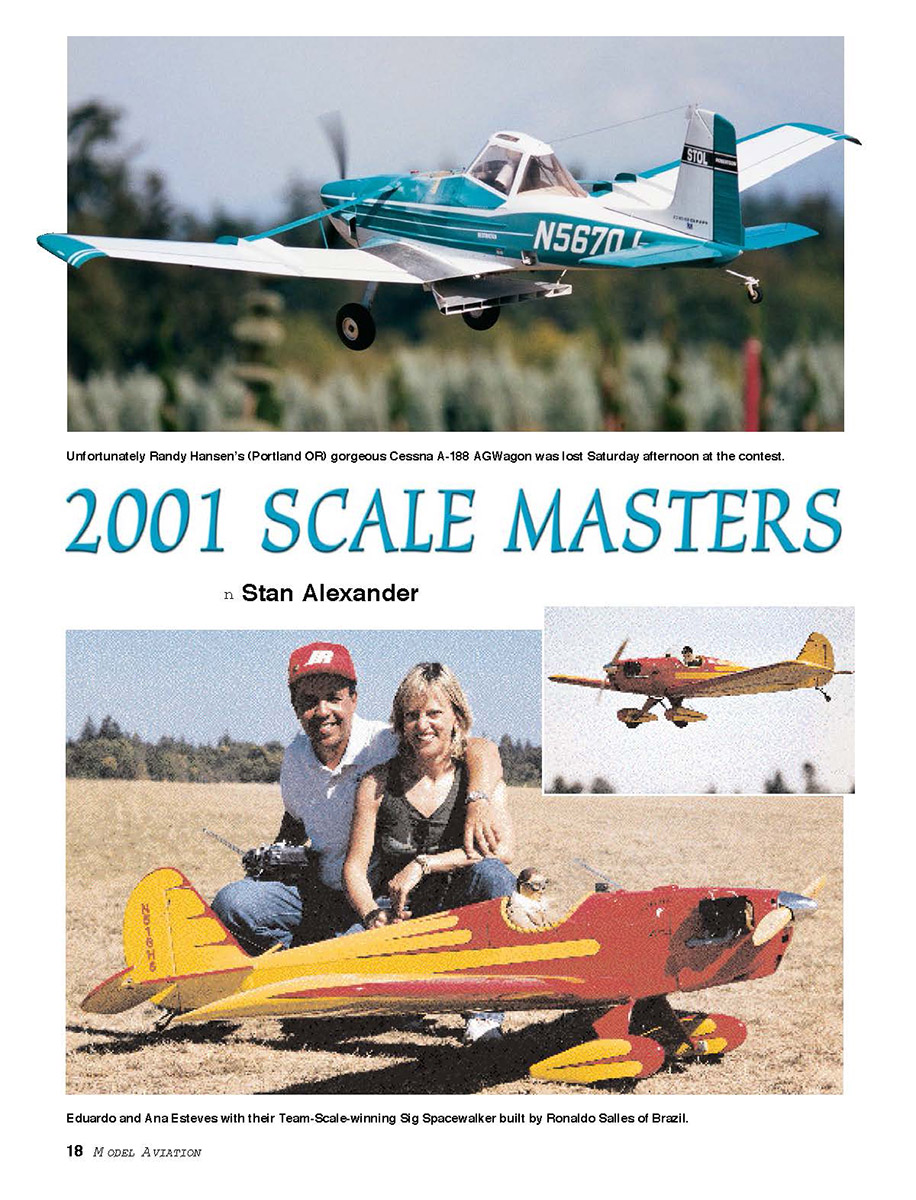
2001 SCALE MASTERS
By Stan Alexander
It's a testament to the US Scale Masters organization, Chairman Earl Aune, the Portland Sky Knights, the Barnstormers, and the Fern Prairie Modelers, as well as approximately 100 volunteers across the country who planned this event and still went forward, even though our nation was gripped by unspeakable terror.
There are several small, quaint, club type airports in the Willamette Valley, and being at some of them is like stepping back in time to the 1950s. Held at Lenhardt's Air Park in beautiful Hubbard, Oregon, the Scale Masters was moved from the heartland of the US to the West Coast. Grass and asphalt runways were available for the modelers at the site.
Although it was expected that the attendance would be slightly lower than normal, at least 15 modelers who had planned to attend the Championships didn't make it.
Contestant Brian O'Meara had shipped his Corsair ahead of him. His model was statically judged, but Brian couldn't get a flight out of Denver CO in time to make the contest. Modelers in other areas had similar problems as flight schedules changed daily.
Eduardo and Ana Esteves had an interesting time trying to cross the border from Canada, especially after the Federal Bureau of Investigation (FBI) found Eduardo's JR radio in his toolbox.
The couple was allowed to enter the country after showing the five FBI agents documentation indicating that they were going to the Scale Masters.
Several contestants had their flights canceled, or their families wanted them to stay close; it's understandable. These were the reasons many felt that there was a downturn in attendance in 2001 compared to the 2000 contest at Dayton, Ohio.
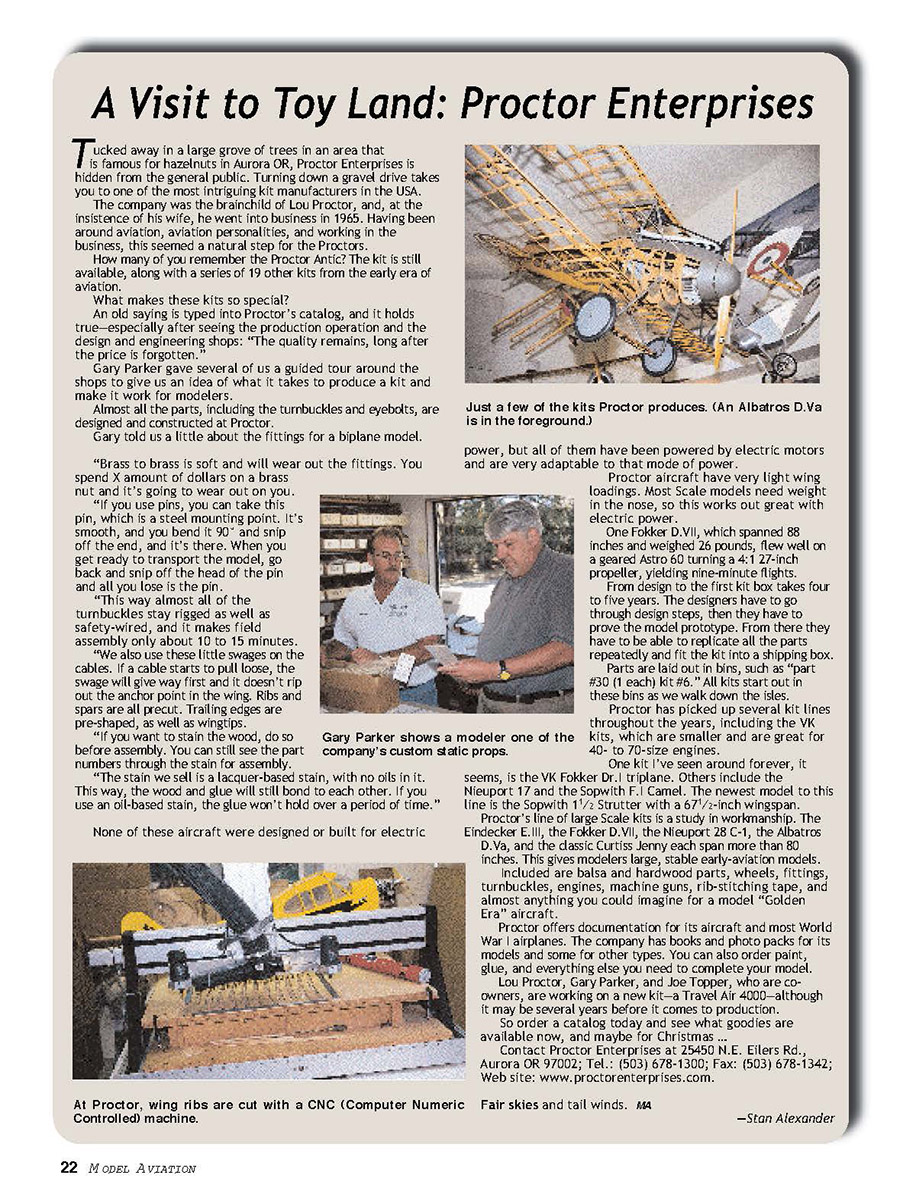
For those of us who did go to Oregon, we were in for a treat: this year's static judging on Thursday was held at Proctor Enterprises in nearby Aurora, Oregon. The whole area is sort of cozy, with deer roaming the tree-covered grounds during the day.
Temperatures were cool, with no humidity to speak of, and the days were beautiful, sunny, and cloudless.
Lunch was served on site, and people had a great time with guided tours through Proctor Enterprises conducted by co-owner Gary Proctor.
Static judging took most of the day for Expert and the Team Scale classes. Eleven models finished the static competition with a 97 or higher score.
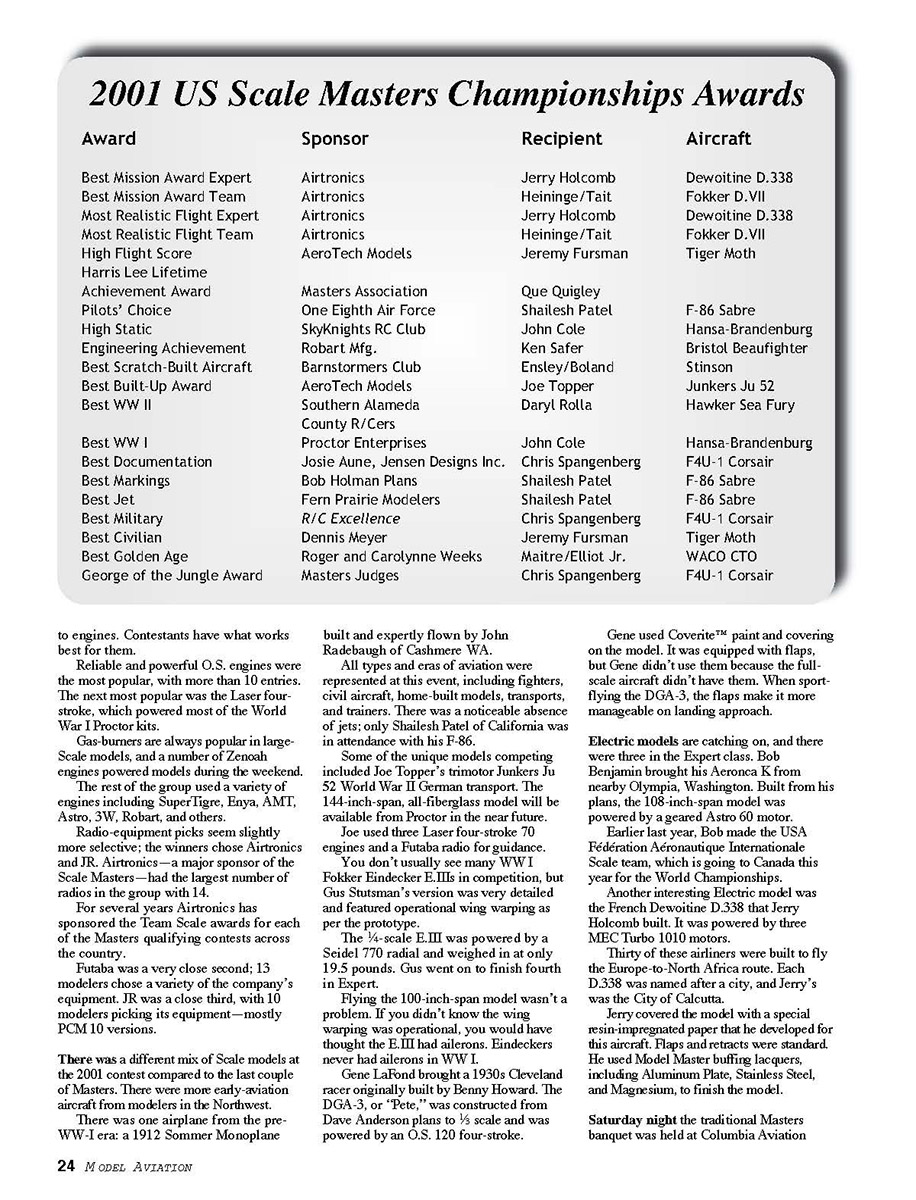
The top static score of 98.00 in Expert went to John Cole with his Heinkel Brandenburg C.I.
Team-Scale builder Ronaldo Salles and pilot Eduardo Esteves received the high static score of 97.75 with an expertly finished home-built Spitfire.
Several scratch-built models and models built from plans competed. Of the kit manufacturers, there were more Proctor kits or kits sold by Proctor (nine total) than any other. Sig Manufacturing had the next largest number of kits, with four.
A real test for spectators was the number of scratch-built models competing; a total of 14 models built from their own plans.
Equipment: As with any Scale contest, there isn't a clear-cut favorite with regard to engines. Contestants have what works best for them.
Reliable and powerful O.S. engines were the most popular, with more than 10 entries. The next most popular was the Laser four-stroke, which powered most of the World War II Proctor kits.
Gas-burners are always popular in large-scale models, and a number of Zenoah engines powered models during the weekend.
The rest of the group used a variety of engines including Super Tigre, Enya, AMT, Astro, 3W, Robart, and others.
Radio-equipment picks seem slightly more selective; the winners chose Airtronics and JR. Airtronics—a major sponsor of the Scale Masters—had the largest number of radios in the group with 14.
For several years Airtronics has sponsored the Team Scale awards for each of the Masters qualifying contests across the country.
Futaba was a very close second; 13 modelers chose a variety of the company's equipment. JR was a close third, with 10 modelers picking its equipment—mostly PCM 10 versions.
There was a different mix of Scale models at the 2001 contest compared to the last couple of Masters. There were more early-aviation aircraft from modelers in the Northwest.
There was one airplane from the pre-WW I era: a 1912 Sommer Monoplane built and expertly flown by John Radebaugh of Cashmere WA.
All types and eras of aviation were represented at this event, including fighters, civil aircraft, home-built models, transports, and trainers. There was a noticeable absence of jets; only Shailesh Patel of California was in attendance with his F-86.
Some of the unique models competing included Joe Topper's trimotor Junkers Ju 52 World War II German transport. The 144-inch-span, all-fiberglass model will be available from Proctor in the near future.
Joe used the Laser four-stroke 70 engines and a Futaba radio for guidance.
You don't usually see many WW I Fokker Eindecker E.III's in competition, but Gus Stutsman's version was very detailed and featured operational wing warping as per the prototype.
The 1/4-scale E.III was powered by a Seidel 770 radial and weighed in at only 19.5 pounds. Gus went on to finish fourth in Expert.
Flying the 100-inch-span model wasn't a problem. If you didn't know the wing warping was operational, you would have thought the E.III had ailerons. Eindeckers never had ailerons in WW I.
Gene LaFond brought a 1930s Cleveland racer originally built by Benny Howard. The DGA-3, or "Pete," was constructed from Dave Anderson plans to 3/5 scale and was powered by an O.S. 120 four-stroke.
Gene used Coverite paint and covering on the model. It was equipped with flaps, but Gene didn't use them because the full-scale aircraft didn't have them. When spotting the DGA-3, the flaps make it more manageable on landing approach.
Electric models are catching on, and there were three in the Expert class. Bob Benjamin brought his Aeronca K from nearby Olympia, Washington. Built from his plans, the 108-inch-span model was powered by a geared Astro 60 motor.
Earlier last year, Bob made the USA Fédération Aéronautique Internationale Scale team, which is going to Canada this year for the World Championships.
Another interesting electric model was the French Dewoitine D.338 that Jerry Holcomb built. It was powered by three MEC Turbo 1010 motors.
Thirty of these airliners were built to fly the Europe-to-North Africa route. Each D.338 was named after a city and Jerry's was the City of Calcutta.
Jerry covered the model with a special resin-impregnated paper that he developed for his aircraft. Flaps and retracts were standard. He used Model Master buffing lacquers, including Aluminum Plate, Stainless Steel, and Magnesium, to finish the model.
Saturday night the traditional Masters banquet was held at Columbia Aviation at the field. The big jet flies over a lot of real estate just on a regular flight pattern.
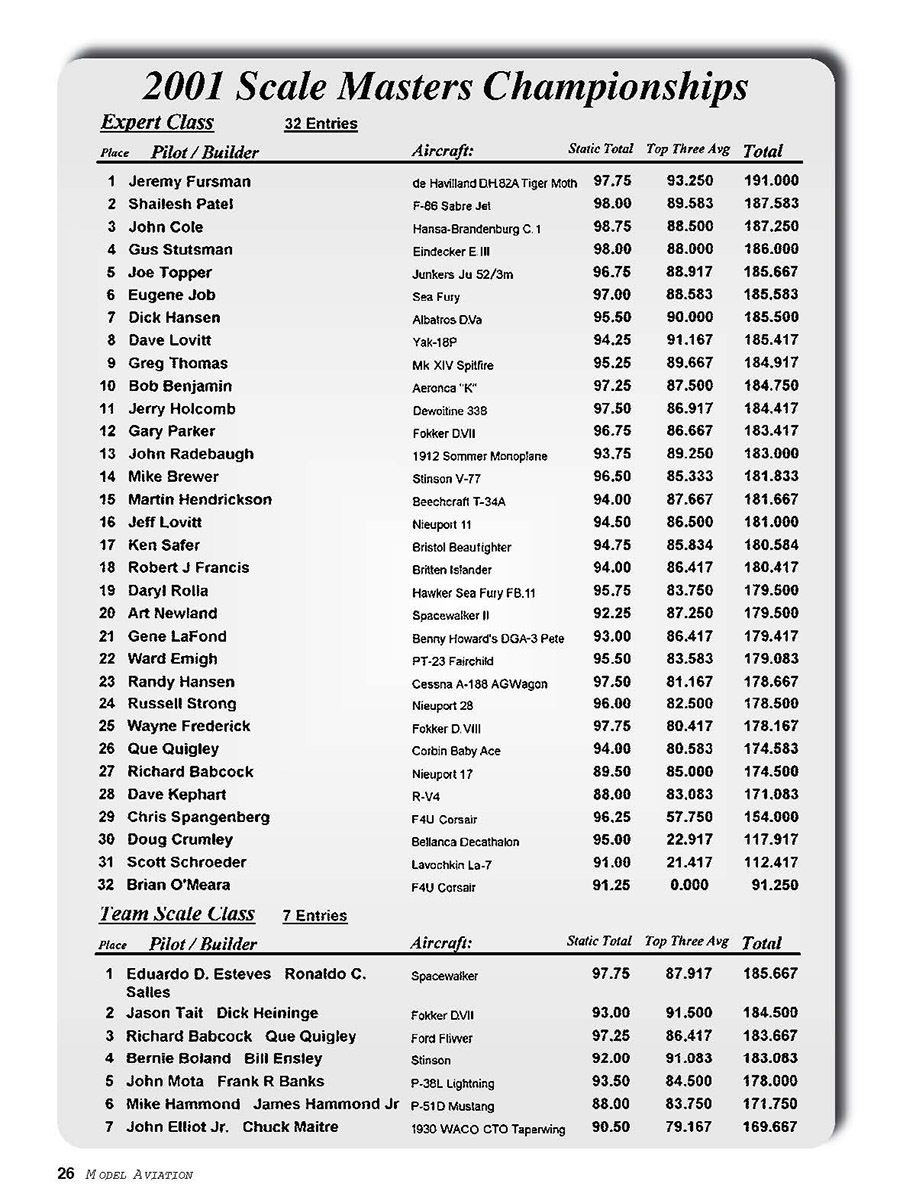
2001 Scale Masters Championships
Expert Class 32 Entries
Place Pilot / Builder Aircraft Static Total Top Three Avg Total 1 Jeremy Fursman de Havilland DH82A Tiger Moth 97.75 93.250 191.000 2 Shailesh Patel F-86 Sabre Jet 98.00 89.583 187.583 3 John Cole Hansa-Brandenburg C.1 98.75 88.500 187.250 4 Gus Stutsman Eindecker E.III 98.00 88.000 186.000 5 Joe Topper Junkers Ju 52/3m 96.75 88.917 185.667 6 Eugene Job Sea Fury 97.00 88.583 185.583 7 Dick Hansen Albatros D.Va 95.50 90.000 185.500 8 Dave Lovitt Yak-18P 94.25 91.167 185.417 9 Greg Thomas Mk XIV Spitfire 95.25 89.667 184.917 10 Bob Benjamin Aeronca "K" 97.25 87.500 184.750 11 Jerry Holcomb Dewoitine 338 97.50 86.917 184.417 12 Gary Parker Fokker D.VII 96.75 86.667 183.417 13 John Radebaugh 1912 Sommer Monoplane 93.75 89.250 183.000 14 Mike Brewer Stinson V-77 96.50 85.333 181.833 15 Martin Hendrickson Beechcraft T-34A 94.00 87.667 181.667 16 Jeff Lovitt Nieuport 11 94.50 86.500 181.000 17 Ken Safer Bristol Beaufighter 94.75 85.834 180.584 18 Robert J Francis Britten Islander 94.00 86.417 180.417 19 Daryl Rolla Hawker Sea Fury FB.11 95.75 83.750 179.500 20 Art Newland Spacewalker II 92.25 87.250 179.500 21 Gene LaFond Benny Howard's DGA-3 Pete 93.00 86.417 179.417 22 Ward Emigh PT-23 Fairchild 95.50 83.583 179.083 23 Randy Hansen Cessna A-188 AGWagon 97.50 81.167 178.667 24 Russell Strong Nieuport 28 96.00 82.500 178.500 25 Wayne Frederick Fokker D.VII 97.75 80.417 178.167 26 Que Quigley Corbin Baby Ace 94.00 80.583 174.583 27 Richard Babcock Nieuport 17 89.50 85.000 174.500 28 Dave Kephart R-V4 88.00 83.083 171.083 29 Chris Spangenberg F4U Corsair 96.25 57.750 154.000 30 Doug Crumley Bellanca Decathlon 95.00 22.917 117.917 31 Scott Schroeder Lavochkin La-7 91.00 21.417 112.417 32 Brian O'Meara F4U Corsair 91.25 0.000 91.250
Team Scale Class 7 Entries
Place Pilot / Builder Aircraft Static Total Top Three Avg Total 1 Eduardo D. Esteves Ronaldo C. Salles Spacewalker 97.75 87.917 185.667 2 Jason Tait Dick Heininge Fokker D.VII 93.00 91.500 184.500 3 Richard Babcock Que Quigley Ford Flivver 97.25 86.417 183.667 4 Bernie Boland Bill Ensley Stinson 92.00 91.083 183.083 5 John Mota Frank R Banks P-38L Lightning 93.50 84.500 178.000 6 Mike Hammond James Hammond Jr P-51D Mustang 88.00 83.750 171.750 7 John Elliot Jr. Chuck Maitre 1930 WACO CTO Taperwing 90.50 79.167 169.667
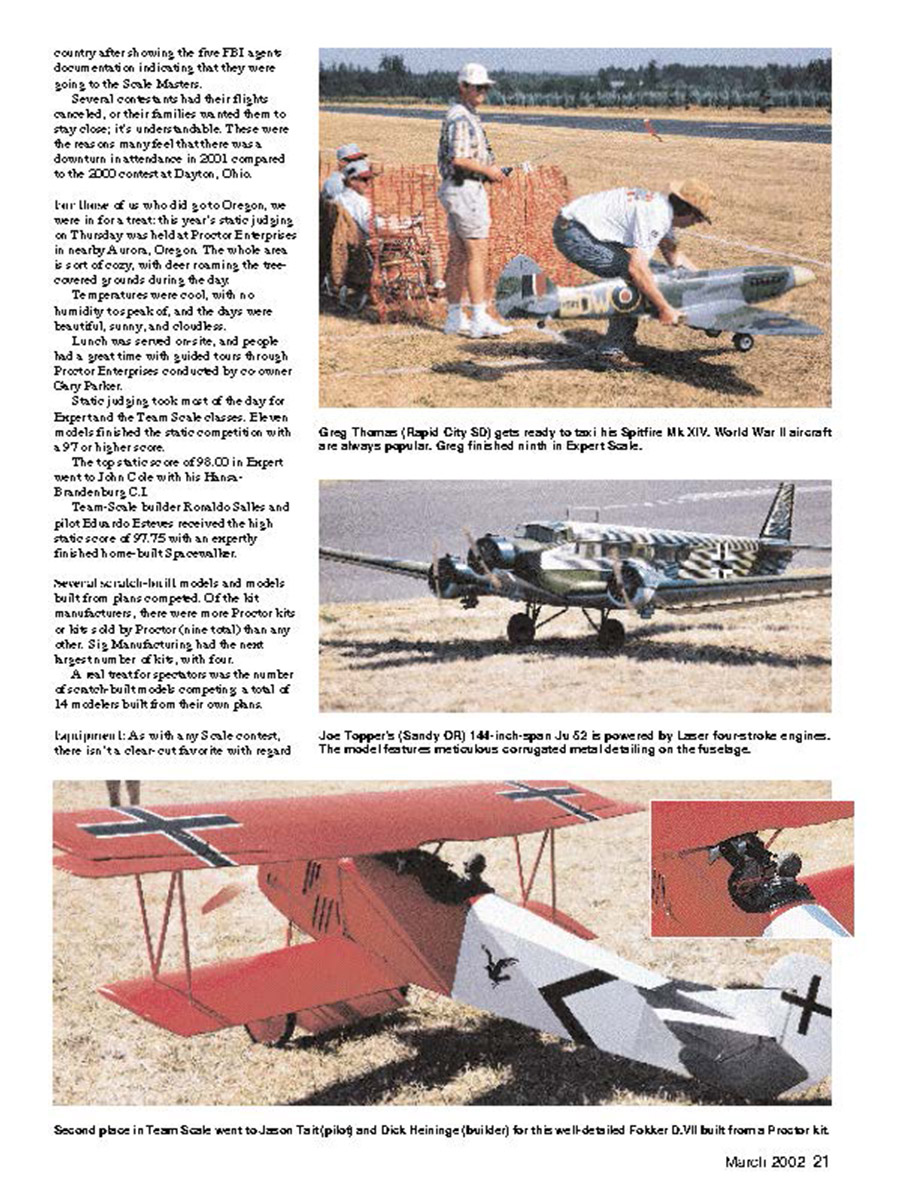
Jason Tait was a close second, flying a Proctor Fokker D.VII built by Dick Heininge. Their flight scores couldn't overcome the Spacewalker's high static score.
Richard Babcock and builder Que Quigley took home third place with a unique Ford Flivver.
There was only two points difference among the first three models in this class.
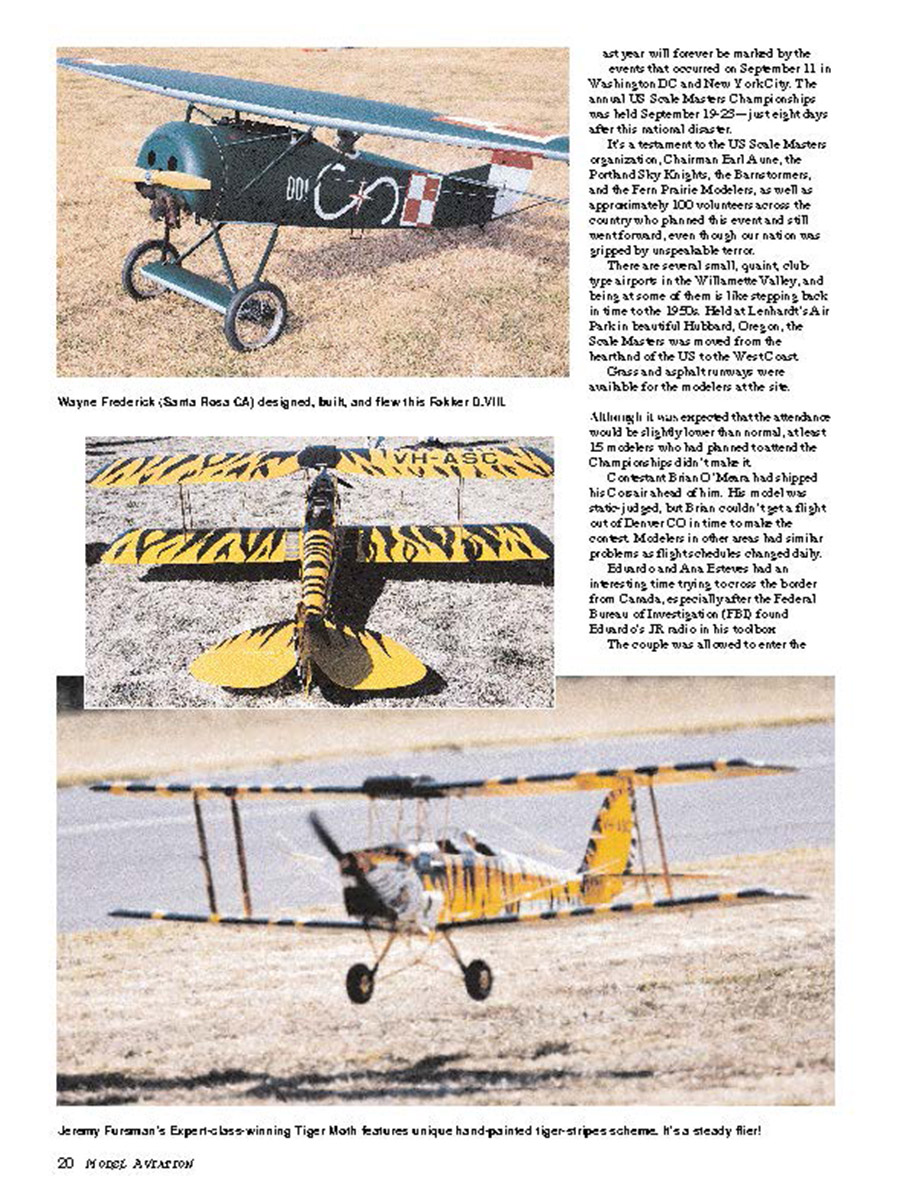
Expert: Jeremy Fursman brought a model that was seen at last year's Championships. His Duncan Hutson 1/4-scale de Havilland D.H.82A Tiger Moth spanned 88 inches, but only weighed 17 pounds, and was powered by a Laser 150 four-stroke engine.
Built from a kit, the model is no longer available. But Proctor Enterprises (who brought the kit to the USA) hopes to pick up the production rights soon.
Jeremy controlled the trainer with an Airtronics Stylus radio system.
The full-scale aircraft Jeremy modeled was featured in the book Tiger Moth by Stuart McKay, published in 1988. Jeremy's mother gave him the book several years ago.
This particular Moth is featured in color on page 97, with owner Neil Ottoe flying the uniquely painted aircraft in Australia. I bet some of you have this book in your aviation library.
Jeremy tracked down the owner by the "N" number on the airplane through the CAA (Civil Aviation Authority) registration in Australia.
The original owner said that his local flying club in Australia was a little boring and he wanted to liven it up, so he came up with this Tiger paint scheme for his airplane.
Jeremy's correspondence with him garnered additional photos of the airplane and some more details. On the flip side, Jeremy sent the owner photos of the finished model.
Jeremy learned that the full-scale aircraft was painted with a four-inch paintbrush, so he used a one-inch paintbrush (quarter scale) on his Tiger Moth.
He drew the design with a pencil on the basecoat of paint. When he was satisfied with the result, he began by painting one panel at a time.
Jeremy used Nelson Polyurethane paint to finish the unique "tiger" paint scheme. The process took approximately a month.
Other aircraft in the top three included Shailesh Patel's North American F-86 Sabre jet. The model spanned 96 inches at a scale of 4.78.
Powered by an AMT Olympus turbine, the huge jet featured a small canopy, speed brakes, wheel brakes, and landing lights, and it was controlled by a Futaba 12-channel radio. Retracts were machined for this model, and the wheels were provided by Glennis.
This was one of this model's first competitions, and I look forward to seeing it a lot in the near future.
Shailesh flew a practice F-86, which was the same size with no paint on it, Thursday.
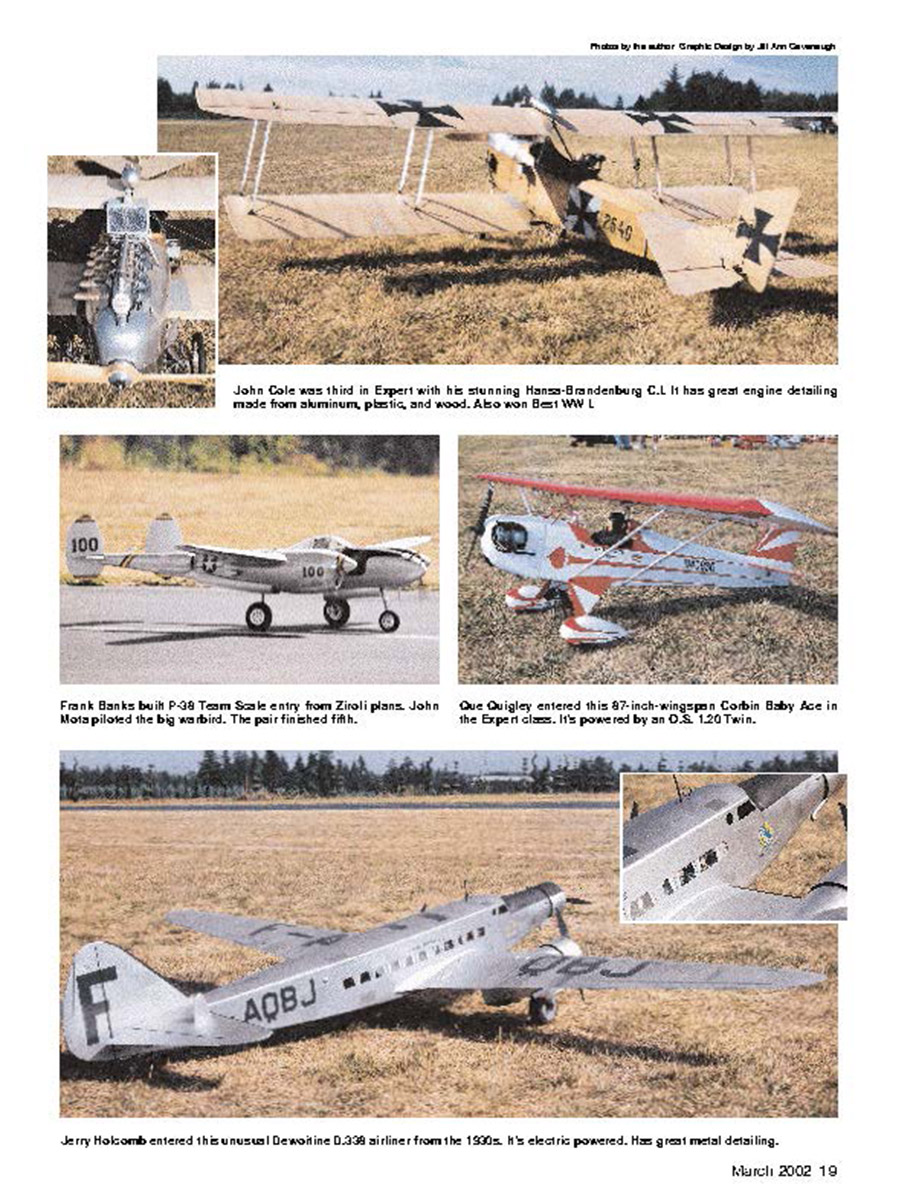
John Cole scratch-built his obscure and beautiful Hansa-Brandenburg C.I from his own plans using spruce, birch, and aluminum tubing.
The 1/4-scale model spanned 122 inches but only weighed 19.5 pounds; John used weight-saving construction practices on this model.
He built the C.I using original factory data obtained from Europe. All controls were operated as per the prototype, with cable operation through a JR radio. The C.I was covered with Super Coverite™, painted with Testors Model Master paint, then sealed with a clear coat.
After the first few rounds, it was clear that Jeremy Fursman would be in the top five along with Shailesh Patel, John Cole, Gus Stutsman flying his Eindecker, and Joe Topper with his Ju 52.
With two flight scores exceeding 91.00 and a static score of 97.50, Jeremy didn't have a lock on first place until the fifth round. His final flight score Sunday of 95.25 clinched the Championships.
Shailesh Patel came in a close second, and John Cole captured third place with his fifth-round score.
It was a great time, and I hope that all of the volunteers and officials know how much their hard work is appreciated.
Sponsors of the 2001 Championships include Gold: Airtronics Radio Systems; Silver: Bob Smith Industries, Hobbico Inc., Proctor Enterprises, and William Bros. Inc.; and Patron: Balas USA, Barbee Concrete & Construction Co., Bob Holman Plans, Vailly Aviation.
Associate: AeroTech Models, Fantasy Fibers, Hansen Scale Aviation Videos, Jensen Designs, Inc., Lee Harris, Nelson Aircraft Co., One Eighth Air Force, Robart Manufacturing, Scale Squadron of Southern California, and The Gary Parker Family.
Friend: Barnstormers R/C Club, Dennis Meyer, Fern Prairie Modelers Club, Propwash Video Enterprises, R/C Excellence magazine, Rogers and Carolyne Weeks, Sig Mfg. Inc., Sky Knights R/C Club, Southern Alameda County R/Cers, and Zurich International.
Prize donations were made by C.B. Talone Model Accessories, Dave Brown Products, Horizon Hobby Distributors, Mehel B. Aune & Associates, Sullivan Products, and Windsor Propeller Co. Inc.
For more information about the 2001 Championships, please check out the official Scale Masters Web site at www.scalemasters.org.
Stan Alexander 3709 Valley Ridge Dr. Nashville TN 37211 [email protected]
Transcribed from original scans by AI. Minor OCR errors may remain.

