


2005 F3A World Championships
By Brian Clemmons
Overview
The 24th F3A World Championships (FAI RC Aerobatics / Pattern) were held in St. Yan, France, August 20–27, 2005. The contest drew 118 competitors from 43 countries (one to three pilots per country). Every competitor wanted the individual title and every country wanted the team title, but only three trophy placings were available in each category.
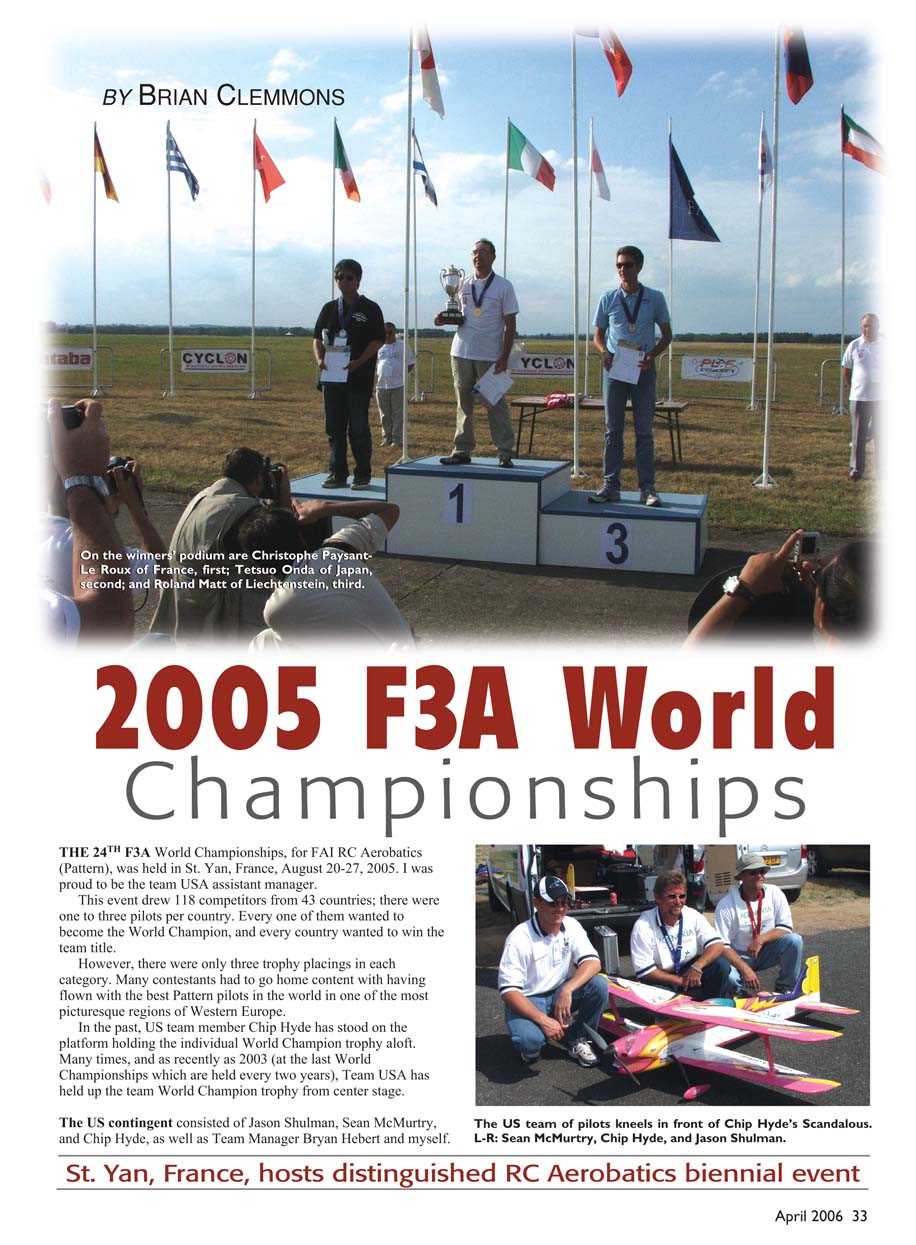
This event attracted many of the world’s best Pattern pilots and was held in one of the most picturesque regions of Western Europe. Christophe Paysant-Le Roux won the overall championship for the third consecutive time.
Team USA
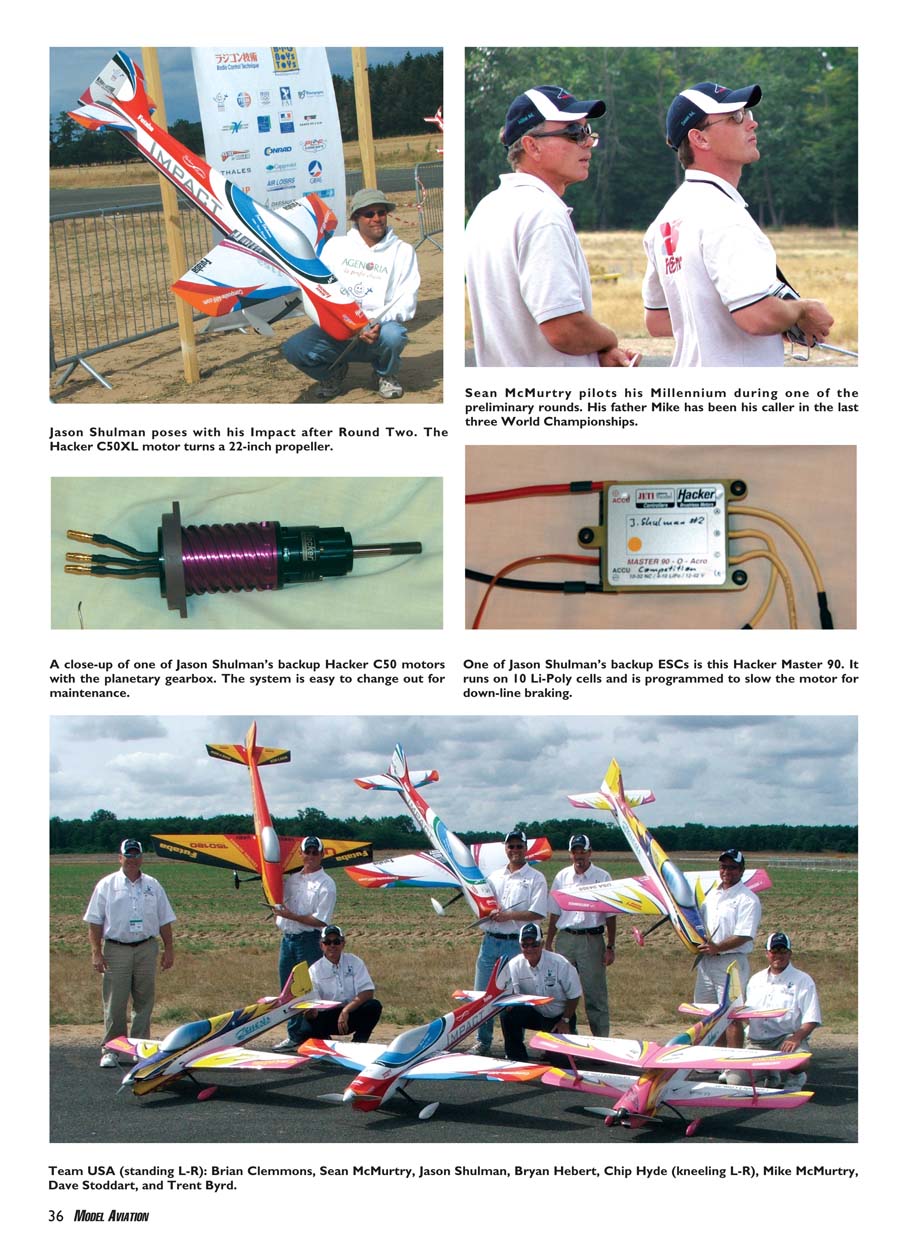
The U.S. contingent consisted of:
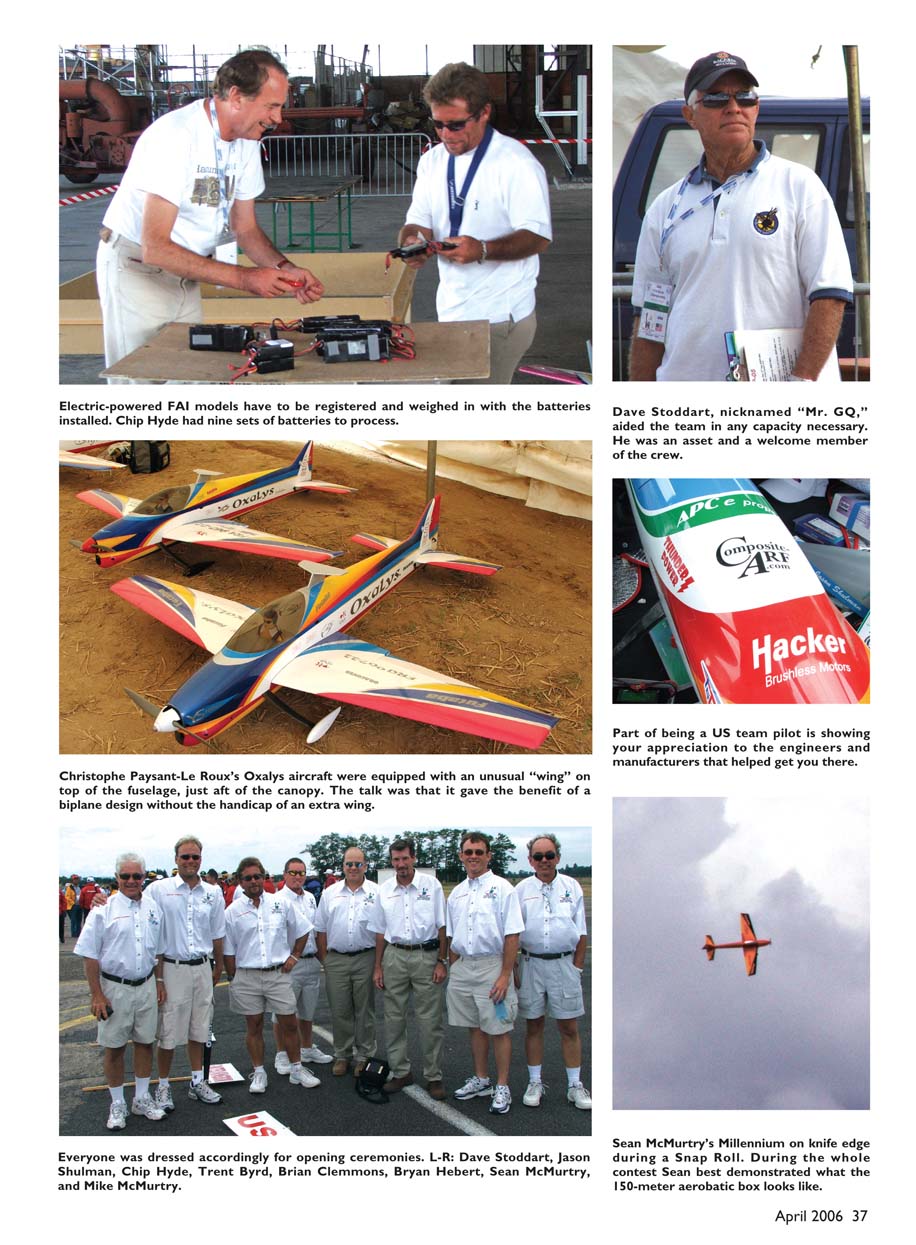
- Jason Shulman (team captain)
- Sean McMurtry
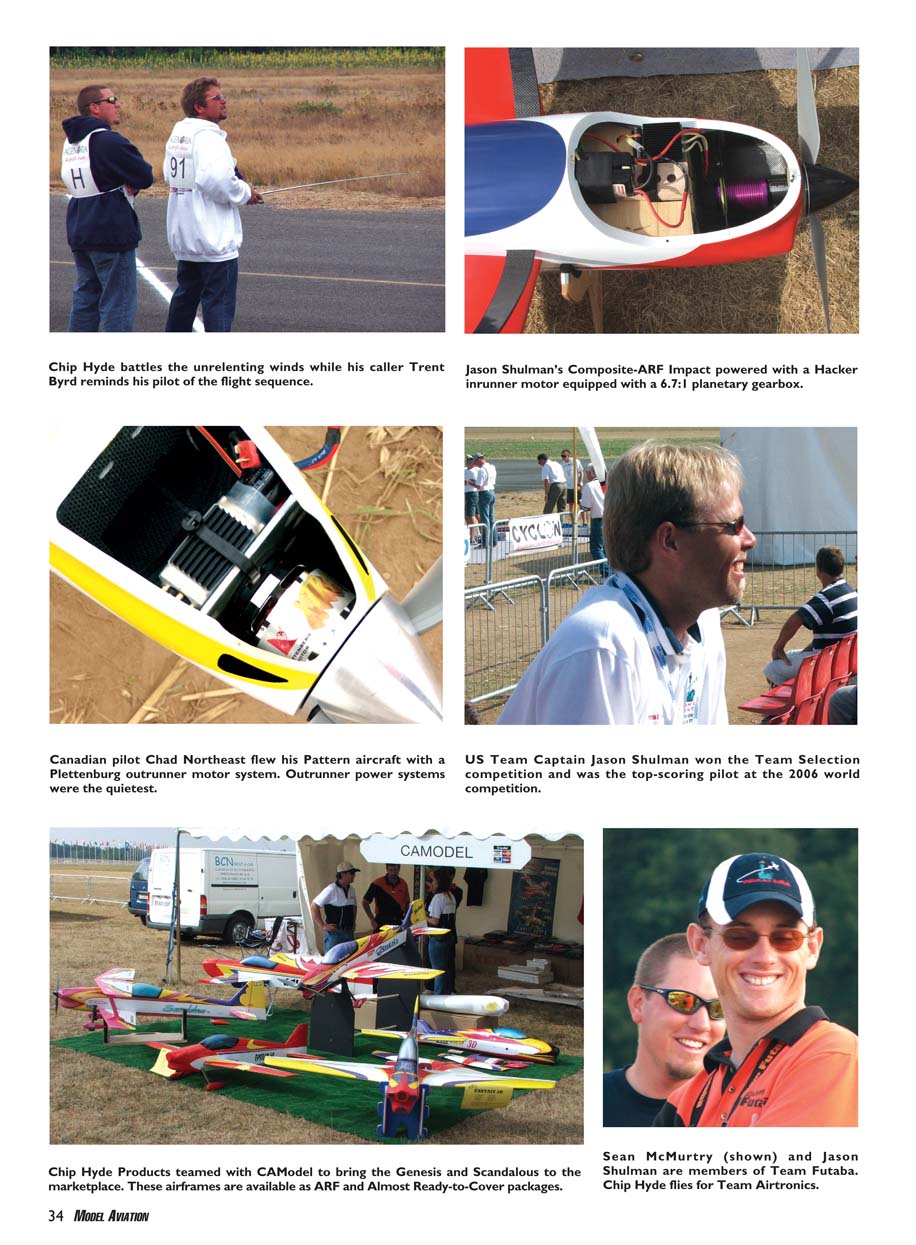
- Chip Hyde
- Team Manager: Bryan Hebert
- Assistant Manager: Brian Clemmons
- Alternate: Don Sczur
- U.S. judge: Don Ramsey
Jason won the Team Selection contest (held with the 2004 Nats) and was named team captain. Sean placed second in the Team Selection and Chip was the third eligible pilot. Bryan Hebert stepped up to serve as team manager.
Judges and NSRCA
Don Ramsey served as the U.S. judge. His scoring held up extremely well under the TBL (Tarasov–Bauer–Long) statistical averaging scoring system. The National Society of Radio Controlled Aerobatics (NSRCA) — AMA's Pattern SIG — has been active in developing judges’ training and evaluation programs, with Don heading that effort for several years. His selection to represent the U.S. in France was a hard-earned honor and a coming of age for the NSRCA judging program.
The selection process involved NSRCA recommendations (four names sent to AMA President Dave Brown), AMA’s submission to the French promoters, and final selection by the promoters.
At one point the FAI Jury Chairman Bob Skinner was asked to investigate apparent effects of nationalism in scoring. He found insufficient grounds to take action and communicated this in writing to Bryan Hebert. Subsequent email conversations indicated agreement that more work on impartiality and judging consistency is needed.
St. Yan and Conditions
Venue and Weather
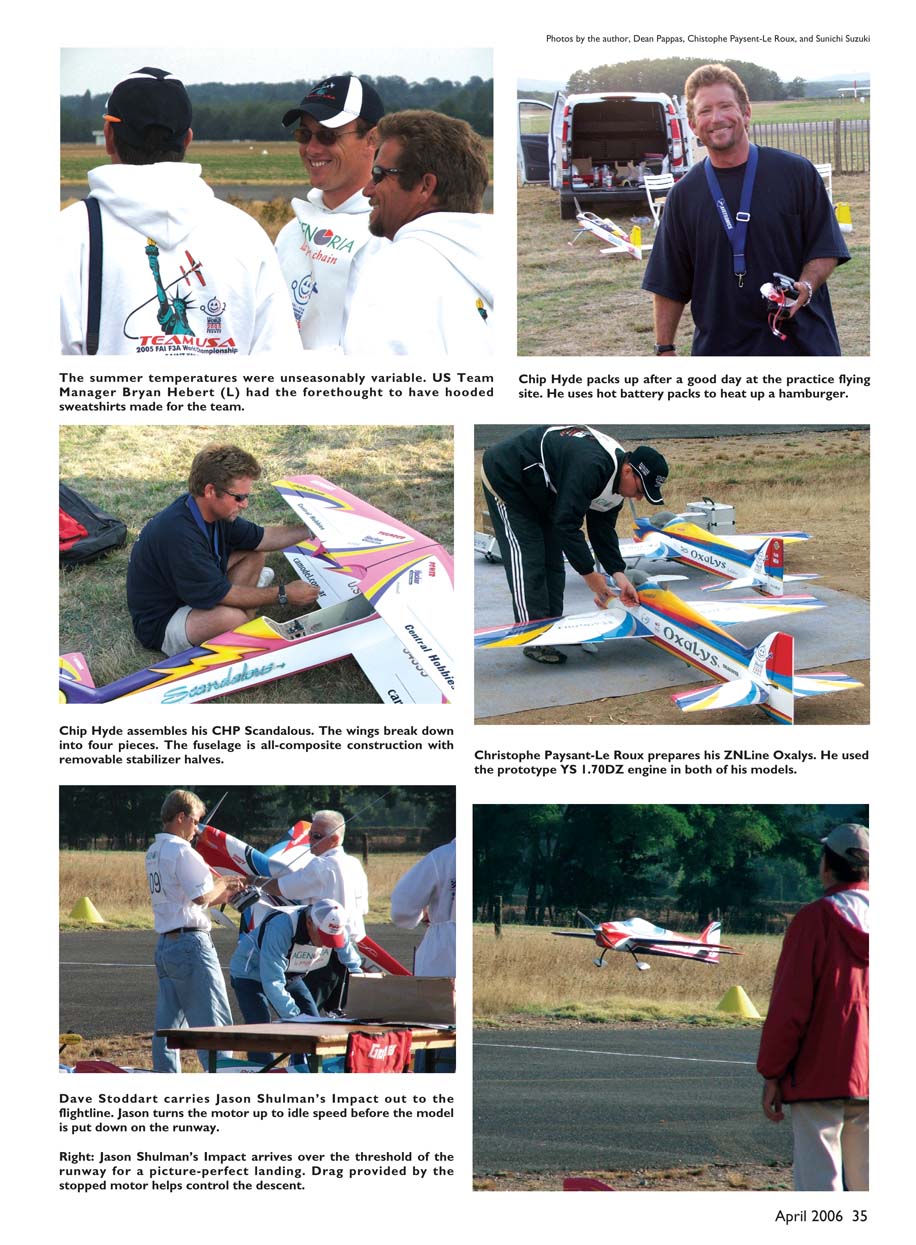
The St. Yan airfield is a full-scale civil-aviation facility and was once a military aerobatic training center. Two taxiways were used for flying, approximately a half-mile apart. The dominant weather pattern during the week was windy and cool, with temperatures around 60°F. A few sunny, warmer days occurred, but most competitors dressed warmly. Hooded sweatshirts supplied by Team Manager Bryan Hebert were much appreciated.
Hospitality and Competitors
Team USA stayed in Paray-le-Monial, roughly 5 km from St. Yan. Practice fields were assigned to each team; the U.S. pilots drew a field about 70 km away near Autun, which still retains Roman architecture. Other teams had practice areas much closer to the competition site. The promoters had the challenge of managing 118 competitors and did a commendable job.
Throughout the week the spirit of friendship among competitors was evident. Special mentions: Paris Christodoulides (Cyprus), Marcelo Colombo (Argentina), Bernd Beschorner (Germany), Marco Benincassa (Italy), Japanese Manager Kouji Tanaka and assistants Shunichi and Kouji Suzuki, Yoichiro Akiba, Tetsuo Onda, South African Manager Carel Germishuys, and Rattanapramon Nuttawut (Thailand).
Competition Highlights
Flight Draws and Unknown Sequences
Some unfortunate draws disadvantaged the U.S. pilots—Jason flew first almost half the time. In the Unknown-sequence selection meeting with the 10 finals pilots, both Americans (Jason and Chip) were allowed to choose only turnaround maneuvers. Poor draws were a factor in final placements, though not the only reason.
Team scoring is the sum of individual points for a country; one great flier isn’t enough. Top nations typically need three pilots in the top 20 and at least two in the top 10. The 2005 team winners all had three competitors in the top 10. Liechtenstein placed third with just two entries: Roland and Wolfgang Matt (Wolfgang is a former two-time World Champion). The Japanese judge Giichi Naruke is also a two-time individual World Champion. Adding Christophe Paysant-Le Roux and former champions Chip Hyde, Wolfgang Matt, and Giichi Naruke made for very strong competition.
Finals and Notable Performances
Christophe Paysant-Le Roux dominated and took the individual title. Chip Hyde showed the experience of a past World Champion and improved during every round—flying both a single-wing and a biplane. Sean McMurtry flew farther out (150 meters) as suggested by FAI Sporting Code but was one of the few to do so; that pattern likely affected his scores and contributed to narrowly missing the finals.
Aircraft, Powerplants, and Equipment
This year electrics were dominant. Two motor types led: geared units (e.g., Hacker) and outrunners (e.g., Plettenburg). YS dominated the glow-fuel engines; the YS 170 performed well. Geared motors had an advantage in wind; outrunners were very quiet and excelled in calm air. Battery brands most represented were Thunder Power and Kokam.
During official processing Chip Hyde had nine battery packs — unprecedented for contest officials, who had to scramble for stickers. Glow-powered airplanes used fuel provided by Morgan Fuels of Enterprise, Alabama.
Models were limited to:
- 2 meters wingspan (78.74 inches)
- 2 meters length
- 5 kilograms weight (about 11 lb)
No automatic piloting devices were allowed; powerplants were unlimited. Only two pilots flew biplanes; they finished second and fourth overall. ARFs dominated model selection — top pilots come to fly, not to build. Main radio brands were Futaba, JR, Graupner, and Airtronics.
Common equipment/style notes:
- Most pilots used fixed landing gear (throttle, elevator, rudder, ailerons).
- Propeller diameters averaged 18–22 inches.
- Paint schemes varied from classic Pattern to IMAC-style and modern airbrush designs.
A small wing atop a pylon behind Christophe’s canopy (similar to a Formula One car’s small wing) was a notable equipment surprise; he claimed performance benefits and it correlated with his victory.
Flying Style and Judging Notes
The dominant flying style was big, slow, and 200 meters out. Although judges discussed flying out to 150 meters per FAI Sporting Code, only Sean McMurtry consistently did so. The emphasis in modern Pattern is smoothness and control rather than speed; high precision at low speeds is rewarded.
History and U.S. Performance
Since 1960 the U.S. and Japan have dominated F3A World Championships. Historical record highlights:
- U.S. team wins since 1960: 13
- U.S. team 2nd place: 8
- U.S. team 3rd place: 1
- U.S. team failed to podium only three times: 1997 (Poland), 1995 (Japan), and 1987 (France)
American pilots have earned six individual firsts, five seconds, and eight third-place finishes historically. Team USA’s 2005 second-place finish continues a strong tradition.
Looking Ahead
The next F3A World Championships will be in Argentina in 2007 (site: Argentina). Chip Hyde (U.S. FAI Committee Chairman) is working on format, location, and timing for the 2007 Team Selection contest. Returning and rising U.S. pilots to watch include Don Sczur, Andrew Jesky, Peter Collinson, Quique Somenzini (becoming eligible), Todd Blose, Dave Lockhart, Michael Hill, A.C. Glenn, and Brett Wickizer. David Shulman is rumored to return to Pattern in 2006.
Final Results
Individual
- Christophe Paysant-Le Roux (France)
- Tetsuo Onda (Japan)
- Roland Matt (Liechtenstein)
- Chip Hyde (USA)
- Benoit Paysant-Le Roux (France)
- Jason Shulman (USA)
- Sean McMurtry (USA)
Team
- Japan
- USA
- Liechtenstein
Return Home and Aftermath
Please excuse the delay in reporting: Bryan Hebert and I arrived home in the middle of Hurricane Katrina. We drove a rental SUV from Charlotte, North Carolina, through the storm after flights were grounded. Cell service was often useless, traffic was unbelievable, and life in southern Louisiana was far from normal. Bryan captured some video in central Mississippi while I drove. My SUV was stranded at New Orleans airport for three weeks (fortunately on the third level). My home sustained some damage but should be fully repaired by the end of the year.
Brian Clemmons [email protected]
Transcribed from original scans by AI. Minor OCR errors may remain.

