
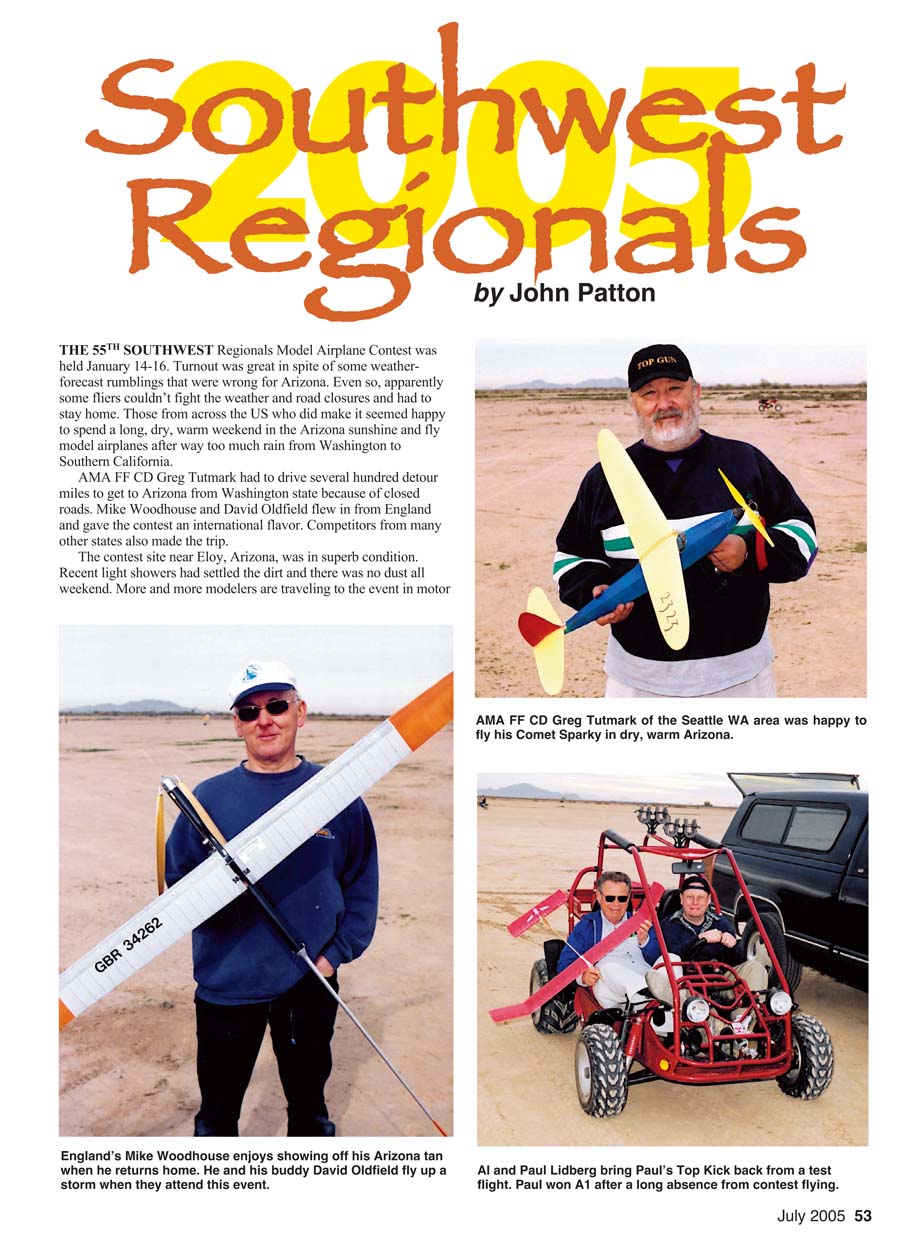
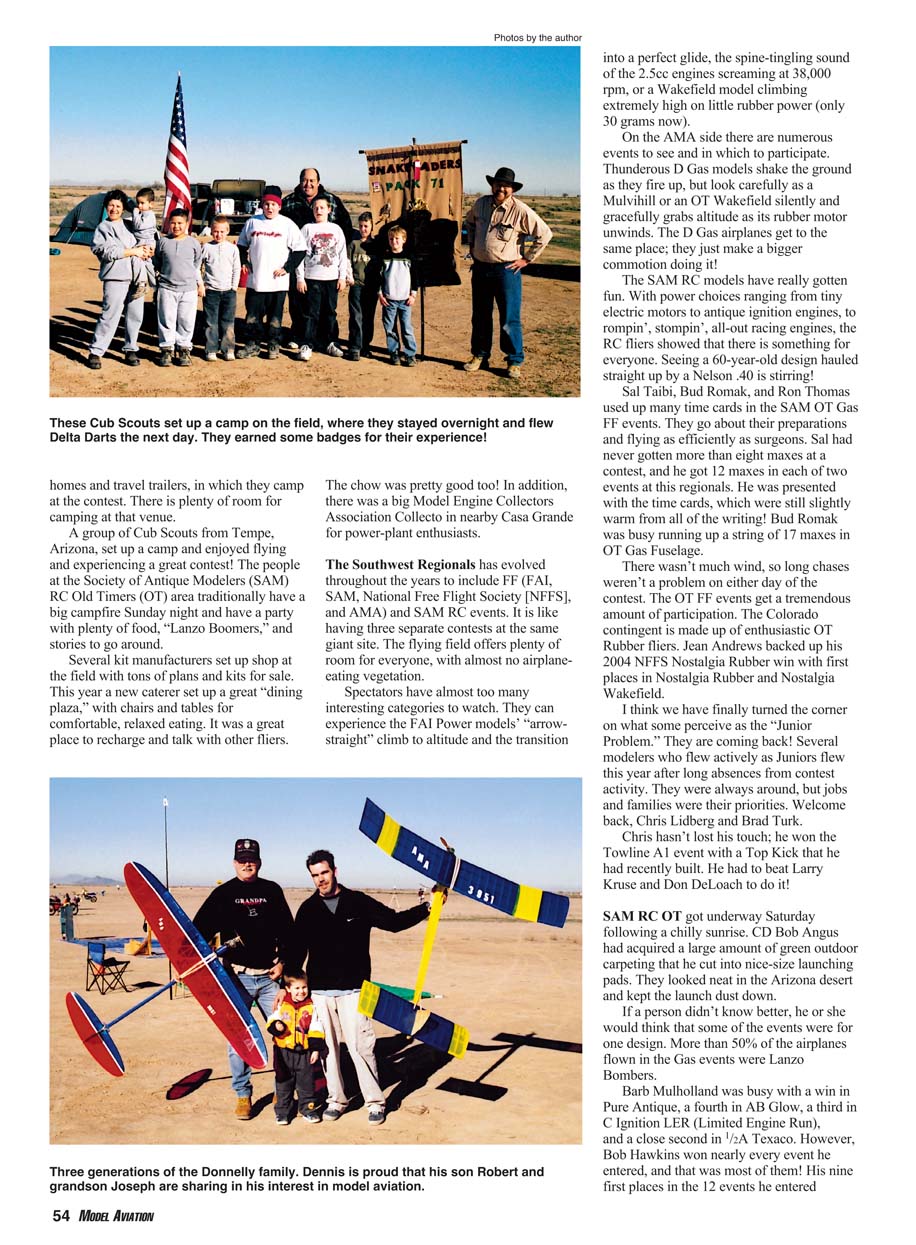
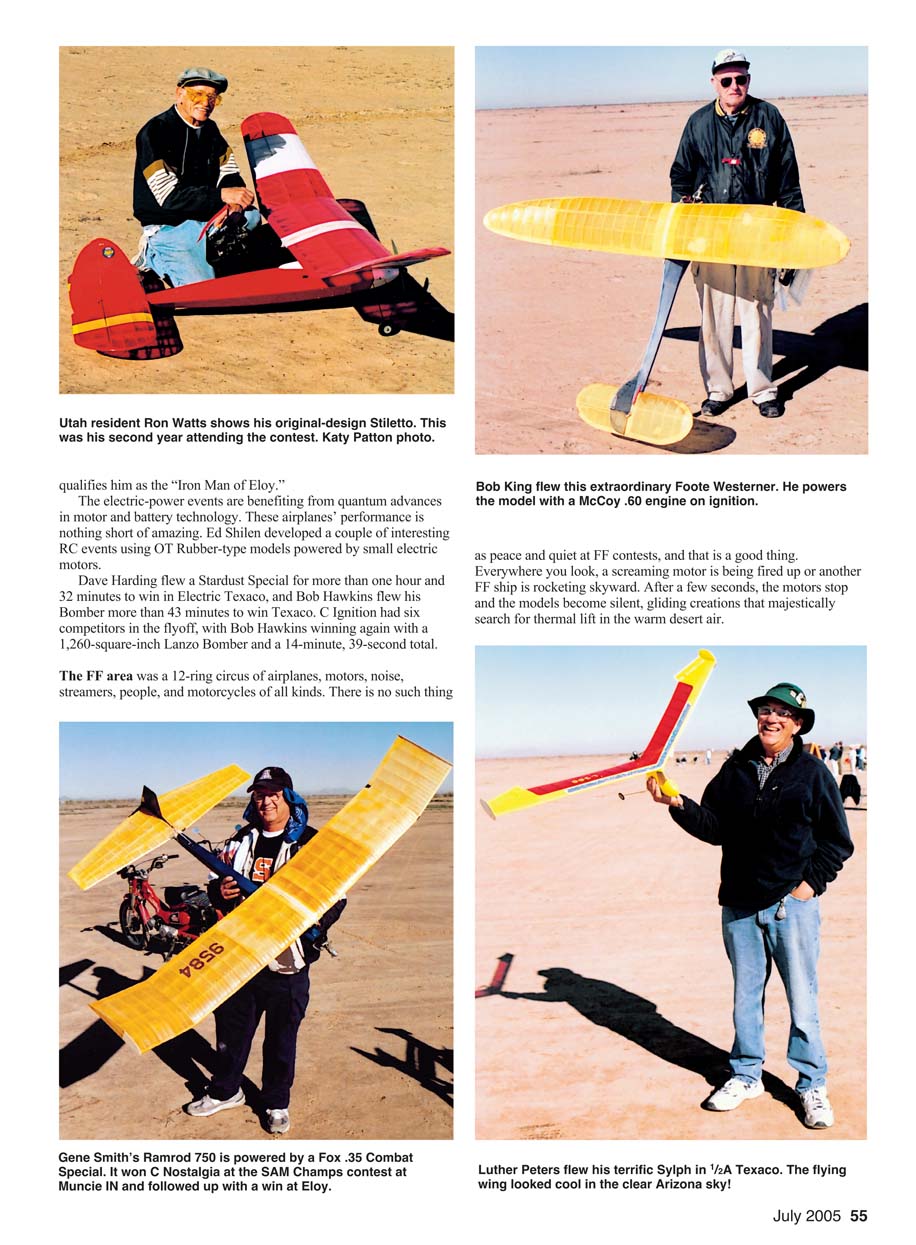
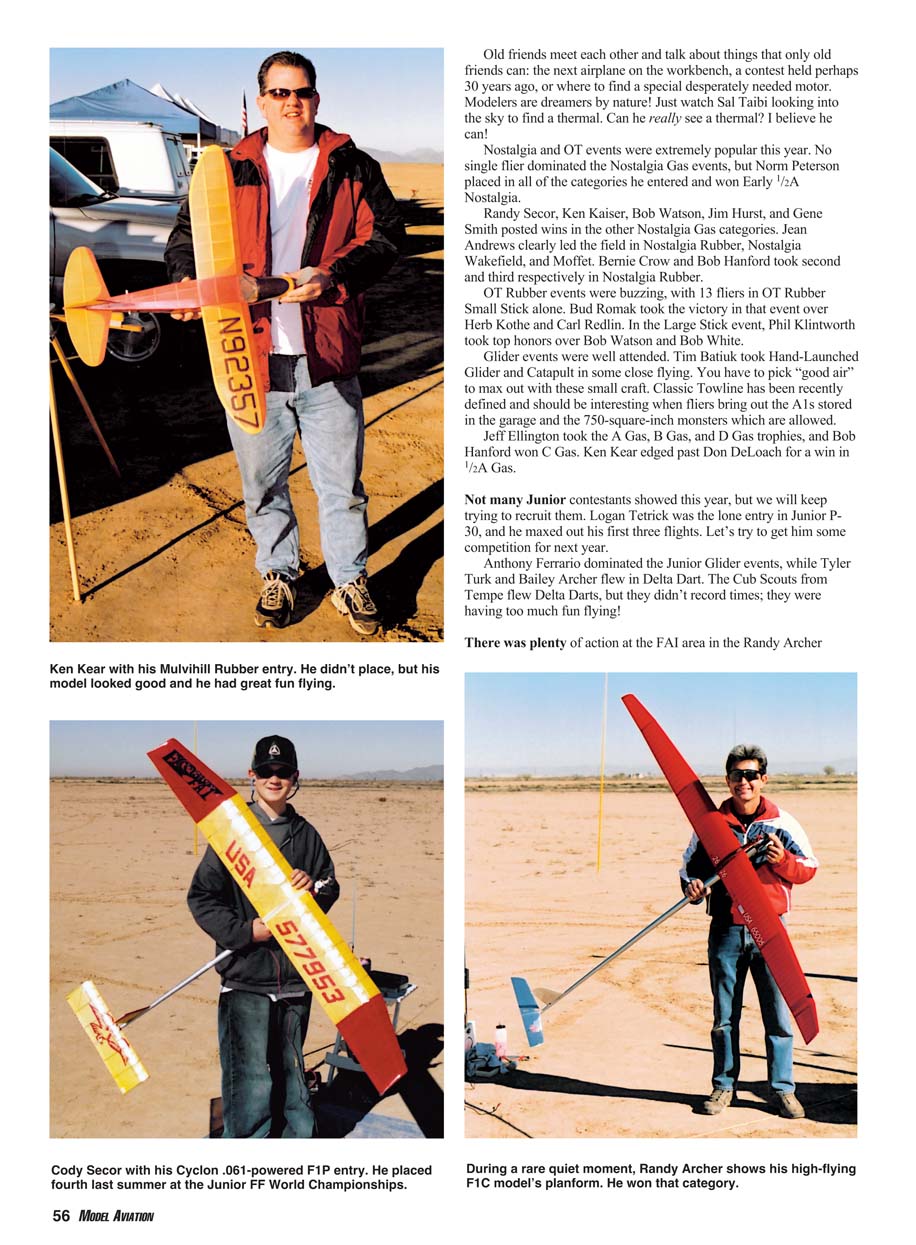
2005 Southwest Regionals
by John Patton
THE 55TH SOUTHWEST Regionals Model Airplane Contest was held January 14-16. Turnout was great in spite of some weather-forecast rumblings that were wrong for Arizona. Even so, apparently some fliers couldn't fight the weather and road closures and had to stay home. Those from across the US who did make it seemed happy to spend a long, dry, warm weekend in the Arizona sunshine and fly model airplanes after way too much rain from Washington to Southern California.
AMA FF CD Greg Tutmark had to drive several hundred detour miles to get to Arizona from Washington state because of closed roads. Mike Woodhouse and David Oldfield flew in from England and gave the contest an international flavor. Competitors from many other states also made the trip.
The contest site near Eloy, Arizona, was in superb condition. Recent light showers had settled the dirt and there was no dust all weekend. More and more modelers are traveling to the event in motor homes and travel trailers, in which they camp at the contest. There is plenty of room for camping at that venue.
A group of Cub Scouts from Tempe, Arizona, set up a camp and enjoyed flying and experiencing a great contest! The people at the Society of Antique Modelers (SAM) RC Old Timers (OT) area traditionally have a big campfire Sunday night and have a party with plenty of food, "Lanzo Boomers," and stories to go around.
Several kit manufacturers set up shop at the field with tons of plans and kits for sale. This year a new caterer set up a great "dining plaza," with chairs and tables for comfortable, relaxed eating. It was a great place to recharge and talk with other fliers.
The chow was pretty good too! In addition, there was a big Model Engine Collectors Association Collecto in nearby Casa Grande for power-plant enthusiasts.
The Southwest Regionals has evolved throughout the years to include FF (FAI, SAM, National Free Flight Society [NFFS], and AMA) and SAM RC events. It is like having three separate contests at the same site. The flying field offers plenty of room for everyone, with almost no airplane-eating vegetation.
Spectators have almost too many interesting categories to watch. They can experience the FAI Power models' "arrow-straight" climb to altitude and the transition into a perfect glide, the spine-tingling sound of the 2.5cc engines screaming at 38,000 rpm, or a Wakefield model climbing extremely high on little rubber power (only 30 grams now).
On the AMA side there are numerous events to see and in which to participate. Thunderous D Gas models shake the ground as they fire up, but look carefully as a Mulvihill or an OT Wakefield silently and gracefully grabs altitude as its rubber motor unwinds. The D Gas airplanes get to the same place; they just make a bigger commotion doing it!
The SAM RC models have really gotten fun. With power choices ranging from tiny electric motors to antique ignition engines, to rompin', stompin', all-out racing engines, the RC fliers showed that there is something for everyone. Seeing a 60-year-old design hauled straight up by a Nelson .40 is stirring!
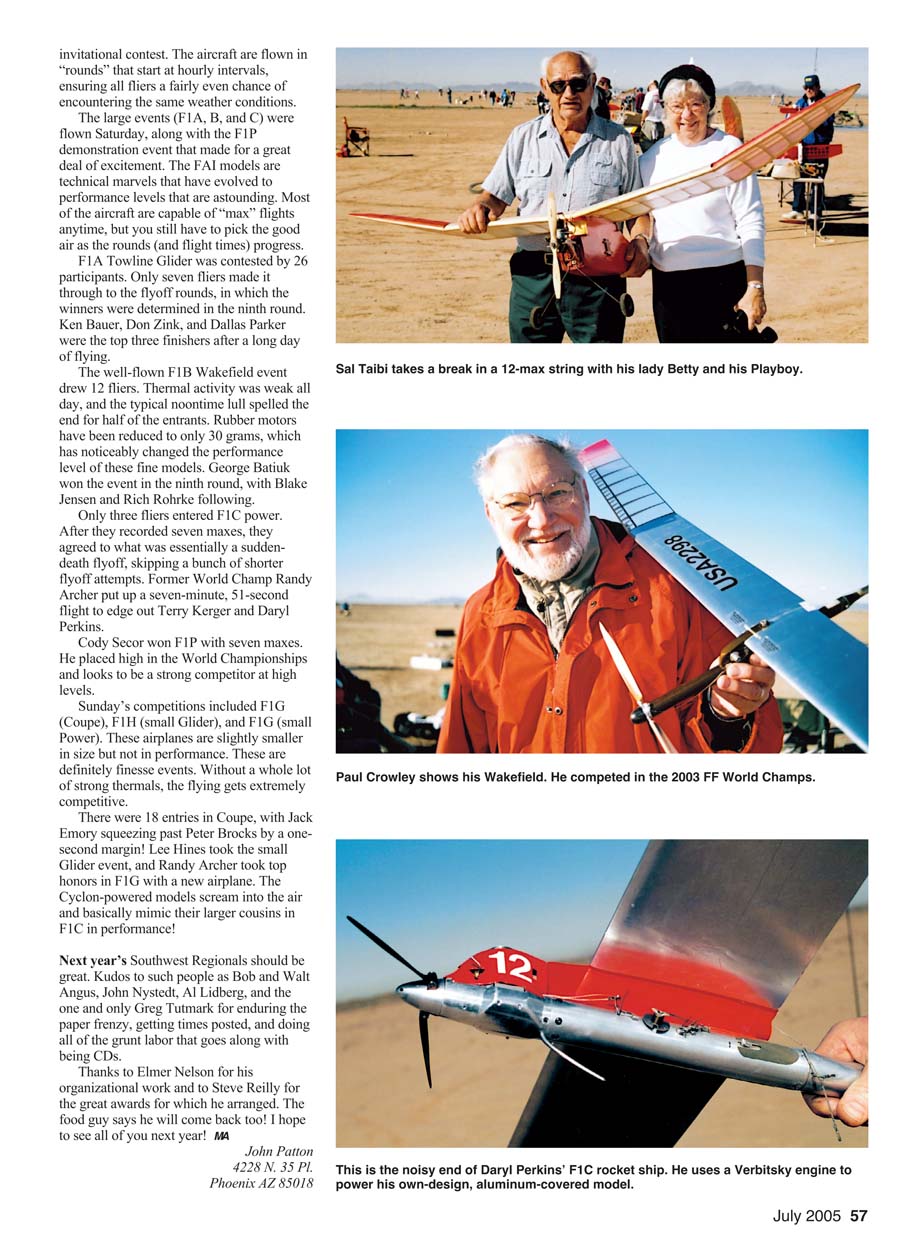
Sal Talbi, Bud Romak, and Ron Thomas used up many time cards in the SAM OT Gas FF events. They go about their preparations and flying as efficiently as surgeons. Sal had never gotten more than eight maxes at a contest, and he got 12 maxes in each of two events at this regionals. He was presented with the time cards, which were still slightly warm from all of the writing! Bud Romak was busy running up a string of 17 maxes in OT Gas Fuselage.
There wasn't much wind, so long chases weren't a problem on either day of the contest. The OT FF events got a tremendous amount of participation. The Colorado contingent is made up of enthusiastic OT Rubber fliers. Jean Andrews backed up his 2004 NFFS Nostalgia Rubber win with first places in Nostalgia Rubber and Nostalgia Wakefield.
I think we have finally turned the corner on what some perceive as the "Junior Problem." They are coming back! Several modelers who flew actively as Juniors flew this year after long absences from contest activity. They were always around, but jobs and families were their priorities. Welcome back, Chris Ludberg and Brad Turk.
Chris hasn't lost his touch; he won the Towline A event with a Top Kick that he had recently built. He had to beat Larry Kruse and Don DeLoach to do it!
SAM RC OT got underway Saturday following a chilly sunrise. CD Bob Angus had acquired a large amount of green outdoor carpeting that he cut into nice-size launching pads. They looked neat in the Arizona desert and kept the launch dust down.
If a person didn't know better, he or she would think that some of the events were for one design. More than 50% of the airplanes flown in the Gas events were Lanzo Bombers.
Barb Mulholland was busy with a win in Pure Antique, a fourth in AB Glow, a third in C Ignition LER (Limited Engine Run), and a close second in 1/2A Texaco. However, Bob Hawkins won nearly every event he entered, and that was most of them! His nine first places in the 12 events he entered qualifies him as the "Iron Man of Eloy."
The electric-power events are benefiting from quantum advances in motor and battery technology. These airplanes' performance is nothing short of amazing. Ed Shilen developed a couple of interesting RC events using OT Rubber-type models powered by small electric motors.
Dave Harding flew a Stardust Special for more than one hour and 32 minutes to win in Electric Texaco, and Bob Hawkins flew his Bomber more than 43 minutes to win Texaco. C Ignition had six competitors in the flyoff, with Bob Hawkins winning again with a 1,260-square-inch Lanzo Bomber and a 14-minute, 39-second total.
The FF area was a 12-ring circus of airplanes, motors, noise, streamers, people, and motorcycles of all kinds. There is no such thing as peace and quiet at FF contests, and that is a good thing. Everywhere you look, a screaming motor is being fired up or another FF ship is rocketing skyward. After a few seconds, the motors stop and the models become silent, gliding creations that majestically search for thermal lift in the warm desert air. Old friends meet each other and talk about things that only old friends can: the next airplane on the workbench, a contest held perhaps 30 years ago, or where to find a special desperately needed motor. Modelers are dreamers by nature! Just watch Sal Taibi looking into the sky to find a thermal. Can he really see a thermal? I believe he can!
Nostalgia and OT events were extremely popular this year. No single flier dominated the Nostalgia Gas events, but Norm Peterson placed in all of the categories he entered and won Early 1/2A Nostalgia.
Randy Secor, Ken Kaiser, Bob Watson, Jim Hurst, and Gene Smith posted wins in the other Nostalgia Gas categories. Jean Andrews clearly led the field in Nostalgia Rubber, Nostalgia Wakefield, and Moffet. Bernie Crow and Bob Hanford took second and third respectively in Nostalgia Rubber.
OT Rubber events were buzzing, with 13 fliers in OT Rubber Small Stick alone. Bud Romak took the victory in that event over Herb Kothe and Carl Redlin. In the Large Stick event, Phil Klintworth took top honors over Bob Watson and Bob White.
Glider events were well attended. Tim Batiuk took Hand-Launched Glider and Catapult in some close flying. You have to pick "good air" to max out with these small craft. Classic Towline has been recently defined and should be interesting when fliers bring out the A1s stored in the garage and the 750-square-inch monsters which are allowed.
Jeff Ellington took the A Gas, B Gas, and D Gas trophies, and Bob Hanford won C Gas. Ken Kear edged past Don DeLoach for a win in 1/2A Gas.
Not many Junior contestants showed this year, but we will keep trying to recruit them. Logan Tetrick was the lone entry in Junior P-30, and he maxed out his first three flights. Let's try to get him some competition for next year.
Anthony Ferrario dominated the Junior Glider events, while Tyler Turk and Bailey Archer flew in Delta Dart. The Cub Scouts from Tempe flew Delta Darts, but they didn't record times; they were having too much fun flying!
There was plenty of action at the FAI area in the Randy Archer invitational contest. The aircraft are flown in "rounds" that start at hourly intervals, ensuring all fliers a fairly even chance of encountering the same weather conditions.
The large events (F1A, B, and C) were flown Saturday, along with the F1P demonstration event that made for a great deal of excitement. The FAI models are technical marvels that have evolved to performance levels that are astounding. Most of the aircraft are capable of "max" flights anytime, but you still have to pick the good air as the rounds (and flight times) progress.
F1A Towline Glider was contested by 26 participants. Only seven fliers made it through to the flyoff rounds, in which the winners were determined in the ninth round. Ken Bauer, Don Zink, and Dallas Parker were the top three finishers after a long day of flying.
The well-flown F1B Wakefield event drew 12 fliers. Thermal activity was weak all day, and the typical noontime lull spelled the end for half of the entrants. Rubber motors have been reduced to only 30 grams, which has noticeably changed the performance level of these fine models. George Batiuk won the event in the ninth round, with Blake Jensen and Rich Rohrke following.
Only three fliers entered F1C power. After they recorded seven maxes, they agreed to what was essentially a sudden-death flyoff, skipping a bunch of shorter flyoff attempts. Former World Champ Randy Archer put up a seven-minute, 51-second flight to edge out Terry Kerger and Daryl Perkins.
Cody Secor won F1P with seven maxes. He placed high in the World Championships and looks to be a strong competitor at high levels.
Sunday's competitions included F1G (Coupe), F1H (small Glider), and F1G (small Power). These airplanes are slightly smaller in size but not in performance. These are definitely finesse events. Without a whole lot of strong thermals, the flying gets extremely competitive.
There were 18 entries in Coupe, with Jack Emory squeezing past Peter Brocks by a one-second margin! Lee Hines took the small Glider event, and Randy Archer took top honors in F1G with a new airplane. The Cyclon-powered models scream into the air and basically mimic their larger cousins in F1C in performance!
Next year's Southwest Regionals should be great. Kudos to such people as Bob and Walt Angus, John Nystedt, Al Lidberg, and the one and only Greg Tumark for enduring the paper frenzy, getting times posted, and doing all of the grunt labor that goes along with being CDs.
Thanks to Elmer Nelson for his organizational work and to Steve Reilly for the great awards for which he arranged. The food guy says he will come back too! I hope to see all of you next year! MA
John Patton 4228 N. 35 Pl. Phoenix AZ 85018
Transcribed from original scans by AI. Minor OCR errors may remain.

