



2006 Control Line World Championships - 2006/12
F2A Speed
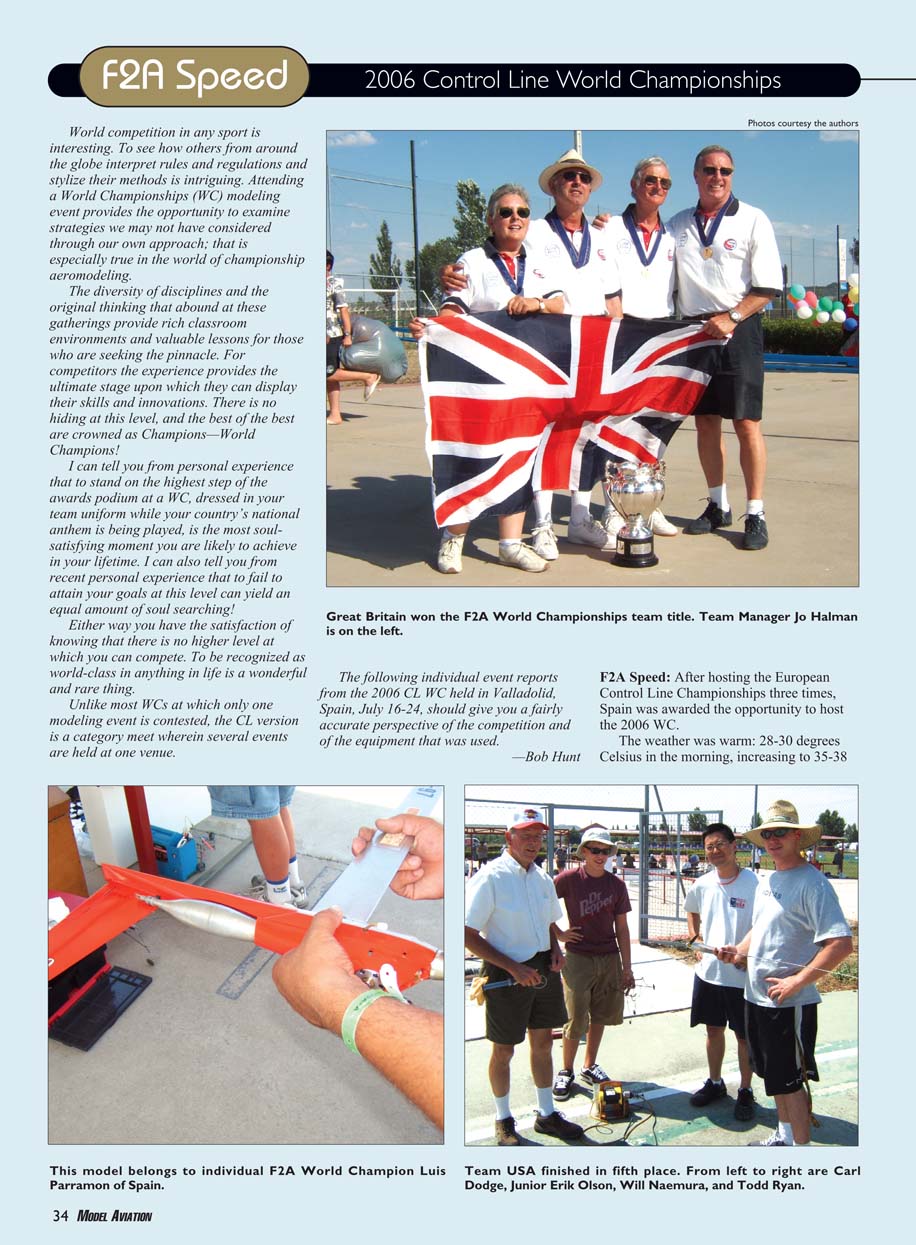
World competition in any sport is interesting. To see how others from around the globe interpret rules and regulations and stylize their methods is intriguing. Attending a World Championships (WC) modeling event provides the opportunity to examine strategies we may not have considered through our own approach; that is especially true in the world of championship aeromodeling.
The diversity of disciplines and the original thinking that abound at these gatherings provide rich classroom environments and valuable lessons for those who are seeking the pinnacle. For competitors the experience provides the ultimate stage upon which they can display their skills and innovations. There is no hiding at this level, and the best of the best are crowned as Champions—World Champions!
I can tell you from personal experience that to stand on the highest step of the awards podium at a WC, dressed in your team uniform while your country's national anthem is being played, is the most soul-satisfying moment you are likely to achieve in your lifetime. I can also tell you from recent personal experience that to fail to attain your goals at this level can yield an equal amount of soul searching! Either way you have the satisfaction of knowing that there is no higher level at which you can compete. To be recognized as world-class in anything in life is a wonderful and rare thing.
Unlike most WCs at which only one modeling event is contested, the CL version is a category meet wherein several events are held at one venue.
The following individual event reports from the 2006 CL WC held in Valladolid, Spain, July 16–24, should give you a fairly accurate perspective of the competition and of the equipment that was used. —Bob Hunt
Report
After hosting the European Control Line Championships three times, Spain was awarded the opportunity to host the 2006 WC.
The weather was warm: 28–30°C in the morning, increasing to 35–38°C in the afternoon. The density/altitude was 5,000–6,500 feet most of the time. These conditions made for difficult tuning. With 32 entries from 14 countries, this was a fast contest.
Official practice had been scheduled for 9:00 a.m. However, after five attempts problems with the primary and secondary Transitrace systems arose. It was decided to delay the round until the next day. The rest of the day was spent on unofficial training, which helped. Organizers trained the officials and worked out other problems with the Transitrace system.
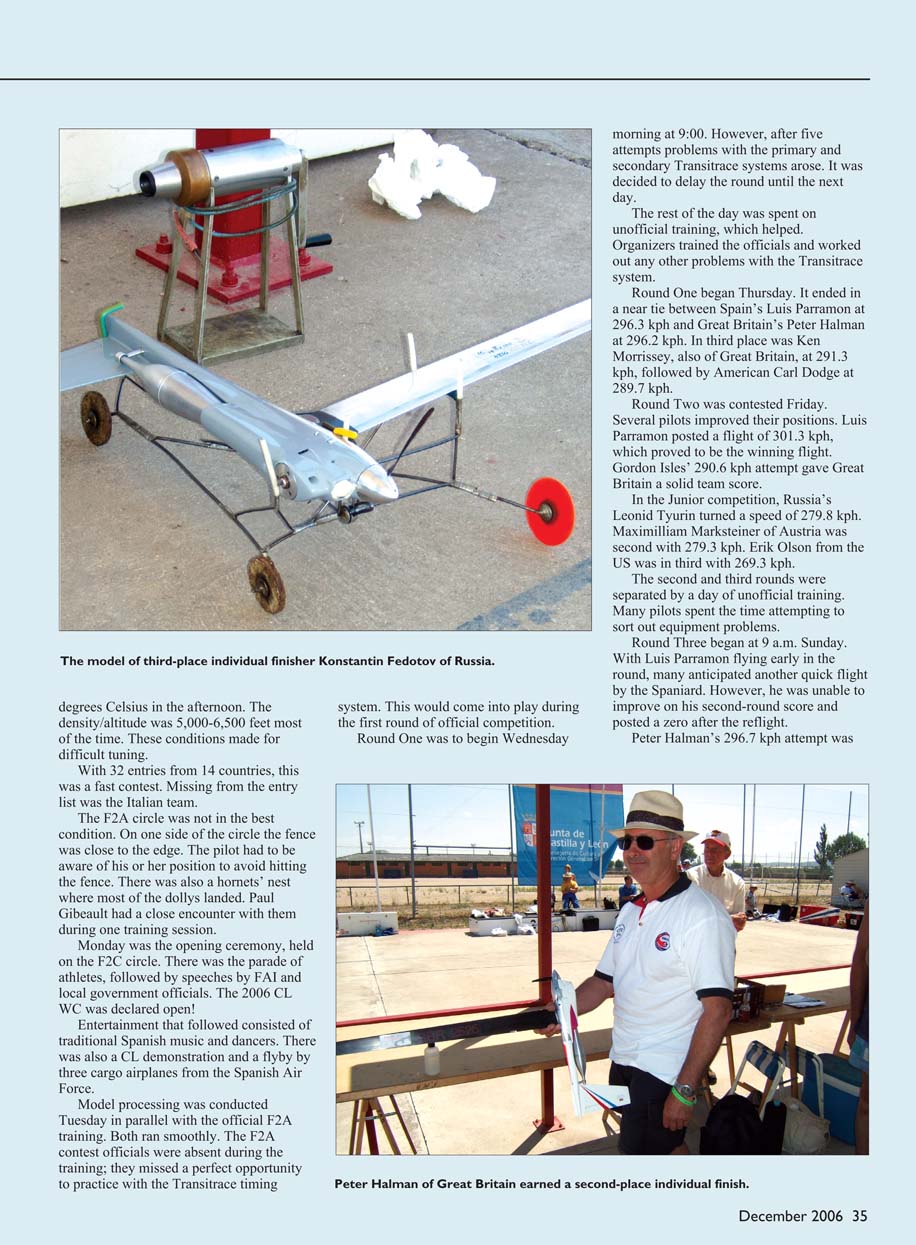
Round One began Thursday. It ended in a near tie between Spain's Luis Parramon at 296.3 kph and Great Britain's Peter Halman at 296.2 kph. In third place was Ken Morrissey, also of Great Britain, at 291.3 kph, followed by American Carl Dodge at 289.7 kph.
Round Two was contested Friday. Several pilots improved their positions. Luis Parramon posted a flight of 301.3 kph, which proved to be the winning flight. Gordon Isles' 290.6 kph attempt gave Great Britain a solid team score. In the Junior competition, Russia's Leonid Tyurin turned a speed of 279.8 kph. Maximillian Marksteiner of Austria was second with 279.3 kph. Erik Olson from the US was in third with 269.3 kph.
The second and third rounds were separated by a day of unofficial training. Many pilots spent the time attempting to sort out equipment problems. Round Three began at 9 a.m. Sunday. With Luis Parramon flying early in the round, many anticipated another quick flight by the Spaniard. However, he was unable to improve on his second-round score and posted a zero after the reflight. Peter Halman's 296.7 kph attempt was no improvement. Russian Konstantin Fedotov moved into third place with a 292.4 kph flight.
There was a tie for fourth place between Regis Gilbert of France and Ken Morrissey at 291.3 kph. Regis's backup flight of 289.3 kph broke the tie. Jean Marc Aube of France finally posted a score of 283.2 kph, which earned the French team the Bronze Medal.
Maximilian Marksteiner was the only pilot to improve his score in the Junior category; he posted a 285.3 kph. That speed won the Junior competition and was fast enough for 14th place overall.
The awards ceremony was held at the flying site. Medals and trophies were awarded to the top three Seniors, Juniors, and teams. Luis Parramon had won his sixth consecutive F2A World Championship. The Silver Medal was awarded to Peter Halman, and Konstantin Fedotov earned the Bronze Medal.
In the Junior class the Gold Medal went to Maximilian Marksteiner. The Silver Medal went to Leonid Tyurin, and Erik Olson was awarded the Bronze.
The team Gold Medal went to the British for the fifth time in a row. The Silver Medal went to the Russian team, and France had earned the Bronze. The Spanish team finished fourth, and the US team was fifth.
A traditional banquet following the awards ceremony closed the competition.
Team USA worked extremely well together trying to sort things out. Carl Dodge had returned to WC competition after a 12-year absence. He did great, finishing eighth with 289.7 kph. As always, Carl used his homemade bar-stock, rear-valve engine.
Todd Ryan finished 16th at 284.1 kph, and Will Naemura garnered 23rd place with 279.1 kph. Both worked hard putting in hours of test flights but were unable to extract the full potential of their Kostin-powered models.
US Junior entrant Erik Olson did well in his first international competition, finishing with a speed of 269.3 kph.
It's time to begin working toward the 2008 WC, to be held in Landres-Piennes, France.
Bill Hughes [email protected]
F2B Precision Aerobatics
Valladolid is a city of approximately 350,000 located 200 kilometers north-northwest of Madrid. The WC flying site was built specifically for aeromodeling. Three or four European CL Championships and a World Cup event have been held there.
There were three paved circles: one for Racing, one for Speed, and one for F2B. There was one rough-grass circle on the site. The F2B circle was just big enough for full-length lines and was surrounded by bushes of varying heights, from roughly 2 to 3 feet.
Outside the bushes, where the judges stood, the ground was approximately 2 1/2 feet above the circle's surface. This made it a challenge for the judges to determine the maneuver bottoms. The prevailing wind direction had trees on the upwind side, which resulted in significant turbulence up high while the bushes created bumps down low.
The new rules changes specified a two-circle format: two flights on each circle, with the better score on each circle totaled to determine the top 15 competitors, who would be the finalists.
The second official circle, which was grass, was located on an athletic field with concrete stands and trees on one side and only trees on another side. The prevailing winds came over the stands and/or over the trees. A 10–15 mph wind over the stands made this circle virtually unflyable.
The grass circle was decent, but a few bumps caused problems during qualifications. The grass was cut before official practice but was still long enough to cause difficulties if your model touched down with the wind blowing over the tail.
The practice facility was marginal; it was a concrete parking lot with a significant slope and was bumpy enough that you had to be extremely careful. This site claimed four models during the contest. It made the US team and all others who attended the 2004 WC appreciate the AMA facility in Muncie, Indiana.
The grass field on the Spanish site was finally cut but was still long enough that only the brave flew there. However, people were flying on these circles with no grumbles. Could we be a bit spoiled?
The number of different ways the international entrants approach the problem of executing the F2B pattern's 16 maneuvers is interesting.
The Chinese used four-stroke engines. The models were evolved from Xiang Dong's Skywriter design. The level flight speeds are brisk, between 4.65 and 4.85 seconds per lap. Han Xin Ping and Zhang Wei used the Saito .56, which slowed considerably during maneuvers. Niu An Lin had a Saito .80, which did not slow nearly as much and seemed to have plenty of drive.
The Chinese flying style emphasizes bottoms and intersections while losing some of the shape. The corners are soft. This approach has been effective; Xin Ping has won five WC titles. This year most felt that Niu An Lin was flying the best of the three and was bothered the least by the wind.
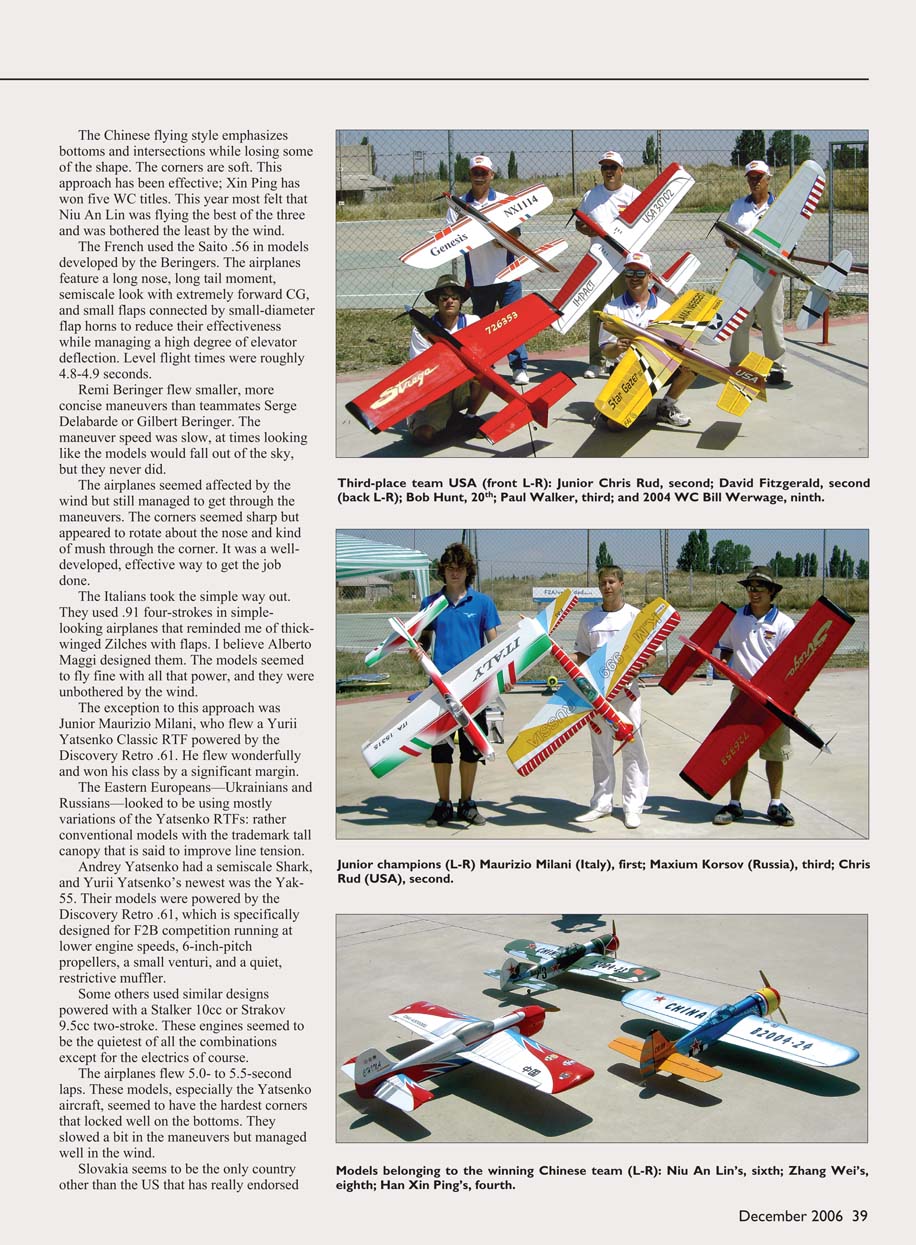
The French used the Saito .56 in models developed by the Beringers. The airplanes feature a long nose, long tail moment, semiscale look with extremely forward CG, and small flaps connected by small-diameter flap horns to reduce their effectiveness while managing a high degree of elevator deflection. Level flight times were roughly 4.8–4.9 seconds.
Remi Beringer flew smaller, more concise maneuvers than teammates Serge Delabarde or Gilbert Beringer. The maneuver speed was slow, at times looking like the models would fall out of the sky, but they never did. The airplanes seemed affected by the wind but still managed to get through the maneuvers. The corners seemed sharp but appeared to rotate about the nose and kind of mush through the corner. It was a well-developed, effective way to get the job done.
The Italians took the simple way out. They used .91 four-strokes in simple-looking airplanes that reminded me of thick-winged Zilches with flaps. I believe Alberto Maggi designed them. The models seemed to fly fine with all that power, and they were unbothered by the wind.
The exception to this approach was Junior Maurizio Milani, who flew a Yurii Yatsenko Classic RTF powered by the Discovery Retro .61. He flew wonderfully and won his class by a significant margin.
The Eastern Europeans—Ukrainians and Russians—looked to be using mostly variations of the Yatsenko RTFs: rather conventional models with the trademark tall canopy that is said to improve line tension.
Andrey Yatsenko had a semiscale Shark, and Yurii Yatsenko's newest was the Yak-55. Their models were powered by the Discovery Retro .61, which is specifically designed for F2B competition running at lower engine speeds, 6-inch-pitch propellers, a small venturi, and a quiet, restrictive muffler.
Some others used similar designs powered with a Stalker 10cc or Strakov 9.5cc two-stroke. These engines seemed to be the quietest of all the combinations except for the electrics, of course.
The airplanes flew 5.0–5.5 second laps. These models, especially the Yatsenko aircraft, seemed to have the hardest corners that locked well on the bottoms. They slowed a bit in the maneuvers but managed well in the wind.
Slovakia seems to be the only country other than the US that has really endorsed the tuned-pipe approach. Their airplanes were Igor Burger’s pleasant-looking, conventional Max design. The engines were the PA .61, Jett/Aldrich .51, or MVVS .51. Alexander Schrek’s model seemed to handle the wind well.
The US models used tuned-pipe PA or RoJett engines from .61 to .75 cu. in. displacement. David Fitzgerald’s PA .75 model flew a bit slower than the others, at roughly 5.3 seconds. The others flew at 5.0–5.2 seconds, depending on the conditions.
Paul Walker’s Impact with a RoJett .65 flew terrific, turning a bit higher rpm and speed than David’s, who softened his corners to help get consistent bottoms. Junior competitor Chris Rudd flew a RoJett .61 in an Urtnowski Strega—a bit quicker yet but performed corners and bottoms well.
Rob Gruber flew a Randy Smith Starfire with a PA .61 and just missed qualifying for the top 15. Billy Werwage flew the venerable P-47 razorback with the PA .61. This was the same combination he used at the 2004 Nats. Billy and a couple others wished for the wind to blow in the finals, to no avail.
The newest combination was the electric power system; four were entered. Heinz-Willi Schmitz of Germany had a model in the early stages of development.
Canadian Kim Dougherty was aggressive in his approach by going to a larger motor-and-battery combination; power equivalent to that of a .91 cu. in. two-stroke was the goal. Kim’s model was purpose-designed and built for electric power. It was larger and heavier than the other electric entries but seemed to fly well and had plenty of power.
Bruno Van Hoek of the Netherlands used an older model from Henk De Jong and installed a motor-and-battery combination that was similar to American Bob Hunt’s. Bruno had a speed controller with a brake function so the propeller would stop when the power was switched off.
Bob’s combination used a motor that was roughly equivalent to a .40 cu. in. two-stroke. He had a new sequencer that was programmed to sense load, and he set it to yield a lap speed of 5.2 seconds that was constant from the beginning to the end of the flight. Bob had a couple early flight draws that didn’t help his cause, but he missed qualifying in the top 15 by only 6.6 points.
The electric movement made an impressive first attempt in this arena. Electric power is doing well in RC Aerobatics, and there is a great deal of potential for it in F2B.
Notice my references to lap times. It is interesting that speeds of flight or maneuver times are never mentioned in the rules, but we continue to talk about speed or lack thereof. It is a puzzlement; geometry is the goal, isn’t it?
In addition to the two-circle qualifying format, a rules change specified that all the judges’ scores would count; that is, no high- and low-score throwaways. The US team was unenthusiastic about this, fearing that a single poor score could be very damaging. Also, only three judges per circle were used for the qualification flights. Therefore, a single judge could make a difference of several positions in qualifying. However, all competitors were subject to the same rules. I hope Bruno DeLorch checks to see if it would have made any significant difference if the high and low scores had been dropped in the finals.
Qualifications were scheduled to begin at 9 a.m. Wednesday. Since Bob Hunt was to make the first flight, the US group arrived at the grass field at 8:00. The weather was unflyable above the allowable 9 meters/second limit. The organizers wisely delayed the starting time one hour. By 9:30 the wind had dropped to less than 5 mph but the skies were threatening.
At 10:00 Bob was called to fly the first electric-powered F2B flight in WC competition. He took off, aborted the Reverse Wingover, and began yelling "Electricite! Electricite!" at the top of his lungs. Then he pointed to his handle yelling "Shock! Shock!" and the US team doubled over with laughter at Bob's expense. He was getting static electric shocks at the handle.
The competition was delayed another half hour, and Bob began his reflight. He was still unnerved and didn't fly his best. For some reason the model didn't want to fly level and didn't want to lock on the bottoms. The power package worked well, but Bob and the Genesis never seemed to be in sync.
He flew at the tilted practice site Friday morning, trying to get the trim right, and pancaked in during the inside rounds. Wake turbulence, dead air, and trying to find the bottoms were the culprits. It didn't break the propeller but bent the landing gear and tail wheel. Bob did settle down and had a good third official flight.
Rob Gruber flew later in the morning. He landed his airplane with the wind blowing on the tail, and it flipped over as it stopped. That zeroed his landing score.
Rob was the defending Junior World Champion and was shown as a Junior entrant all week. US Team Manager Keith Trostle pointed this out to the organizers, but to no avail.
Rob recovered and missed qualifying for the finals by 1.4 points—a real heartbreaker, especially since the original results showed him as the 13th qualifier. There was a scoring error on Mitsuru Yokoyama's sheet, and he ended up in the final qualifying spot.
Chris Rudd did great for a first-timer in a WC. He was practicing early Saturday morning when he had a control-system failure and pancaked his Strega in inertial. That scraped the top, ruined the canopy, and broke the rudder.
Fortunately Chris had a late flight time. Repairs were made and he had time to practice before his last qualifying flight. He qualified second in Junior. Maurizio Milani did an excellent job and was the top Junior qualifier.
David Fitzgerald and Billy Werwage had late flights Thursday and Friday, which were thought not to be too bad if thinking about some possible ballooning of the judges, but for some reason the wind wasn't bad in the morning. Then the later it got, the faster the wind blew. It became a case of making decent flights and no big mistakes to qualify.
David had late flights all week until the finals. Saturday he and Paul Walker encountered reasonable winds. Both had solid attempts, but Paul landed hot and then hit a bump that launched the model approximately 4 feet into the air and broke the carbon-fiber landing gear. One judge gave him a 3.5, apparently ignoring the fact that they are supposed to take the surface of the field into consideration when scoring.
Billy's flights looked good, but the judges on the grass circle weren't buying what he was putting up. Even so, it looked as though he could finish strong in the finals.
Team USA qualified with Paul in first, David in fifth, and Bob in 20th. Chris was the second Junior. The defending World Champions qualified with Bill in sixth and Rob 16th. Unless the Chinese or French fell flat in the finals, the US would probably be the third-place team.
We didn't learn until we were at the banquet that the organizers gave the individual qualifying results to the judges Saturday evening. That is in direct violation of the rules, which read: "In order to prevent influence of any kind, no judge should look at the tabulated scores and/or contestants' placing until after the completion of the contest."
The US and British judges advised the organizers of this but were told that the qualifications were a separate contest. No one knows if this affected the final results, but it was definitely against the rules.
The finals began with Bill and Paul leading off and David being fifth to fly. These early draws were almost as bad as they could get. There appeared to be some ballooning toward the end of Round One.
The Juniors fly after the Seniors. Maurizio Milani was last to fly and had the fourth highest score of the round. Remi Beringer was first, David was second by 3.86 points, Paul was seventh, and Bill was 13th. Chris Rudd had the 12th highest score and finished second in the Junior class, 28 points behind Maurizio.
The second round was flown after siesta. Winds were light. The second-round draw was better, with US pilots scheduled seventh, tenth and thirteenth. David had the high flight of the round, putting him in first place. Paul had an excellent flight and moved up to the fourth spot. Remi flew well and was in second place, 0.75 point behind David. Chris tried extra hard to catch the Italian but lost ground. Maurizio posted the second-highest score of the round.
Monday was the last round of the finals. David was sixth to fly and put in an excellent attempt. He was happy with his performance.
Remi flew 11th and had an outstanding flight as well. Bill flew 12th and felt good about the flight but bad about the score he received. Paul flew next to last in Senior and had the second best flight of the round. When he came off the circle, he said that flight was the best he could do. Then it was up to the judges.
David felt he had the edge on Remi. Rather than wait for the official results, the two compared scores and Remi had the advantage by 1.62 points. Paul moved up to third, which was just three points back. It was close but not to be for the US. Chris settled down and nailed second place in Junior, ahead of young Russian Maxim Korsov. As expected, the US finished third in team competition behind China and France.
This was my first time at a WC in a foreign country. I renewed friendships I made in Muncie in 2004, and I made more friends this time. I hope I can make it to the 2008 CL WC and lend my support once again.
Warren Tiahart [email protected]
F2C Team Race
Valladolid has a dry climate. It is quite warm during the day, with an occasional afternoon thunderstorm. Showers popped up several days during our stay, and one day a major thunderstorm with high winds and hail abused the site. But the real story was the general high heat and low humidity. Lots of sunscreen and bottled water were essential on the field.
Most of the F2C team members arrived a day or two early to get extra practice time. The site, on the outskirts of the city, is purpose-built and accompanied by venues for other activities such as an RC car track and several soccer fields.
The F2C circle was smooth and free from problems. But since it was situated in such a dry climate, it was necessary to frequently brush and clean the pit segments.
In addition to the official site, the organizers provided a practice area that was in a large parking lot adjacent to a soccer stadium on the opposite side of the city. It was unavailable until Monday, so all practice and last-minute tuning was done at the official site.
With 45 teams entered in F2C, this rapidly became a frustrating experience since opportunities to get onto the circle were infrequent. This problem diminished Monday when the practice circle became available.
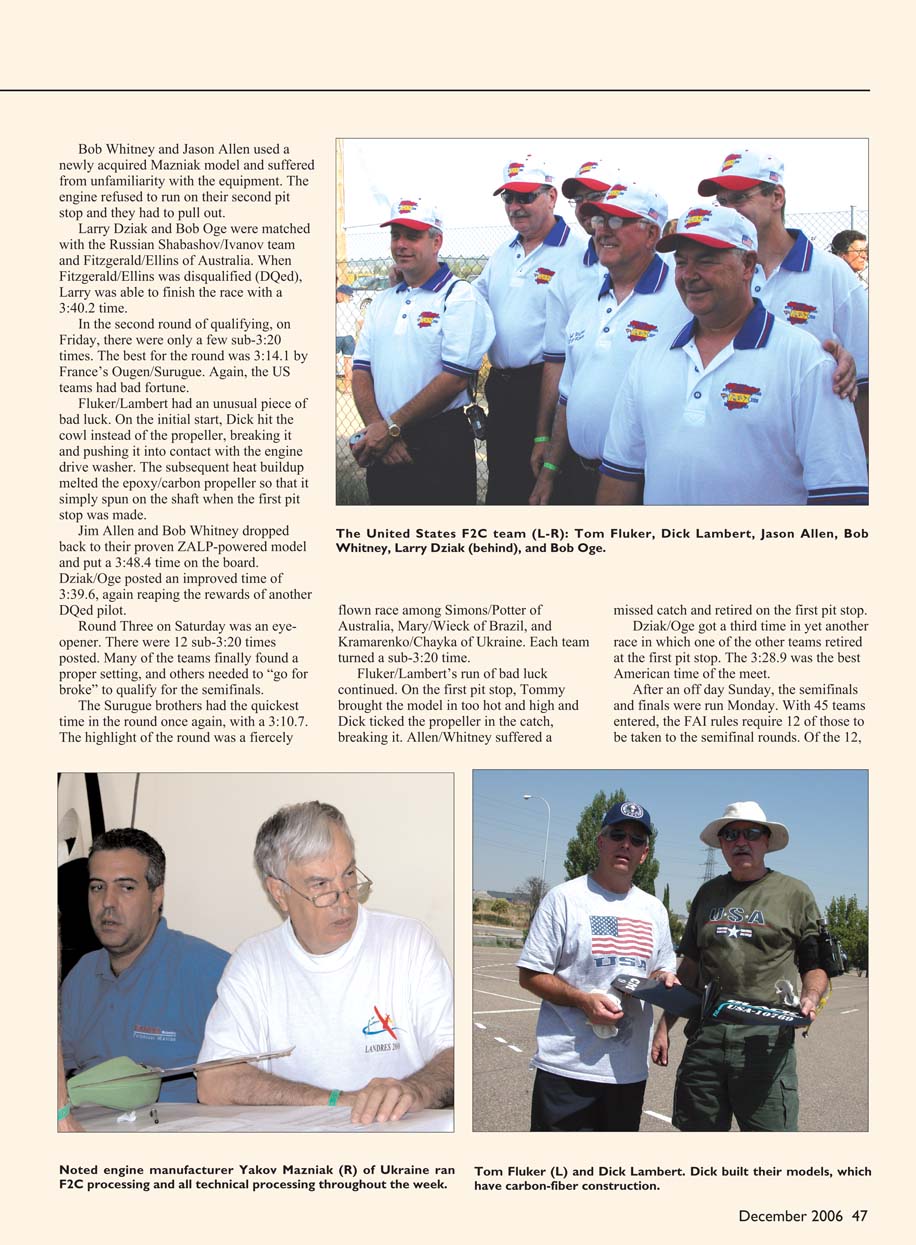
The WC was officially opened Monday, and the models were processed Tuesday. Noted Ukrainian engine manufacturer Yakov Mazniak headed the F2C processing. Airplanes were checked for adherence to the rules, engines marked to assure ownership, and fuel tanks measured to be certain they did not exceed the maximum of 7cc allowed fuel.
Official practice was Wednesday. While all other events were officially competing, F2C had scheduled time for each team to be on the contest circle. Each national pair was allotted a 10-minute segment. Official practice is a time to get that last-minute setting and, for many, a chance to show off a bit.
It was common to see someone circulating at speeds that would be unusable in an actual race. Times for 10 laps in the mid-to-high 16s were frequent, but race settings would be slower.
Thursday was the first round of qualifications. The reigning World Champion team of Georges and Pascal Surugue of France set the quickest time for all qualifications: 3:09.5. First-round times were relatively slow overall, with only a half dozen sub-3:20s.
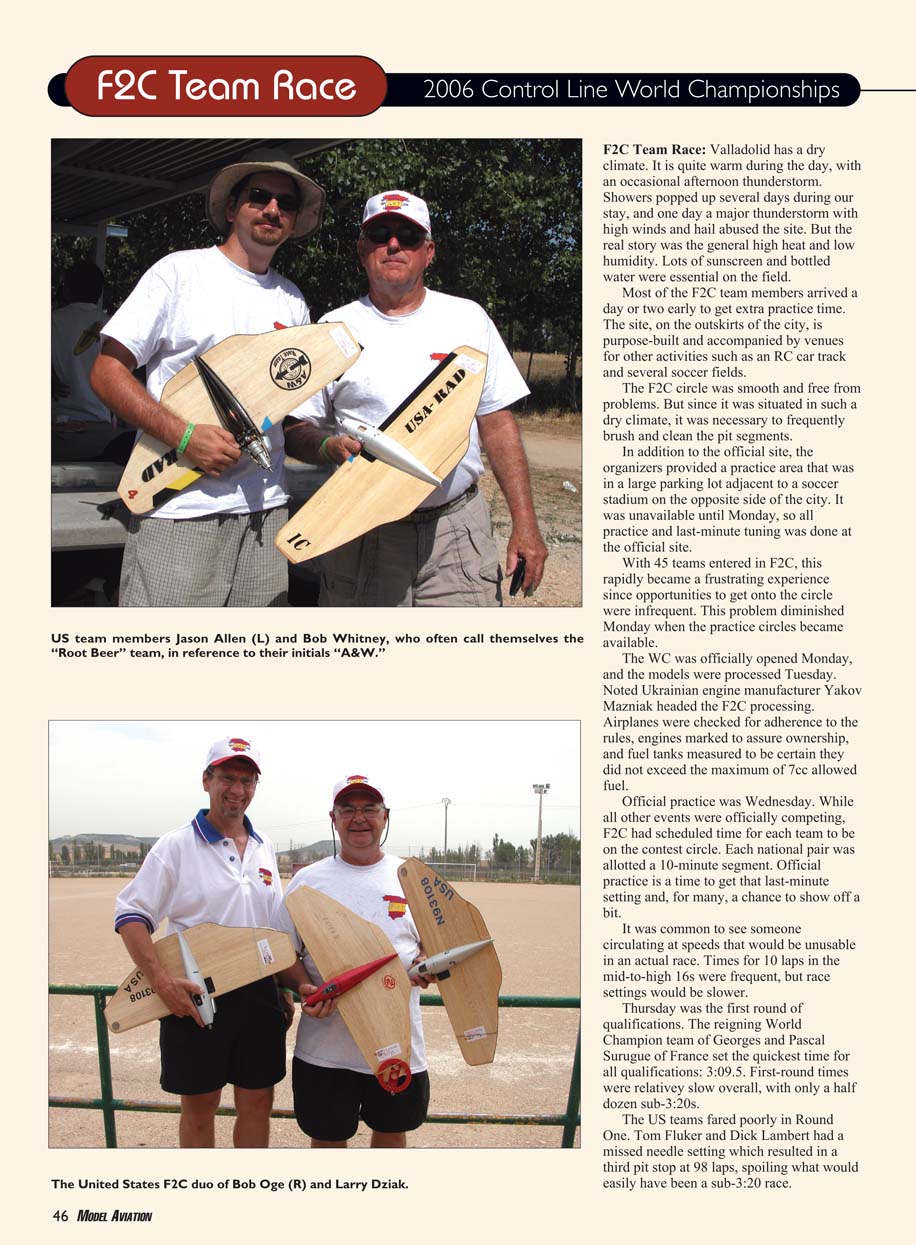
The US teams fared poorly in Round One. Tom Fluker and Dick Lambert had a missed needle setting which resulted in a third pit stop at 98 laps, spoiling what would easily have been a sub-3:20 race.
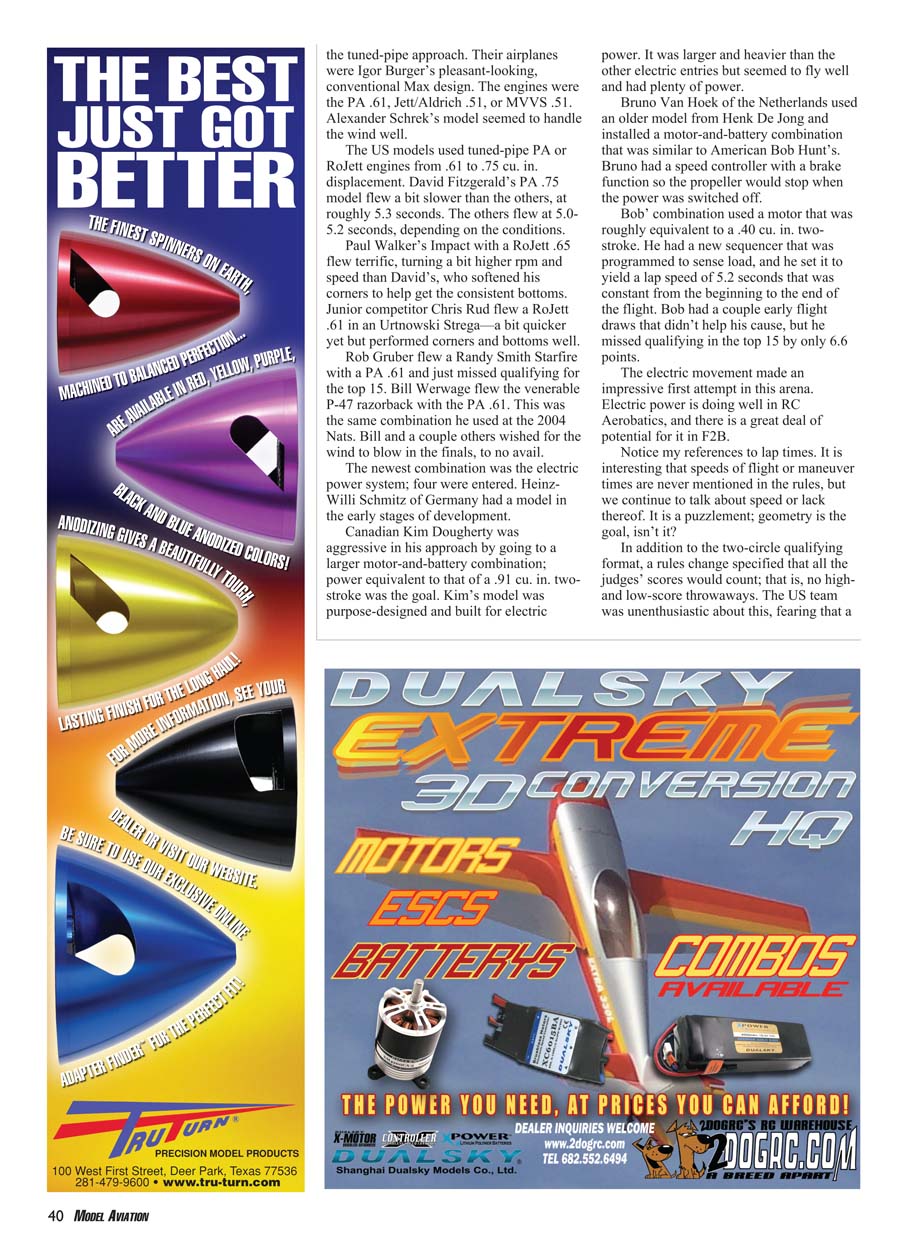
Bob Whitney and Jason Allen used a newly acquired Mazniak model and suffered from unfamiliarity with the equipment. The engine refused to run on their second pit stop and they had to pull out.
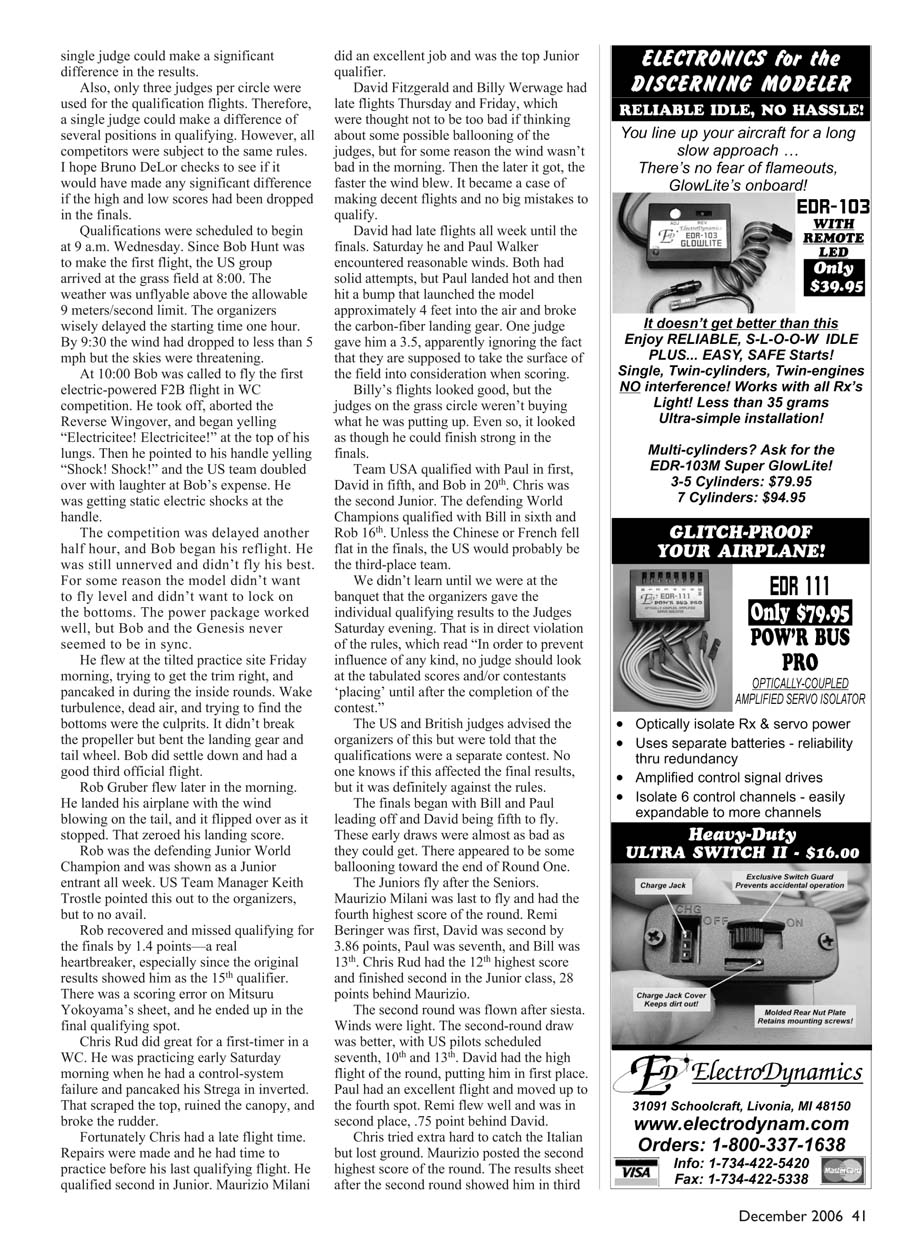
Larry Dziak and Bob Oge were matched with the Russian Shabashov/Ivanov team and Fitzgerald/Ellins of Australia. When Fitzgerald/Ellins was disqualified (DQed), Larry was able to finish the race with a 3:40.2 time.
In the second round of qualifying, on Friday, there were only a few sub-3:20 times. The best for the round was 3:14.1 by France's Ougen/Surugue. Again, the US teams had bad fortune.
Fluker/Lambert had an unusual piece of bad luck. On the initial start, Dick hit the cowl instead of the propeller, breaking it and pushing it into contact with the engine drive washer. The subsequent heat buildup melted the epoxy/carbon propeller so that it simply spun on the shaft when the first pit stop was made.
Jim Allen and Bob Whitney dropped back to their proven ZALP-powered model and put a 3:48.4 time on the board. Dziak/Oge posted an improved time of 3:39.6, again reaping the rewards of another DQed pilot.
Round Three on Saturday was an eye-opener. There were 12 sub-3:20 times posted. Many of the teams finally found a proper setting, and others needed to "go for broke" to qualify for the semifinals.
The Surugue brothers had the quickest time in the round once again, with a 3:10.7. The highlight of the round was a fiercely flown race among Simon/Potter of Australia, Mary/Wieck of Brazil, and Kramarenko/Chayka of Ukraine. Each team turned a sub-3:20 time.
Fluker/Lambert's run of bad luck continued. On the first pit stop, Tommy brought the model in too hot and high and Dick ticked the propeller in the catch, breaking it. Allen/Whitney suffered a missed catch and retired on the first pit stop.
Dziak/Oge got a third time in yet another race in which one of the other teams retired at the first pit stop. The 3:28.9 was the best American time of the meet.
After an off day Sunday, the semifinals and finals were run Monday. With 45 teams entered, the FAI rules require 12 of those to be taken to the semifinal rounds. Of the 12, three were from France, two each were from Australia, Spain, and Ukraine, and one team each from Russia, Italy, and Singapore rounded out the field. The cutoff time for the semifinals was 3:17.4, with 15 teams posting qualifying times below 3:20.
The semifinals were flown in two rounds. In the first, Kramarenko/Chayka of Ukraine posted the quickest time of 3:08.4 for the 100 laps. While there were several other times in the low teens, none were within two seconds of this pair's.
In the second round Bondarenko/Lerner of Ukraine turned the fastest time of the meet—3:07.7—to gain its spot in the finals. World Champions Surugue/Surugue flew a 3:10.8 for the third spot. The finals would be composed of two Ukrainian and one French team.
The finals consisted of three evenly matched teams with virtually identical airspeeds. The obvious difference was in the pit stops, and that's where it was decided.
On the second pit stop Kramarenko was near the pitting circle. With his arm outstretched, his model just ticked Lerner's helmet as he was bent over pitting his model. On the subsequent stop, Chayka discovered that the propeller was broken and pulled the model out.
It was unclear when the damage occurred, but it left Bondarenko/Lerner and Surugue/Surugue to finish the last 100 laps in a two-up. Their models were virtually identical in the air, and the Surugue brothers successfully defended their World Championship title by roughly a two-lap margin.
My overall impression of this WC was that many teams are capable of running quickly. In previous events there have been small numbers of excellent teams, whereas this WC had many pairs that were capable of extraordinarily fast times. This year also saw a widespread adoption of models with retractable landing gear.
The contest organization was good, owing largely to the up-front efforts of the Spanish organizers. They were aided by the experienced F2C Jury of Bruno Delor of France, Andy Sweetland of Switzerland, and Francisco Mata of Spain.
Bill Lee [email protected]
F2D Combat
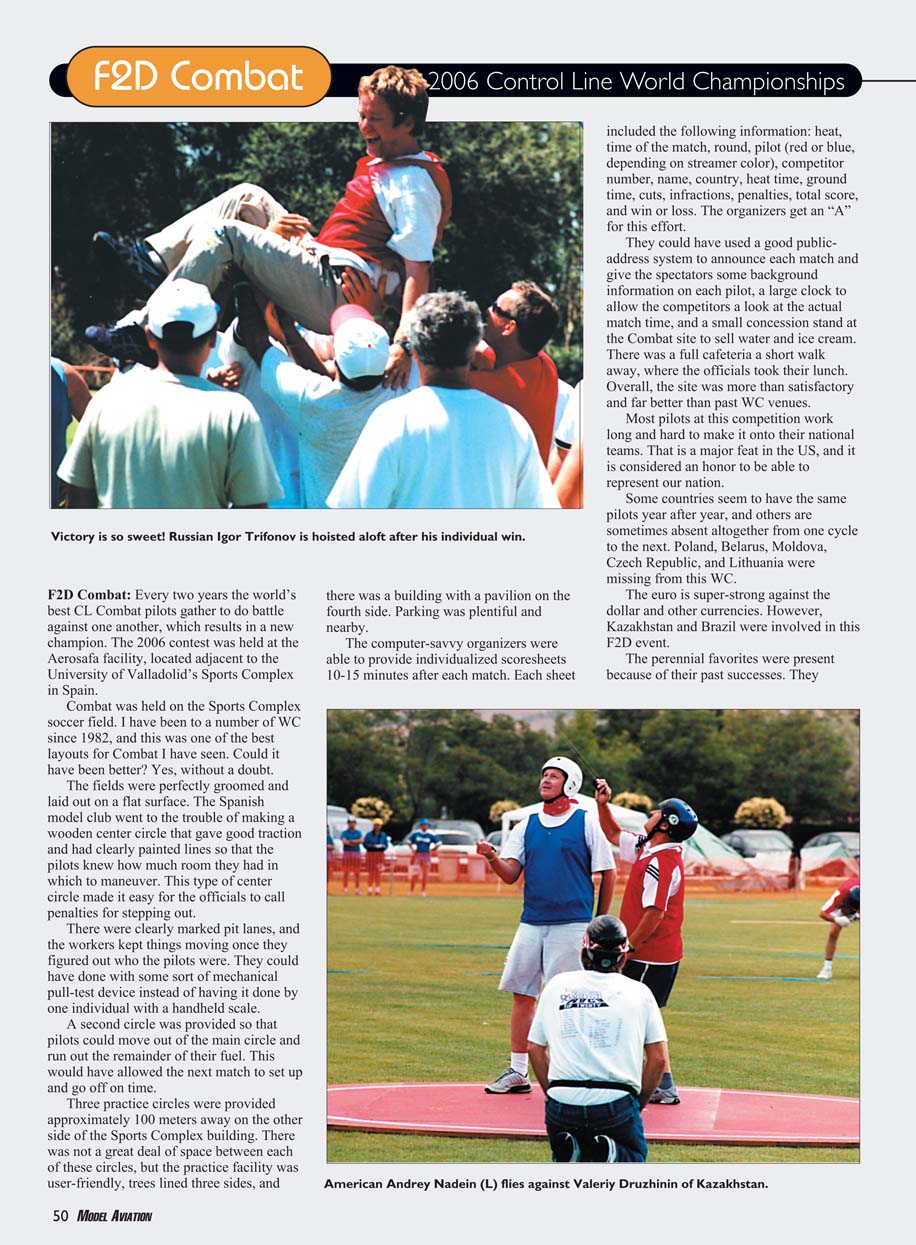
Every two years the world's best CL Combat pilots gather to do battle against one another, which results in a new champion. The 2006 contest was held at the Aerosafa facility, located adjacent to the University of Valladolid's Sports Complex in Spain.
Combat was held on the Sports Complex soccer field. I have been to a number of WCs since 1982, and this was one of the best layouts for Combat I have seen. Could it have been better? Yes, without a doubt.
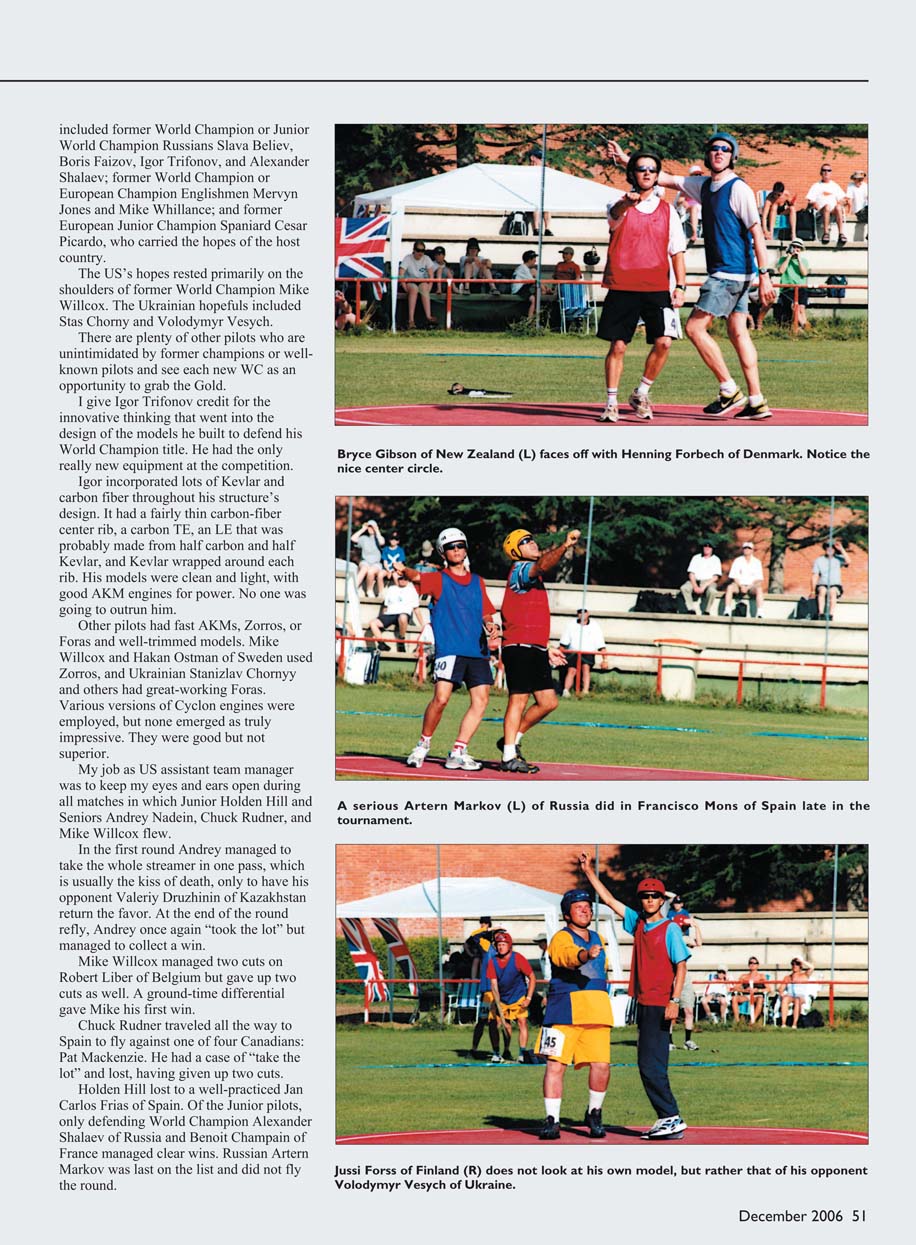
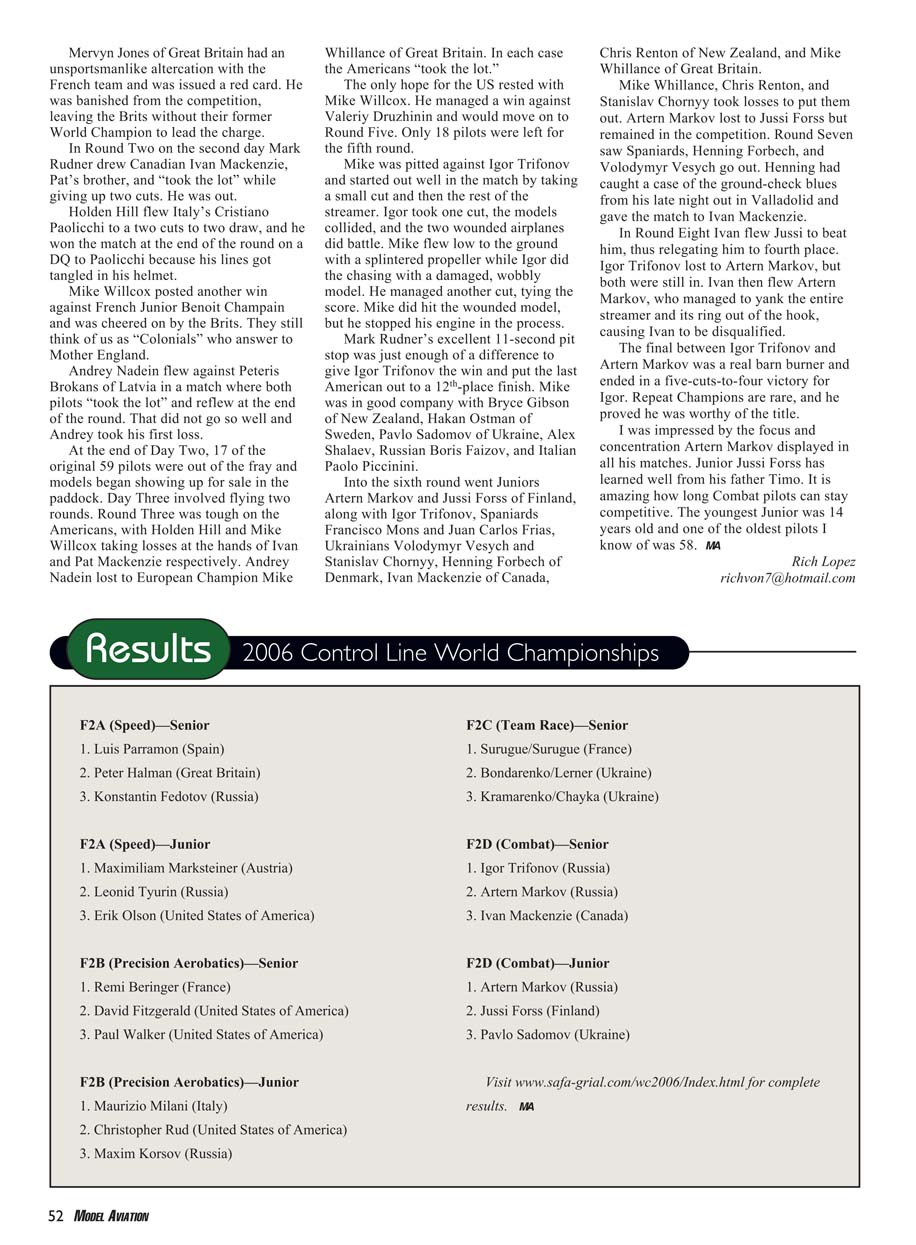
The fields were perfectly groomed and laid out on a flat surface. The Spanish model club went to the trouble of making a wooden center circle that gave good traction and had clearly painted lines so that the pilots knew how much room they had in which to maneuver. This type of center circle made it easy for the officials to call penalties for stepping out.
There were clearly marked pit lanes, and the workers kept things moving once they figured out who the pilots were. They could have done with some sort of mechanical pull-test device instead of having it done by one individual with a handheld scale.
A second circle was provided so that pilots could move out of the main circle and run out the remainder of their fuel. This would have allowed the next match to set up and go off on time.
Three practice circles were provided approximately 100 meters away on the other side of the Sports Complex building. There was not a great deal of space between each of these circles, but the practice facility was user-friendly: trees lined three sides, and there was a building with a pavilion on the fourth side. Parking was plentiful and nearby.
The computer-savvy organizers were able to provide individualized scoresheets 10–15 minutes after each match. Each sheet included the following information: heat, time of the match, round, pilot (red or blue, depending on streamer color), competitor number, name, country, heat time, ground time, cuts, infractions, penalties, total score, and win or loss. The organizers get an "A" for this effort.
They could have used a good public-address system to announce each match and give the spectators some background information on each pilot, a large clock to allow the competitors a look at the actual match time, and a small concession stand at the Combat site to sell water and ice cream. There was a full cafeteria a short walk away, where the officials took their lunch. Overall, the site was more than satisfactory and far better than past WC venues.
Most pilots at this competition work long and hard to make it onto their national teams. That is a major feat in the US, and it is considered an honor to be able to represent our nation.
Some countries seem to have the same pilots year after year, and others are sometimes absent altogether from one cycle to the next. Poland, Belarus, Moldova, Czech Republic, and Lithuania were missing from this WC. The euro is super-strong against the dollar and other currencies. However, Kazakhstan and Brazil were involved in this F2D event.
The perennial favorites were present because of their past successes. They included former World Champion or Junior World Champion Russians Slava Believ, Boris Faizov, Igor Trifonov, and Alexander Shalaev; former World Champion or European Champion Englishmen Mervyn Jones and Mike Willance; and former European Junior Champion Spaniard Cesar Picardo, who carried the hopes of the host country.
The US's hopes rested primarily on the shoulders of former World Champion Mike Willcox. The Ukrainian hopefuls included Stas Chorny and Volodymyr Vesych.
There are plenty of other pilots who are unintimidated by former champions or well-known pilots and see each new WC as an opportunity to grab the Gold.
I give Igor Trifonov credit for the innovative thinking that went into the design of the models he built to defend his World Champion title. He had the only really new equipment at the competition.
Igor incorporated lots of Kevlar and carbon fiber throughout his structure's design. It had a fairly thin carbon-fiber center rib, a carbon TE, an LE that was probably made from half carbon and half Kevlar, and Kevlar wrapped around each rib. His models were clean and light, with good AKM engines for power. No one was going to outrun him.
Other pilots had fast AKMs, Zorros, or Foras and well-trimmed models. Mike Willcox and Hakan Ostman of Sweden used Zorros, and Ukrainian Stanislav Chorny and others had great-working Foras. Various versions of Cyclon engines were employed, but none emerged as truly impressive. They were good but not superior.
My job as US assistant team manager was to keep my eyes and ears open during all matches in which Junior Holden Hill and Seniors Andrey Nadein, Chuck Rudner, and Mike Willcox flew.
In the first round Andrey managed to take the whole streamer in one pass, which is usually the kiss of death, only to have his opponent Valeriy Druzhinin of Kazakhstan return the favor. At the end of the round refly, Andrey once again "took the lot" but managed to collect a win.
Mike Willcox managed two cuts on Robert Liber of Belgium but gave up two cuts as well. A ground-time differential gave Mike his first win.
Chuck Rudner traveled all the way to Spain to fly against one of four Canadians: Pat Mackenzie. He had a case of "take the lot" and lost, having given up two cuts.
Holden Hill lost to a well-practiced Jan Carlos Frias of Spain. Of the Junior pilots, only defending World Champion Alexander Shalaev of Russia and Benoit Champain of France managed clear wins. Russian Artem Markov was last on the list and did not fly the round.
Mervyn Jones of Great Britain had an unsportsmanlike altercation with the French team and was issued a red card. He was banished from the competition, leaving the Brits without their former World Champion to lead the charge.
In Round Two on the second day Mark Rudner drew Canadian Ivan Mackenzie, Pat's brother, and "took the lot" while giving up two cuts. He was out.
Holden Hill flew Italy's Cristiano Paolicchi to a two-cuts-to-two draw, and he won the match at the end of the round on a DQ to Paolicchi because Paolicchi's lines got tangled in his helmet.
Mike Willcox posted another win against French Junior Benoit Champain and was cheered on by the Brits. They still think of us as "Colonials" who answer to Mother England.
Andrey Nadein flew against Peteris Brokans of Latvia in a match where both pilots "took the lot" and reflew at the end of the round. That did not go so well and Andrey took his first loss.
At the end of Day Two, 17 of the original 59 pilots were out of the fray and models began showing up for sale in the paddock. Day Three involved flying two rounds. Round Three was tough on the Americans, with Holden Hill and Mike Willcox taking losses at the hands of Ivan and Pat Mackenzie respectively. Andrey Nadein lost to European Champion Mike Willance of Great Britain. In each case the Americans "took the lot."
The only hope for the US rested with Mike Willcox. He managed a win against Valeriy Druzhinin and would move on to Round Five. Only 18 pilots were left for the fifth round.
Mike was pitted against Igor Trifonov and started out well in the match by taking a small cut and then the rest of the streamer. Igor took one cut, the models collided, and the two wounded airplanes did battle. Mike flew low to the ground with a splintered propeller while Igor did the chasing with a damaged, wobbly model. He managed another cut, tying the score. Mike did hit the wounded model, but he stopped his engine in the process.
Mark Rudner's excellent 11-second pit stop was just enough of a difference to give Igor Trifonov the win and put the last American out to a 12th-place finish. Mike was in good company with Bryce Gibson of New Zealand, Hakan Ostman of Sweden, Pavlo Sadomov of Ukraine, Alex Shalaev, Russian Boris Faizov, and Italian Paolo Piccinini.
Into the sixth round went Juniors Artem Markov and Jussi Forss of Finland, along with Igor Trifonov, Spaniards Francisco Mons and Juan Carlos Frias, Ukrainians Volodymyr Vesych and Stanislav Chornyy, Henning Forbech of Denmark, Ivan Mackenzie of Canada, Chris Renton of New Zealand, and Mike Willance of Great Britain.
Mike Willance, Chris Renton, and Stanislav Chornyy took losses to put them out. Artem Markov lost to Jussi Forss but remained in the competition. Round Seven saw Spaniards, Henning Forbech, and Volodymyr Vesych go out. Henning had caught a case of the ground-check blues from his late night out in Valladolid and gave the match to Ivan Mackenzie.
In Round Eight Ivan flew Jussi to beat him, thus relegating him to fourth place. Igor Trifonov lost to Artem Markov, but both were still in. Ivan then flew Artem Markov, who managed to yank the entire streamer and its ring out of the hook, causing Ivan to be disqualified.
The final between Igor Trifonov and Artem Markov was a real barn burner and ended in a five-cuts-to-four victory for Igor. Repeat Champions are rare, and he proved he was worthy of the title.
I was impressed by the focus and concentration Artem Markov displayed in all his matches. Junior Jussi Forss has learned well from his father Timo. It is amazing how long Combat pilots can stay competitive. The youngest Junior was 14 years old and one of the oldest pilots I know of was 58.
Rich Lopez [email protected]
Results
2006 Control Line World Championships
F2A (Speed)—Senior
- 1. Luis Parramon (Spain)
- 2. Peter Halman (Great Britain)
- 3. Konstantin Fedotov (Russia)
F2A (Speed)—Junior
- 1. Maximilian Marksteiner (Austria)
- 2. Leonid Tyurin (Russia)
- 3. Erik Olson (United States of America)
F2B (Precision Aerobatics)—Senior
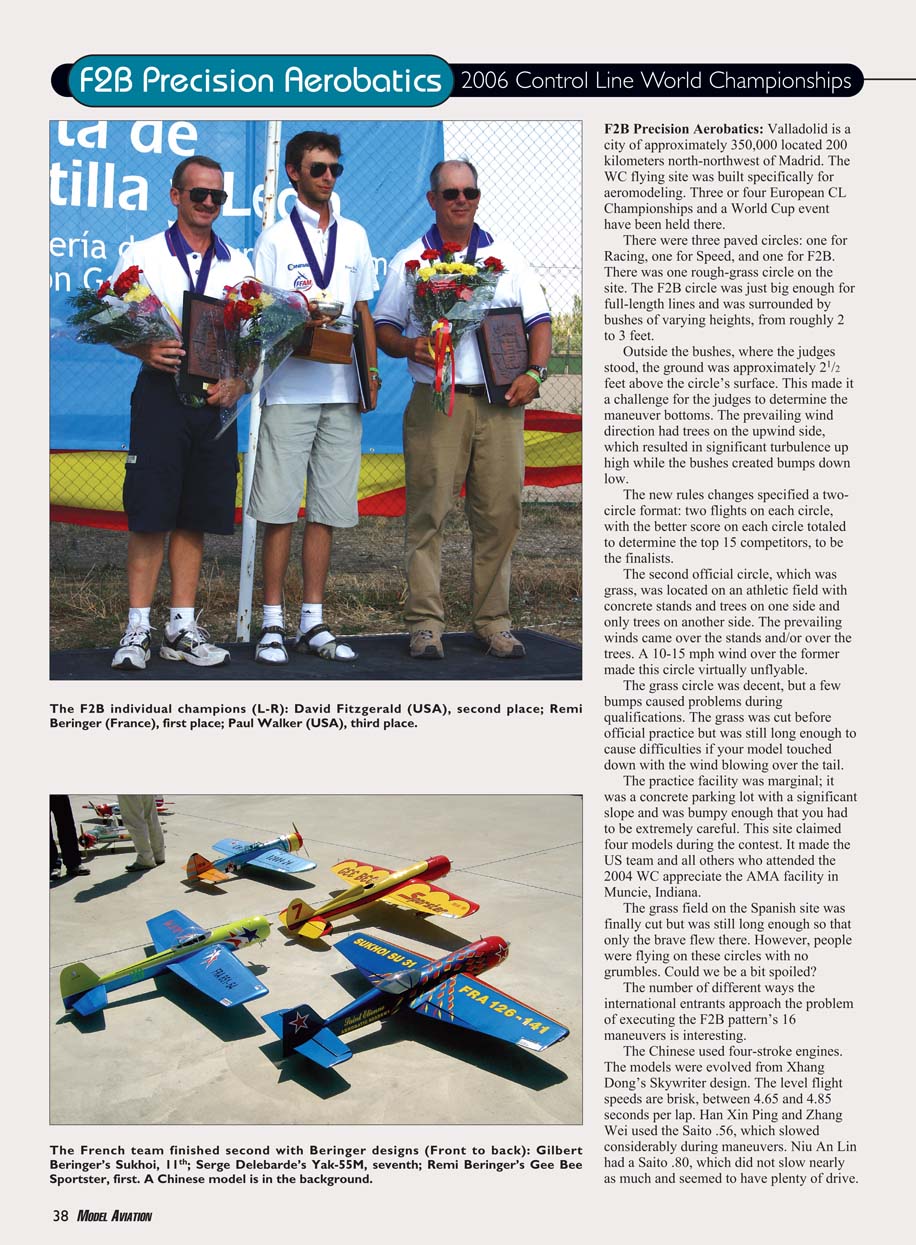
- 1. Remi Beringer (France)
- 2. David Fitzgerald (United States of America)
- 3. Paul Walker (United States of America)
F2B (Precision Aerobatics)—Junior
- 1. Maurizio Milani (Italy)
- 2. Christopher Rud (United States of America)
- 3. Maxim Korsov (Russia)
F2C (Team Race)—Senior
- 1. Surugue/Surugue (France)
- 2. Bondarenko/Lerner (Ukraine)
- 3. Kramarenko/Chayka (Ukraine)
F2D (Combat)—Senior
- 1. Igor Trifonov (Russia)
- 2. Artem Markov (Russia)
- 3. Ivan Mackenzie (Canada)
F2D (Combat)—Junior
- 1. Artem Markov (Russia)
- 2. Jussi Forss (Finland)
- 3. Pavlo Sadomov (Ukraine)
Visit www.safa-grial.com/wc2006/index.html for complete results. MA
Transcribed from original scans by AI. Minor OCR errors may remain.

