
2006 International Extreme Flight Championships
BY MICHAEL RAMSEY
Near the east-central point in Ohio, just north of the famed Wright brothers' home in Dayton, there's another cherished place in historic aviation circles. Troy, Ohio, is the location of Historic WACO Field, which is close to the original WACO factory where the famous biplanes were designed and built.
During the Golden Age of Aviation the WACO biplane was renowned for its tremendous capabilities. Wright Whirlwind engines were shoehorned into airframes of steel tubing and cloth, revealing to pilots what was to become a pinnacle in civil-aviation history.
In those days a loop and a roll were death-defying stunts. Inverted flight was what breaking the sound barrier was to Major Chuck Yeager: that which couldn't be done. The WACO Taperwing biplane Joseph Mackey flew in 1936 broke the rules (as did the Bell Aircraft X-1). Those new aerodynamic ideas allowed pilots to redefine the limits and encouraged engineers to keep at it and develop new ideas.
Is it ironic that Historic WACO Field is the site of the International Extreme Flight Championships (XFC)? Not at all; the event pays tribute to those Golden Age aviators who challenged perception—only in this case it is done with remote-controlled models, and instead of industry we're expanding a pastime.
The XFC is unique in that it's like an aerobatics contest, but it's not. It's mainly a freestyle contest, but it's not. It's a Giant Scale event, but it includes helicopters. Combining all of its characteristics, this competition is designed to be a spectator thrill ride—something the rank beginners can drop their jaws at while being something even more to the pilot who appreciates precision aerobatics as opposed to stick whacking and sheer luck.
This was the fifth year for the event, and it was held the weekend of June 16–18, 2006. The XFC is currently led by an able committee that includes Wendell Atkins, Bill Cline, and Frank Noll Jr. As an invitational, the finest pilots in the world are encouraged to participate for cash prizes and respected places in the history of RC.
To attract spectators from across the region, the contest is freestyle only. It's a challenge to the pilots that pushes them, as no other event does, to fly harder and define the next limit in RC freestyle flying.
Flying to the Extreme
Yeah, gravity-defying, low-level aerobatics is fun to watch, but as a contestant it requires an incredible amount of energy. To stay focused even for one four-minute routine takes a tremendous amount of stamina.
However, the crowds love it, so the event directors thought it would be great if the show were coordinated to include 40 pilots and 98 performances during the course of a three-day weekend. Having pilots from across the country and a few from abroad, a culmination of diverse aerobatic styles unfolds, breeding the "next level" in freestyle RC performance.
The advancements demonstrated at the XFC include a diverse scope—not just with aircraft, but with helicopters as well. The daily event schedule was shared between the two widely divergent model regimes.
The 20 aircraft pilots and 20 helicopter pilots flew five at a time, switching back and forth between disciplines to maintain the theatrical appeal to the crowd. Whether you were a fixed-wing fan, a rotor-wing fan, or a fan of both, there was good reason to stay seated in the warm sun to watch the show go down and cheer for your favorites.
The pilot's goal is to present a flight routine, choreographed to music, that shows the agility and grace his model is capable of. While aircraft pronounce their presence with the grunt of a gas-powered engine, helicopters show off their unique agility by "barking." The sound they make when their blades quickly change pitch from one extreme to the other is similar to the sound a Harley-Davidson motorcycle makes.
Giant scale aircraft grooving and tumbling through the air is a magnificent sight. The big aerobatic models required for this contest seem to defy gravity despite their remarkable size and weight.
Overall, the flight routines used up a tremendous amount of airspace, but the aircraft is never a speck in the sky. The music selected is typically pop or instrumental (such as movie scores). The performances can be described, in a single word, as "graceful."
Airplanes aren't the only models making strides in freestyle aerobatics. RC helicopters are incredible products of engineering. Not limited to flying "straight ahead," expert helicopter pilots are also comfortable flying inverted, backward, sideways, and crossways, not to mention mixtures of all those conditions.
The music most helicopter pilots performed to was hard rock and rap; those genres did a good job of accompanying the fast "flipping" exercises the models performed. The helicopter pilots typically maintained a speedy flight routine much closer to the field. Their routines were fast-paced and very low to the ground most of the time. In a word, the helicopter performances were "wild."
All airplane and helicopter pilots performed outstanding feats of aerobatic skill. To claim that either is more fun to watch would be erroneous. Besides the physical appearances, they fly so differently and require such a diverse set of skills that there exists a level of appreciation that is different for each aircraft type.
The judging criteria are the same for aircraft and helicopter pilots. The rounds are defined as Known and Unknown four-minute-long programs. A Known program requires that the pilot perform three compulsory maneuvers, in whatever order he or she chooses, within a sequence program of his or her own design. Presenting the three maneuvers timed to music proved to be challenging for many of the pilots. The graceful intent of the compulsory maneuvers typically slowed routines down. The pilots who made it all look seamless reaped the rewards.
Part of the pilot's job is to demonstrate a versatile range of aerobatics. The skill is not just how good a pilot can be at moving the transmitter sticks, but how prepared that person is with the aircraft setup. To fly delicate precision maneuvers and frame-bending stunts in the same flight presented a unique set of challenges.
Pilots typically compete to fly precision or freestyle—not both in the same flight. Radically different setups are required to execute either style well. The panel of judges was charged with deciphering the pilot's skill from sheer daring and reward the performance that dynamically presented the routine with precision.
As the weekend unfolded, each flight presented an aerobatic routine set to popular music, including wish-I-could-do-that, down-on-the-deck stunts. The crowds cheered and engines roared, all for the purpose of pushing the envelope and developing "next-level" modeling for the Sunday flier to try someday.
The preliminary rounds were flown on the first two days of the XFC. Of those 40 pilots (20 aircraft and 20 helicopter), 14 flew in the semifinals on the last day. To qualify for the finals, the better of the pilots' two Unknown scores and the better of their two Known scores are added together.
The final standings are scored by combining the pilots' best Known and Unknown performances flown in the finals and the leftover rounds scored from the preliminaries. It's not unusual to have preliminary scores carry over into the final standings.
This scoring system encourages the pilots to fly more consistently and aggressively from Day One. There's no "sandbagging"; pilots have to make every flight count. Playing hardball like that steps up the quality of the flight routines. Whether you were a spectator on Friday or Sunday, the flying was great.
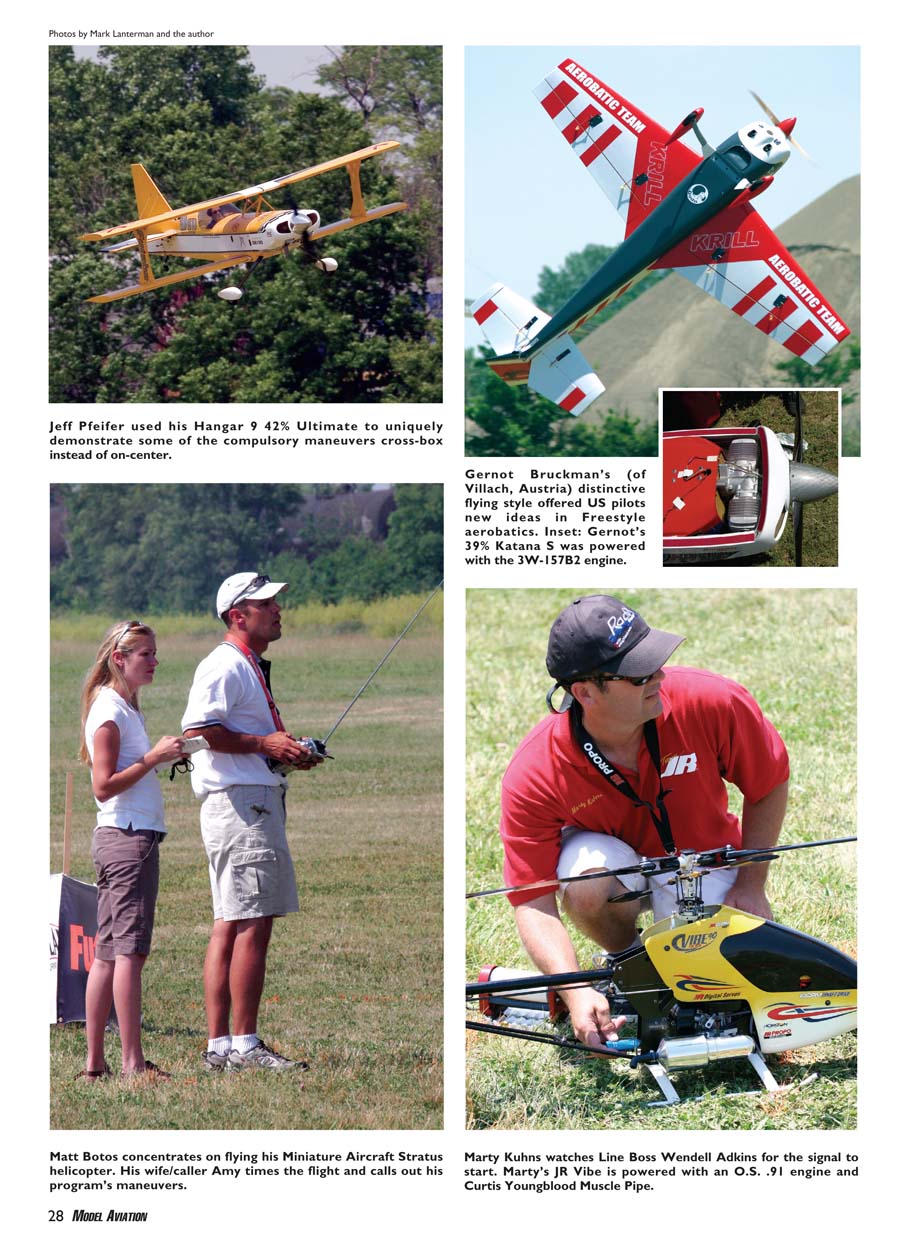
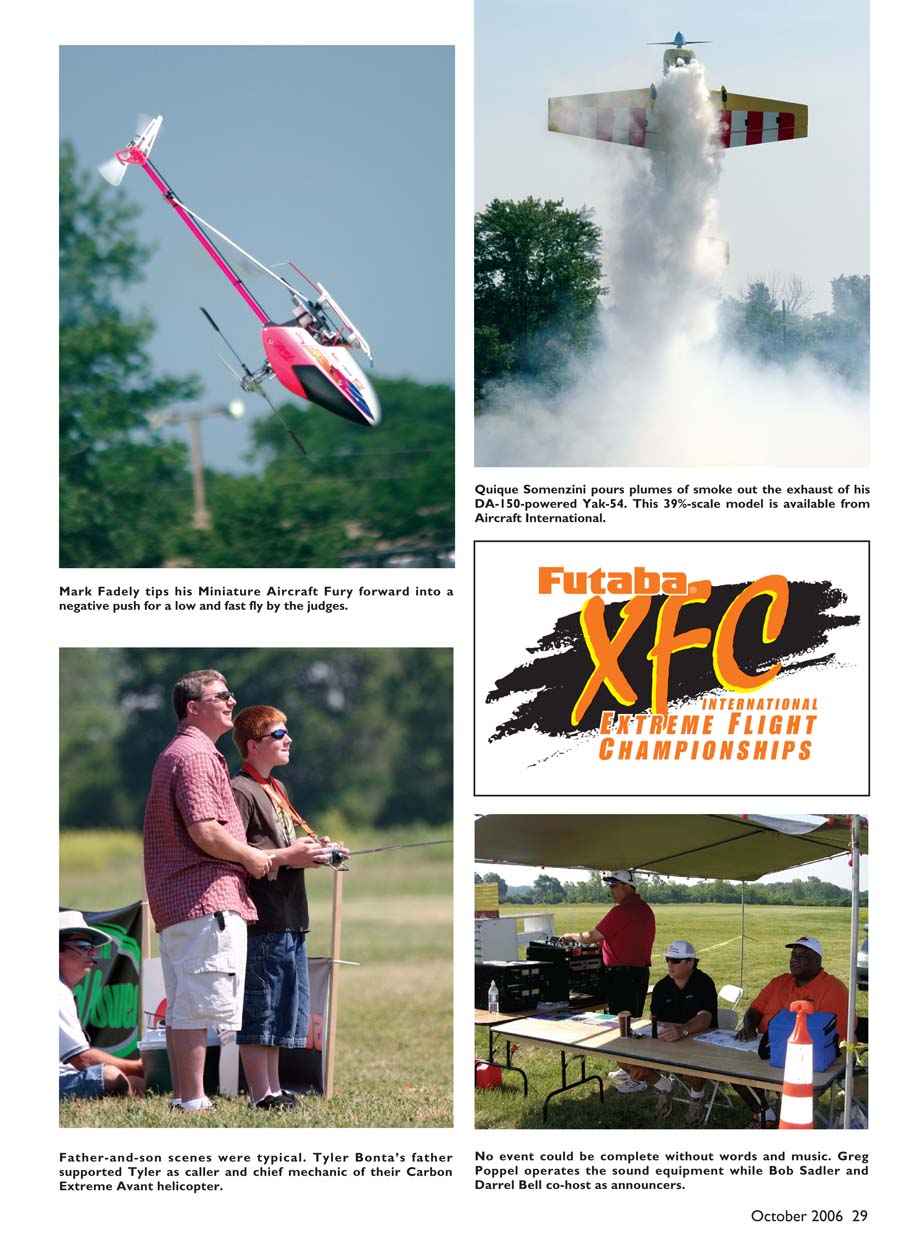
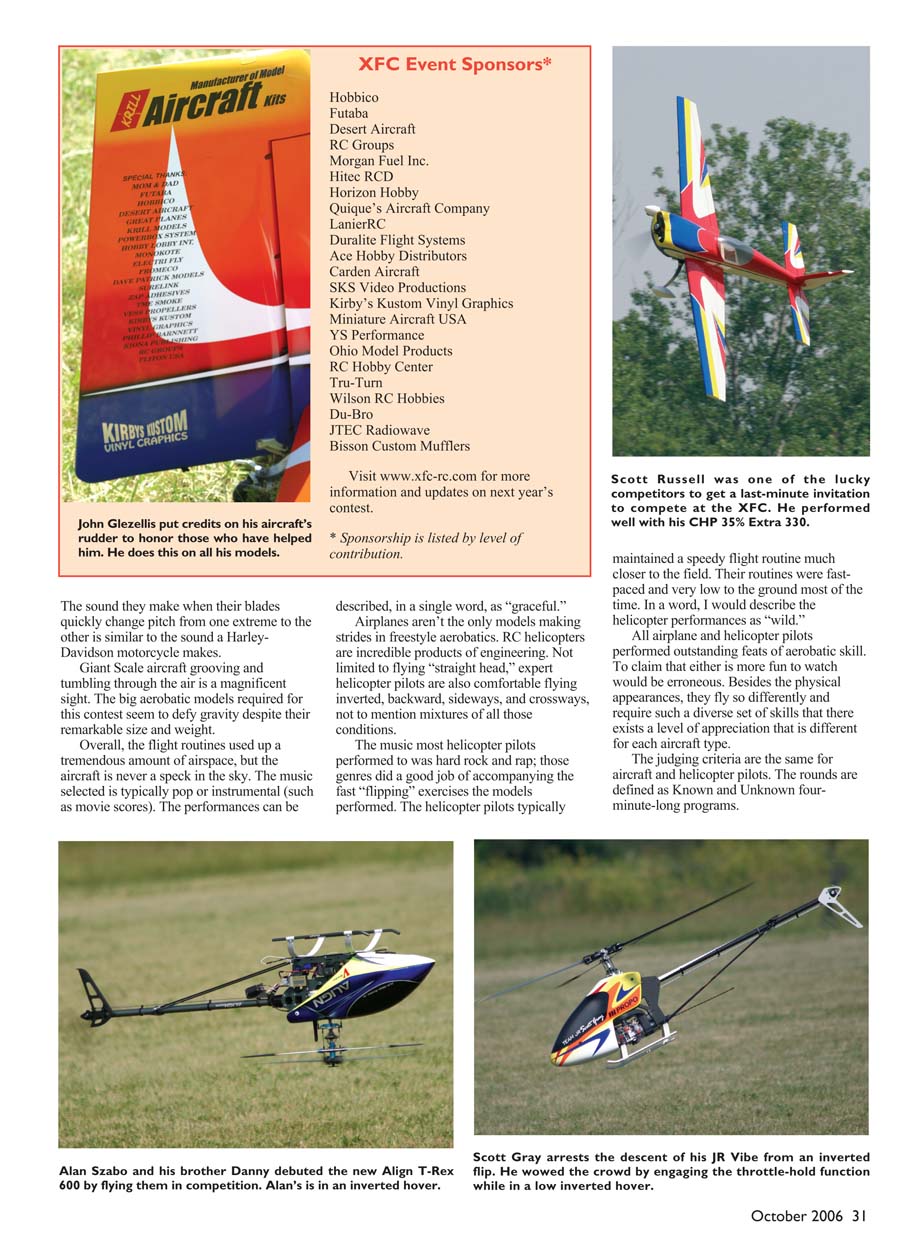
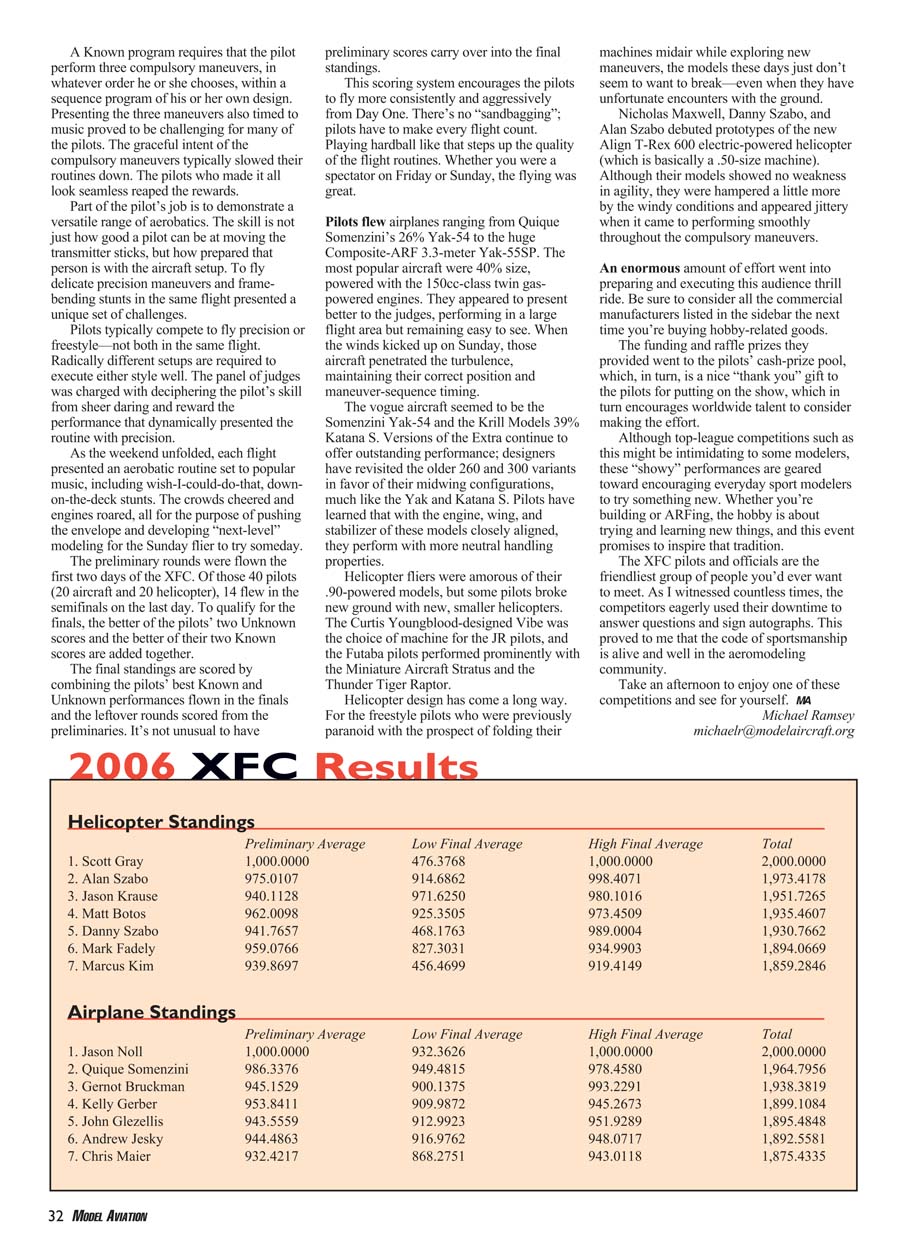
Pilots flew airplanes ranging from Quique Somenzini's 26% Yak-54 to the huge Composite-ARF 3.3-meter Yak-55SP. The most popular aircraft were 40% size, powered with the 150cc-class twin gas-powered engines. They appeared to present better to the judges, performing in a large flight area but remaining easy to see. When the winds kicked up on Sunday, those aircraft penetrated the turbulence, maintaining their correct position and maneuver-sequence timing.
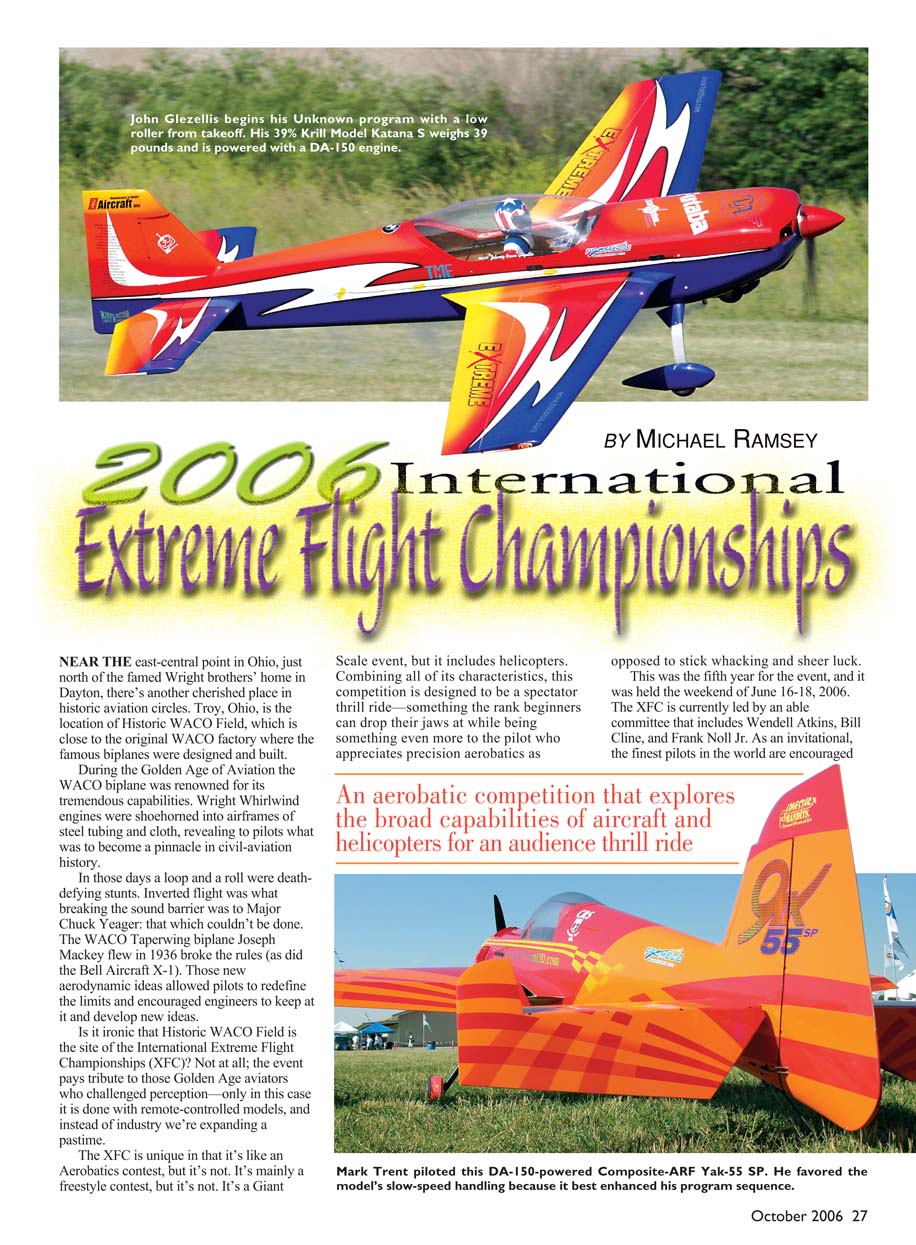
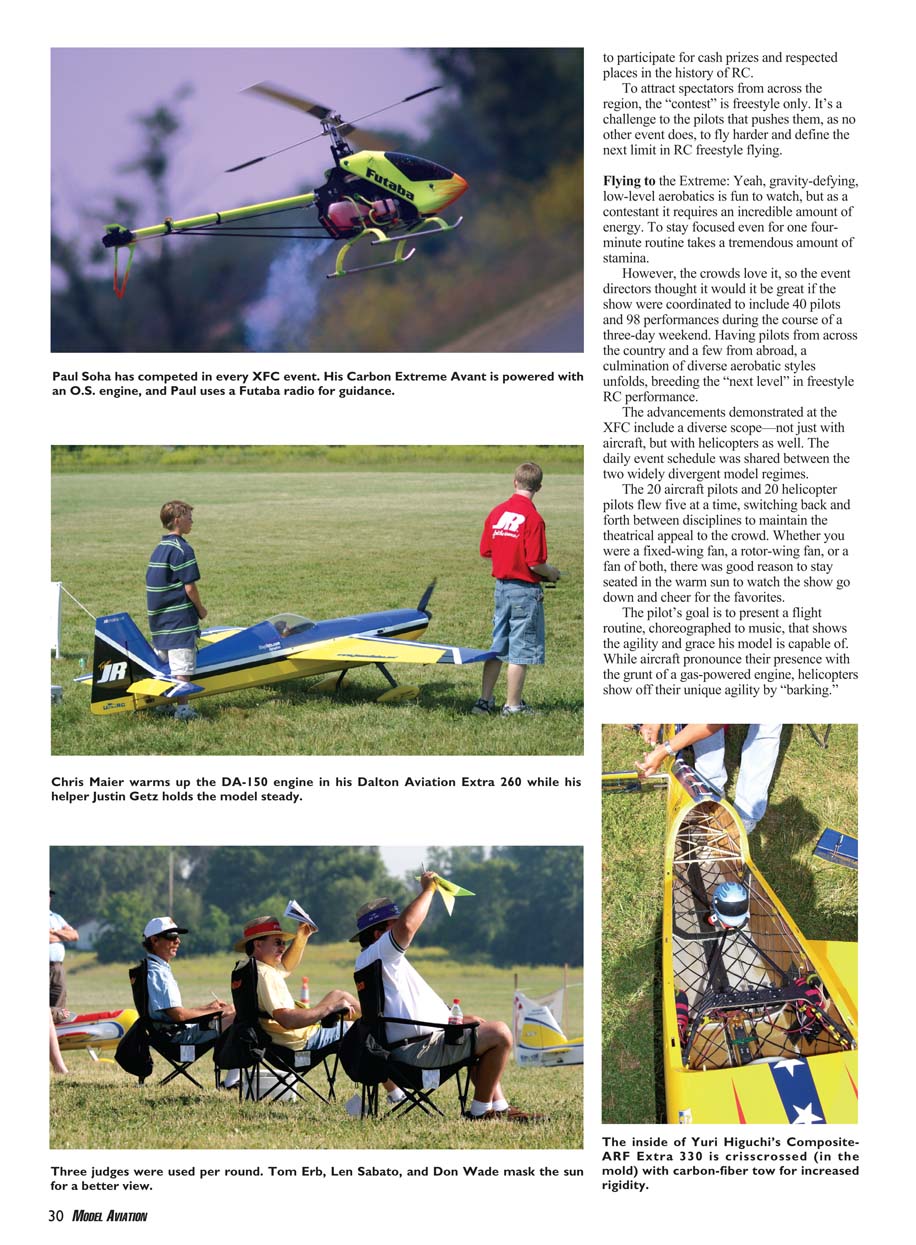
The vogue aircraft seemed to be the Somenzini Yak-54 and the Krill Models 39% Katana S. Versions of the Extra continue to offer outstanding performance; designers have revisited the older 260 and 300 variants in favor of their midwing configurations, much like the Yak and Katana S. Pilots have learned that with the engine, wing, and stabilizer of these models closely aligned, they perform with more neutral handling properties.
Helicopter fliers favored their .90-powered models, but some pilots broke new ground with new, smaller helicopters. The Curtis Youngblood-designed Vibe was the choice of machine for the JR pilots, and the Futaba pilots performed prominently with the Miniature Aircraft Stratus and the Thunder Tiger Raptor.
Helicopter design has come a long way. For the freestyle pilots who were previously paranoid with the prospect of folding their machines midair while exploring new maneuvers, the models these days just don't seem to want to break—even when they have unfortunate encounters with the ground.
Nicholas Maxwell, Danny Szabo, and Alan Szabo debuted prototypes of the new Align T-Rex 600 electric-powered helicopter (which is basically a .50-size machine). Although their models showed no weakness in agility, they were hampered a little more by the windy conditions and appeared jittery when it came to performing smoothly throughout the compulsory maneuvers.
An enormous amount of effort went into preparing and executing this audience thrill ride. Be sure to consider all the commercial manufacturers listed in the sidebar the next time you're buying hobby-related goods.
The funding and raffle prizes they provided went to the pilots' cash-prize pool, which in turn, is a nice "thank you" gift to the pilots for putting on the show, which in turn encourages worldwide talent to consider making the effort.
Although top-league competitions such as this might be intimidating to some modelers, these "showy" performances are geared toward encouraging everyday sport modelers to try something new. Whether you're building or ARFing, the hobby is about trying and learning new things, and this event promises to inspire that tradition.
The XFC pilots and officials are the friendliest group of people you'd ever want to meet. As I witnessed countless times, the competitors eagerly used their downtime to answer questions and sign autographs. This proved to me that the code of sportsmanship is alive and well in the aeromodeling community.
Take an afternoon to enjoy one of these competitions and see for yourself.
Michael Ramsey [email protected]
2006 XFC Results
Helicopter Standings
- Scott Gray — Preliminary Average: 1,000.0000; Low Final Average: 476.3768; High Final Average: 1,000.0000; Total: 2,000.0000
- Alan Szabo — Preliminary Average: 975.0107; Low Final Average: 914.6862; High Final Average: 998.4071; Total: 1,973.4178
- Jason Krause — Preliminary Average: 940.1128; Low Final Average: 971.6250; High Final Average: 980.1016; Total: 1,951.7265
- Matt Botos — Preliminary Average: 962.0098; Low Final Average: 925.3505; High Final Average: 973.4509; Total: 1,935.4607
- Danny Szabo — Preliminary Average: 941.7657; Low Final Average: 468.1763; High Final Average: 989.0004; Total: 1,930.7661
- Mark Fadely — Preliminary Average: 959.0766; Low Final Average: 827.3031; High Final Average: 934.9903; Total: 1,894.0669
- Marcus Kim — Preliminary Average: 939.8697; Low Final Average: 456.4699; High Final Average: 919.4149; Total: 1,859.2846
Airplane Standings
- Jason Noll — Preliminary Average: 1,000.0000; Low Final Average: 932.3626; High Final Average: 1,000.0000; Total: 2,000.0000
- Quique Somenzini — Preliminary Average: 986.3376; Low Final Average: 949.4815; High Final Average: 978.4580; Total: 1,964.7956
- Gernot Bruckman — Preliminary Average: 945.1529; Low Final Average: 900.1375; High Final Average: 993.2291; Total: 1,938.3819
- Kelly Gerber — Preliminary Average: 953.8411; Low Final Average: 909.9872; High Final Average: 945.2673; Total: 1,899.1084
- John Glezellis — Preliminary Average: 943.5559; Low Final Average: 912.9923; High Final Average: 951.9289; Total: 1,895.4848
- Andrew Jesky — Preliminary Average: 944.4863; Low Final Average: 916.9762; High Final Average: 948.0717; Total: 1,892.5581
- Chris Maier — Preliminary Average: 932.4217; Low Final Average: 868.2751; High Final Average: 943.0118; Total: 1,875.4335
Transcribed from original scans by AI. Minor OCR errors may remain.

