
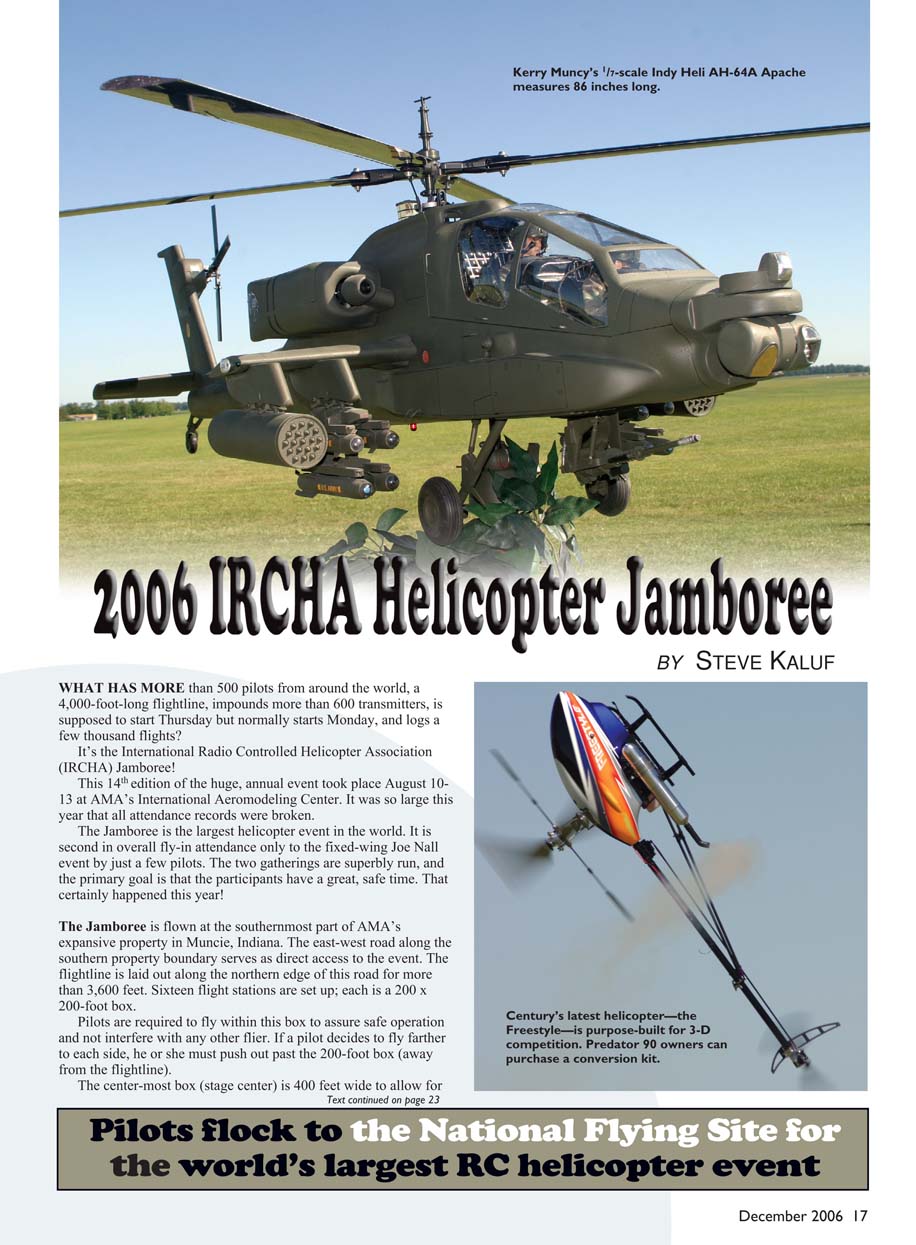
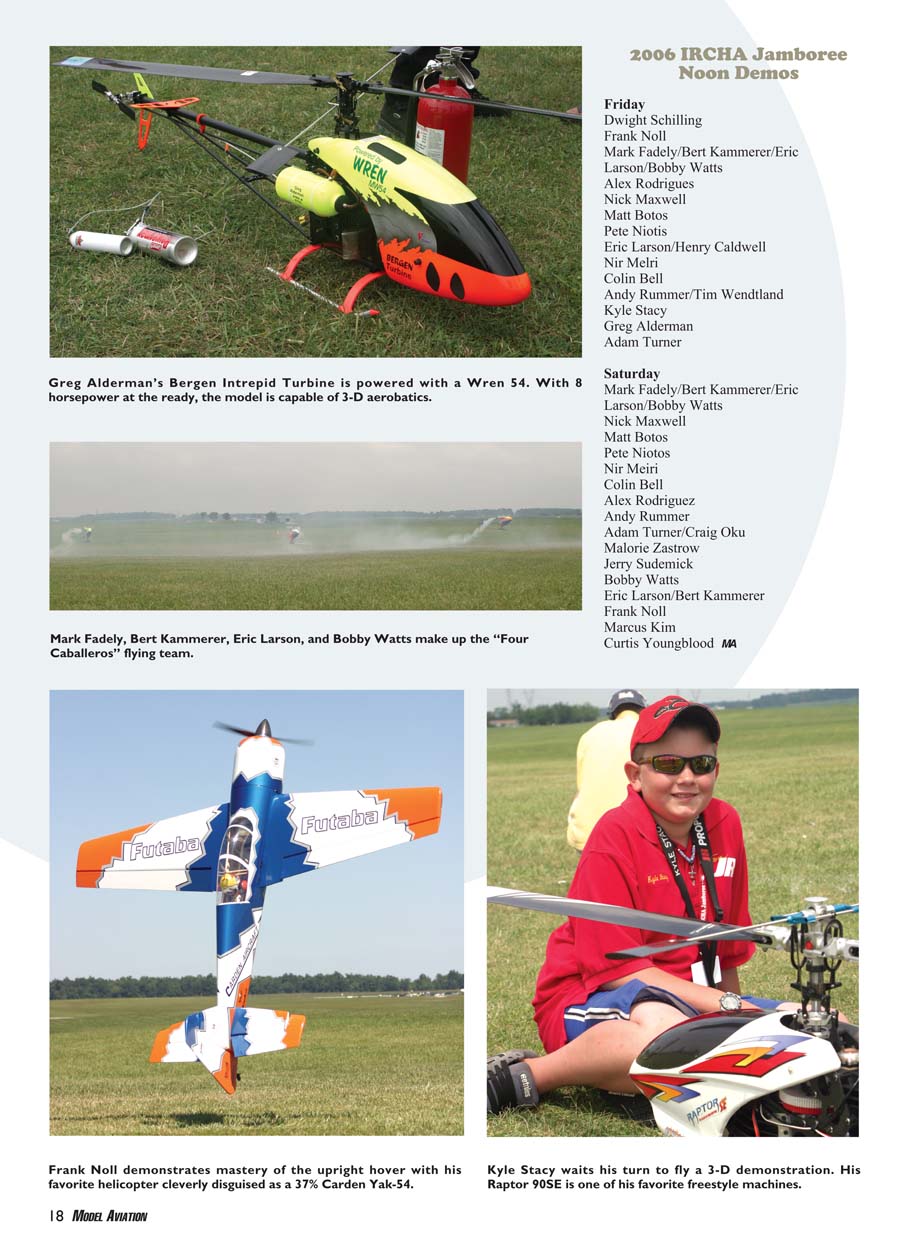
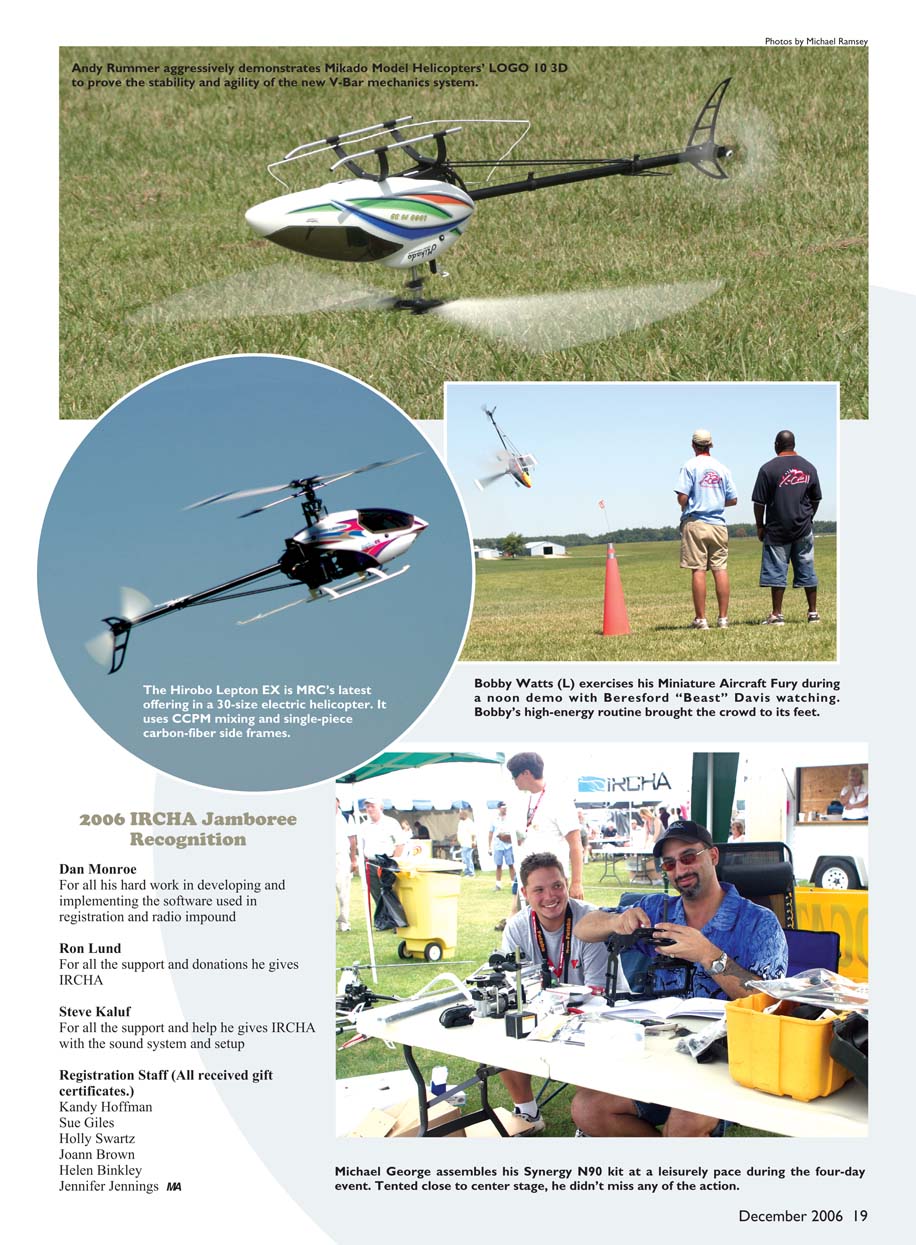
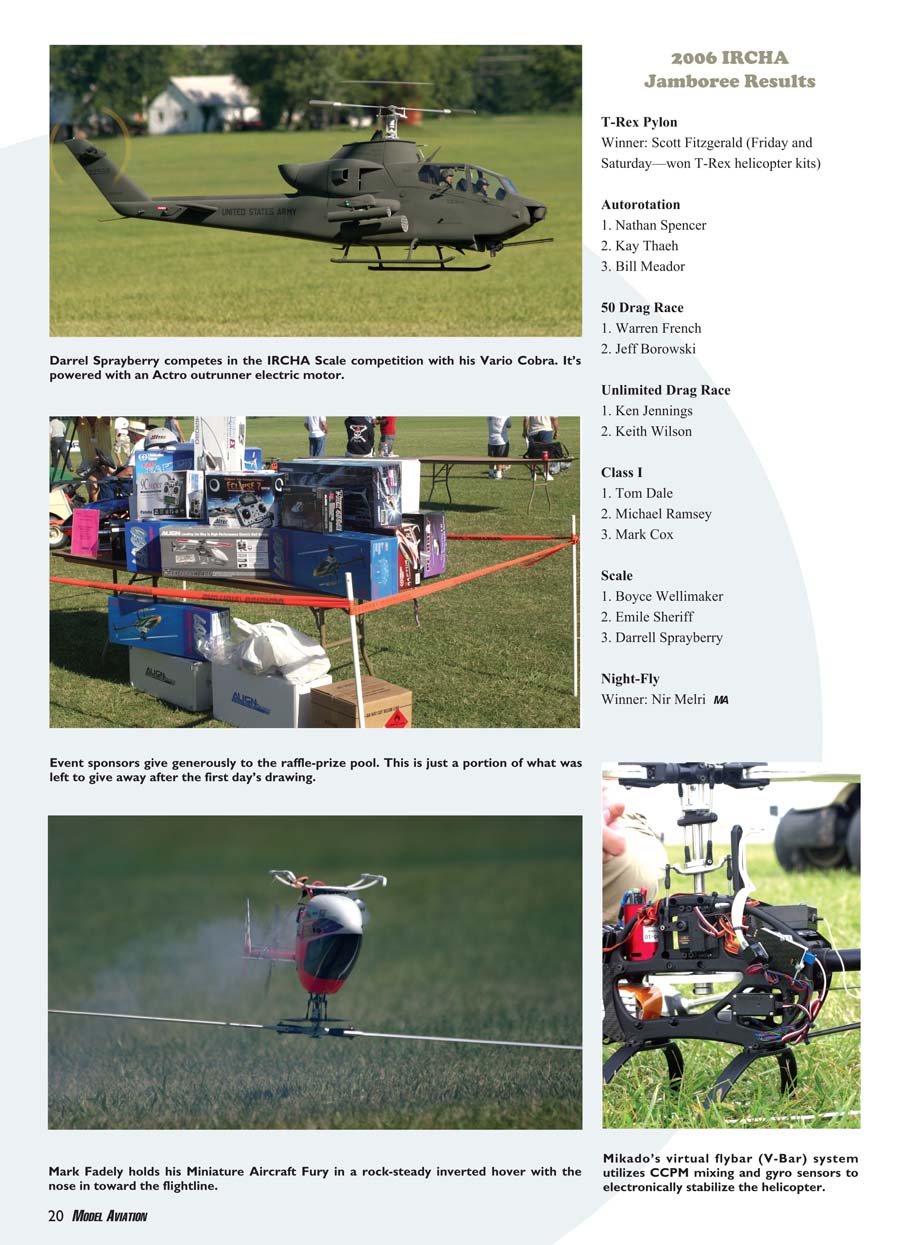
2006 IRCHA Helicopter Jamboree
By Steve Kaluf
WHAT HAS more than 500 pilots from around the world, a 4,000-foot-long flightline, impounds more than 600 transmitters, is supposed to start Thursday but normally starts Monday, and logs a few thousand flights? It's the International Radio Controlled Helicopter Association (IRCHA) Jamboree!
This 14th edition of the huge annual event took place August 10–13 at AMA's International Aeromodeling Center. It was so large this year that all attendance records were broken.
The Jamboree is the largest helicopter event in the world. It is second in overall fly-in attendance only to the fixed-wing Joe Nall event by just a few pilots. The two gatherings are superbly run, and the primary goal is that the participants have a great, safe time. That certainly happened this year!
Event Overview
The Jamboree is flown at the southernmost part of AMA's expansive property in Muncie, Indiana. The east–west road along the southern property boundary serves as direct access to the event. The flightline is laid out along the northern edge of this road for more than 3,600 feet. Sixteen flight stations are set up; each is a 200 x 200-foot box.
Pilots are required to fly within this box to assure safe operation and not interfere with any other flier. If a pilot decides to fly farther to each side, he or she must push out past the 200-foot box (away from the flightline). The center-most box (stage center) is 400 feet wide to allow for factory demonstrations and other organized activities and is typically closed to normal flying.
Along the majority of the access road, pilots can park their vehicles and/or trailers directly behind their pit areas. Latecomers may have to park a bit farther away, but it's never a very far walk from your vehicle to your pit area.
A 20-foot-wide walkway is maintained so that spectators can walk directly behind each pit and have a clear view of the machines and ask questions. Even though the pilots line their tents end to end, there is a temporary fence directly behind the pits to keep spectators from walking out onto the flightline.
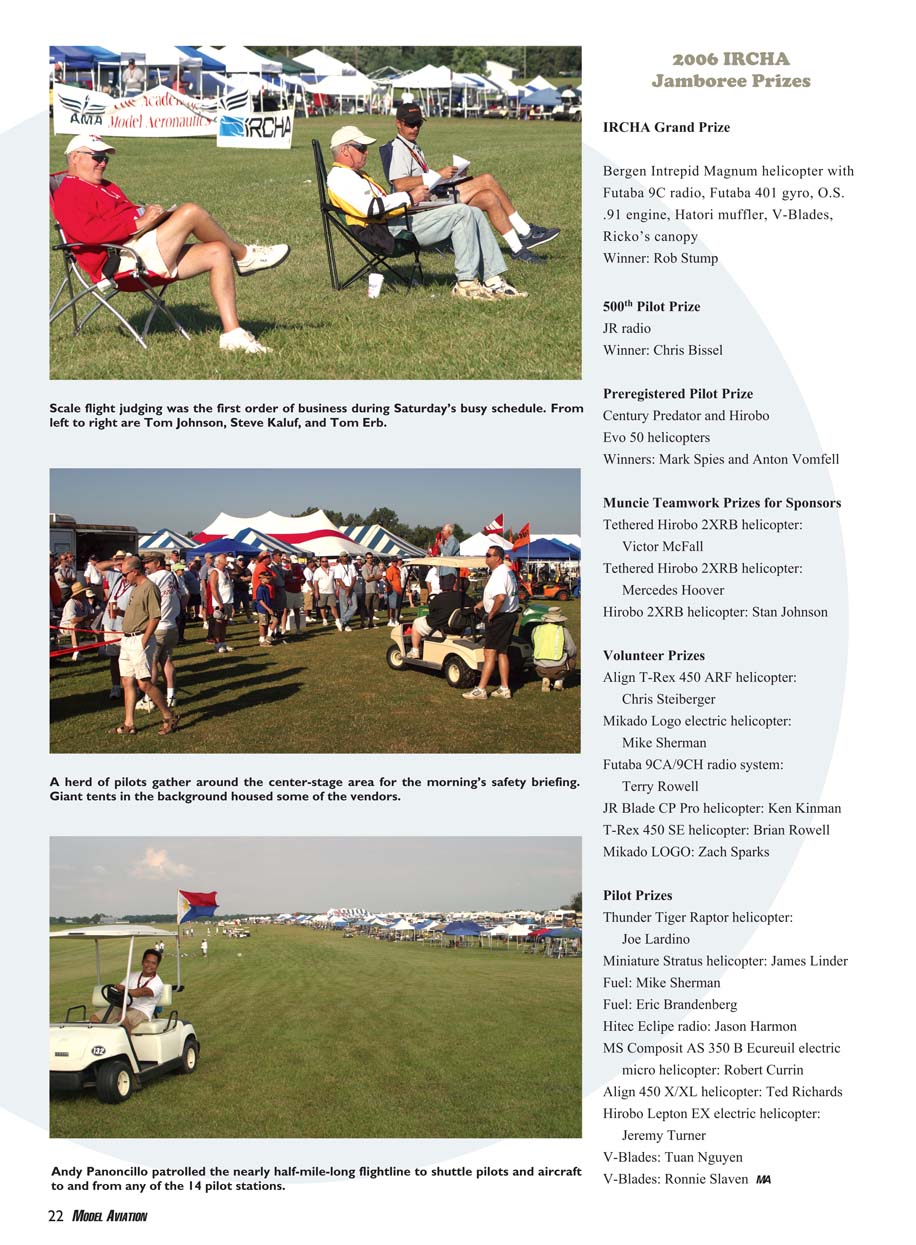
A huge area centrally located behind the flightline contains the main vendor section, transmitter-impound trailer, registration trailer, audio/music trailer, two food vendors, and seminar tents. This area is a hotbed of activity every day and late into the night. Almost everyone calls it the "midway," and it has much of the same atmosphere.
This is the place to introduce new helicopter equipment. Forty vendors displayed their wares this year, and everyone from major radio manufacturers to local hobby shops attended. Another great aspect of having so many vendors around is that if you break or need any part or piece, you can probably obtain it somewhere along vendor row.
A large public-address (PA) system and enthusiastic announcers kept things moving throughout the day. It was a treat to have Greg Poppel and Darrel Bell (Big D) return to fill that role. Bob Sadler, who is more well known within the fixed-wing ranks, also provided commentary and seemed to be having fun. IRCHA Secretary Brett Walker and I filled in at times.
Music played continuously to keep the mood light, and the same system provided high-energy music for the noontime demonstrations and night-fly competition. Last year the midday demos were changed so that only manufacturers or invited pilots could fly. This was an excellent decision; it made the demos interesting, professional, and fun. You not only get to see the best fliers put on a show, but you also see some great new products shown for the first time by the manufacturers.
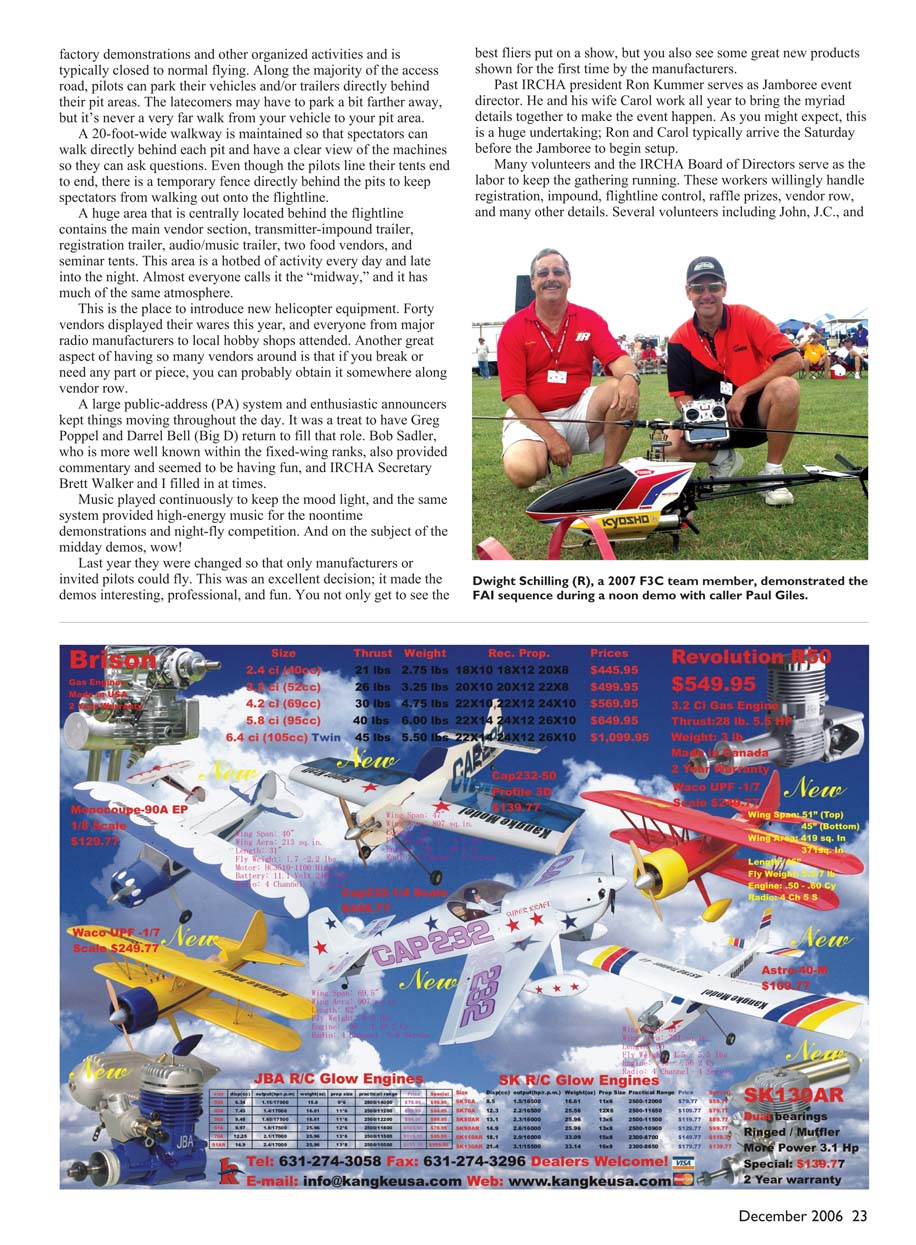
Past IRCHA president Ron Kummer serves as Jamboree event director. He and his wife Carol work all year to bring the myriad details together to make the event happen. As you might expect, this is a huge undertaking; Ron and Carol typically arrive the Saturday before the Jamboree to begin setup.
Many volunteers and the IRCHA Board of Directors serve as the labor to keep the gathering running. These workers willingly handle registration, impound, flightline control, raffle prizes, vendor row, and many other details. James Zankle, Craig Bradley, me, and many others are on-site by Sunday morning to provide the labor to get things up and running as quickly as possible.
The AMA grounds crew sets up the AMA-provided tents, brings in tables, helps run wiring, and does a thousand other things. The rest of the IRCHA Board of Directors is on-site by Monday evening to help finish up the remainder of the details, and the Jamboree is typically in full swing by Tuesday morning. That's not bad for an event that does not officially start until Thursday.
The early arrivals get the choice pit-area locations; flying buddy Craig Bradley and I were set up as soon as we could be. We prefer what I call the "cheap" seats down on the west end. This location gives us the best access to our pit area, which is just past where the vendor line ends.
I'd estimate that by Tuesday night approximately 100 pilots were flying at the site. Thursday morning the flightline extended quite a distance to the east and west, and by Friday afternoon it was roughly 3,000 feet long, with more than 400 pilots logged in the registry. By Saturday afternoon the Jamboree exceeded all records, with 503 registered pilots.
Registration, Impound, and Sound
The registration trailer—found at stage center—is the first stop any pilot makes. Preregistered fliers enjoy expedited check-in, where their name tags and pilots' packages are ready for them as soon as they show up. Others go through a short registration process. Each pilot receives a bag complete with a T-shirt, program for the event, and copious information from various manufacturers. Included are raffle tickets and a ticket to Saturday night's cookout. Pilots are also issued a plastic name tag, which authorizes them to be on the flying side of the flightline.
The registration trailer's computer is networked to the impound trailer, and all run Dan Monroe's CD Pro software. The custom program collects each pilot's registration information, making it immediately available at the 32-foot impound trailer filled with hundreds of transmitters and transmitter modules.
Two computers running CD Pro manage the impound operation, which is staffed with three people most of the time. A person sits under a tent just outside the trailer; this is the "In" area and the first stop any pilot makes when checking in his/her radio gear.
Each transmitter or module is assigned a number, based on the pilot's number, and is stored in the trailer organized by those numbers. Two other people run the inside operation.
To check out a transmitter, the pilot reports to the "Out" window of the trailer and tells the volunteers what channel he/she would like to fly on. A quick glance at the CD Pro data screen tells the staff if the channel is available. If it is not, it indicates who is flying on it and how long it has been checked out.
As each transmitter is checked out, the pilot is issued a pager. Each channel has a pager assigned to it, so if the pilot has the channel out too long (more than 25 minutes) the impound staff pages him or her to return. When the pilot returns his or her radio to the impound, it goes to the "In" side, the pager is returned, and the frequency is punched into the networked computer, freeing up the channel. The cycle continues throughout the event.
Next to the impound trailer is the sound trailer, which is stuffed with high-end equipment. Two high-power amplifiers shoot sound to the four huge speakers that are distributed down the flightline. Multiple professional-grade CD players, tape decks, a 16-channel mix board, and wireless microphones combine to drive announcements and music up and down the near-half-mile flightline and provide the concert-level music for the demos and night-fly competition.
Continuing down the midway is the seminar tent. Friday and Saturday it hosted back-to-back presentations made by manufacturers and other experts. Everything from engine setup to 3-D flying was covered. Next to the seminar tent were two huge vendor tents which were able to hold as many as 24 10-foot booths. Past these tents (in each direction) were food vendors and more hobby-related retailers. The hobby booths extended roughly 800 feet in each direction down the flightline.
Vendors and New Products
New products were plentiful at the Jamboree. Mikado Model Helicopters (www.mikado-heli.de/en) showed one of the coolest things there: its new V-Bar, or virtual flybar. This unit allows a helicopter to operate without a flybar but perform as if it actually has one. This device can best be described as a "fly-by-wire" system for models. Mikado demonstrated the V-Bar several times during the week and held an informative seminar about it. This device seems to work exceedingly well. Look for it to be available later this year.
Miniature Aircraft USA (www.miniatureaircraftusa.com) showed its new 50-size machine now called the Razor. It can accommodate glow or electric (600 class) power and looks nice. The parts count is low and the frame stiffness has to be felt to be believed. The tail rotor is belt driven. The demonstration flight I saw proved that it is worthy of the Miniature Aircraft name.
Align (www.align.com.tw) had its new T-Rex 600 out in force, and several vendors were even selling them (but not for very long). I've been fortunate to see this model fly many times, and it can really perform. It features a CCPM head, carbon frames, and numerous great details that pilots have become accustomed to having with the T-Rex line.
Jason Kruse and Todd Bennett had the new Synergy N9 at the event, and several pilots were putting it to the test. Wow, can it perform! One particular pilot was doing some low-level tic-tocs that impressed me; you could see the precision in the machine's movements.
Perhaps one of the most awaited arrivals (and man, did we wait) was the new Avant Aurora. Everyone knew that Alan Jr. and Danny Szabo were in town, but they had barely been to the flying site. The rumors came back that they were in their hotel room frantically putting the finishing touches on their demo Auroras. The Szabos showed up Saturday afternoon, and Alan Jr. and Danny brought their models. They flew them hard for new helicopters. The models seemed to be rock solid and capable of anything in the air. Both were damaged during flights, but not badly. My hat is off to Alan Jr., Danny, and Alan Sr. for taking the time and going to all the effort to show us this new machine.
V-Blades by Campbell Manufacturing had the typical super line of helicopter blades but also had the new blade set for the T-Rex 450. I was fortunate to get a set before they ran out, and they provide awesome performance. I have roughly 30% greater collective authority on my stock T-Rex SE than I did with the original blades. They are so stiff that I can pick the entire machine up by a blade tip and they do not bend at all!
Past vendor row was pit area after pit area and helicopter after helicopter. Most pilots put their canopies up so they almost touched their neighbors' canopies, which provided almost continuous shade. The only gaps in the canopies were the spaces in the fence to allow walk-throughs.
A pilots' meeting was held daily at roughly 9 a.m. to make sure everyone was up to speed on procedures, including flying with a spotter, only three people at a flight station, and impound guidelines. At each pilots' meeting Ron Kummer tossed out some great prizes; it often pays to attend these.
The transmitter impound is typically operated from approximately 9 a.m. to at least 7 p.m. each day at this event, but flying begins at sunup and ends well after dark. During these "off" times a frequency control board is set up outside the impound trailer. To fly, a pilot inserts his or her AMA membership card into the appropriate channel slot on the board.
At least as many flights are put up after hours as during the times the impound is open. From Thursday through Sunday the impound logged roughly 1,500 flights. That does not include those with mini/micro helicopters using spread-spectrum systems or any of the after-hours flights. Double that 1,500 figure and you might have a realistic number of flights made at the Jamboree.
IRCHA treats all registered pilots to dinner Saturday night. This is always a great time and approximately 500 people typically stick around to be fed. An IRCHA membership meeting is held after dinner, and then the prize-giving begins!
The recipients include the winners of the various contests that take place during the Jamboree. Scale, drag racing, Class I, Autorotation, and T-Rex pylon racing winners were recognized. The night-fly winners were given their awards later, at the conclusion of that night's competition.
The huge amount of raffle prizes is distributed to the lucky winners at this time. One of the included pictures shows the table with some of the raffle prizes on it, not even including the grand-prize RTF. It's incredible. The contest winners are listed in one of the sidebars.
This year's level of flying was amazing. I've been attending the Jamboree since 1996, and this year everyone seemed to kick it up a notch. Some of this (if not much of it) is certainly owing to the new machines and electronics that are now available to the helicopter pilot. However, it's also clear that these men and women can flat-out fly!
3-D flying is the norm at this event, but you'll see everything from pilots who are just learning to hover to the best FAI or 3-D flier. The noontime demos were hard to believe; they rocked. Many of the pictures will give you a sense of what took place during the demonstrations.
What makes this group unique is that if someone learning how to hover needs help, he or she may be assisted by Curtis Youngblood, Jason Kruse, or one of the Szabo brothers. This is a close-knit bunch.
If you break a machine and go get a hamburger, you are liable to come back and find it fixed. I ended up needing some servo gears (and a few other parts) for my T-Rex. (No, I did not crash it; someone else did.) The vendors did not stock the gears I needed, but a quick ride down the flightline netted me those parts. Thank you, Ray Stacy.
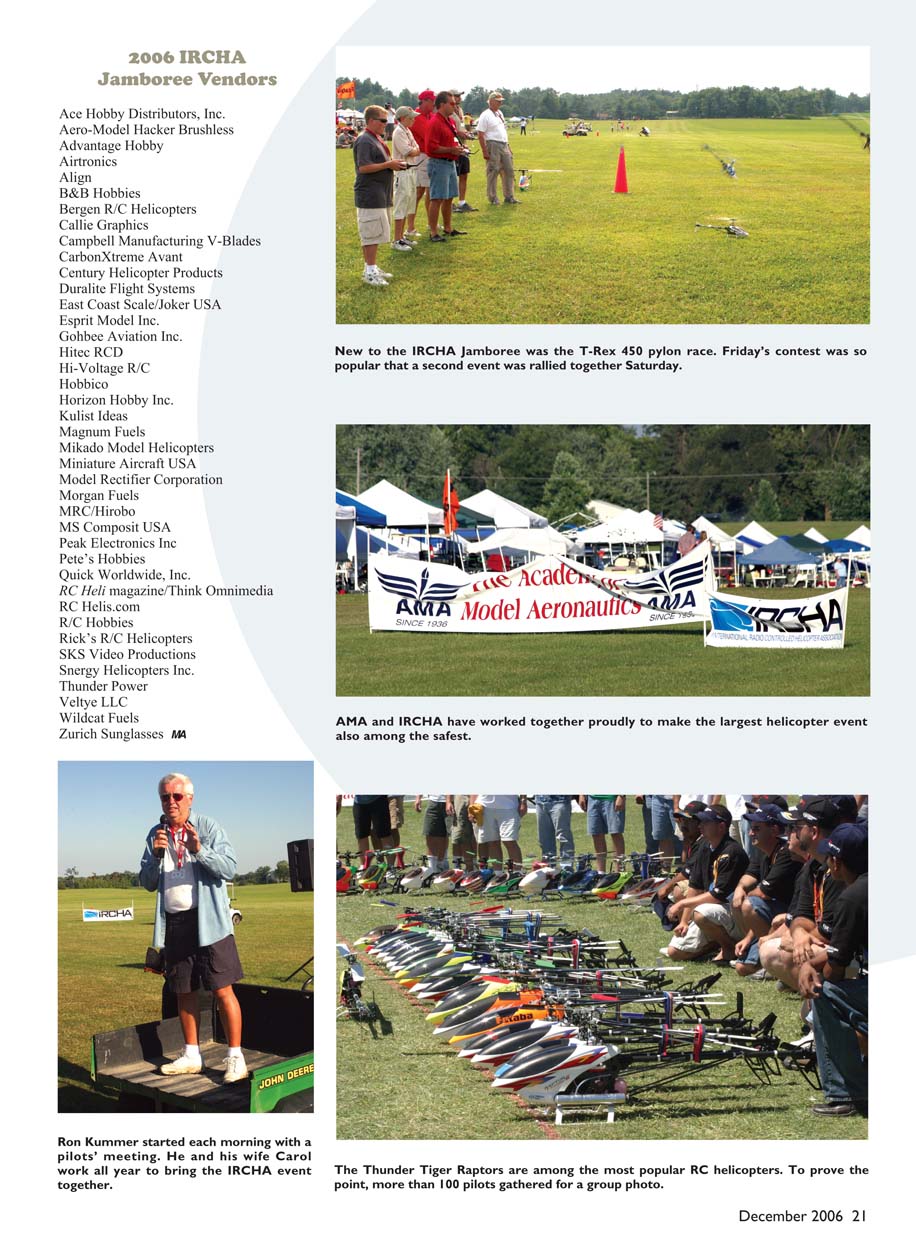
As I mentioned, several contests were held as part of the Jamboree. There were the new T-Rex pylon race pickup event, the traditional autorotation and drag-race contests, and the night-fly. All were great fun to watch (and participate in).
Complete results are listed elsewhere, but I do want to mention that helicopter speed world record-holder Ken Jennings won the Unlimited Drag Race with an electric-powered machine.
I was fortunate to be asked to serve as a judge for Class I and the Scale category, which brought out some beautiful models. The only thing that holds some of the builders back is lack of or inaccurate documentation. Without that vital piece of the puzzle, it's impossible to receive a decent static score.
A few machines suffered mechanical difficulties, making it hard for them to obtain good flight scores. One of the favorites—Tim Dawson (last year's champion)—suffered what appeared to be a radio bump and wiped out the four rotor blades on his Super Puma. Being the competitor he is, "Dr. Tim" worked hard to locate new blades between rounds and get the helicopter back into the air. He was able to get it together, but a vibration (maybe a bent main shaft) limited his second flight to just a liftoff and set-down.
Class I had three competitors; two were new to AMA helicopter competition and one was flying in his second contest (the Nats being his first). All three did a super job, and I hope we will see them at future contests. Class I at the Jamboree is a relaxed event that is designed to give competitors a chance to get their feet wet. The judges provide good feedback to the pilots so they can learn and improve.
IRCHA rents 14 golf carts for its staff and volunteers, and they are used for flightline duty and many other tasks. After all, that flightline is very long. You used to see pilots using bicycles to get up and down the line, then motorized scooters, and now it's golf carts. A few of the more local pilots try to obtain and rent the carts for the pilots to use. I can't imagine how many carts run up and down the flightline. Some pilots even have private, customized carts with built-in sound systems, hot paint jobs, and chrome wheels.
Even with all the great flying there were crashes; in fact, there were many. The good thing is that, owing in large part to the flightline setup, each accident happened well away from people. The mishaps were a result of pilots pushing the limits a bit too far. I'd rather see the flights take place a bit higher and maybe the pilots not push as hard. Every time one crashes I feel like we were robbed of seeing an excellent performance.
I hope you enjoy the pictures of this great event; it is one of the most fun gatherings I've ever had the pleasure of attending. Consider joining us next year at AMA's International Aeromodeling Center during roughly the second weekend in August for the 2007 IRCHA Jamboree!
2006 IRCHA Jamboree Noon Demos
Friday
- Dwight Schilling
- Frank Noll
- Mark Fadely / Bert Kammerer / Eric Larson / Bobby Watts
- Alex Rodriguez
- Nick Maxwell
- Matt Botos
- Pete Niotis
- Eric Larson / Henry Caldwell
- Nir Meiri
- Colin Bell
- Andy Rummer / Tim Wendtland
- Kyle Stacy
- Greg Alderman
- Adam Turner
Saturday
2006 IRCHA Jamboree Recognition
- Dan Monroe — For all his hard work in developing and implementing the software used in registration and radio impound
- Ron Lund — For all the support and donations he gives IRCHA
- Steve Kaluf — For all the support and help he gives IRCHA with the sound system and setup
Registration Staff (All received gift certificates.)
- Kandy Hoffman
- Sue Giles
- Holly Swartz
- Joann Brown
- Helen Binkley
- Jennifer Jennings
2006 IRCHA Jamboree Results
T-Rex Pylon
- Winner: Scott Fitzgerald (Friday and Saturday — won T-Rex helicopter kits)
Autorotation
- Nathan Spencer
- Kay Thach
- Bill Meador
50 Drag Race
- Warren French
- Jeff Borowski
Unlimited Drag Race
- Ken Jennings
- Keith Wilson
Class I
- Tom Dale
- Michael Ramsey
- Mark Cox
Scale
- Boyce Wellmaker
- Emile Sheriff
- Darrell Sprayberry
Night-Fly
- Winner: Nir Meiri
2006 IRCHA Jamboree Vendors
- Ace Hobby Distributors, Inc.
- Aero-Model Hacker Brushless
- Advantage Hobby
- Airtronics
- Align
- B&B Hobbies
- Bergen R/C Helicopters
- Callie Graphics
- Campbell Manufacturing V-Blades
- CarbonXtreme Avant
- Century Helicopter Products
- Duralite Flight Systems
- East Coast Scale / Joker USA
- Esprit Model Inc.
- Gohbee Aviation Inc.
- Hitec RCD
- Hi-Voltage R/C
- Hobbico
- Horizon Hobby Inc.
- Kulist Ideas
- Magnum Fuels
- Mikado Model Helicopters
- Miniature Aircraft USA
- Model Rectifier Corporation
- Morgan Fuels
- MRC / Hirobo
- MS Composites USA
- Peak Electronics Inc.
- Pete's Hobbies
- Quick Worldwide, Inc.
- RC Heli magazine / Think Omnimedia
- RCHelis.com
- R/C Hobbies
- Rick's R/C Helicopters
- SKS Video Productions
- Synergy Helicopters Inc.
- Thunder Power
- Veltye LLC
- Wildcat Fuels
- Zurich Sunglasses
2006 IRCHA Jamboree Prizes
IRCHA Grand Prize
- Bergen Intrepid Magnum helicopter with Futaba 9C radio, Futaba 401 gyro, O.S. .91 engine, Hatori muffler, V-Blades, Rick's canopy
- Winner: Rob Stump
500th Pilot Prize
- JR radio
- Winner: Chris Bissel
Preregistered Pilot Prize
- Century Predator and Hirobo Evo 50 helicopters
- Winners: Mark Spies and Anton Vomfell
Muncie Teamwork Prizes for Sponsors
- Tethered Hirobo 2XRB helicopter: Victor McFall
- Tethered Hirobo 2XRB helicopter: Mercedes Hoover
- Hirobo 2XRB helicopter: Stan Johnson
Volunteer Prizes
- Align T-Rex 450 ARF helicopter: Chris Steiberger
- Mikado Logo electric helicopter: Mike Sherman
- Futaba 9CA/9CH radio system: Terry Rowell
- JR Blade CP Pro helicopter: Ken Kinman
- T-Rex 450 SE helicopter: Brian Rowell
- Mikado LOGO: Zach Sparks
Pilot Prizes
- Thunder Tiger Raptor helicopter: Joe Lardino
- Miniature Stratus helicopter: James Linder
- Fuel: Mike Sherman
- Fuel: Eric Brandenberg
- Hitec Eclipse radio: Jason Harmon
- MS Composites AS 350 B Ecureuil electric micro helicopter: Robert Currin
- Align 450 X/XL helicopter: Ted Richards
- Hirobo Lepton EX electric helicopter: Jeremy Turner
- V-Blades: Tuan Nguyen
- V-Blades: Ronnie Slaven
Steve Kaluf [email protected]
Transcribed from original scans by AI. Minor OCR errors may remain.

