
2006 Power Scale Soaring Festival
By Dave Garwood
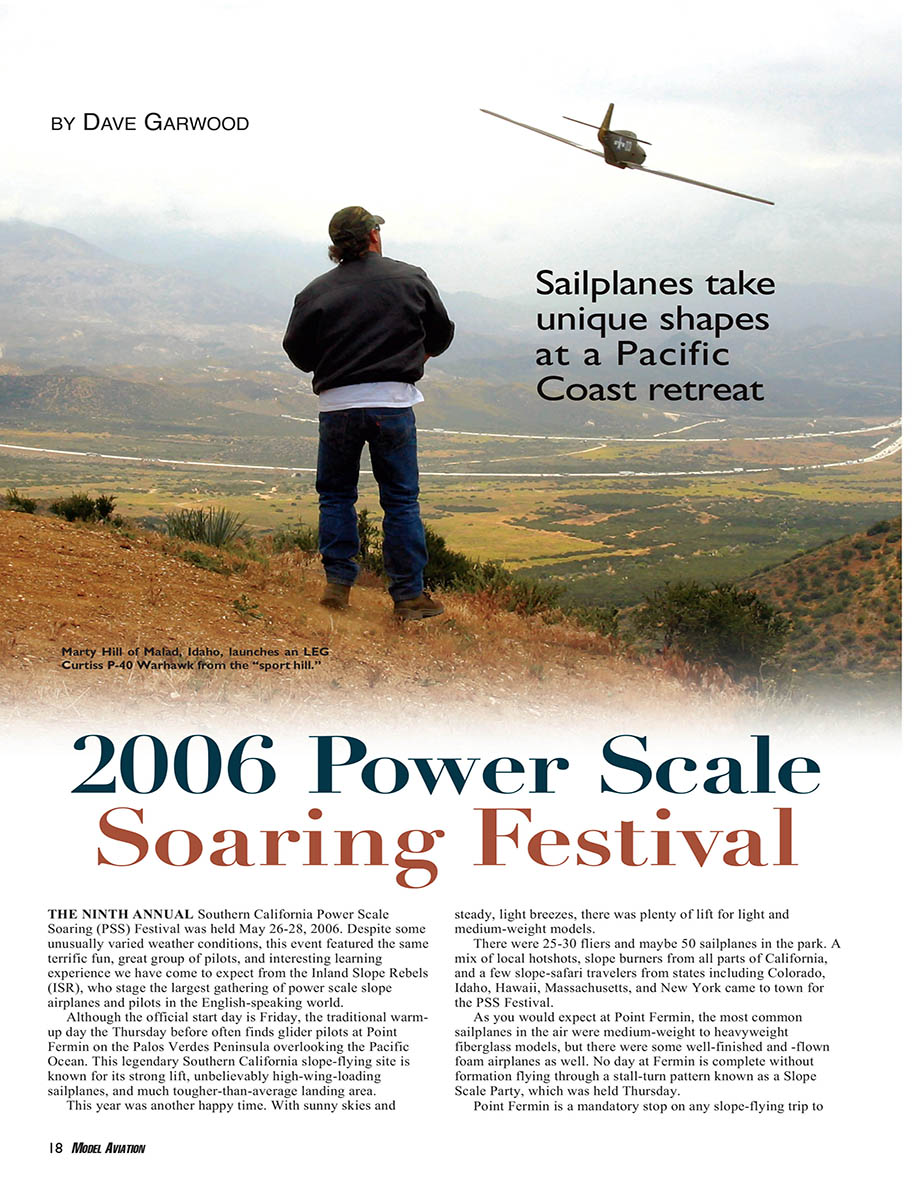
The ninth annual Southern California Power Scale Soaring (PSS) Festival was held May 26–28, 2006. Despite some unusually varied weather conditions, the event featured the same terrific fun, great group of pilots, and interesting learning experiences we expect from the Inland Slope Rebels (ISR), who stage the largest gathering of power scale slope airplanes and pilots in the English‑speaking world.
Thursday — Warm‑up Day (Point Fermin)
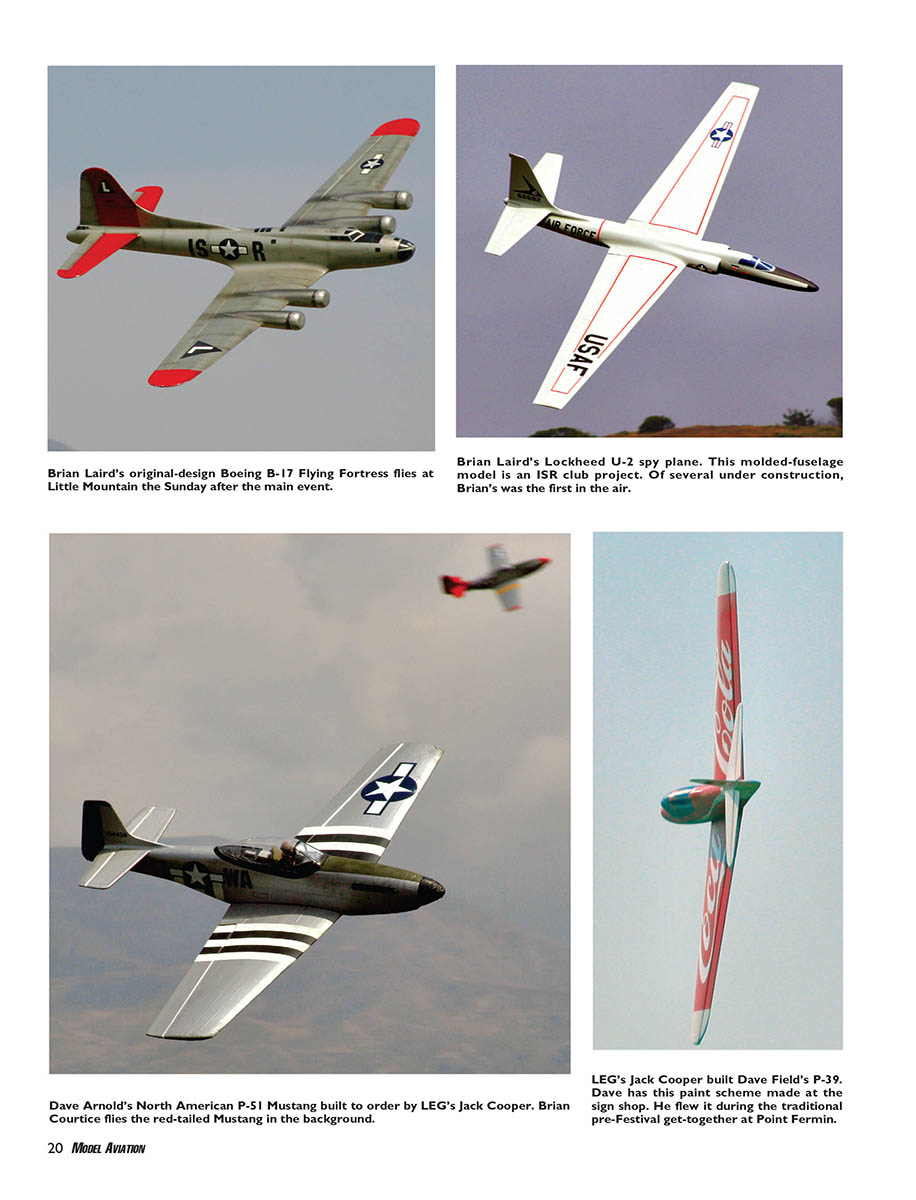
Although the official start day is Friday, the traditional warm‑up day on Thursday often finds glider pilots at Point Fermin on the Palos Verdes Peninsula overlooking the Pacific Ocean. This legendary Southern California slope‑flying site is known for strong lift, unbelievably high‑wing‑loading sailplanes, and a much tougher‑than‑average landing area. This year was another happy time: sunny skies, steady light breezes, and plenty of lift for light and medium‑weight models. About 25–30 fliers and maybe 50 sailplanes filled the park — a mix of local hotshots, slope burners from across California, and slope‑safari travelers from states including Colorado, Idaho, Hawaii, Massachusetts, and New York.
As you would expect at Point Fermin, the most common sailplanes in the air were medium‑weight to heavyweight fiberglass models, but there were also some well‑finished and well‑flown foam airplanes. No day at Fermin is complete without formation flying through a stall‑turn pattern known as a Slope Scale Party, which was held Thursday.
Point Fermin is a mandatory stop on any slope‑flying trip to Southern California. Directions (from the ISR club site at www.inlandsloperebels.com/isrsites.htm):
- Take the 110 freeway south until it ends into Gaffey Street.
- Continue south on Gaffey Street until it ends. You will be facing Point Fermin Park and the Pacific Ocean.
- Turn right; about 100 yards away on your left is the grassy cliff area. Park along the road and set up here.
Notes: This is a very fast, very smooth vertical flying slope. It faces west to southwest.
Friday — Official Practice Day (Cajon Summit)
Friday is the official practice day. We arrived at the Cajon Summit flying site to find the ridge in fog. Cajon Summit is a mile‑long ridge in the San Bernardino National Forest, roughly 40 miles inland from Los Angeles. After a morning of hangar flying the fog cleared and we had fine lift for the afternoon. Most pilots flew until approximately 6 p.m. Several pilots rated to fly for the camera put sailplanes up, and we produced several of the photos used to illustrate this article.
Saturday — Main Event Day
Saturday was characterized by strange and changeable winds. At about 9 a.m. the fog had lifted and the ceiling was high enough to fly, but the wind had not come up yet. Later in the morning, light sailplanes could stay up. The wind gradually increased to supply lift so that most models could fly, but the lift came and went — sometimes strong, sometimes waning. Midafternoon the wind died completely, then turned around and started blowing from our backs toward the valley below. A high‑pressure system in the high desert behind the ridge blocked the normal pattern of afternoon sea breezes and stole our lift.
The fact that lift can drop out any day is the main reason to arrive early at a big slope event and plan to stay a day or two afterward — to allow weather patterns to pass through and still have opportunities to fly with new and old friends. It also provides chances to fly for the camera on warm‑up or practice days and increase the odds of getting that in‑flight money shot of your sailplane. The main event day can be hectic, with two or more worthy models flying at once from different launch points; when this happens we sometimes miss excellent photo opportunities.
Despite the fickle winds, many impressive PSS flights took place Saturday, including:
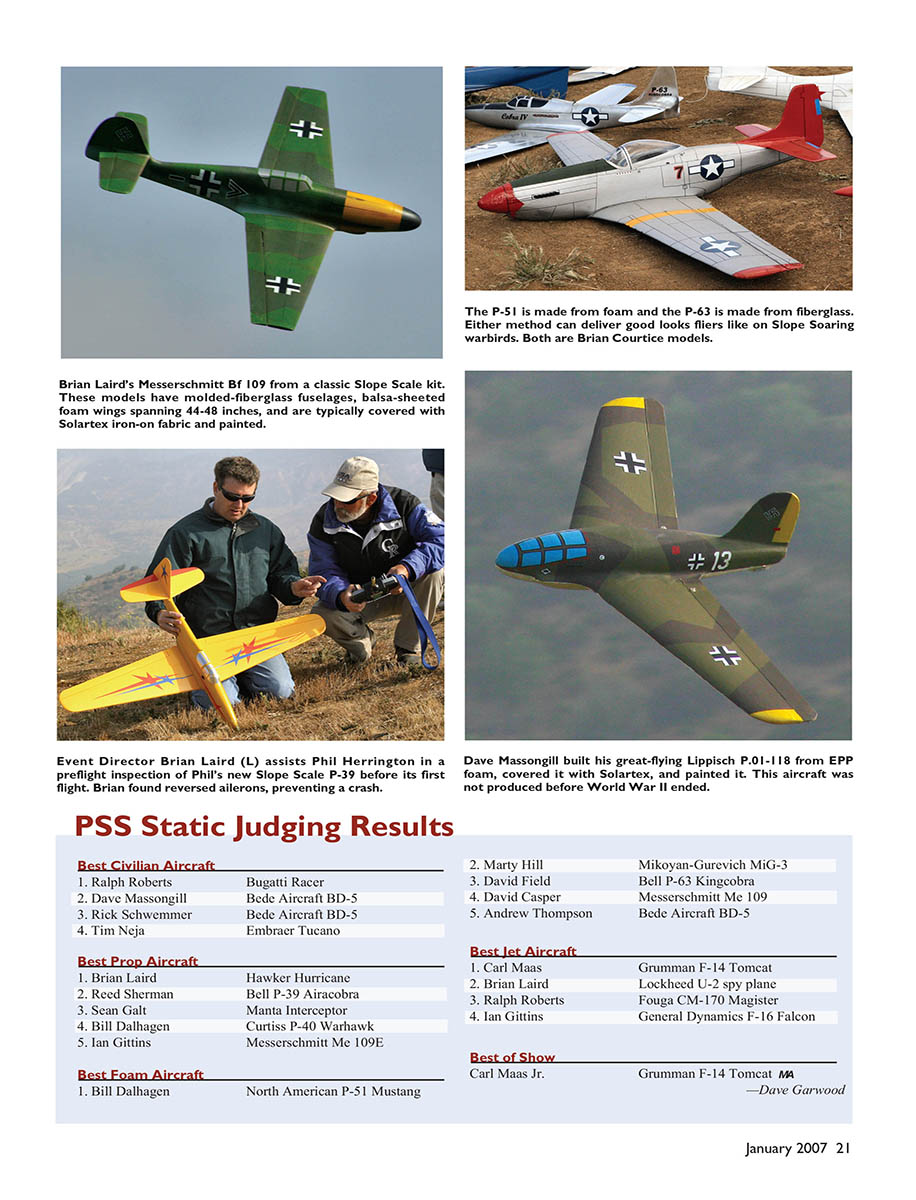
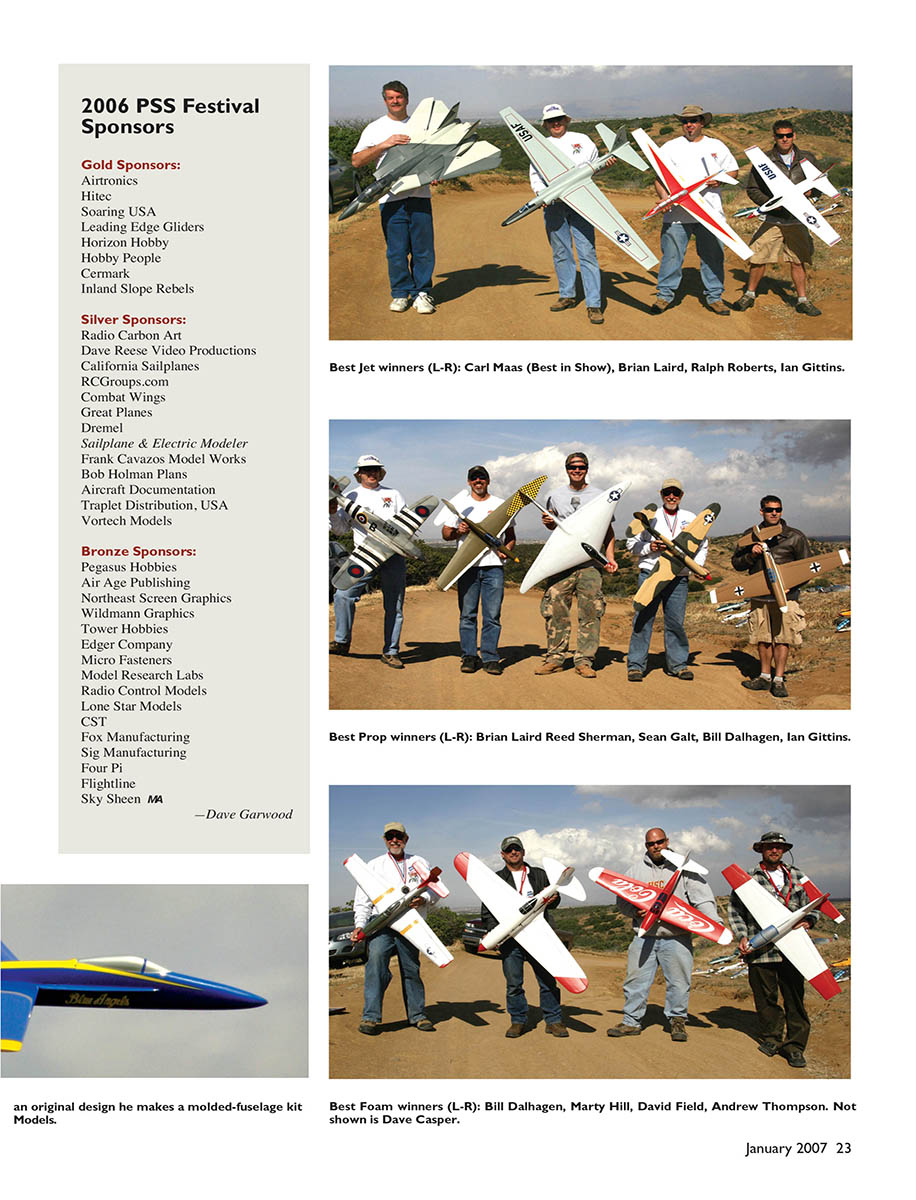
- The maiden flight of Brian Laird's Lockheed U‑2 Dragon Lady high‑altitude spy plane from the Cold War era. This ISR club project had been discussed many times and finally came to fruition. Several members began U‑2 builds, but Brian's was the only one finished and ready to fly at the Festival.
- Carl Maas showed a highly impressive F‑14 Tomcat (surprising for molding‑man Carlski), built from balsa sticks and sheets. It featured a swing‑wing mechanism and was immaculately finished in an experimental optical camouflage scheme. The craftsmanship earned him the Best of Show award. Unfortunately, winds were not steady enough Saturday or Sunday to see this sailplane fly.
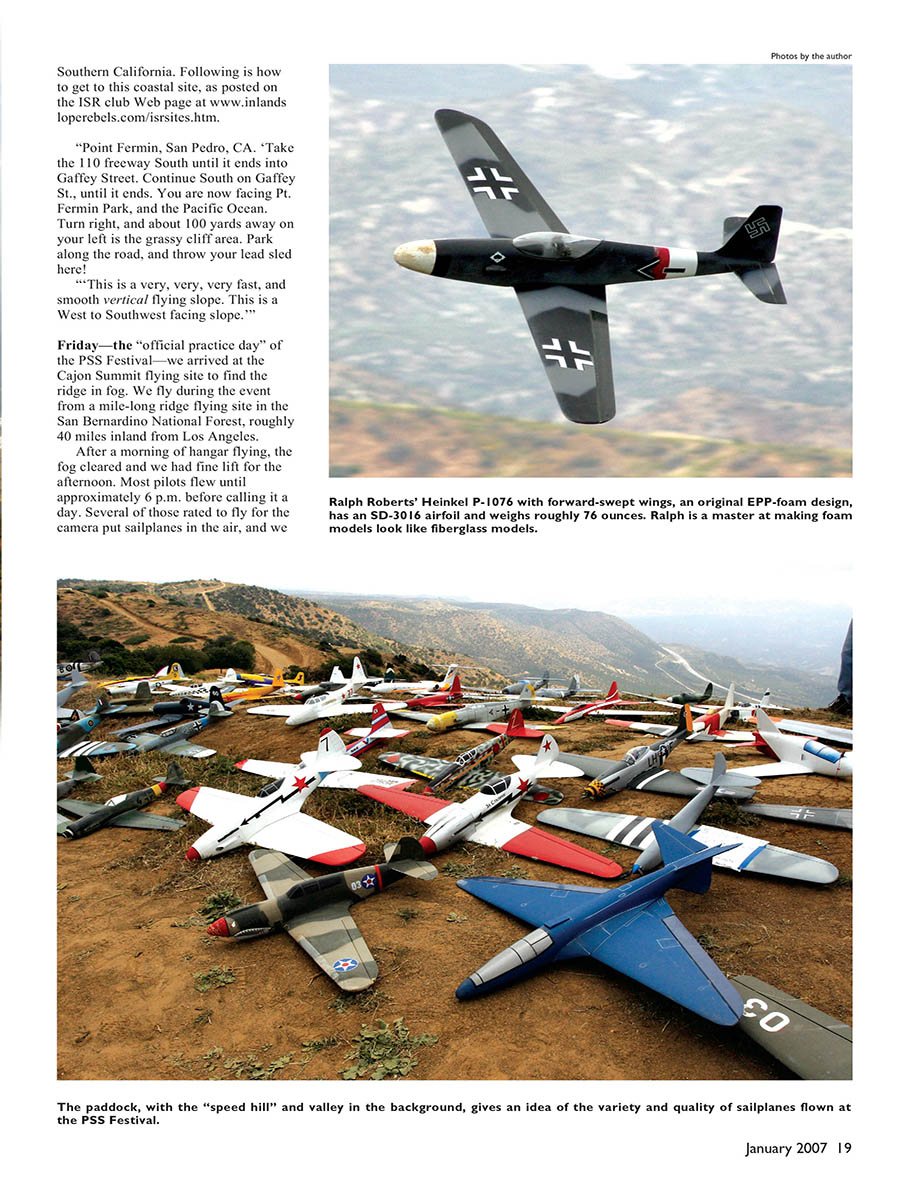
- Ralph Roberts, the artist behind the Festival T‑shirt artwork over the years, continues to make EPP foam models look like painted fiberglass. This year he shared one of his finishing secrets: spackle filler, no strapping tape, and two layers of Solartex. Ralph favors forward‑swept‑wing designs and flew an exquisite Heinkel P‑1076 at the contest.
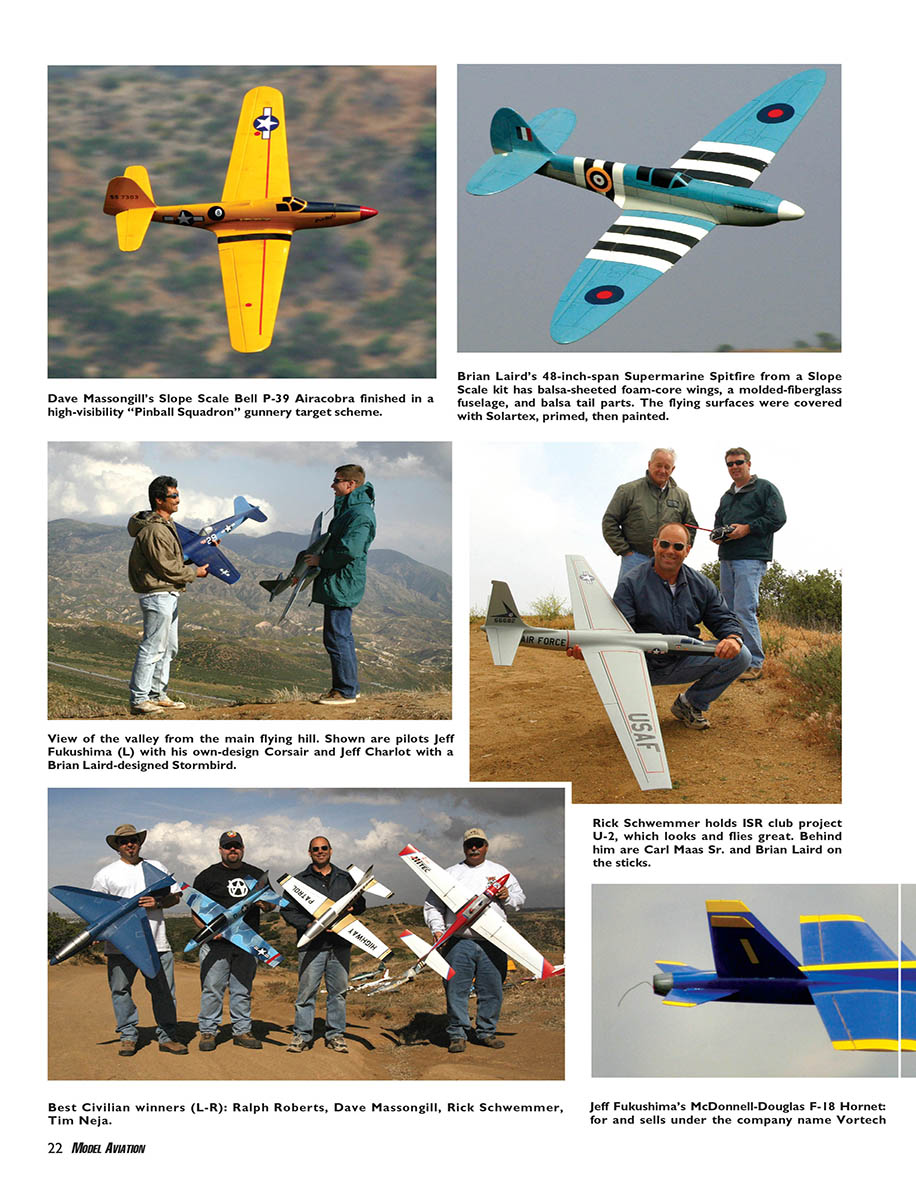
- Dave Massongill, a rapidly rising builder and pilot, flew a Slope Scale fiberglass Bell P‑39 Kingcobra and his original‑design EPP foam Lippisch Li P.01‑118 single‑seat rocket fighter — an excellent example of foam design and finishing.
- Jeff Fukushima, a seasoned PSS designer, builder, and finisher, flew several models he kits under the name Vortech Models, including a McDonnell‑Douglas F‑18 Hornet and a large‑scale Focke‑Wulf FW 190D Dora (see www.geocities.com/vortechmodels).
- Jack Cooper at Leading Edge Gliders (LEG) continues to make an impact with PSS kits that favor fatter fuselages and narrower wing chords for a more scale appearance. Several pilots flew LEG sailplanes built and finished at the factory (see www.leadingedgegliders.com).
Saturday also included a fantastic lunch organized by Lori Maas and helpers, plus static judging of models in four classes. Because of the changing wind conditions, the festival relaxed the usual "must fly to place in the contest" rule for this year. An aerobatics clinic run by instructor pilots Reed Sherman, Carl Maas, and Steve Lange provided an educational opportunity during a low‑wind period. Later came the awards ceremony and a huge raffle. After the day's events many pilots gathered at the Beer Hunter in Rancho Cucamonga for dinner and conversation.
Sunday — Third Official Day (Little Mountain option)
By noon Sunday there were blue skies and sun, but the wind was still from the north — at our backs, 180° from what we needed at Cajon Summit. With little sign of the wind turning, some pilots headed to lower altitudes and flew at Little Mountain in San Bernardino. There we saw a tremendous variety of sailplanes in the air, including Weasels, EPP foam warbirds, Slope Scale warbirds, a Bob Martin Talon, and one of my favorites: Brian Laird’s original‑design B‑17 Flying Fortress.
Little Mountain is friendlier to less experienced slope pilots than Point Fermin. It’s surrounded by grass rather than sea cliffs, concrete fences, and chain‑link fences. Directions (from www.inlandsloperebels.com/isrsites.htm):
- Take the I‑215 north from Riverside through San Bernardino to the Mt. Vernon/27th exit.
- Exit to the right and make an almost immediate left onto Little Mountain Drive.
- Follow it near the top of the hill and make a right onto the dirt road.
- Follow the dirt road up (easy in a passenger car) and past the communications towers.
- There is a parking location about 75 yards past the towers; the hill is directly adjacent.
Notes: West and southwest wind.
Looking ahead
The 2007 PSS Festival will be the 10th‑anniversary gathering, and ISR club members are planning a particularly memorable event. Check www.inlandsloperebels.com for information about next year’s edition, which is scheduled for May.
At the time of this writing, a North American F‑86 Sabre group build is being discussed. Watch the Slope Soaring section of RCGroups.com for building‑project information.
MA
Dave Garwood [email protected]
Transcribed from original scans by AI. Minor OCR errors may remain.

