
2007 F3D RC Pylon World Championships - 2007/10
BY MICHAEL RAMSEY
AMA’s International Aeromodeling Center welcomed pylon heroes from around the world.
Attending a contest is like reading a best-selling novel, except the story is live and there's no way to peek at the last page to see how it all ends. The book of the 2007 F3D World Championships was written at perhaps the best place on earth to fly a model airplane: the International Aeromodeling Center at Muncie, Indiana.
Some have compared RC pylon racing to Formula 1 auto racing. Before attending my first F3D World Championships, it seemed reasonable to expect commonalities with state-of-the-art open-wheel racing: speed freaks seeking tiny advantages, a high level of friendly professionalism, and sportsmanship that is often heroic.
After spending the better part of a week in the field with competitors (June 20–28), it was my privilege to witness the pylon community’s pride and passion. The pursuit pushes the envelope of speed and performance, and the pilots deserve our respect; they earned mine.
Each of the 16 countries that applied to compete was allowed three pilot/caller entries and as much pit crew, family, and management as they could bring. Pilots raced to acquire the fewest points possible—points equaled seconds in lap time. Rather than try to cross the finish line first, the 43 pilots raced primarily against the clock during 15 rounds of flying.
Competition format and race dynamics
- Each round included approximately 16 heats, typically with three aircraft launched in a staggered fashion as a safety precaution.
- Aircraft often bunched together during a race, creating intense anticipation—the separation around the pylons could be barely half a wing length.
- Each 10-lap race was roughly 2.5 miles and typically took 59–66 seconds to complete. The fastest official time on record is about 56.8 seconds, though the thick Muncie air was not conducive to beating that mark.
- Pilots aimed to make the fewest control inputs possible. Every control input adds drag; the goal is to fly at constant altitude and only make heading adjustments when necessary.
AMA’s Take: Many Thanks!
Organizing and conducting an FAI-level contest requires teamwork. Many talented and professional people gave their time to make the F3D World Championships a success—something countries around the world will try to emulate. As a tribute to their efforts, the scores, many more photos, video, official bulletins, and a copy of the official program with team biographies are available online: www.modelaircraft.org/events/f3dwc.aspx.
— Michael Ramsey
Timing system credit
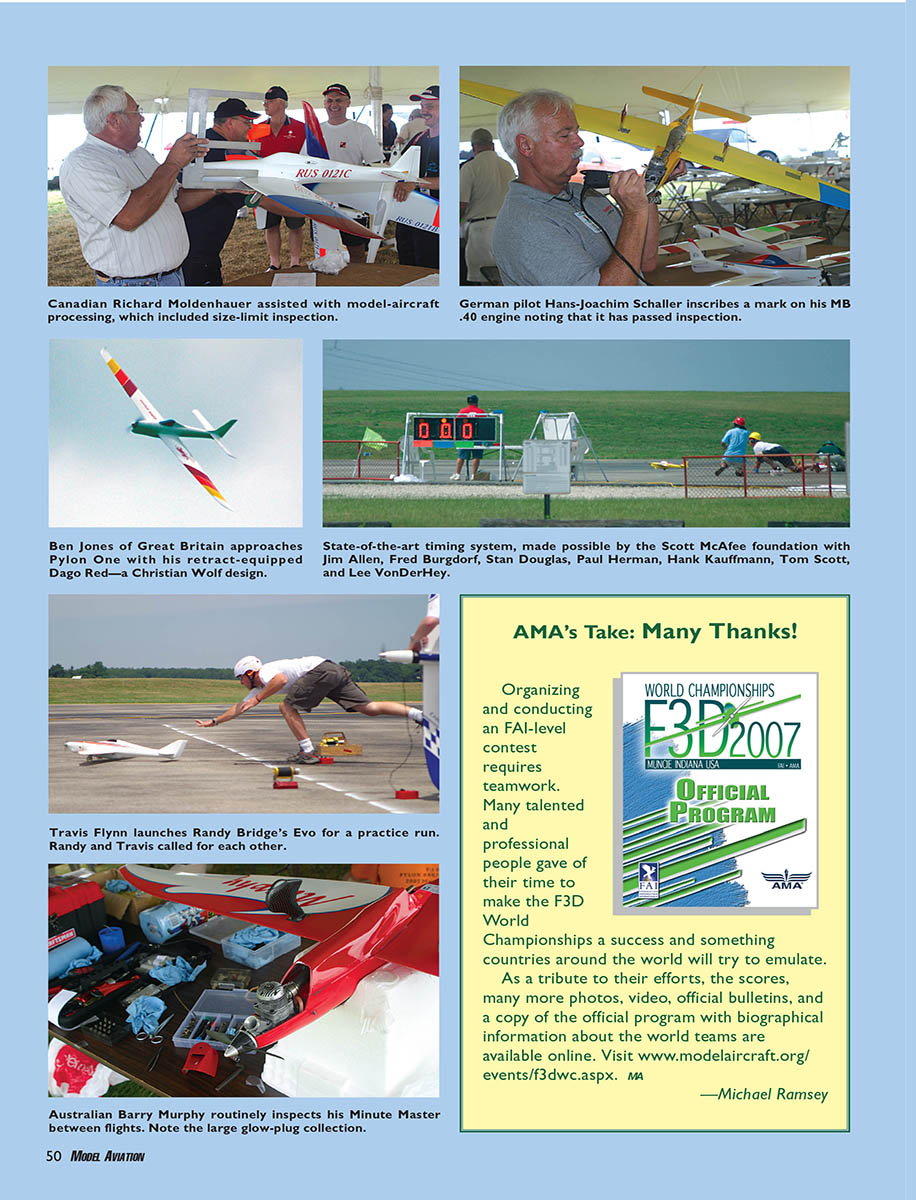
State-of-the-art timing system, made possible by the Scott McAfee Foundation with Jim Allen, Fred Burgdorf, Stan Douglas, Paul Herman, Hank Kauffmann, Tom Scott, and Lee VonDerHey.
F3D World Championships Medal Winners
Individual
- Randy Bridge (USA)
- Travis Flynn (USA)
- Ranjit Phelan (AUS)
In addition to medals, individuals in the top three places were presented with FAI diplomas. For a complete listing of pilots’ final scores and team standings, visit www.modelaircraft.org/events/f3dwc/F3DScores.aspx.
Team
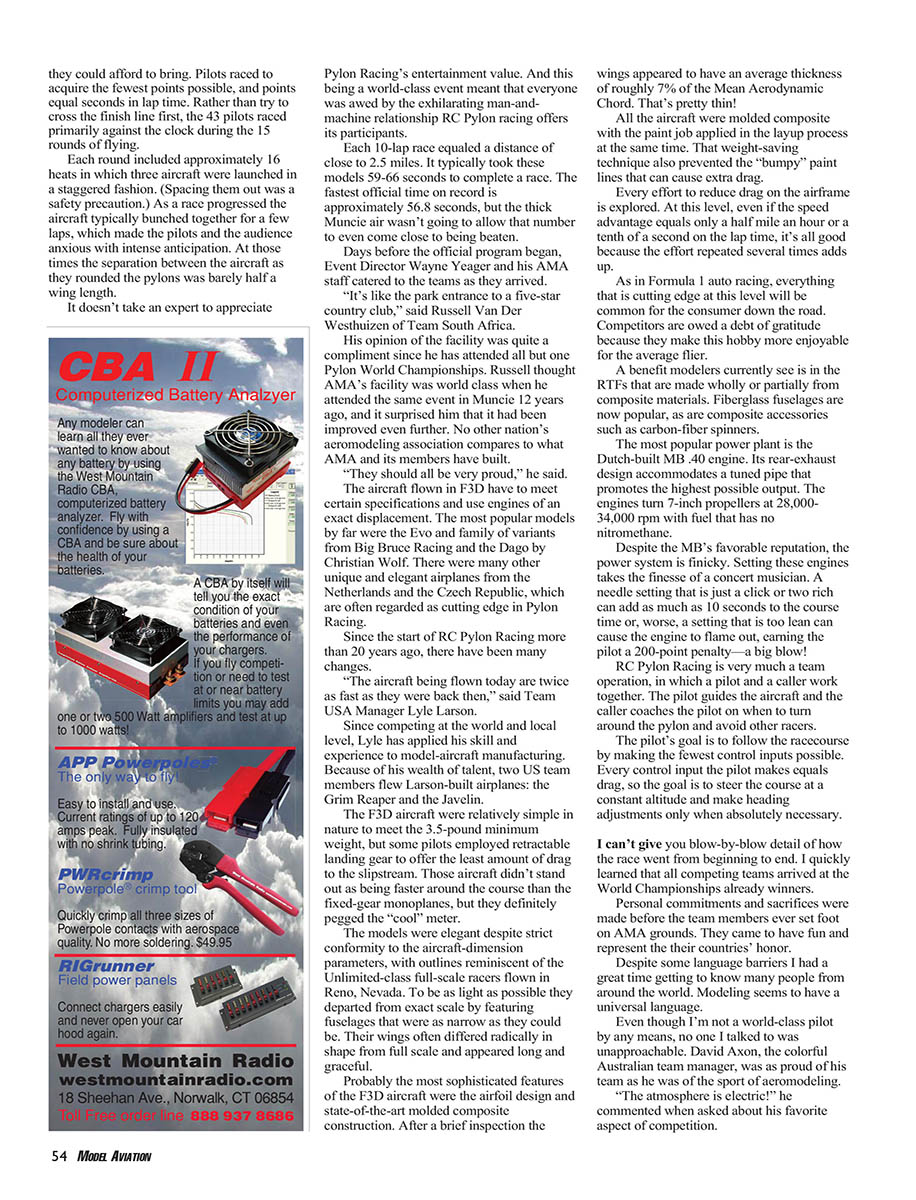
- Australia: Ranjit Phelan, Chris Graham, Barry Murphy
- Italy: Paolo Mucedola, Antonio Tosi, Giorgio Gianassi
- Czech Republic: Milos Malina, Frantisek Hovorka, Tomas Andrlik
Facility, arrival, and atmosphere
Days before the official program began, Event Director Wayne Yeager and his AMA staff catered to the teams as they arrived. “It’s like the park entrance to a five-star country club,” said Russell Van Der Westhuizen of Team South Africa. Russell has attended nearly every Pylon World Championships and noted that AMA’s facility—already world class—had been improved even further.
People traveled from around the globe, and despite language barriers the atmosphere remained friendly. The modeling community speaks a universal language; competitors were approachable and generous with help and advice. David Axon, Australian team manager, summed up the scene: “The atmosphere is electric!” He also noted that despite fierce competition, teams helped one another—for example, Lyle Larson assisted the British team with engine work.
Aircraft, construction, and powerplants
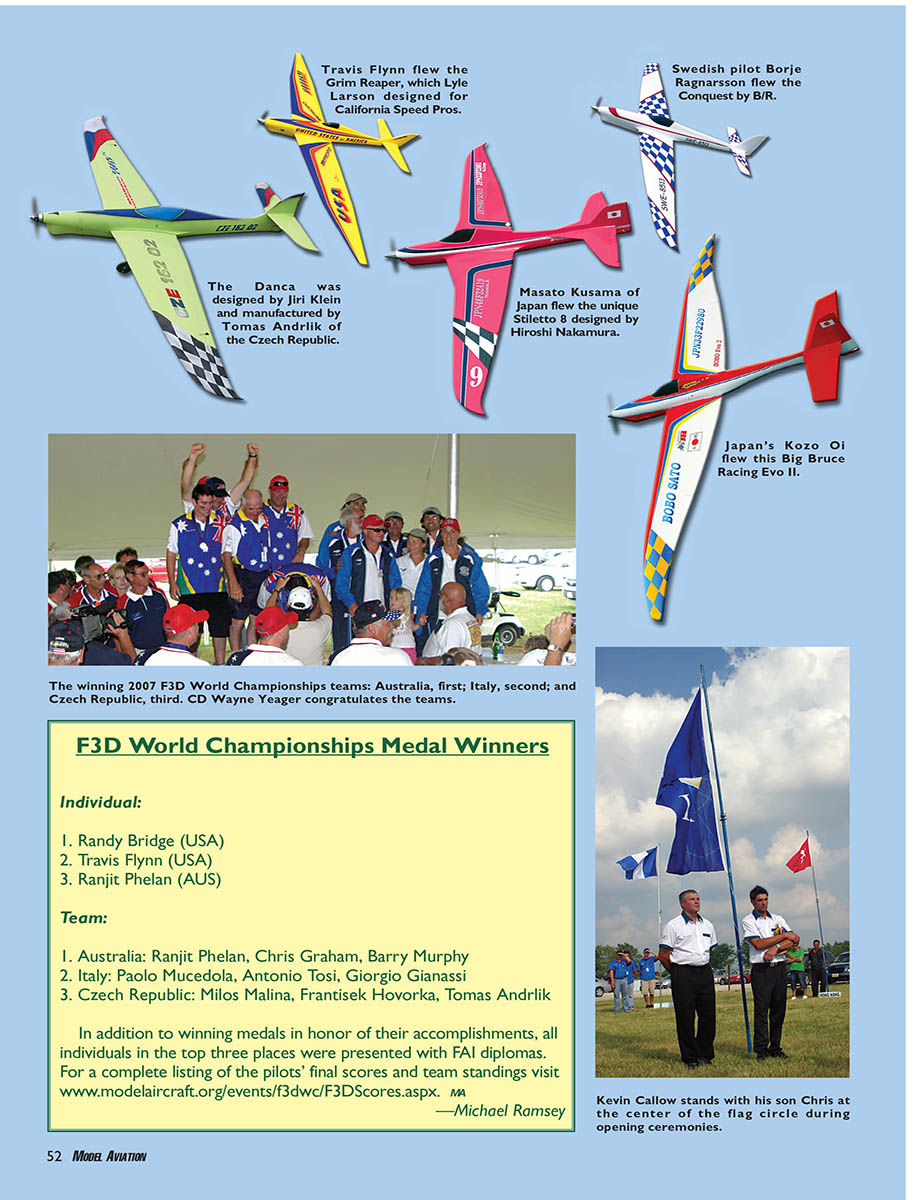
The aircraft used in F3D must meet strict specifications and use engines of exact displacement. Popular models included the Evo (and its variants) from Big Bruce Racing and the Dago by Christian Wolf. The Netherlands and the Czech Republic also contributed unique and elegant designs that are often cutting edge in pylon racing.
Key design and construction points:
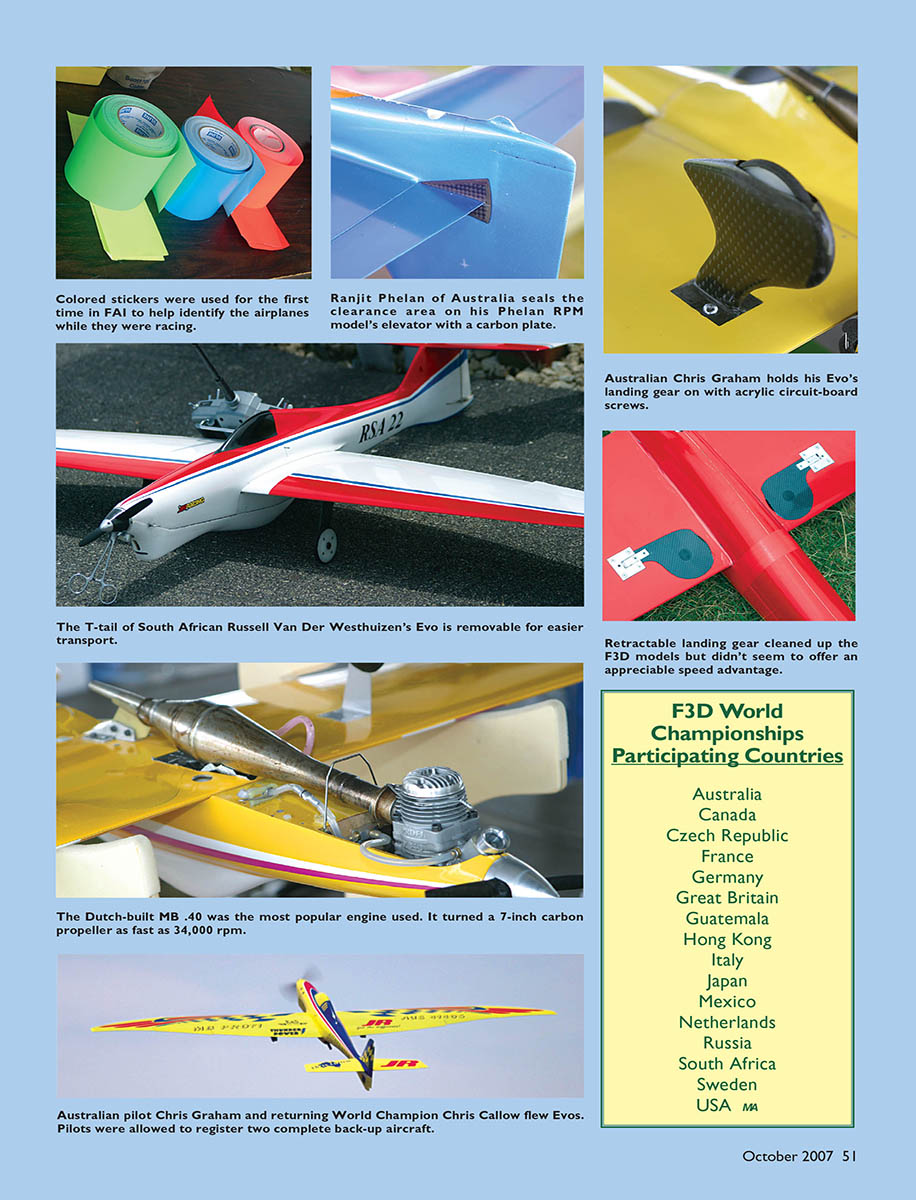
- F3D aircraft are relatively simple to meet a 3.5-pound minimum weight, though some used retractable landing gear to reduce drag.
- Designs often echo Unlimited-class full-scale racers with narrow fuselages and long, graceful wings. Wings typically appeared very thin—around 7% mean aerodynamic chord.
- Most airframes were molded composite with the paint applied in the layup process, saving weight and preventing bumpy paint lines that increase drag.
- Every effort to reduce drag matters; even a half mile per hour or a tenth of a second per lap can be decisive.
Powerplants:
- The most popular engine was the Dutch-built MB .40. Its rear-exhaust design accommodates a tuned pipe for high output.
- Engines typically turned 7-inch propellers at 28,000–34,000 rpm using fuel with no nitromethane.
- MB engines are finicky to tune. A needle setting just a click or two rich can add up to 10 seconds to a course time; a too-lean setting can cause a flameout and a 200-point penalty.
Composite construction and techniques from high-end competition eventually trickle down to consumer products: RTFs and fiberglass or composite accessories (carbon-fiber spinners, etc.) benefit from this development.
Teamwork, roles, and notable competitors
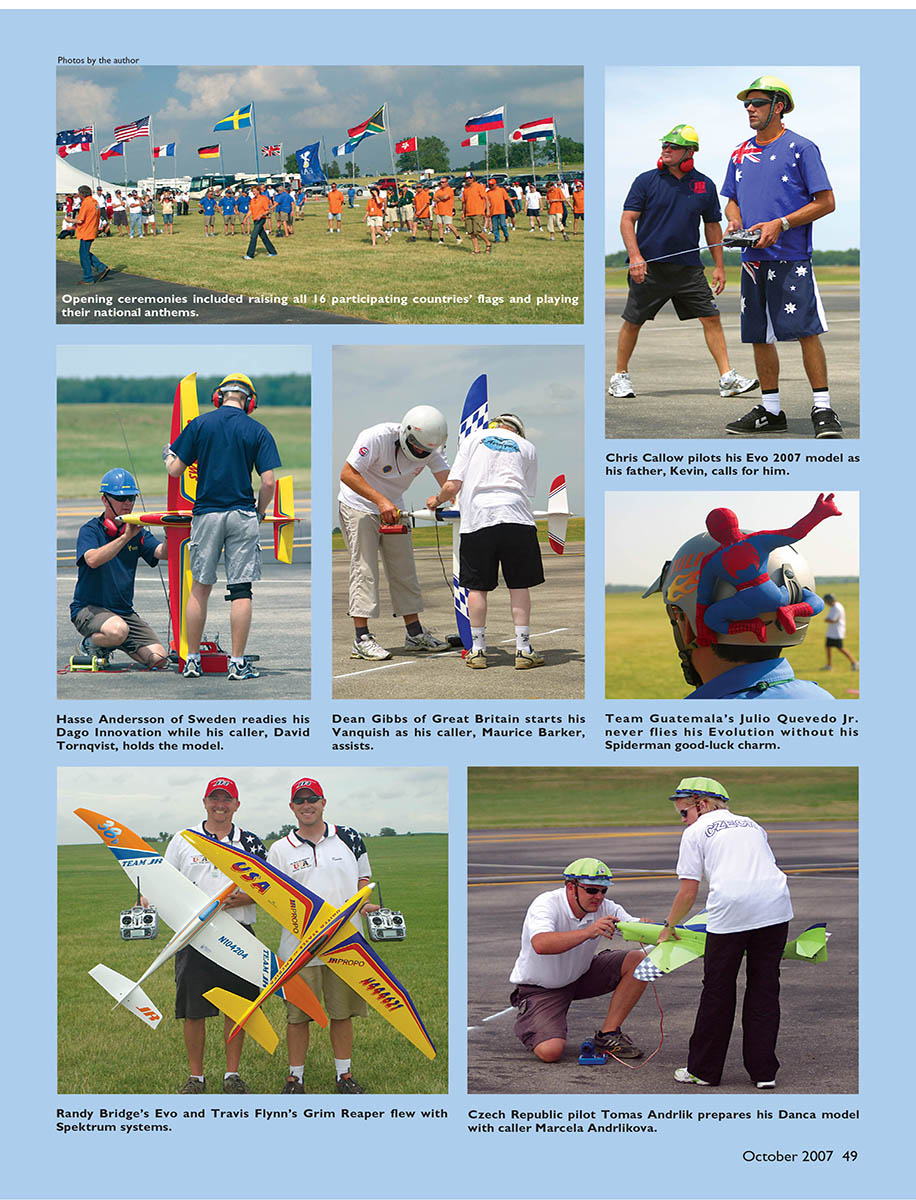
RC pylon racing is a team sport: pilot and caller work closely together. The caller coaches the pilot on when to turn around pylons and how to avoid other racers. Team strategy emphasized consistency and precision.
Highlights and personalities:
- Chris Callow (AUS) came into the event as a three-time World Champion and a favorite to win again. He flew very low—about a wing length above the pylons—because “the air is much cleaner down there.”
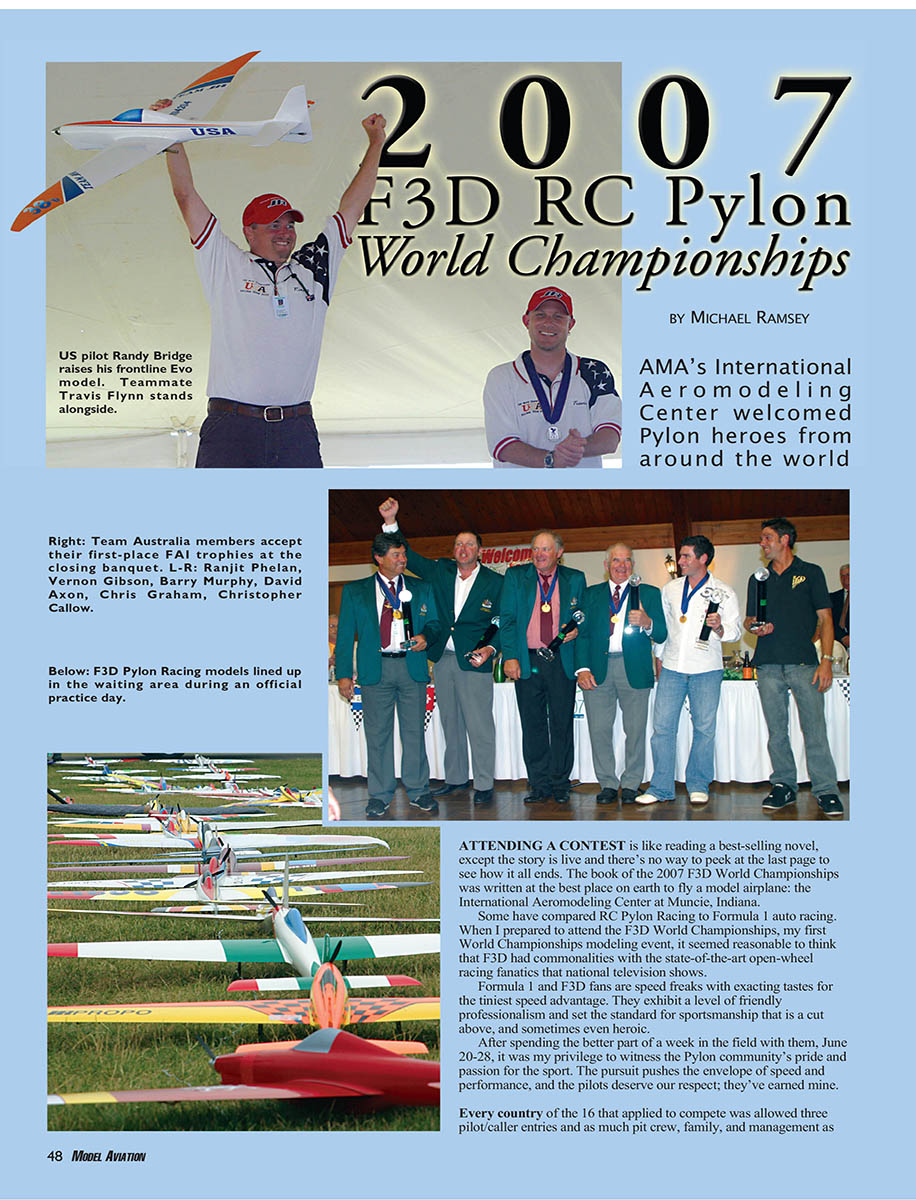
- Team USA consisted of Randy Bridge, Travis Flynn, and Fred Burgdorf—none had previous F3D World Championships experience. F3D pylon racing is not widely practiced in the U.S.; these pilots honed skills in related classes (Quarter 40 and Quickie 500) and by flying together often.
- The U.S. team developed a familylike bond, trading pilot and caller roles and helping one another—an advantage that showed early in the contest.
- Travis Flynn used his F5D (RC electric pylon) experience to take an early lead, but a missed pylon on the final day opened the field. He recovered to finish a close second.
- Equipment trouble hindered Fred Burgdorf on Day Two, denying the U.S. a full podium sweep.
- Sportsmanship was exemplary throughout—competitors helped one another and kept the contest fair and friendly.
Event outcome and reflections
Randy Bridge earned the Gold medal, with Travis Flynn taking Silver by just half a second. Australian Ranjit Phelan finished only one second behind them to claim Bronze. The defending champion Christopher Callow remained in contention but was unseated. Team Australia captured the team Gold, Italy took Silver, and the Czech Republic earned Bronze.
All 43 pilots who competed arrived as winners in their own right—having made personal commitments and sacrifices to represent their countries. Every participant contributed to a memorable World Championships and helped strengthen the international modeling community.
My experience at this World Championships was unique, and I’m sure many other stories are being shared across the 16 participating countries. Having witnessed the drama and camaraderie of this FAI World Championships, my pride in the modeling community is stronger than ever.
— Michael Ramsey [email protected]
Transcribed from original scans by AI. Minor OCR errors may remain.

