
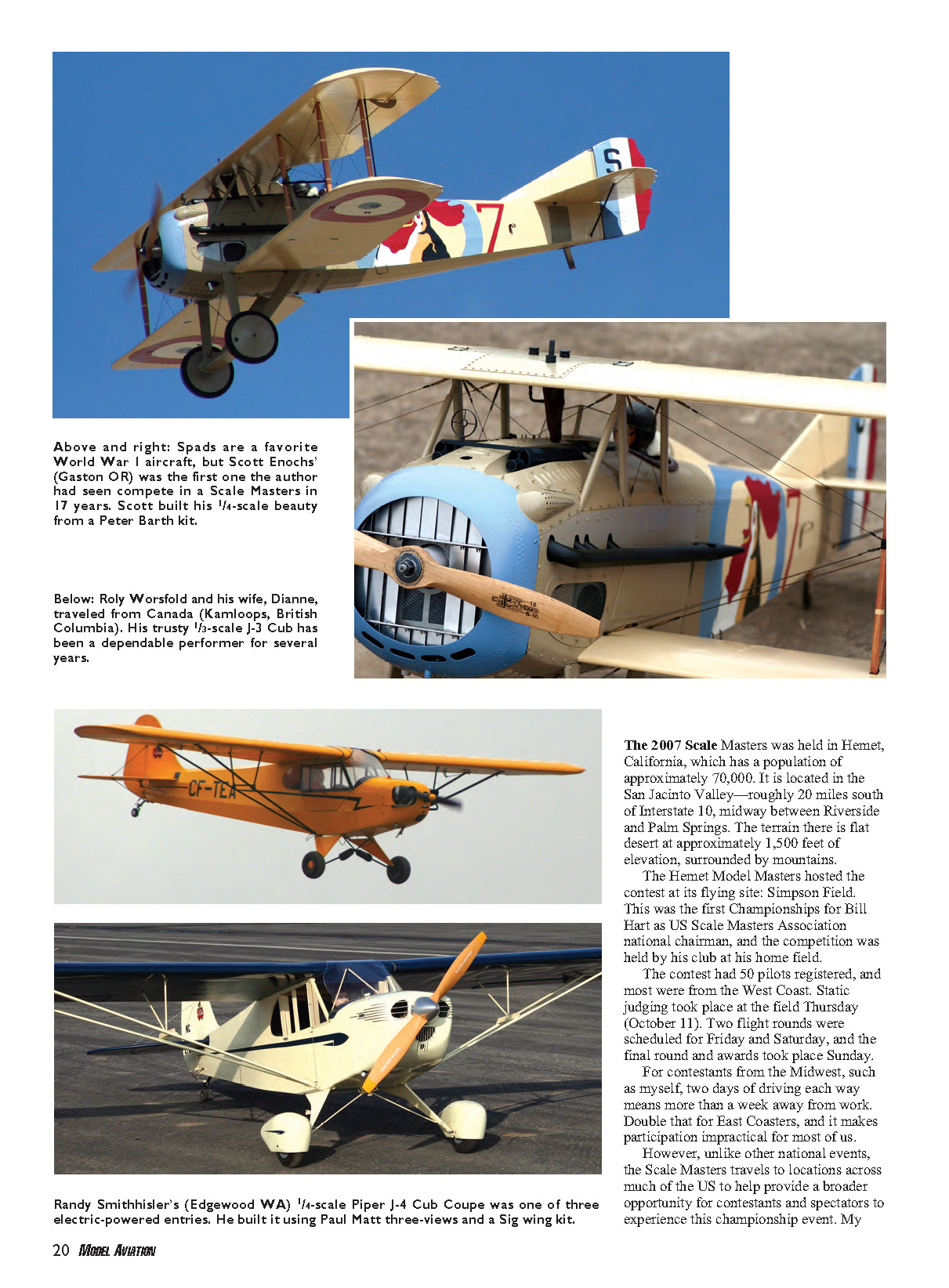
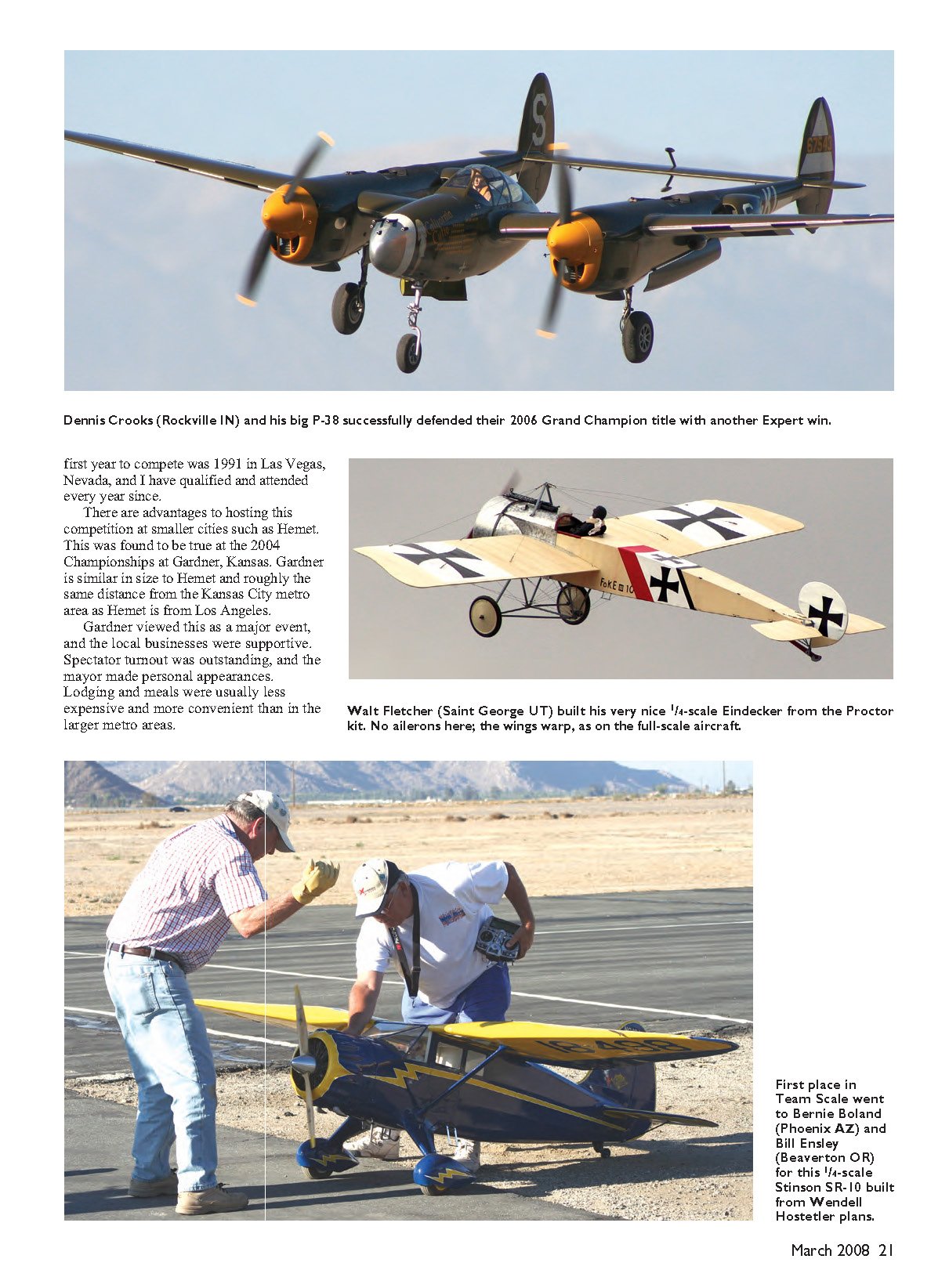
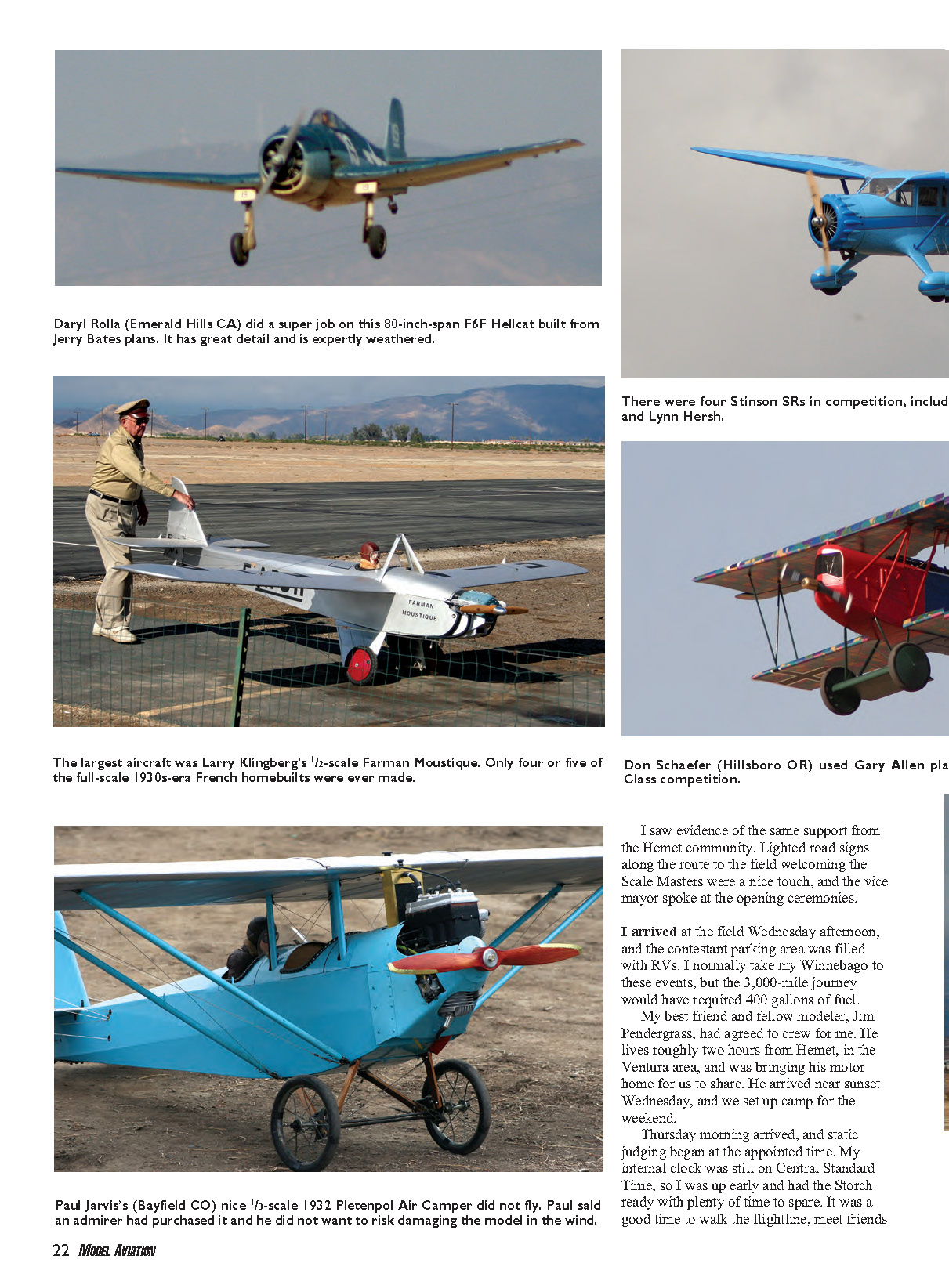
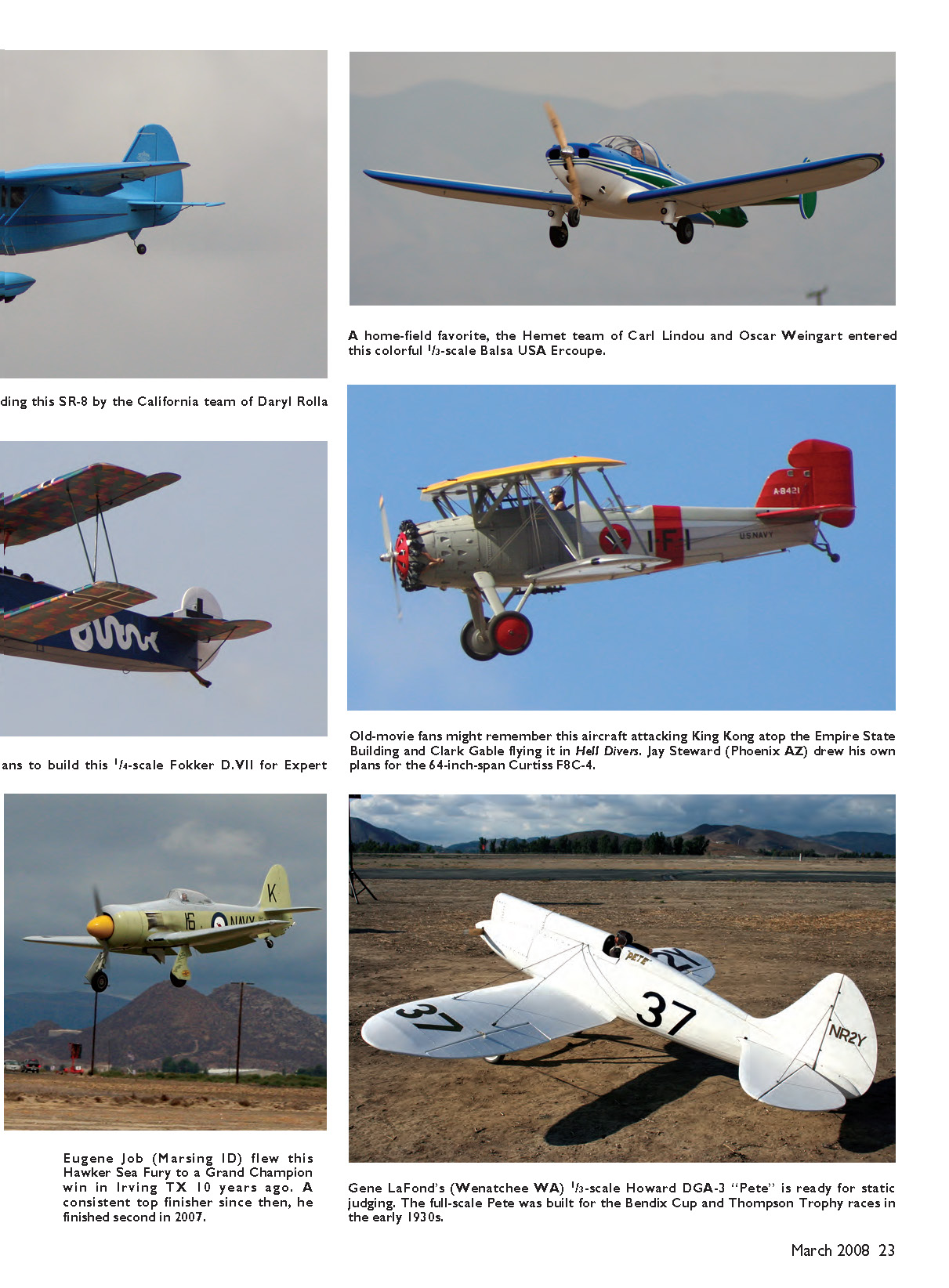
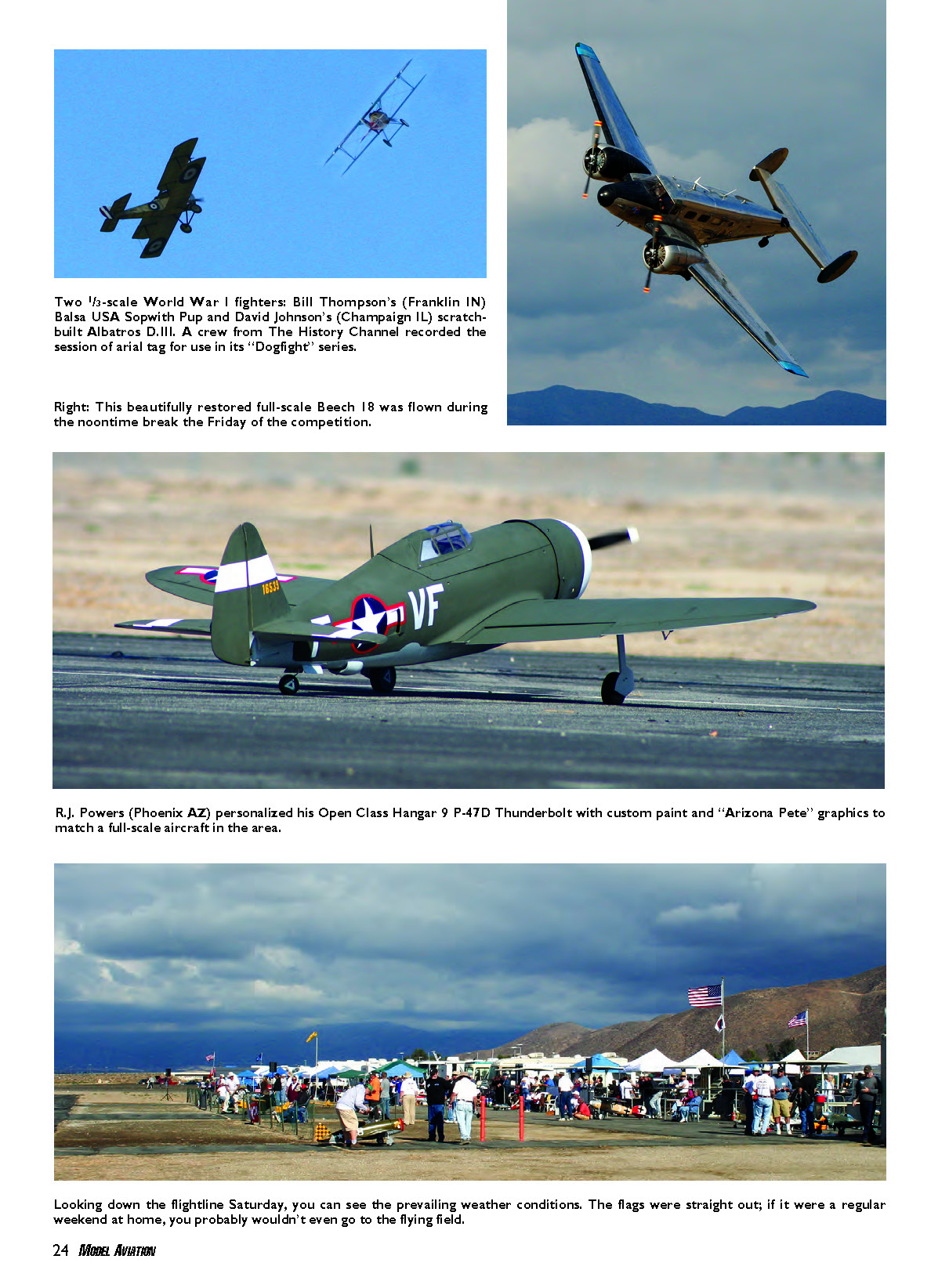
2007 US Scale Masters Championships - 2008/03
In October last year it was time to get ready for the 28th annual US Scale Masters Championships, held October 11–14. It would have been nice to get in some practice flying before the trip, but fall arrived in Kansas on the calendar only. For most of the month the winds were high, even by Kansas standards (25–40 mph), and the temperatures were near 90°F. So instead of practicing, I packed up the van and headed west on a two-day drive to California. I had scheduled an early static-judging time, which would give me time for a couple of practice flights later that afternoon.
A few days earlier I had spoken with MA’s editor, Michael Ramsey, about the article I was submitting about my Fieseler Fi 156 Storch (which ran in the February issue). He expressed concern about the lack of coverage the magazine had been getting of West Coast events and asked if I would like to write about the Scale Masters. I could not recall any Scale Masters article written from a competitor’s perspective, so I decided to try it.
From a pilot’s perspective, this competition gets 10s every year.
The 2007 Scale Masters was held in Hemet, California (population approximately 70,000), located in the San Jacinto Valley—roughly 20 miles south of Interstate 10, midway between Riverside and Palm Springs. The terrain is flat desert at approximately 1,500 feet elevation, surrounded by mountains. The Hemet Model Masters hosted the contest at Simpson Field. This was the first Championships for Bill Hart as US Scale Masters Association national chairman, and his club held the competition at his home field.
The contest had 50 pilots registered, most from the West Coast. Static judging took place at the field on Thursday (October 11). Two flight rounds were scheduled for Friday and Saturday, and the final round and awards took place Sunday.
For contestants from the Midwest, such as myself, two days of driving each way means more than a week away from work. Double that for East Coasters, and participation becomes impractical for most. However, unlike other national events, the Scale Masters travels to locations across much of the U.S. to provide broader opportunity for contestants and spectators to experience the championships. My first year to compete was 1991 in Las Vegas, Nevada, and I have qualified and attended every year since.
There are advantages to hosting this competition in smaller cities such as Hemet. This was true at the 2004 Championships in Gardner, Kansas, which is similar in size to Hemet and roughly the same distance from the Kansas City metro area as Hemet is from Los Angeles. Gardner viewed the event as major, local businesses were supportive, spectator turnout was outstanding, and the mayor made personal appearances. Lodging and meals were usually less expensive and more convenient than in larger metro areas. I saw evidence of the same support from the Hemet community: lighted road signs welcoming the Scale Masters and the vice mayor speaking at the opening ceremonies.
I arrived at the field Wednesday afternoon and found the contestant parking area filled with RVs. I normally take my Winnebago to these events, but the 3,000-mile journey would have required 400 gallons of fuel. My best friend and fellow modeler, Jim Pendergrass, agreed to crew for me. He lives roughly two hours from Hemet in the Ventura area and brought his motor home for us to share. He arrived near sunset Wednesday, and we set up camp for the weekend.
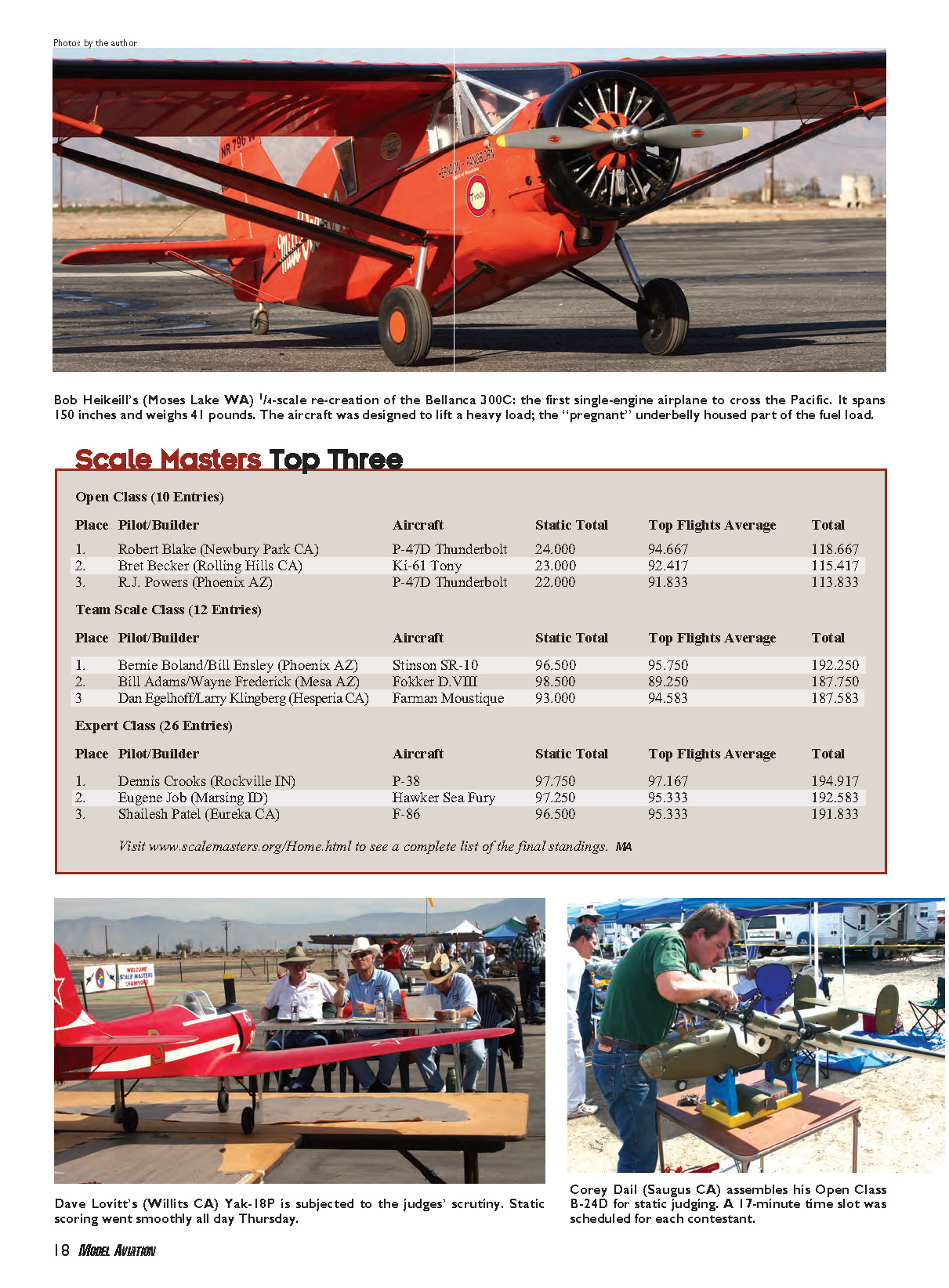
Thursday morning, static judging began at the appointed time. My internal clock was still on Central Standard Time, so I was up early and had the Storch ready with plenty of time to spare. It was a good time to walk the flightline, meet friends, and check out the new models. Static scoring went smoothly all day Thursday. A 17-minute time slot was scheduled for each contestant.
After lunch my static portion of the contest was complete, and it was time to get in some practice flights. I went through my checklist: the Fi 156 was fueled, the transmitter and receiver batteries were charged, and the flight propeller was installed. I had the frequency pin, so I powered up and checked the controls. The elevator was moving, but the rudder wouldn't budge. Although the rudder and tail wheel were on separate servos, the rudder servo was completely jammed with damaged gears.
I returned to the pits to defuel and remove the servo. It was tight access through a side baggage door, but I finally removed the unit and confirmed my suspicions: this could be a serious problem. The rudder servo was a heavy-duty, high-torque Airtronics unit, and another brand would not match the splines on the pull-pull servo arm. Fortunately, several vendor booths were in the parking area, including Peak Electronics. They had a large selection of servos and had an exact replacement. All I needed was my Visa card and about an hour of assembly time.
Once everything was back together, all seemed to be working fine, so it was back to the flightline. There was still time to fly, but the winds were starting to get unfriendly. The takeoff went fine, and I ran through maneuvers a couple of times. The Storch was flying well, so I worked on landings. The crosswinds were getting ugly, and the first three landings were a struggle. On the fourth landing, a strong gust hit the upwind wing, the other tip dragged, and the aircraft pivoted until the wind was directly behind it—then it flipped upside down.
A quick damage assessment revealed several minor issues that could be repaired in a couple of hours and one that looked like a showstopper: the main gear strut that had taken the brunt of the impact was badly bent and twisted. I couldn't repair those parts at the field; it was a custom-welded assembly that held the axle and functioned as the outer cylinder for the shock strut, contained in a telescoping aerodynamic fairing. It started to look like I was going to have plenty of time to play reporter and take photos.
In the spirit of camaraderie and sportsmanship common at these events, a group of fellow competitors quickly joined and asked what needed to be done to get the Storch back in service. Several phone calls and approximately an hour later, one of the Hemet club members arrived from town to offer assistance. He had a shop that built racecars. We agreed there was nothing to lose by trying to straighten the strut; it couldn't be worse if it broke. He headed back to his shop while I started fixing the rest of the damage. About an hour later he returned with the strut straightened. It wasn't perfect, but it was functional and would at least get my model off the ground for the next day's first round.
Friday morning greeted us with a low, overcast sky and temperatures near 60°F. Opening ceremonies were performed and the vice mayor of Hemet, Lori VanArsdale, gave her personal welcome. The pilots' briefing was conducted and flight orders were posted. Four flightlines were staffed, and I was last up on the first. It didn't look like I would get a first flight in before the wind picked up.
Before flying commenced we were instructed to clear behind the ready line and look west; a full-scale aircraft was approaching rapidly out of the haze. It was an L-28 Czech jet trainer providing an up-close air show. The first pass was a straight, level fly-by at prototypical cruise speed. If I were wearing my judge's hat I would have downgraded the pilot because the jet was over the runway centerline (too close). The visual presentation was reduced by the gray aircraft under a dark overcast using cloud-colored smoke, but the pilot compensated with the jet-exhaust smell as the L-28 passed. It departed after a few more photo passes, and Round One got underway.
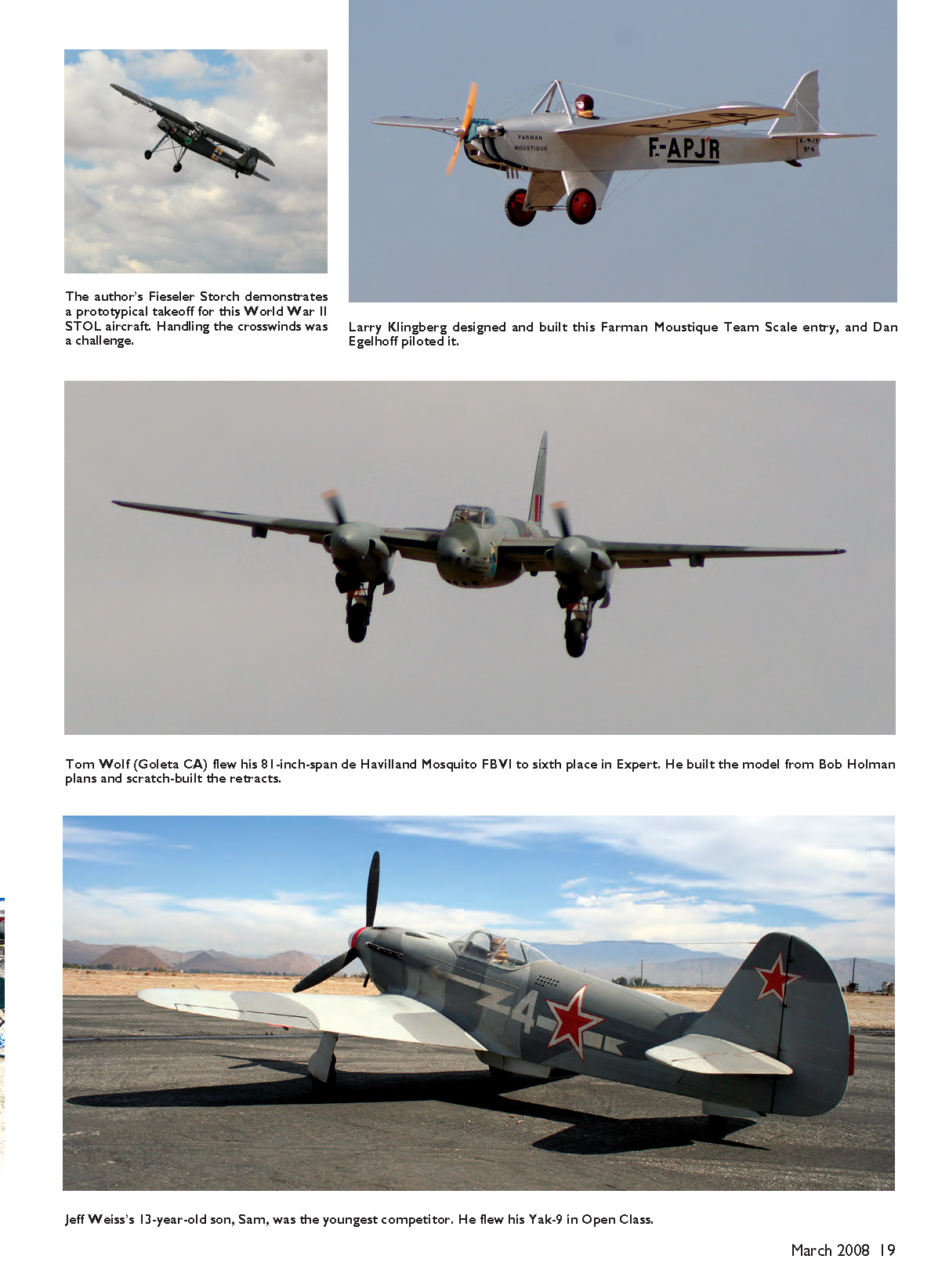
When my turn to fly came up it was half past noon. The winds were at my back, much the same as during the flight the day before. I decided not to fight it and used it to demonstrate the Storch's short takeoff and landing (STOL) capability. I briefed the judges that a full-scale Storch would not attempt to take off or land in such crosswind conditions because it was unsafe and seldom necessary. The Storch needed little space to operate and could orient approaches into the wind. I performed a STOL takeoff, crossed the runway, and turned prior to the deadline. The landing approach was oriented into the wind, with touchdown crossing the far edge of the runway and the aircraft at taxi speed before the runway centerline. I flew as briefed and consistently received 8s–10s on takeoff and landing scores for all my flights. The repaired gear held for the duration.
I was the last to land in the round, and the lunch break was declared as I taxied in. Food service was provided by a local Mexican-style caterer at one of the vendor booths; the food was good, with a nice menu, fair prices, and fast service, and breakfast burritos were available in the morning. Lunchtime entertainment included a continuation of the private air show: a highly polished Beech D-18 twin flew, looking like a great 500% model of one of Nick Ziroli's kits.
Disturbing news Saturday morning got the day off to a sad start: two veteran Expert competitors, Jeff Lovitt and Dave Lovitt, had been burglarized overnight. While parked at the motel, thieves pried open their vehicle and stole Jeff's and Dave's aircraft, all tools, radios, and support equipment. When I'm on the road with my aircraft, I make it a practice to cover the load with dark blankets so my cargo is nonobvious to passersby.
The ugly winds persisted for most of the event. The pilot's final flight score is calculated as the average of the best three flights. I finished Round Three Saturday morning with a respectable average near 90. Round Four that afternoon went well. Even with the wind I had a bunch of 9s and 10s on the scoresheet. My last maneuver before landing was a slow flypast with full flaps. In a strong wind I can almost bring the Storch to a stop in front of the judges.
As I set up for the pass with the flaps full down, I started increasing throttle to maintain altitude but got no power—apparently one cylinder had gone cold. There was no time to mess with it, so I set the model down straight ahead in the outfield as designed. The left main wheel rolled into a gopher hole and the wind beat the Storch around for a while until everyone's airplanes landed and I could retrieve it. A couple of elevator hinges were broken, but there was no serious damage.
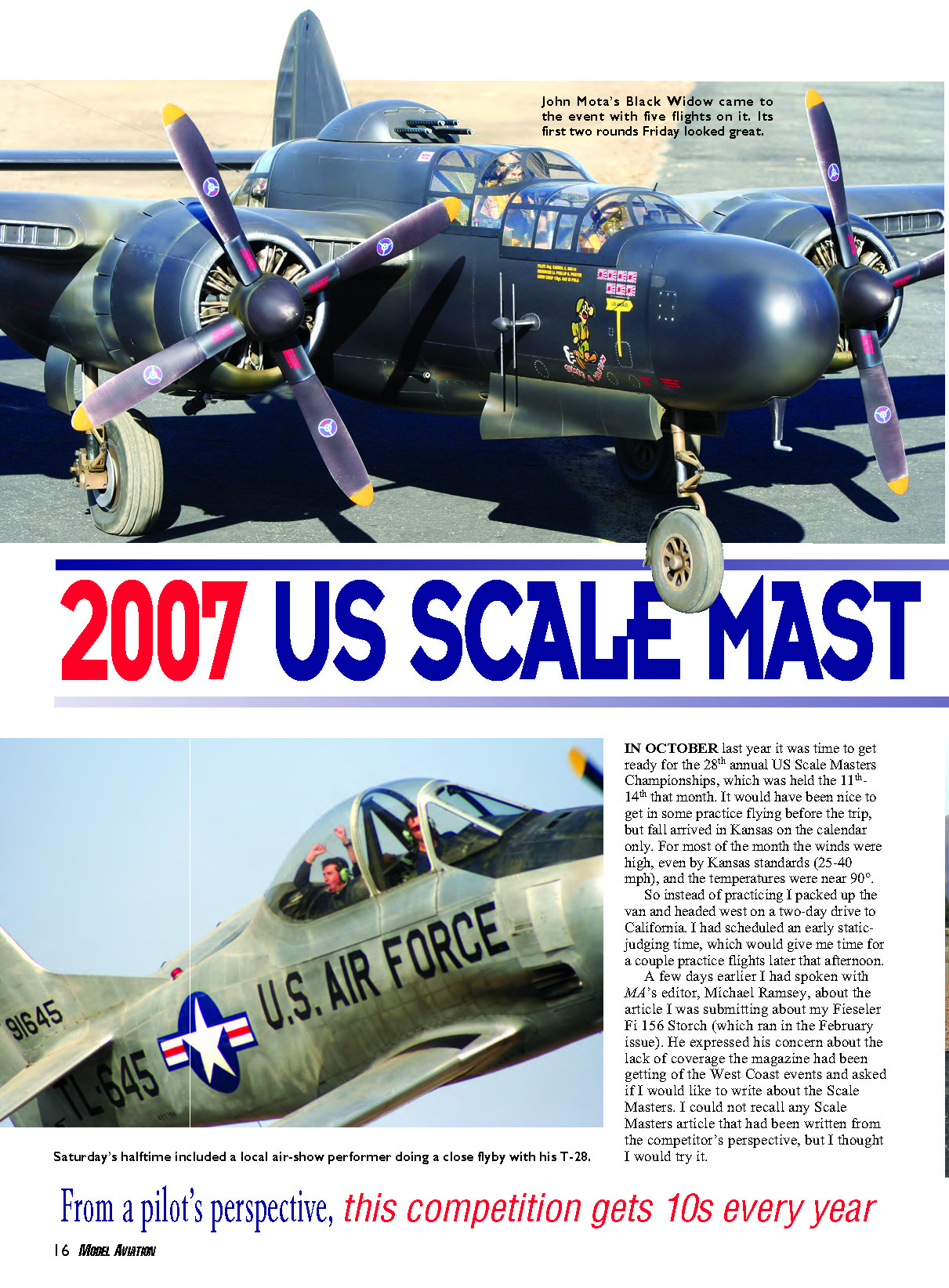
There was no reason to press my luck further. A personal-best score in the last round would nudge my average only a point or two, and it was not worth risking further damage. Saturday's halftime featured more flybys; a T-28 got extremely close. A local pilot who owns the aircraft and has all FAA credentials for air-show demonstration flights performed those breathtaking passes.
Things wrapped up Sunday afternoon with the awards ceremony following completion of the fifth round of flying. The event was well run overall. Thanks to the Hemet Model Masters for the members' hard work and a special thanks to the judges who donated their time and expertise to make the contest possible.
My philosophy for attending any flying event has always been that if I have a good time, don't embarrass myself, and bring the airplane home in one piece, it was a successful trip. This trip was quite successful. The wind took some of the fun out of it, but that was offset by the challenge of proving I could deal with it. As annoying as the wind seemed at the time, it was insignificant in retrospect. California had hardly disappeared in my rearview mirror when the Santa Ana winds ignited the most costly fires in the state's history.
For more information about the Scale Masters and to see photos, visit the web site. To learn more about the association and become more involved, contact Bill Hart or Carolyn Van Herk.
Doug Crumley [email protected]
Scale Masters Top Three
Open Class (10 Entries)
- Robert Blake (Newbury Park, CA) — P-47D Thunderbolt — Static Total 24.000 — Top Flights Average 94.667 — Total 118.667
- Bret Becker (Rolling Hills, CA) — Ki-61 Tony — Static Total 23.000 — Top Flights Average 92.417 — Total 115.417
- R.J. Powers (Phoenix, AZ) — P-47D Thunderbolt — Static Total 22.000 — Top Flights Average 91.833 — Total 113.833
Team Scale Class (12 Entries)
- Bernie Boland / Bill Ensley (Phoenix, AZ) — Stinson SR-10 — Static Total 96.500 — Top Flights Average 95.750 — Total 192.250
- Bill Adams / Wayne Frederick (Mesa, AZ) — Fokker D.VIII — Static Total 98.500 — Top Flights Average 89.250 — Total 187.750
- Dan Egelhoff / Larry Klingberg (Hesperia, CA) — Farman Moustique — Static Total 93.000 — Top Flights Average 94.583 — Total 187.583
Expert Class (26 Entries)
- Dennis Crooks (Rockville, IN) — P-38 — Static Total 97.750 — Top Flights Average 97.167 — Total 194.917
- Eugene Job (Marsing, ID) — Hawker Sea Fury — Static Total 97.250 — Top Flights Average 95.333 — Total 192.583
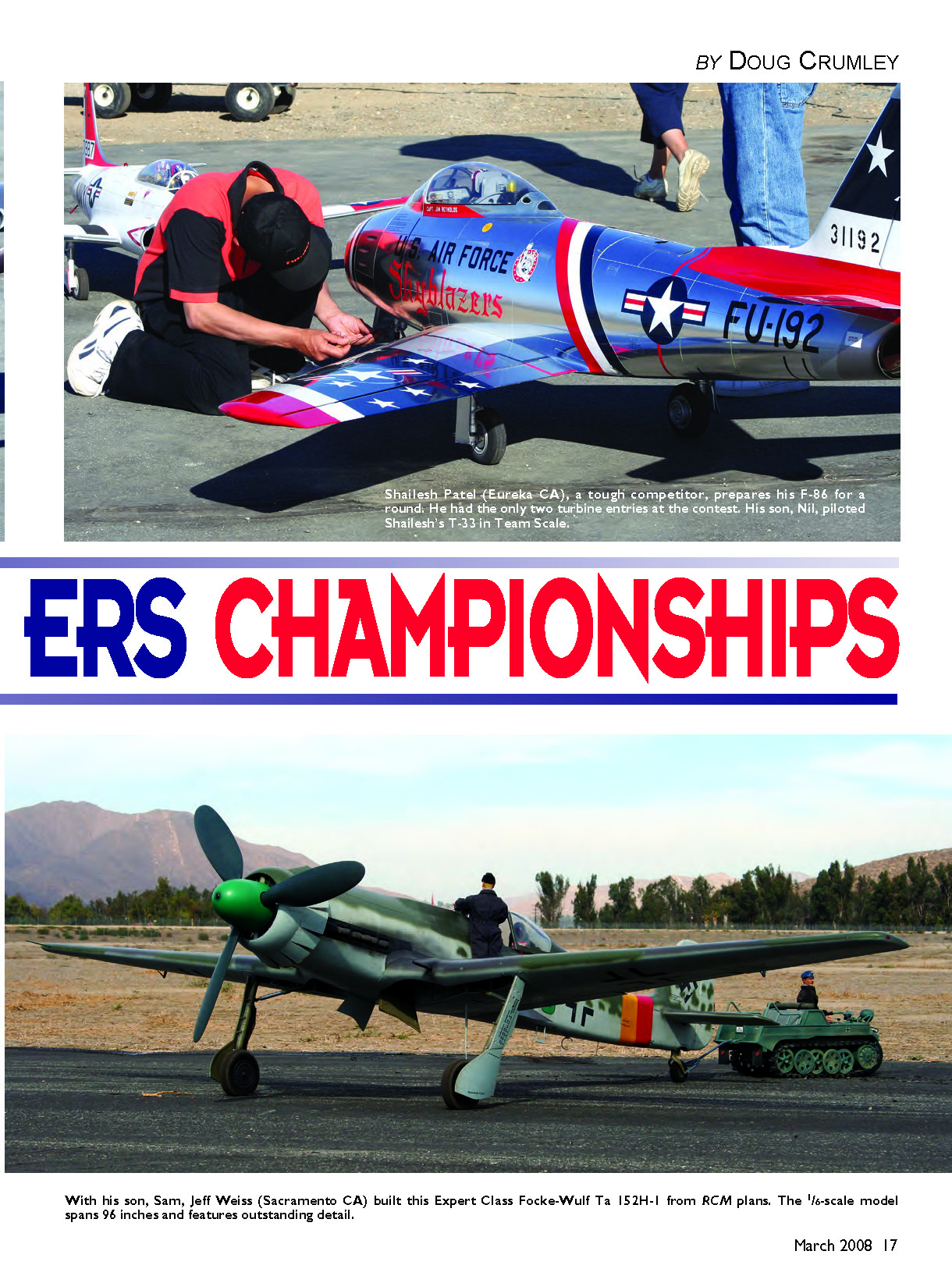
- Shailesh Patel (Eureka, CA) — F-86 — Static Total 96.500 — Top Flights Average 95.333 — Total 191.833
Visit www.scalemasters.org/Home.html to see a complete list of the final standings.
Sources
- Scale Masters — www.scalemasters.org/Home.html
- Bill Hart — (714) 894-2747 — [email protected]
- Carolyn Van Herk — (714) 839-3805 — [email protected]
Transcribed from original scans by AI. Minor OCR errors may remain.

