
2008 Control Line World Championships
Landres, France, hosts honored aeromodelling competitors
by Charlie Johnson, Rich Lopez, and Howard Rush
EVERY TWO YEARS, the FAI authorizes a World Championships (WC) for control-line (CL) models. Nations submit bids to host the event, and for 2008 it was granted to the Fédération Française d'Aéromodélisme (FFAM).
The world's nations sent their teams to Landres, France, located in the historically significant Lorraine region in the eastern part of the country. This is the same dedicated-to-CL-models venue at which the 2000 WC was held.
The French organizers did many things right but could have improved in some areas. The Speed circle was great, and it had state-of-the-art timing equipment and visual displays. Spectators knew exactly who posted the top 10 times and exactly how fast the model in the cage was going lap by lap.
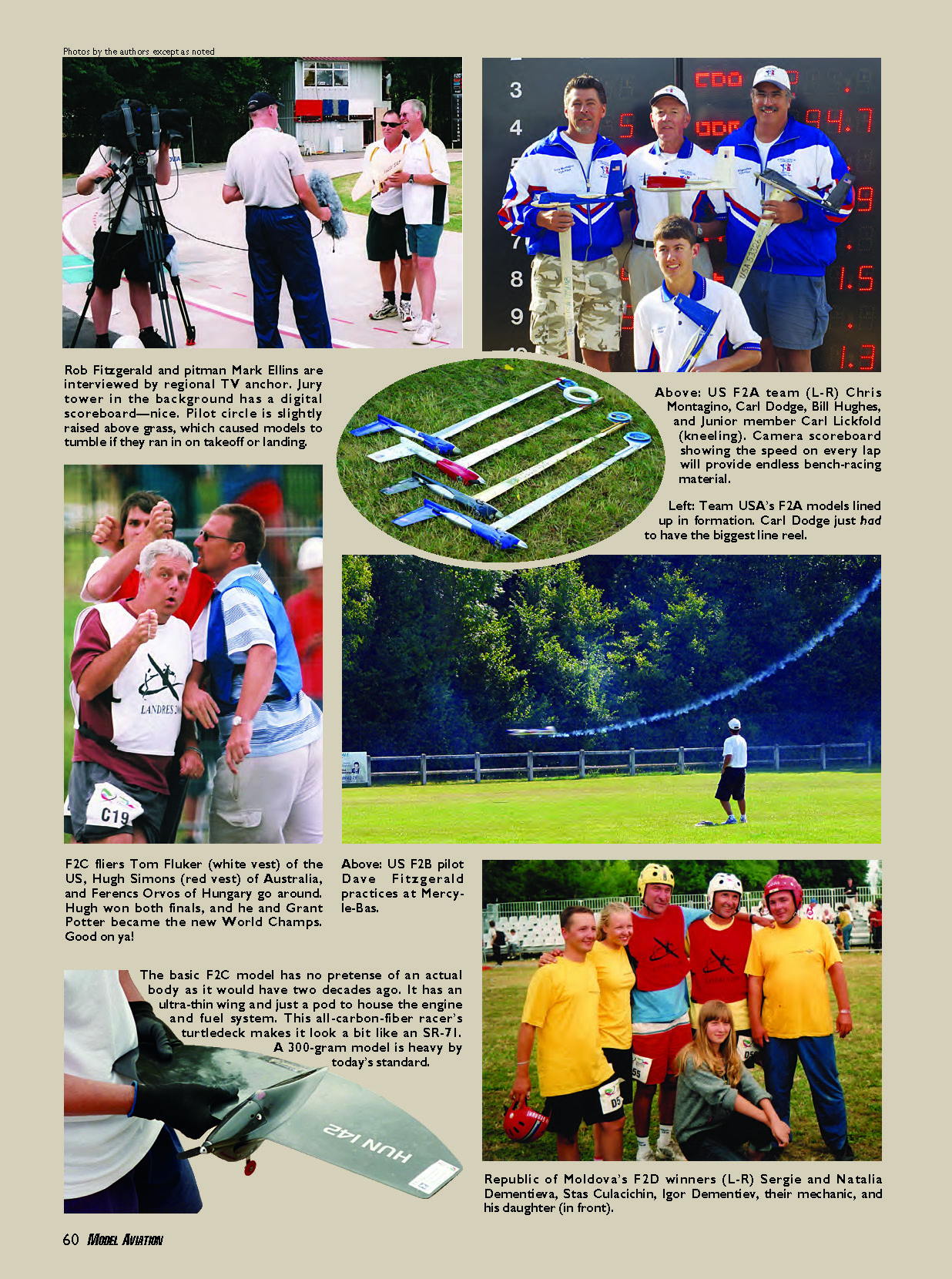
The basic F2C model has no pretense of an actual body as it might have two decades ago. It has an ultra-thin wing and just a pod to house the engine and fuel system. This all-carbon-fiber racer's turtleneck makes it look a bit like an SR-71. A 300-gram model is heavy by today's standard.
The official Precision Aerobatics (Stunt) competition circles were of different surfaces: grass and concrete. There can never be too many practice circles for those pilots, and they prefer the grass surfaces to be cut to putting-green specifications. That did not always happen. Several large scrolling monitors displayed the Stunt scores from first to last place. Although the monitors were not located near the official circles, everyone had access to them at the official headquarters building.
The Team Race venue was excellent, also with state-of-the-art electronic equipment for timing and lap counting. The public-address (PA) system and visual displays kept spectators well informed.
The official Combat circles were quite good, but the venue suffered from a lack of an immediate practice area. Combat did not receive the benefit of electronic displays, an adequate PA system, or the required visual match time clock. The large contingent of spectators was often left to try to figure out who the competitors were and what the outcomes of the bouts were.
The Team Trials competitions held in the US to select the best representatives for the WC are stiff and require the competitors to bring their best games. Once the members are selected, there is no time to slack off from flying; practice is ongoing until the travel date arrives.
The FFAM is to be commended for all the effort it put into organizing and preparing for the opening ceremony, which included an up-close fireworks display, a laser light show, and a giant-screen tribute to the participating countries. The competitions themselves went off without many glitches, and the closing-ceremony banquet featured incredible regional foods.
My biggest disappointment, and that of many team members, was that the national teams did not get the opportunity to parade into a stadium area for all the spectators and government dignitaries to see. The US pilots were dressed and ready to be led in by former World Champions Carl Dodge, Tom Fluker, Mark Rudner, Paul Walker, and Mike Willcox, who were to have carried the American flag held high for all to see.
Enjoy the following coverage. Visit the CL WC Web site to see the complete results.
Rich Lopez [email protected]
F2A (Speed): Oh, so close!
Six-time World Champion Luis Parramon of Spain pulled out a seventh individual title. His speed of 296.3 kilometers per hour (kph) edged out Hungary's Sandor Kalmar by 0.3 kph and Italian Luca Grossi's 295.9 kph.
Luis struggled a bit at this contest with his first-round flight of 293.8 kph, placing him third. It looked good for an upset when he didn't get a time in the second round. The first of three rounds started Wednesday, with Thursday and Saturday off, so there was plenty of time for test-flying. Luis came back Sunday and turned the championship-winning time on his final flight. The top five times were separated by only 0.7 kph.
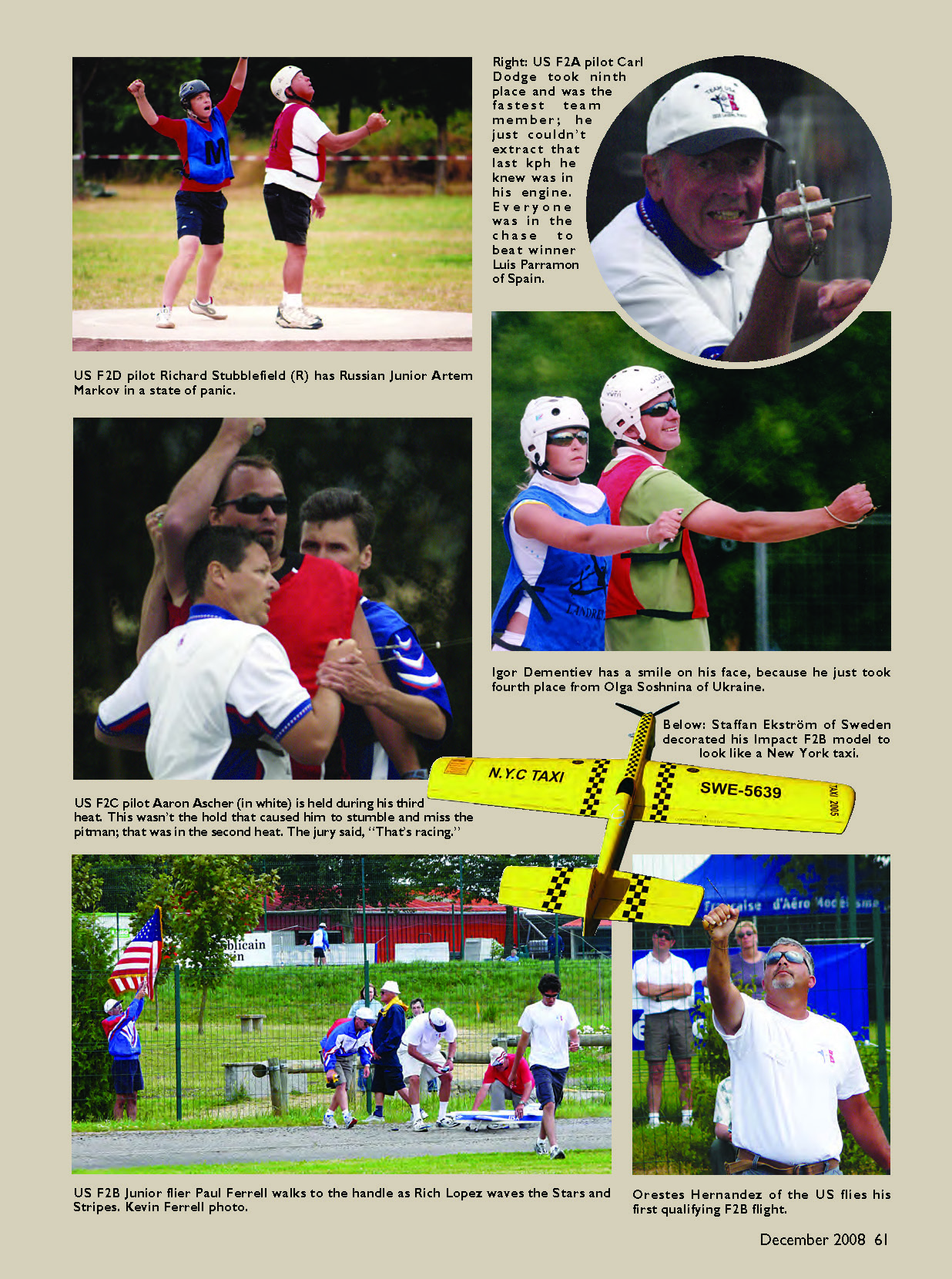
Team USA's Carl Dodge was in the second group, placing ninth overall with a best speed of 291.4 kph. Chris Montagno was the next-highest-placing American with 284.5 kph, which put him in 20th place out of 47 entrants. Bill Hughes, the third US team member, finished 24th with 282.3 kph.
The Junior US team member, Carl Lickfold, turned a respectable 280.0 kph, which made him the second-highest-placing Junior and 28th overall. He also earned bragging rights as the fastest-ever American Junior flier and AMA recordholder. Carl will attend Penn State next year, while his father enjoys a modeler's dream job of working at Nelson Competition Engines.
The Americans landed in sixth place out of 19 teams. The United Kingdom was first, followed by Hungary, Italy, Ukraine, and Russia.
Team places are calculated by adding the top three individual times, so it would have been impossible to pass the UK, which had 881.8 kph. Russia and Ukraine were within striking distance, since 2 kph would have moved the Americans up two spots.
The team members were aware of that and did everything possible to extract that last bit of speed, but everyone was trying the same thing. The members are to be congratulated for their outstanding individual performances and for working so well as a group.
A digital scoreboard made for a more interesting contest, because the top 10 times were listed by nation and by the current flier's speed lap by lap. If the engine's shriek dropped off a bit, you'd see it on the lap speed.
Thanks to the trees' shade and the close proximity of the pits, that proved to be a popular hangout for spectators, drawing large crowds throughout the three rounds. Having the concession stands just around the corner didn't hurt either.
F2A models had similar designs, partly because of rules and what goes fast: side-mounted engines, long inboard wing and outboard tail, and the tuned pipe sticking out of the cowl. Rules limit the wingspan to 1 meter, and the control lines have to be separated by 5 mm at the tip to avoid their grouping. The 2.5cc engines run the same castor oil-and-alcohol mixture.
Processing is stringent, with every dimension checked for compliance. Tanks are flushed before every official flight to make sure that they don't contain an illegal ingredient.
During a flight, the model needs to be whipped up to speed. If everything sounds good, the pilot puts the special handle into the pylon. Once in place, the official timing begins after two laps. Once the timing starts, the flier has an official time no matter what happens, so often the pilot pulls back out of the pylon before it's too late.
There's usually enough time to shut off the engine and adjust the needle-valve setting, and possibly even change a bad plug. If the pilot decides that the setup needs to be changed, he or she will head back to the pits and have a reflight following the end of the round.
Strategy comes into play there. If the conditions are bad, you might see as many as 70% of the contestants go for reflights, hoping for more ideal weather. It makes a long day for contestants and officials.
Engine selection is down to just three options, one of which is to use a Profi as the World Champ and many others did. These power plants are readily available. The next option is to use the Irvine engine, as the Brits do.
The third option is to buy the engine-in-a-box from a specialist engine builder. Without special tools to take the power plant apart, it is returned to the builder for maintenance and you wait for another to arrive in the mail. These can be very expensive—sometimes on the order of $1,000 engines.
There has to be a secret to going fast, right? Luis Parramon has let many people examine his model and engine to look for those secrets. Is it the airflow into the intake, a special pipe or propeller, or the flying surfaces' alignment?
Nobody knows for sure, but the British team has put in a tremendous amount of effort to get close to Luis's speeds. Sandor Kalmar and Luca Grossi are also nipping at his heels, and Sandor would like to end Luis's streak and win the CL WC in his home country of Hungary in 2010.
The 2008 WC was one of the most enjoyable, and I've been going since 1976. It featured an excellent venue, good organization, and great performances by all four US team members, not to mention the pilots who placed ahead of them.
I'm sure the Americans' one request for next time would be to book a hotel that doesn't feature beds for short people. But they were up all night working on engines, so why would they need beds anyway?
Charlie Johnson [email protected]
F2B Aerobatics
European Stunt fliers call the Lorraine Control Line Stadium "Turbulandres." This year's WC was sunny and warm, but eight years of surrounding shrubbery growth made the Stunt circles even more turbulent than in 2000.
The day before, Paul Walker intended to pack his electric-powered model for the trip, but it hit a bird and crashed. He reverted to the RO-Jett .65-powered airplane he flew at the 2006 WC.
Orestes flew the Yatsenko Shark, with which he has won the last two US Nats. Paul Ferrell, a concert pianist, flew a Rhapsody in Blue made from Fancher-designed components. Inside the cockpit was a miniature record-album cover: "Rhapsody in Blue / An American in Paris."
The Stunt team met for three days of practice in Muncie, Indiana, before flying to Europe. After arriving in France and reassembling their models, they set out for the practice site: a soccer field in a lovely setting at the end of Rue du Football in the village of Mercy-le-Bas. The shifting wind on the tree-surrounded practice field was not so merciful, but the team flew.
Dave's first qualifying flight on both circles was so good that he didn't need to fly either second flight. Orestes was also in good shape after his first two flights; he forewent his fourth.
Paul Walker provided the qualifying drama for the US. His model ran out of fuel during the first leaf of the clover in his first flight. His next flight, on the grass circle, was forgettable. Paul's two remaining qualifying flights had to be good.
He had an excellent third flight in extreme turbulence at the top of the circle. The model rolled left almost 90° during one of the insides in his Overhead Figure Eight. Paul knew he needed to maintain the track to qualify, so he did. His fourth flight was also good, putting all US Senior team members in the finals.
Paul Ferrell flew the best he ever had. Dave Fitzgerald had been coaching him, and the California Stunt Varsity's influence showed both in the accuracy of Paul's flying and the style of his movement.
I watched former World Champion Han Xinping fly from downwind. His round maneuvers were as lumpy as in previous years, but FAI scoring emphasizes other elements of the pattern. Han's bottoms were consistent, and his intersections were all right in front of me.
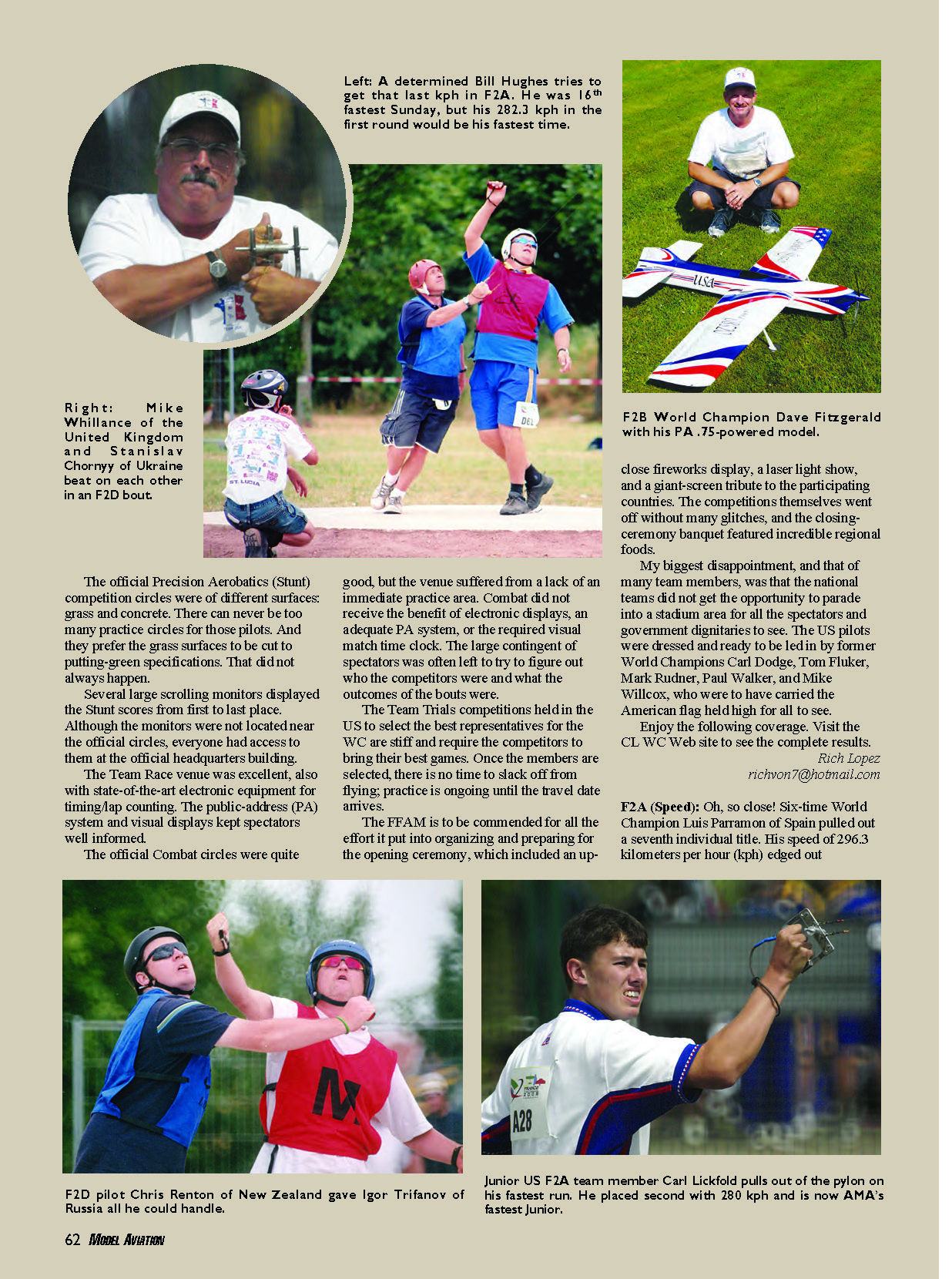
Dave Fitzgerald continued to dominate in the finals. Paul Walker flew well, but turbulence kept hitting his model in the high maneuvers. Orestes's scores improved as the weather worsened.
The Chinese team did well in the finals, but Han struggled to maintain his shapes after a strong 120° wind shift during his third flight. Igor Burger of Slovakia put in a great third flight to knock Han out of second place.
Igor's electric-powered model employed his computational-fluid-dynamics-designed airfoil and a logarithmic flap linkage to give it a great corner while coping with the turbulence. His motor control system had sophisticated augmentation from onboard sensors, but he cautiously disabled the augmentation in the blustery weather.
In addition to finishing as runner-up in the world and having more fun than anybody at the contest except Orestes, Igor spent his week helping Keith Renecle of South Africa keep his motor flying. I think all of Igor's spares were in Keith's airplane.
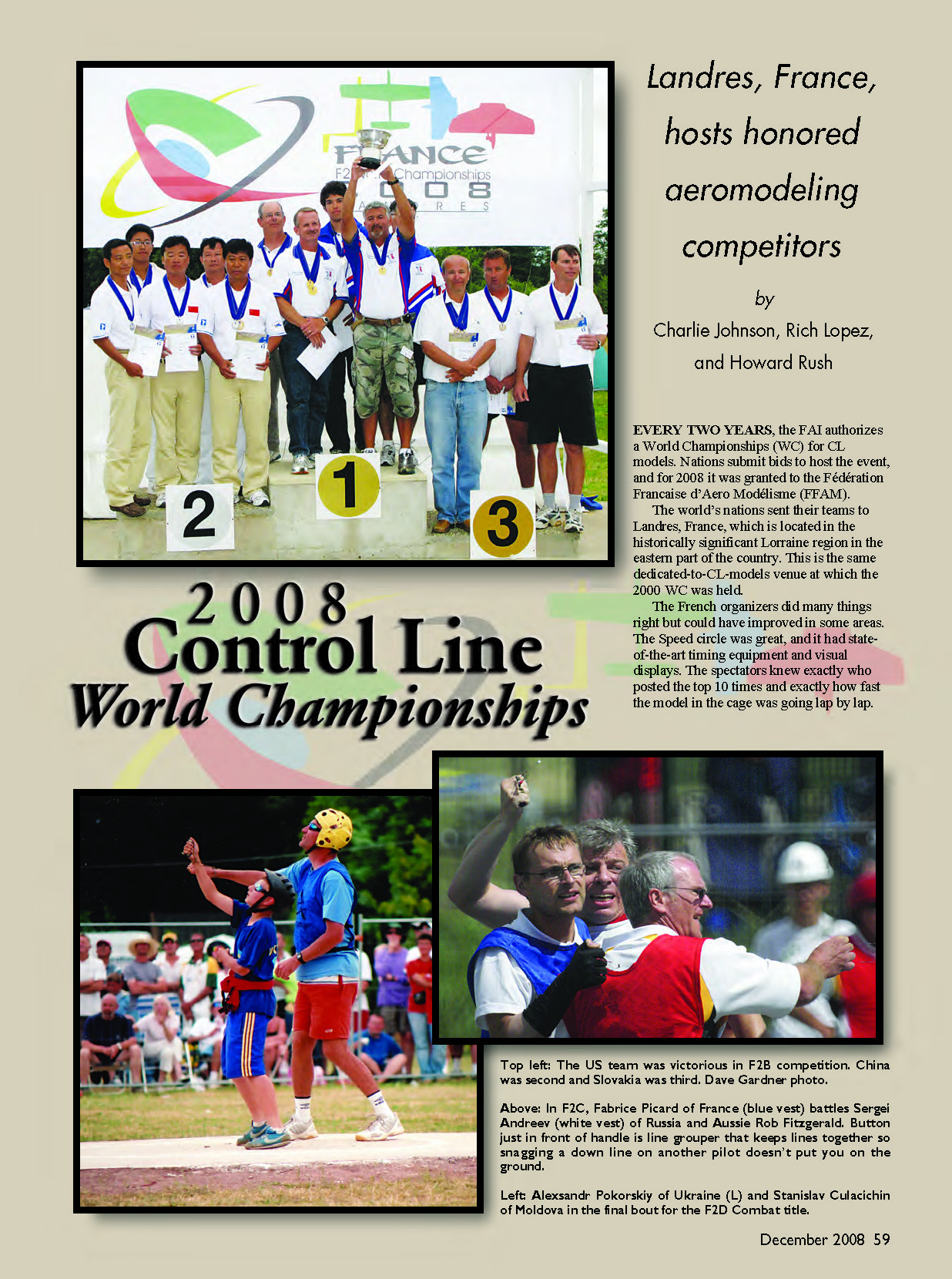
It was a great contest. The US team members' hard work earned them both the individual and team Gold Medals. We are mighty proud.
Howard Rush [email protected]
F2C Team Race
Considering all the misfortune US pilot Tom Fluker and pitman Dick Lambert suffered at the 2006 WC in Spain, it was thrilling to see them blitz a 3:11.7 in their first heat this year. Qualifying for the semifinals shouldn't have been a problem with such a fast time, but halfway through the second round they were in 11th place. Only the top 12 went on to the semifinal races.
Ukrainians Valeriy Kramarenko and pitman Yury Chaika turned a stunning 3:01.9 in their second heat. Talk was that a sub-3:00 time might be achieved in the semifinals.
Hugh Simons and Grant Potter's good fortune was to knock the other Australian team out of the finals; Robert Fitzgerald and Mark Ellins finished fourth with 3:09.7. The Aussie teams also had good times in all their heats and semifinal races; there were no disqualifications or miscues.
Fluker/Lambert did make the semifinals, thanks to many of the teams trying too hard. The 3:13.3 the pair turned in the second semifinal race was most satisfying, since it was a hard-fought battle—sort of like three-pilot Combat but with the lines cut to roughly 40 feet. It netted them seventh place overall.
Each of the other two American teams had just one shot to make an official time. Jason Allen and mechanic Bob Whitney were disqualified in the first heat and had a scorching-fast race going in the second when they broke a propeller during the pit stop at lap 69. We could hear Bob's groan over the cheers of supporters who filled the grandstands.
Lenard and Aaron Ascher had a great time going in their second heat, but Aaron was held in the circle by another pilot after he had shut off the engine. When the other flier released his grip, it caused Aaron to stumble and the model never reached the pitman. A protest was filed with the jury, and video clearly showed Aaron's being held, but the jury decided it was just racing.
Ascher/Ascher and Allen/Whitney flew conservative third heats to make sure they had times that would help their team placing. Allen/Whitney turned a 3:27.7, which was good for 26th overall of 42 entries. Ascher/Ascher turned 3:34.4 for 32nd overall.
The team went to France with a total of 17 (which is determined by adding the final finishing spots). Russia was next with 27, Australia had 35, and Ukraine earned 35 (the Aussies had the higher individual score, which broke the tie).
Italy scored 59, the UK had 64, and the US finished seventh with 65. It was close enough that with slightly better fortune, the Americans could have finished fifth.
In the Junior finals, the Ukrainian team of Igor Savaschenko and Olexsandr Vrons'kyy was on its own after approximately 67 laps, when one team was disqualified and the other retired. During the next 133 laps, some crowd members cried for the race to be rerun, but the jury let them continue.
Igor is an excellent pit pilot and did very well with the Seniors, turning a 3:22.4 heat and a 6:39.0 final time. These are fantastic times.
This WC will long be remembered for its two Senior finals, the first of which featured Simons/Potter of Australia, Thierry Ougen and Roland Surugue of France, and Pascal Surugue and Georges Surugue of France.
The teams had perfect starts, but the Aussies got away cleanly at the first pit stop. Pascal Surugue appeared to stumble and collected Thierry Ougen as he went by for his first pit.
The Australians continued with an eye toward the jury tower, awaiting instruction. The audience sat in disbelief, expecting the race to be stopped.
When the 200 laps were completed, Simons/Potter was announced the winner with what was supposed to be a world record of roughly 6:15. Most people headed off to the Combat final matches.
Looking through the rules, one other competitor should have been in contention at the halfway point (which is 100 laps for a final and 50 laps for a heat or semifinal). The jury apparently looked at the incident as a sort of no-fault happening, such as having two of the models fail on their own.
Ougen/Surugue was forced to protest the other French team, pointing out that it was impeded by the pilot in its way, which should have been a foul. The Team Race jury couldn't reverse its decision, but the FAI jury was consulted and said that the French team should have another chance.
Official results show the Australian team winning again with an even faster final time of 6:13.2, and Ougen/Surugue credited with a 6:32.2 for second place. It was a shame that the Aussie team had to put in 200 laps, be announced the World Champs with a record time, and then have to do it again.
Why are the times so fast? Detail refinements in the engines have allowed 10-lap race times of mid-16 seconds to become fairly common. These would have been classed as exhibition times in years past, showing off for the crowd or trying to sell engines.
Probably the biggest improvement has been in the multifunction valve, which permits the engine to be started while still filling the tank. This takes a lot of coordination by the pitman, but it turns a pit "stop" into just a pit "hesitation."
Many people clocked the model-in-hand time for the pitman to be as short as 1.5 seconds. Watching through a telephoto lens, one could see fuel squirt out the overflow as the pitman released the model.
These valves are high-maintenance items, requiring service between races. You don't toss your equipment in the garage and wait for the next contest.
Watching the racing was a great time. The digital scoreboard, such as the one in Speed, made it more engaging for the spectators.
It was a pleasure to hear Dick Lambert say that he was pleased with the times he had turned. Now the plan is to find those last couple of seconds that will get his team into the finals in Hungary at the 2010 CL WC.
Charlie Johnson [email protected]
F2D Combat
This was the largest F2D competition that has taken place in quest of a Gold Medal and the title of World Champion since 1978. Roughly 90 pilots from 30 countries went to France with dreams of the WC title. Mongolia had an entry for the first time.
Russia’s Igor Trifonov did not specifically defend his 2004 and 2006 World Champion titles, but rather he competed as part of Team Russia. The US team of Mike Willcox, Richard Stubblefield, and Andy Mears represents a long-standing tradition of Texas Combat and years of experience in the center circle. The Americans were well prepared in terms of equipment readiness and practice.
US team mechanics Bobby and Nick Mears, Mark Rudner, Lester Haury, and Allen Deveuve worked tirelessly to start and tune engines. All pilots flew well enough to finish with three-two records, tie for 20th place individually, and tie for fifth as a team. A few more wins could have put them on the podium for a team medal.
The officiating crew members had many years of experience running F2D contests, and they had their work cut out for them at this WC. The volume of flying each day was tremendous, not only because of the number of entries, but also because of the high number of reflow matches caused by ties. The ties usually resulted from both pilots taking a single cut on the string.
The FFAM organizers took a great amount of time to ensure that there was a chain-link fence in front of the spectators’ grandstands. For those who follow the F2D circuit, identifying the pilots was not too difficult; however, it was impossible for the casual observer, since neither pilots nor countries were announced.
Team USA had some 30 supporters who tried to be present for each bout, to cheer and wave Old Glory. It was a pity that little information was provided to them.
Equipment seems to have stabilized with Russian/Ukrainian-style models with either a hinge-pin tail or a sewn-on fan-tail assembly. There was nothing at the contest that we had not seen. There were more carbon-stick TE models than in the past, but that did not seem to give anyone an advantage.
The most popular engine was the Fora of various generations. A variety of competitors used numerous AKMs, Profis, Cyclons, and ZALPs. Some pilots’ speed advantages, such as Stas Chornyy and Andrius Rastenis, seem to come from the correct propellers for the engine’s power band. Stas and Andrius used Foras on blue propellers.
There are so many propellers that come in so many colors that it is almost impossible to know with certainty which ones really do work. The best way to know what works on your engine is to test and keep notes on the results.
Ten Junior pilots entered this WC, two of whom were young ladies. Natalia Dementieva of the Republic of Moldova and Portugal’s Aliona Fomin joined Madina Muhamedjan of Kazakhstan, Monique Wakkerman of the Netherlands, Laura Leino of Finland, and Olga Shoshinina of Ukraine to do battle. Olga is so proficient that she finished fourth overall, and Laura tied for eighth place.
The biggest story had to have been the rise of Ukrainian Junior Aleksandr Pokorskiy, who made his way to the final WC bout. He is short in stature but makes up for it in his aggressive yet controlled flying style.
Andy Mears felt as though he was taught a lesson by a kid one-quarter his age. Andy demonstrated exceptional sportsmanship by congratulating the youngster after their bout. He lost for the second time to new World Champion Stanislav Culacichin of the Republic of Moldova.
Stas flew well throughout the competition to earn his title. Moldovan teammate Igor Dementiev joined him on the podium, on the third-place step.
There were plenty of memorable matches that demonstrated incredible skill and precision. The Central and Eastern Europeans’ dominance was evident in the final results. Only Canadian Pat Mackenzie broke into the top eight, with his tie for fifth place.
Mike Willcox is selling a video CD of much of the F2D action. Contact him via E-mail for the price and his address.
Rich Lopez
Sources:
- CL WC results: www.f2cmbl.org
- Mike Willcox: [email protected]
Transcribed from original scans by AI. Minor OCR errors may remain.

