
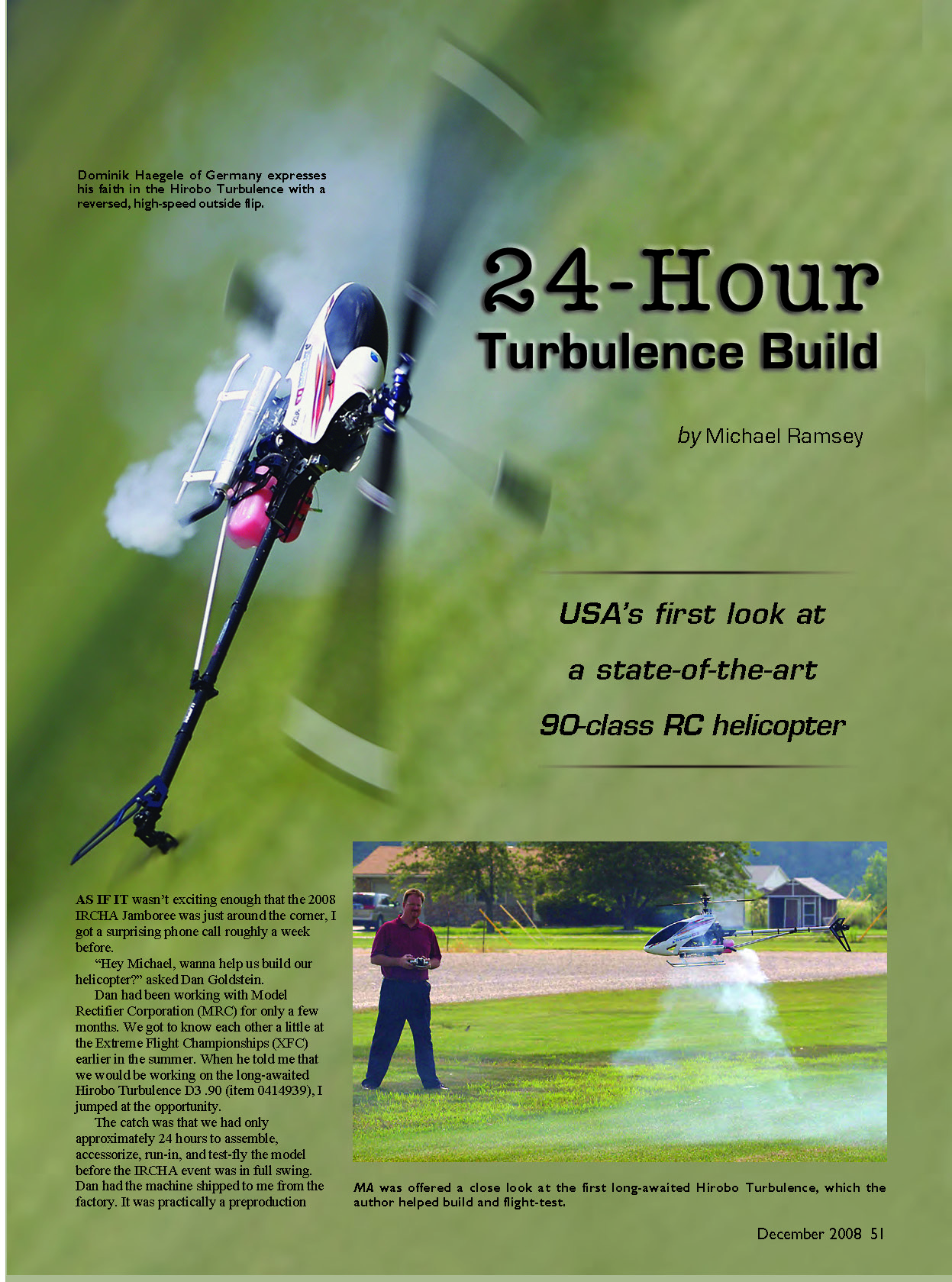
24-Hour Turbulence Build
Introduction
As if it wasn't exciting enough that the 2008 IRCHA Jamboree was just around the corner, I got a surprising phone call roughly a week before.
"Hey Michael, wanna help us build our helicopter?" asked Dan Goldstein.
Dan had been working with Model Rectifier Corporation (MRC) for only a few months. We got to know each other a little at the Extreme Flight Championships (XFC) earlier in the summer. When he told me that we would be working on the long-awaited Hirobo Turbulence D3 .90 (item 0414939), I jumped at the opportunity.
The catch was that we had only approximately 24 hours to assemble, accessorize, run in, and test-fly the model before the IRCHA event was in full swing. Dan had the machine shipped to me from the factory. It was practically a preproduction example, and it was clear that Hirobo uses high-grade bearings. If you have replaced bearings in a glow engine, you're familiar with what happens when they go bad: it's ugly and often leads to more expensive repairs. Good bearings are worth the money.
The Build
As we built the Turbulence, a number of points convinced me that it was worth every penny. Overall, it went together without modification. It's comforting to know that a great deal of money isn't going into a machine that is also going to be a complicated build.
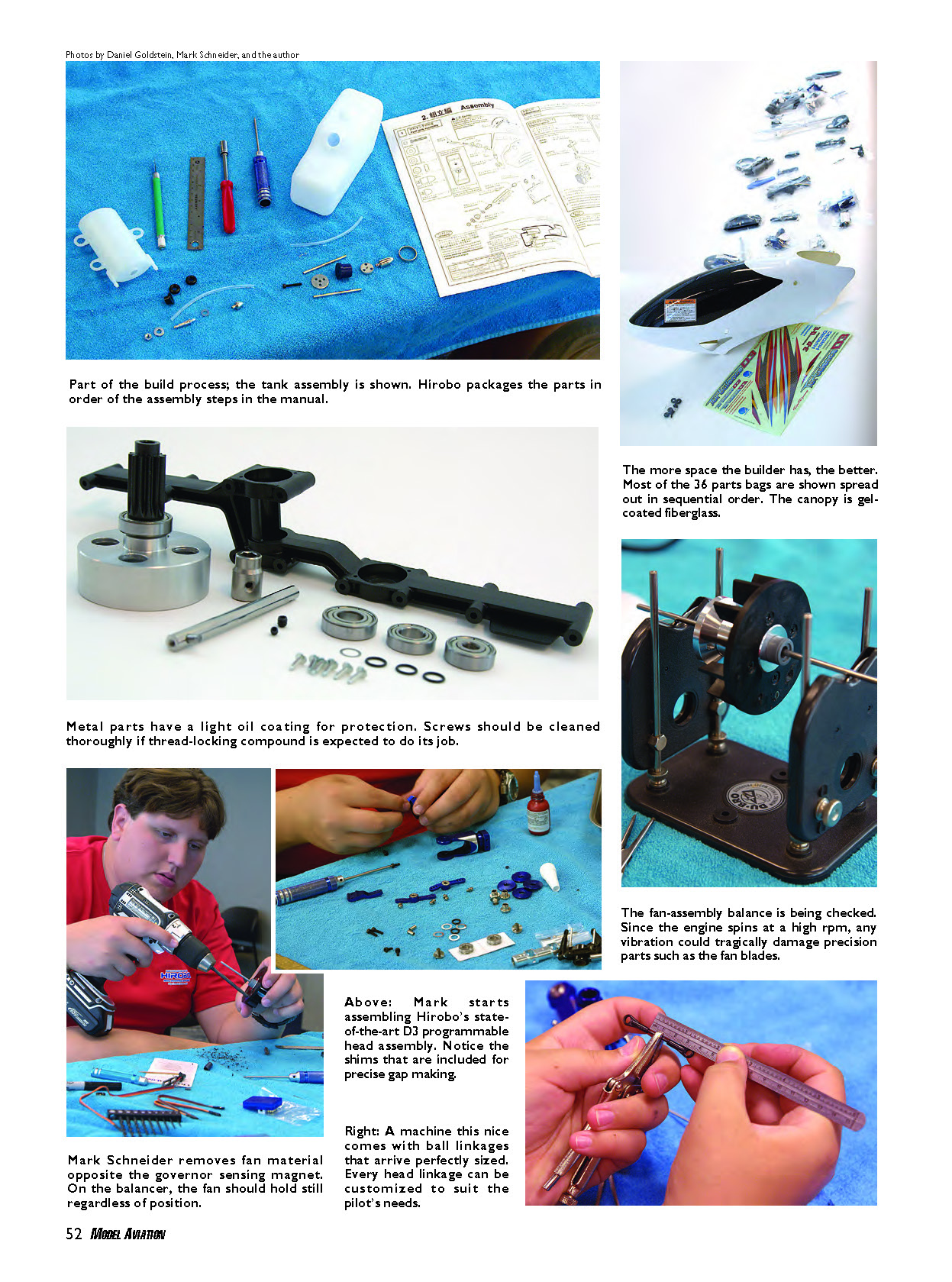
It turned out to be a lot of fun. Yeah, there were more than 36 bags of parts, but the well-organized manual was clear and accurate. The photos and captions point out more of the reasons why I think the Turbulence is special.
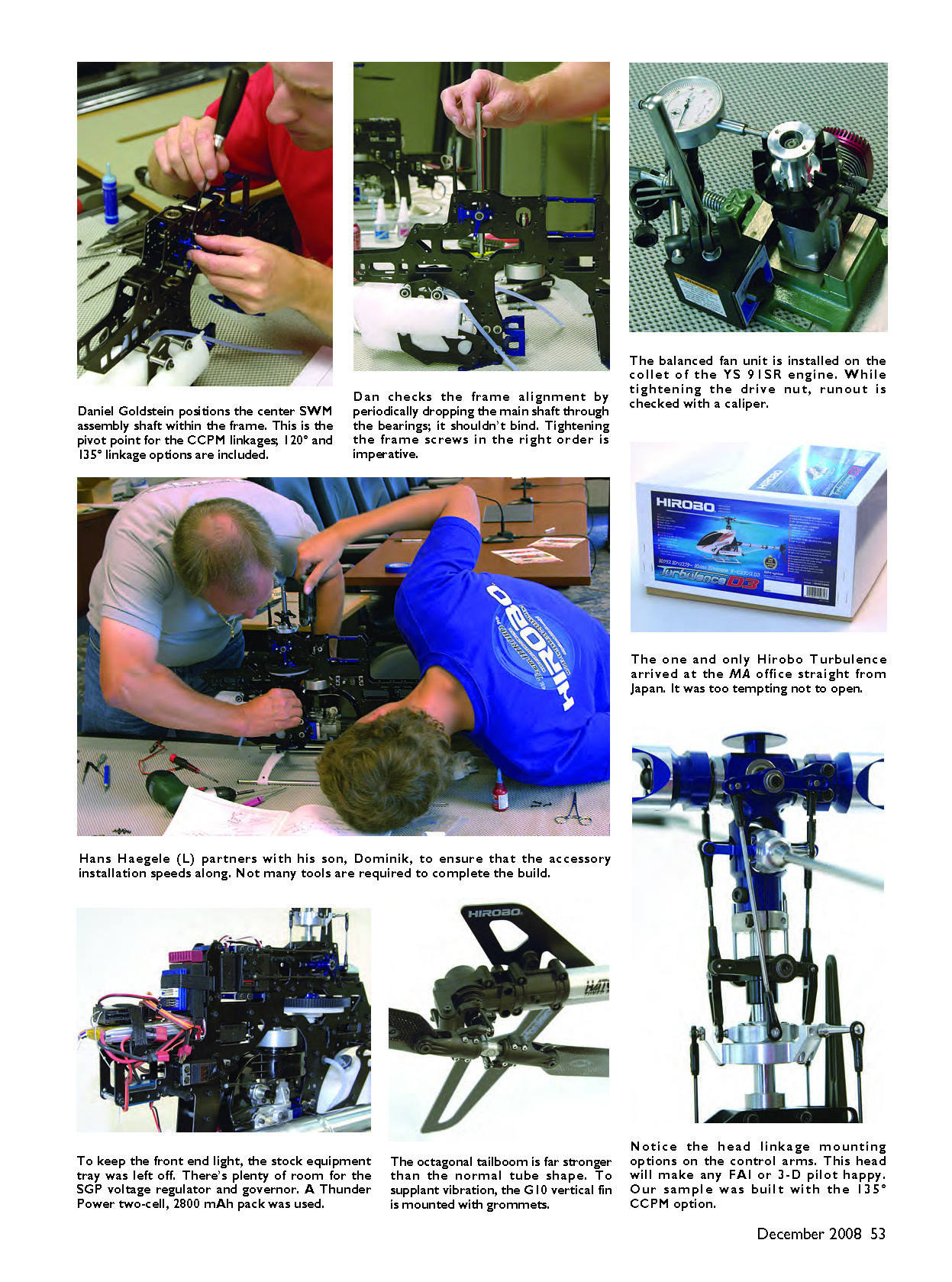
We started building Wednesday afternoon, and by Thursday afternoon we were test-flying the Turbulence D3. Dominik, Hans, and Albert joined in at roughly the time we started installing the radio gear, as expected. Their experience was a huge benefit and helped us finalize the equipment-layout positions and radio programming.
It was important for me to see how experts assemble these machines. As a kid in my father's basement, no matter how many times I watched him build a wing, I learned something new each time. Eventually I built my own airplanes and continued the learning process.
During this project, I was taught more about lubricants and thread-locking compounds than I thought was necessary. I also picked up some tricks involving balance and frame assembly. Study the photos closely and you'll learn them too.
So six guys on a helicopter kit, every supply and accessory known to man, and a quick 24 hours later, we had a new model to test-fly. Mark ran the first tank of fuel through it and trimmed it out on the controls. The tail-rotor servo trim was nailed on the first try; my new machines always need rotor-trim.
Flight Impressions
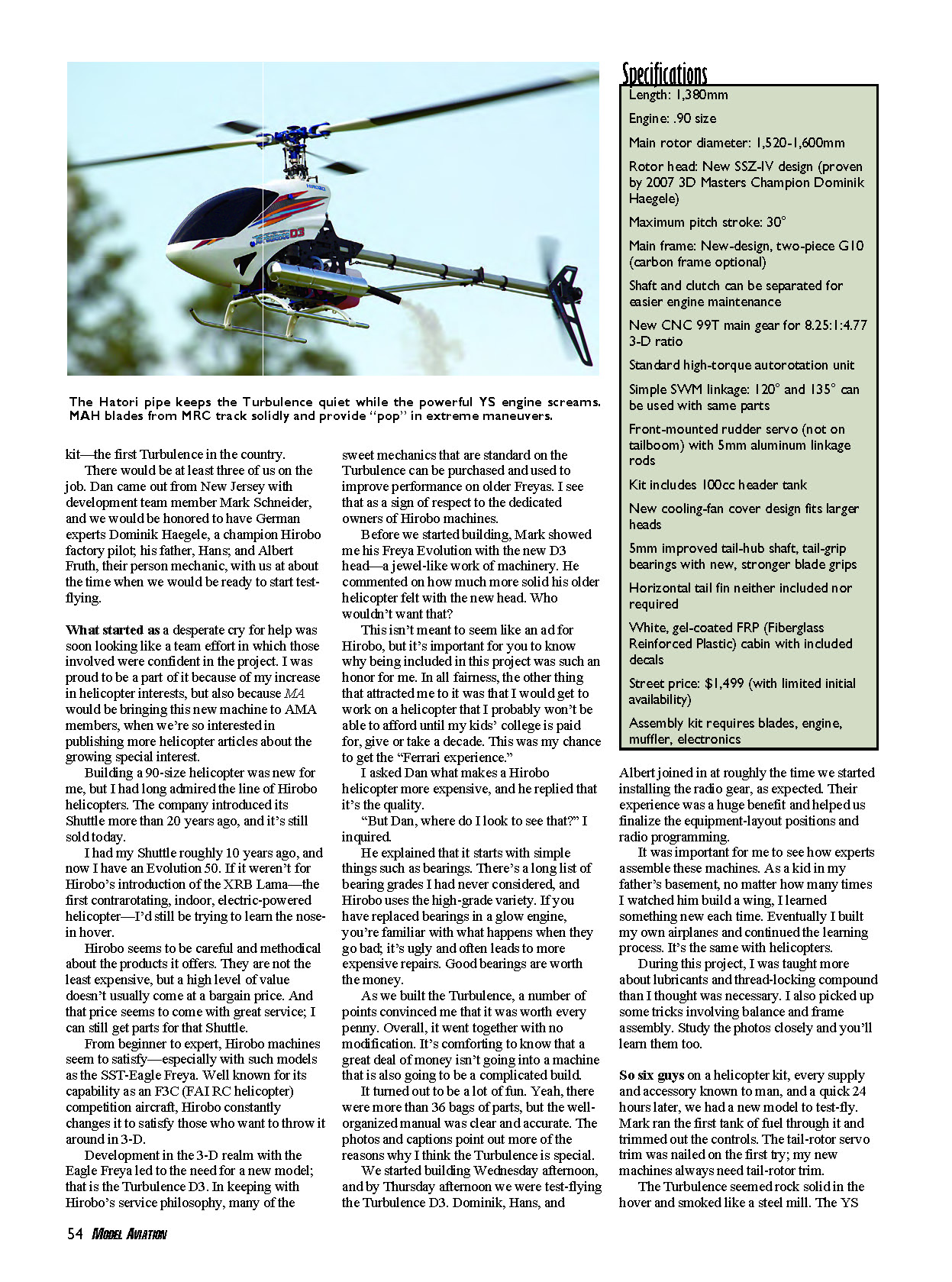
The Turbulence seemed rock solid in the hover and smoked like a steel mill. The YS 91SR engine ran smoothly and coolly, so we pressed on with hover flights.
For 3-D pilots, hovering a helicopter while the engine breaks in appears to be a painful task. I was happy to offer my meager pilot skill and hover the Turbulence for a while. Dan was rightfully nervous since he'd never seen me pilot a helicopter before. I kept it in one spot for a few minutes to put his mind at ease.
Even with the rates set for 3-D control, I was impressed with how honestly the model responded to my input. The 135° swashplate mixing seems to truly help eliminate CCPM (cyclic/collective pitch mixing) control-input interaction. Likewise, the straight servo layout plays a large part in the available control and accuracy of pilot input.
What I noticed most about flying a 90-size machine for the first time was how locked in and solid it felt. I was so used to flimsier helicopters that this one left me with little to do in a hover.
The other thing that impressed me was this size model's autorotation (dead-stick) capability. I'm used to having barely enough inertia to land, but the 90-size almost seemed to have the steam to climb out before the thought of landing would be needed.
In a phrase, I felt "peace of mind" with the Turbulence—as if I could do or fly almost any maneuver.
Further Testing and Issues
As for that "any maneuver" thing, we initially left that testing up to Dominik. He had the opportunity to feel out the machine and show us how our build really went.
Two problems showed up during the weekend. Neither was a problem with the helicopter itself; they were more snafus.
- The governor sensor placement needed adjustment because it was coming loose.
- Our engine developed power-output issues that prevented us from testing the model much further.
Dominik had his Turbulence at the IRCHA event, so we still got to see what it could do. His piloting skills are extraordinary.
It was sad to hear about the test model's trouble, since I was promised another flight—forward this time. But it's sensible not to push the helicopter when things aren't the way they should be.
Lessons Learned
If someone asks you to help him or her with a project, consider the prospect of learning no matter what the subject. In addition to developing friendships, I feel more competent as an RC helicopter builder and pilot, and my ability to maintain and diagnose faults improved. Besides our project, other things that happened at the IRCHA Jamboree increased my awareness.
It's time for me to save my pennies for a great 90-class helicopter. It's so worth it!
MA
Michael Ramsey [email protected]
Transcribed from original scans by AI. Minor OCR errors may remain.

