
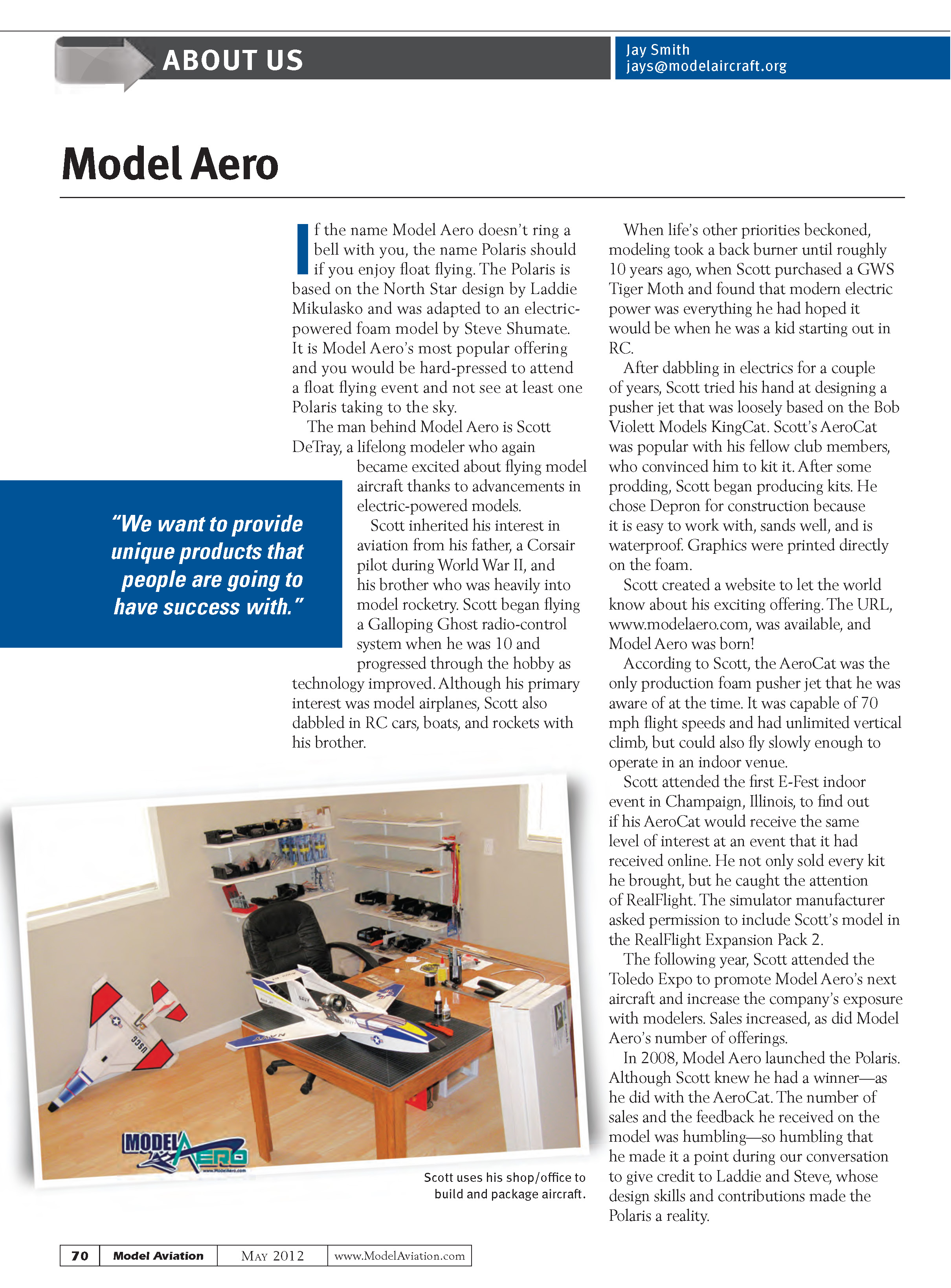
Model Aero
Jay Smith [email protected]
Overview
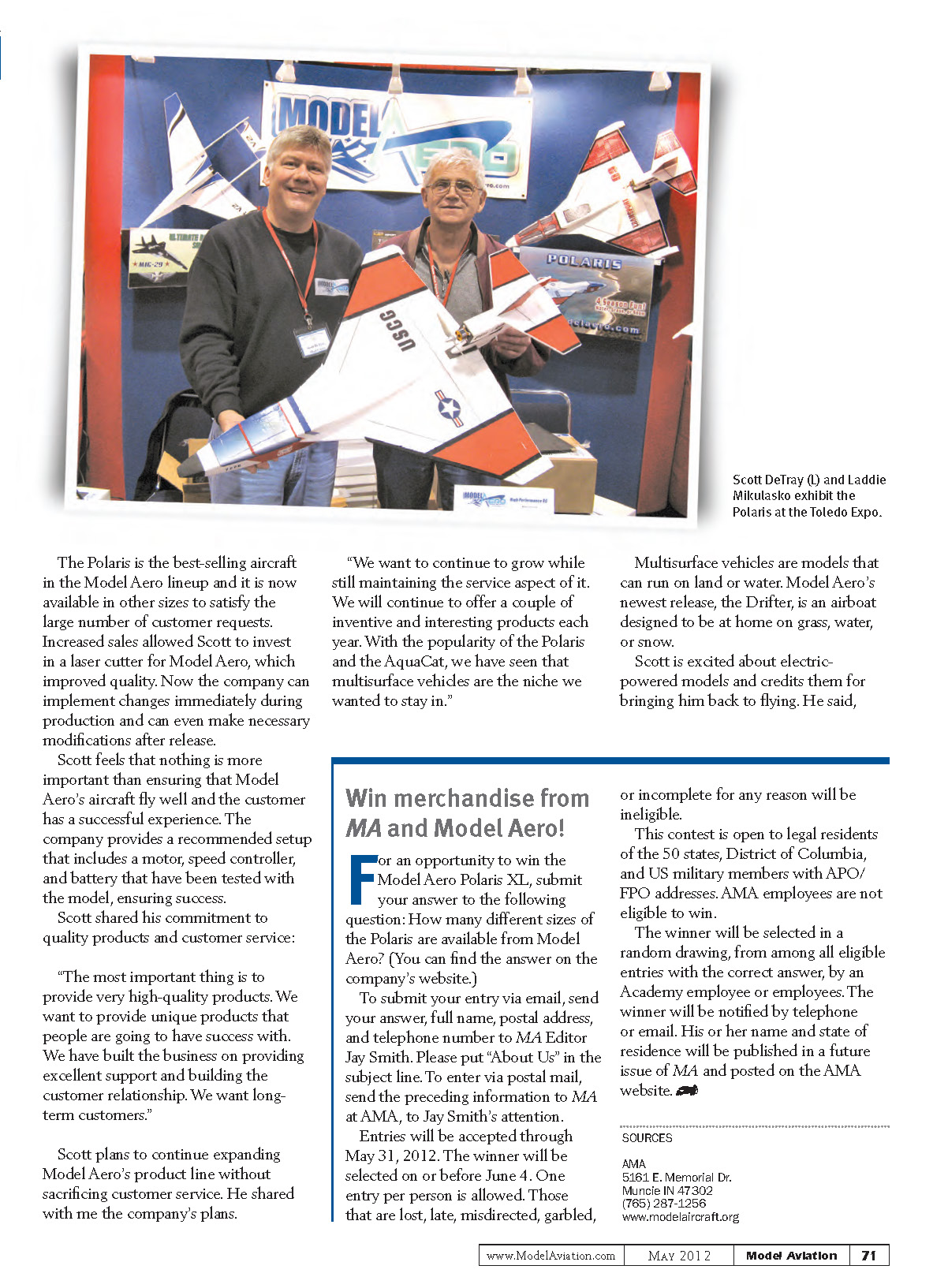
If the name Model Aero doesn't ring a bell, the name Polaris should if you enjoy float flying. The Polaris is based on the North Star design by Laddie Mikulasko and was adapted to an electric-powered foam model by Steve Shumate. It is Model Aero's most popular offering, and you would be hard-pressed to attend a float-flying event and not see at least one Polaris taking to the sky.
Founder
The man behind Model Aero is Scott DeTray, a lifelong modeler who rekindled his excitement about flying model aircraft thanks to advancements in electric power. Scott inherited his interest in aviation from his father, a Corsair pilot during World War II, and from a brother who was heavily into model rocketry.
Scott began flying a Galloping Ghost radio-control system when he was 10 and progressed through the hobby as technology improved. Although his primary interest was model airplanes, he also dabbled in RC cars, boats, and rockets with his brother. When life's other priorities took precedence, modeling took a back seat until roughly 10 years ago when Scott purchased a GWS Tiger Moth and found that modern electric power was everything he had hoped it would be when he first started in RC.
Early designs and the AeroCat
After dabbling in electrics for a couple of years, Scott designed a pusher jet loosely based on Bob Violett Models' KingCat. Scott's AeroCat proved popular with club members, who convinced him to kit it. After some prodding, Scott began producing kits. He chose Depron for construction because it is easy to work with, sands well, and is waterproof. Graphics were printed directly on the foam.
Scott created a website to let the world know about his offering. The URL, www.modelaero.com, was available, and Model Aero was born.
According to Scott, the AeroCat was the only production foam pusher jet he was aware of at the time. It was capable of 70 mph flight speeds and unlimited vertical climb, yet could also fly slowly enough for indoor venues.
Scott attended the first E-Fest indoor event in Champaign, Illinois, to see if his AeroCat would receive the same interest it had online. He not only sold every kit he brought but also caught the attention of RealFlight. The simulator manufacturer asked permission to include Scott's model in the RealFlight Expansion Pack 2. The following year, Scott attended the Toledo Expo to promote Model Aero's next aircraft and increase the company's exposure. Sales and the number of offerings grew.
Polaris, growth, and manufacturing
In 2008, Model Aero launched the Polaris. Scott recognized it as a winner, as he had with the AeroCat. Sales numbers and customer feedback were humbling; Scott made a point of crediting Laddie Mikulasko and Steve Shumate for their design skills and contributions that made the Polaris a reality. The Polaris is the best-selling aircraft in the Model Aero lineup and is now available in multiple sizes to satisfy customer requests.
Increased sales allowed Scott to invest in a laser cutter for Model Aero, which improved build quality and enabled immediate production changes and post-release modifications.
Product quality and customer support
Scott says nothing is more important than ensuring Model Aero’s aircraft fly well and that customers have a successful experience. The company provides a recommended setup (motor, speed controller, and battery) that has been tested with each model to ensure success.
Scott on quality and service: “We want to provide very high-quality products. We want to provide unique products that people are going to have success with. We have been in the business of providing excellent support and building the customer relationship. We want long-term customers.”
Product line and future plans
Scott plans to continue expanding Model Aero’s product line without sacrificing customer service: “We want to continue to grow while still maintaining the service aspect of it. We will continue to offer a couple of inventive and interesting products each year. With the popularity of the Polaris and the AquaCat, we have seen that multisurface vehicles are the niche we wanted to stay in.”
Multisurface vehicles are models that can run on land or water. Model Aero’s newest release, the Drifter, is an airboat designed to be at home on grass, water, or snow.
Scott is excited about electric-powered models and credits them for bringing him back to flying: “I am most excited about the virtually unlimited possibility you have with aircraft design. Thanks to advancements in technology, you are only limited by your imagination on what you can design.”
A reviewer’s note
I reviewed the Model Aero Cessna 310 and had a positive experience with the company. The aircraft combined a nice-looking twin-engine model with the simplicity and indoor flying capability I was looking for.
If you are interested in multisurface models made in the U.S. by a passionate electric-power convert, take a look at Model Aero and its ever-growing lineup of Depron aircraft.
SOURCES:
Model Aero
- Phone: (419) 966-2230
- Website: www.modelaero.com
Jay Smith
- Address: 5161 E. Memorial Dr., Muncie, IN 47302
- Email: [email protected]
Transcribed from original scans by AI. Minor OCR errors may remain.

