
Mountain Models
When I started flying electric aircraft approximately 10 years ago, one of my first was a Mountain Models Dandy Sport purchased at the Southeast Electric Flight Festival (SEFF). I would later own a Switchback, Switchback Senior, and a Tantrum.
"It warms your heart to see other people enjoying what you worked so hard to design and put out."
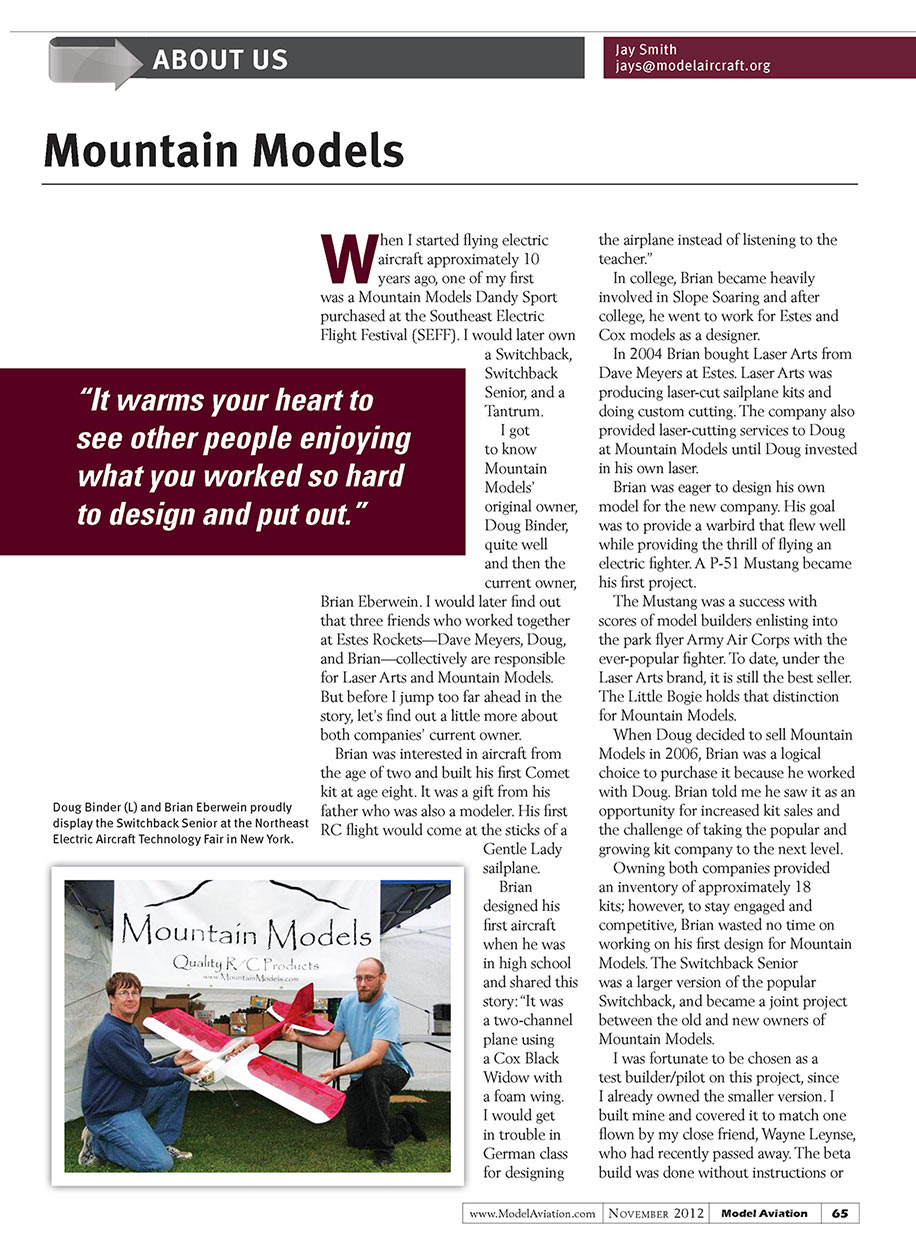
I got to know Mountain Models' original owner, Doug Binder, quite well and then the current owner, Brian Eberwein. I would later find out that three friends who worked together at Estes Rockets—Dave Meyers, Doug, and Brian—collectively are responsible for Laser Arts and Mountain Models. But before I jump too far ahead in the story, let's find out a little more about both companies' current owner.
Brian Eberwein — background
Brian was interested in aircraft from the age of two and built his first Comet kit at age eight. It was a gift from his father, who was also a modeler. His first RC flight came at the sticks of a Gentle Lady sailplane.
Brian designed his first aircraft when he was in high school: "It was a two-channel plane using a Cox Black Widow with a foam wing. I would get in trouble in German class for designing the airplane instead of listening to the teacher."
In college, Brian became heavily involved in slope soaring. After college, he went to work for Estes and Cox models as a designer.
In 2004 Brian bought Laser Arts from Dave Meyers at Estes. Laser Arts was producing laser-cut sailplane kits and doing custom cutting. The company also provided laser-cutting services to Doug at Mountain Models until Doug invested in his own laser.
Early designs and successes
Brian was eager to design his own model for the new company. His goal was to provide a warbird that flew well while providing the thrill of flying an electric fighter. A P-51 Mustang became his first project.
The Mustang was a success, with scores of model builders enlisting into the park-flyer Army Air Corps with the ever-popular fighter. To date, under the Laser Arts brand, it is still the best seller. The Little Bogie holds that distinction for Mountain Models.
When Doug decided to sell Mountain Models in 2006, Brian was a logical choice to purchase it because he worked with Doug. Brian saw it as an opportunity for increased kit sales and the challenge of taking the popular and growing kit company to the next level.
Owning both companies provided an inventory of approximately 18 kits; however, to stay engaged and competitive, Brian wasted no time working on his first design for Mountain Models. The Switchback Senior was a larger version of the popular Switchback and became a joint project between the old and new owners of Mountain Models.
I was fortunate to be chosen as a test builder/pilot on this project, since I already owned the smaller version. I built mine and covered it to match one flown by my close friend Wayne Leynse, who had recently passed away. The beta build was done without instructions or plans; Brian imparted some tips along the way on a thread on RCGroups.
Typical of Mountain Models aircraft, the airplane was of good design, flew well, and was a success.
Design process and production
I was curious about the process of deciding on a model and its design. Brian shared that normally designs come from customer requests or from what seems to be a popular trend, such as micro models and Old-Timers during the last couple of years.
The time it takes for Brian to bring a model to market is roughly two months. He must ensure that the customer has a positive experience from build until flight. Components are carefully chosen for the best balance between cost and performance. In most aircraft, Hitec servos and Scorpion motors are recommended.
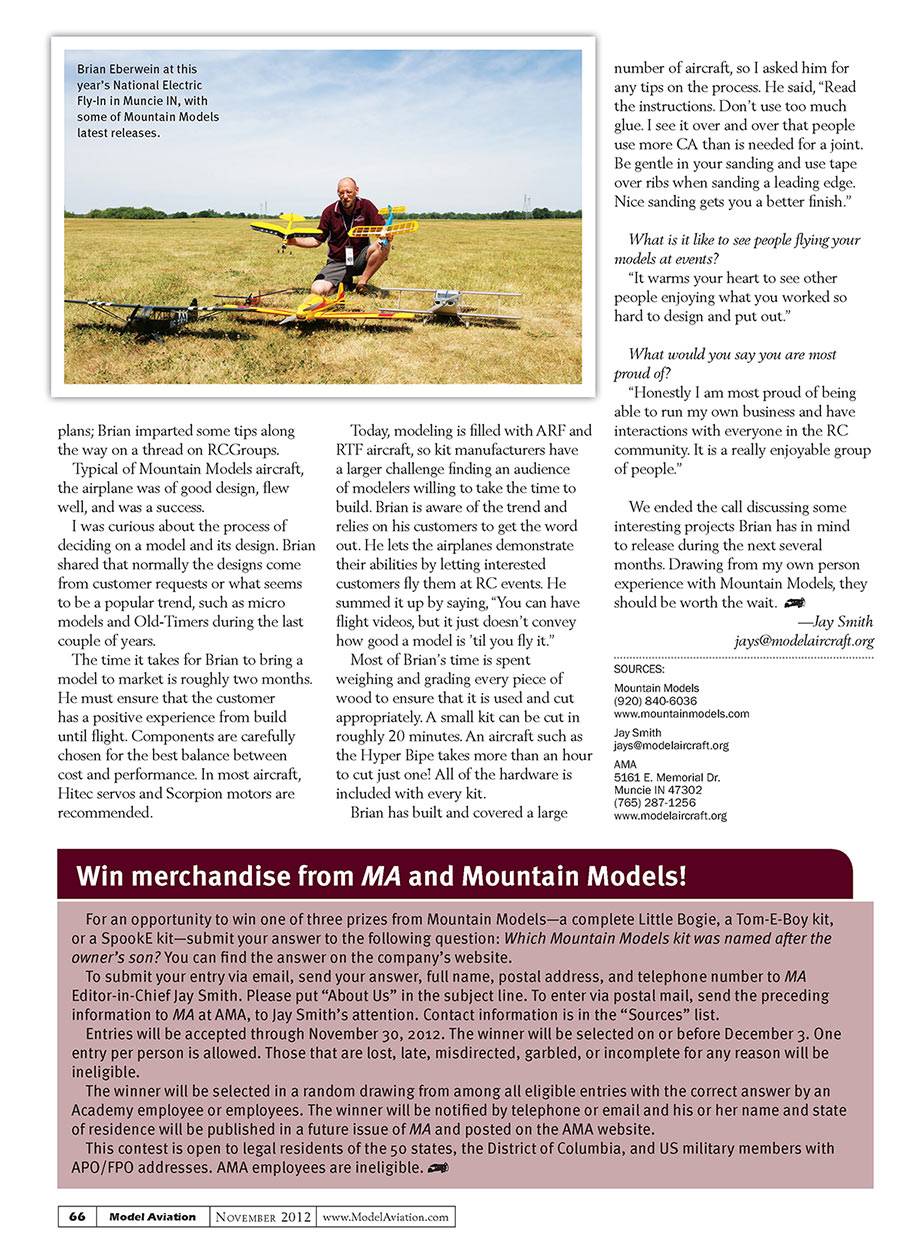
Today, modeling is filled with ARF and RTF aircraft, so kit manufacturers have a larger challenge finding an audience of modelers willing to take the time to build. Brian is aware of the trend and relies on his customers to get the word out. He lets the airplanes demonstrate their abilities by letting interested customers fly them at RC events. As he put it, "You can have flight videos, but it just doesn't convey how good a model is 'til you fly it."
Most of Brian's time is spent weighing and grading every piece of wood to ensure that it is used and cut appropriately. A small kit can be cut in roughly 20 minutes. An aircraft such as the Hyper Bipe takes more than an hour to cut just one! All of the hardware is included with every kit.
Tips from Brian
Brian has built and covered a large number of aircraft, so I asked him for any tips on the process. He said:
- Read the instructions.
- Don't use too much glue. He sees people use more CA than is needed for a joint.
- Be gentle in your sanding and use tape over ribs when sanding a leading edge.
- Nice sanding gets you a better finish.
What is it like to see people flying your models at events? "It warms your heart to see other people enjoying what you worked so hard to design and put out."
What would you say you are most proud of? "Honestly I am most proud of being able to run my own business and have interactions with everyone in the RC community. It is a really enjoyable group of people."
We ended the call discussing some interesting projects Brian has in mind to release during the next several months. Drawing from my own personal experience with Mountain Models, they should be worth the wait.
— Jay Smith [email protected]
Sources
- Mountain Models
(920) 840-6036 www.mountainmodels.com
- Jay Smith
- AMA
5161 E. Memorial Dr. Muncie, IN 47302 (765) 287-1256 www.modelaircraft.org
Transcribed from original scans by AI. Minor OCR errors may remain.

