
Advanced Flight Technologies 2014/05
Debunking the myth of a conflict
Patrick Sherman [email protected]
Some believe that the rise of FPV flying has transformed the world of model aviation into a battleground — a war fought by two opposing factions, each convinced that the other is a threat to the hobby.
On one side of this imagined conflict are the "traditional" aeromodelers — hidebound, impervious to change, and forever shaking their fists at the march of technological progress. Opposing them is the FPV community — a coalition of upstarts and rogues bent on destroying model aviation through their reckless high jinks.
Many people have relied on this notion for the past few years to understand changes taking place in the hobby. It is easy to understand, it offers a compelling narrative, and it's completely wrong.
Aeromodelers' attitudes, especially AMA members, are more nuanced and insightful than many give them credit for. I have some numbers and a couple of charts to prove it.
One in Eight
In preparing a benefits program for FPV and semiautonomous pilots, the AMA commissioned the Membership Corporation of America to create an online survey to better understand attitudes about FPV and other aspects of small Unmanned Aircraft Systems (sUAS) operations among AMA members and the FPV community.
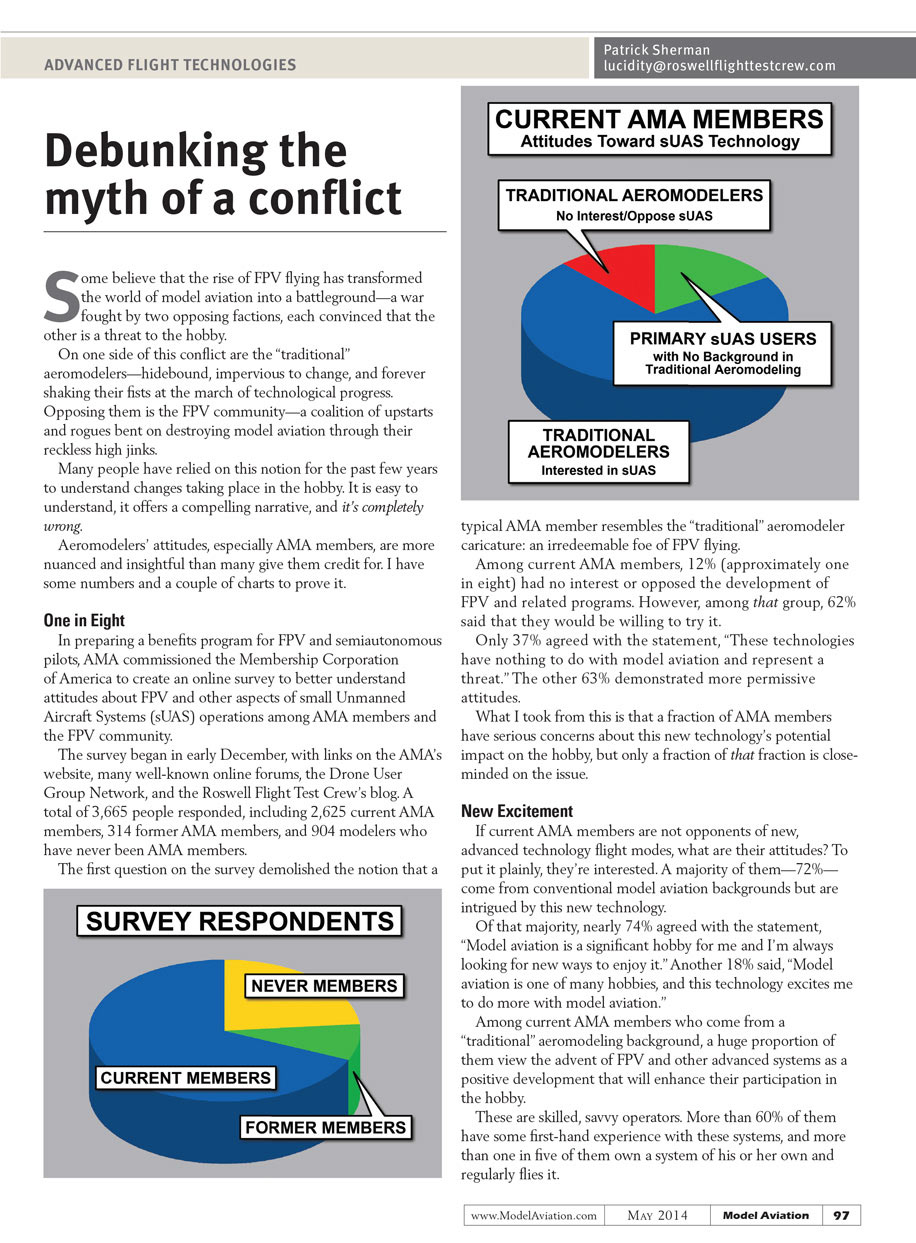
The survey began in early December, with links on the AMA's website, many well-known online forums, the Drone User Group Network, and the Roswell Flight Test Crew's blog. A total of 3,665 people responded, including 2,625 current AMA members, 314 former AMA members, and 904 modelers who have never been AMA members.
The first question on the survey demolished the notion that a typical AMA member resembles the "traditional" aeromodeler caricature: an irredeemable foe of FPV flying.
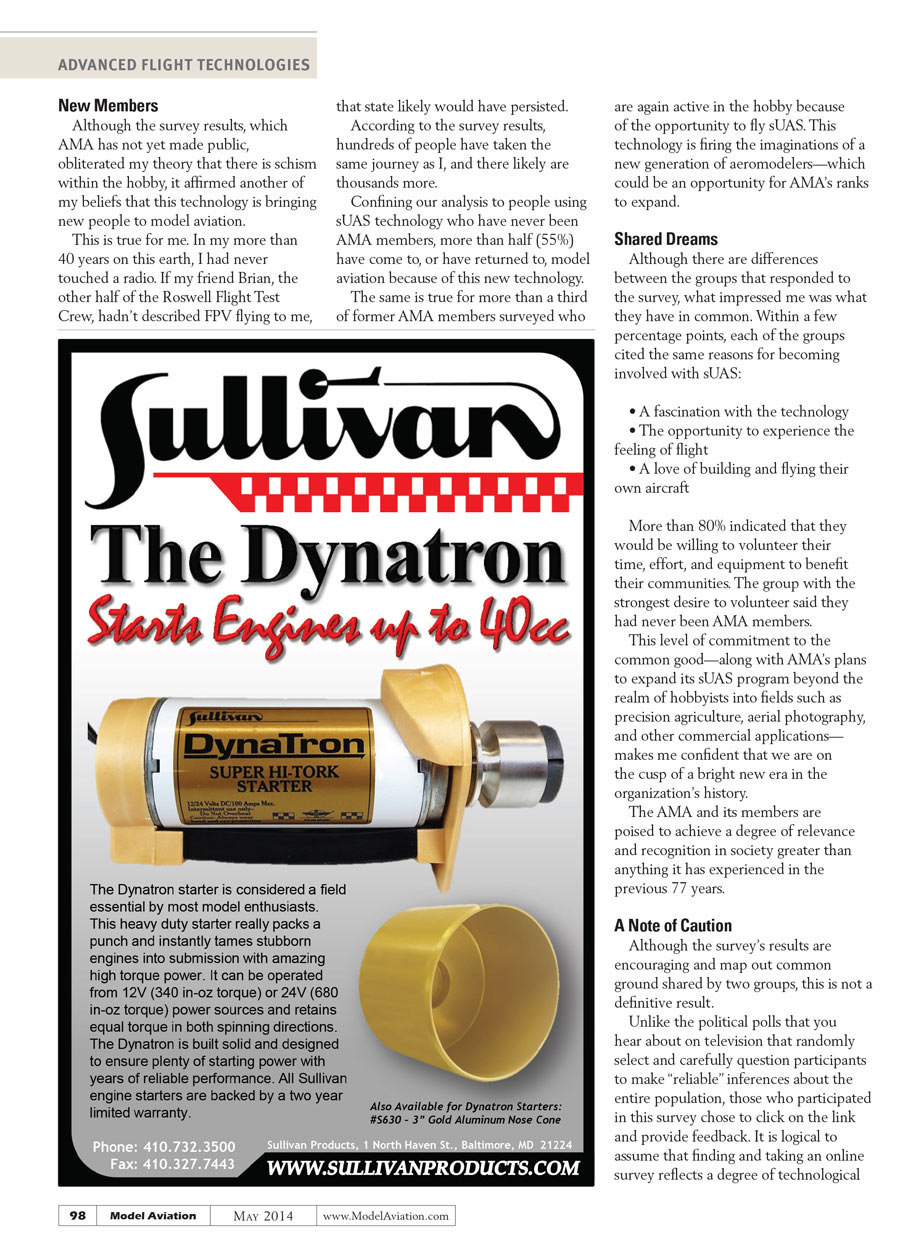
Among current AMA members, 12% (approximately one in eight) had no interest in or opposed the development of FPV and related programs. However, among that group, 62% said they would be willing to try it.
Only 37% agreed with the statement, "These technologies have nothing to do with model aviation and represent a threat." The other 63% demonstrated more permissive attitudes.
What I took from this is that a fraction of AMA members have serious concerns about this new technology's potential impact on the hobby, but only a fraction of that fraction is close-minded on the issue.
New Excitement
If current AMA members are not opponents of new, advanced technology flight modes, what are their attitudes? To put it plainly, they're interested. A majority of them — 72% — come from conventional model aviation backgrounds but are intrigued by this new technology.
Of that majority, nearly 74% agreed with the statement, "Model aviation is a significant hobby for me and I'm always looking for new ways to enjoy it." Another 18% said, "Model aviation is one of many hobbies, and this technology excites me to do more with model aviation."
Among current AMA members who come from a "traditional" aeromodeling background, a huge proportion view the advent of FPV and other advanced systems as a positive development that will enhance their participation in the hobby.
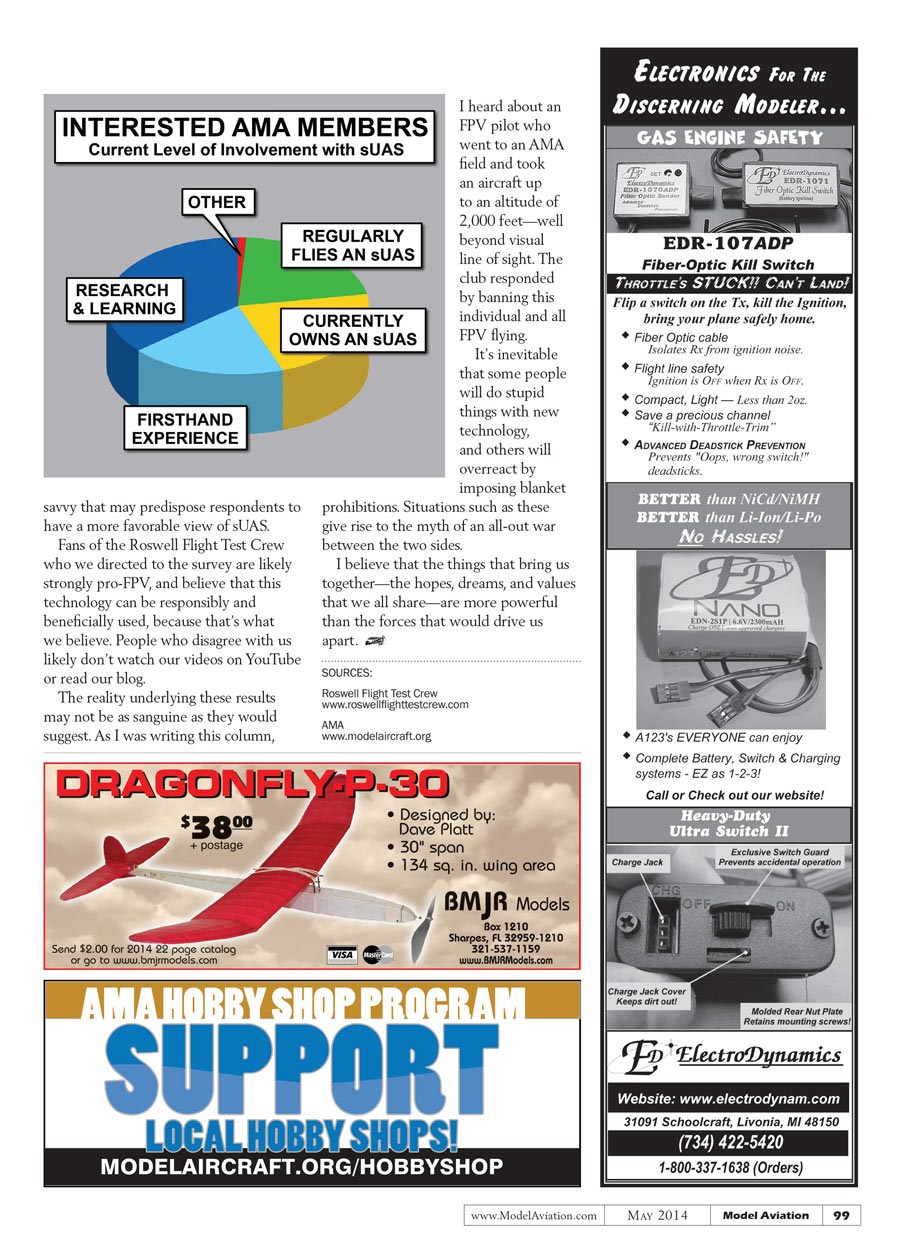
These are skilled, savvy operators. More than 60% of them have some first-hand experience with these systems, and more than one in five own a system of their own and regularly fly it.
New Members
Although the survey results, which the AMA has not yet made public, obliterated my theory that there is a schism within the hobby, they affirmed another of my beliefs: this technology is bringing new people to model aviation.
This is true for me. In my more than 40 years on this earth, I had never touched a radio. If my friend Brian, the other half of the Roswell Flight Test Crew, hadn't described FPV flying to me, that state likely would have persisted.
According to the survey results, hundreds of people have taken the same journey as I, and there likely are thousands more.
Confining our analysis to people using sUAS technology who have never been AMA members, more than half (55%) have come to, or returned to, model aviation because of this new technology.
The same is true for more than a third of former AMA members surveyed who are again active in the hobby because of the opportunity to fly sUAS. This technology is firing the imaginations of a new generation of aeromodelers — which could be an opportunity for the AMA's ranks to expand.
Shared Dreams
Although there are differences between the groups that responded to the survey, what impressed me was what they have in common. Within a few percentage points, each group cited the same reasons for becoming involved with sUAS:
- A fascination with the technology
- The opportunity to experience the feeling of flight
- A love of building and flying their own aircraft
More than 80% indicated that they would be willing to volunteer their time, effort, and equipment to benefit their communities. The group with the strongest desire to volunteer said they had never been AMA members.
This level of commitment to the common good — along with the AMA's plans to expand its sUAS program beyond the realm of hobbyists into fields such as precision agriculture, aerial photography, and other commercial applications — makes me confident that we are on the cusp of a bright new era in the organization's history.
The AMA and its members are poised to achieve a degree of relevance and recognition in society greater than anything it has experienced in the previous 77 years.
A Note of Caution
Although the survey's results are encouraging and map out common ground shared by the groups, this is not a definitive result.
Unlike the political polls you hear about on television, which randomly select and carefully question participants to make "reliable" inferences about the entire population, those who participated in this survey chose to click on the link and provide feedback. It is logical to assume that finding and taking an online survey reflects a degree of technological savvy that may predispose respondents to have a more favorable view of sUAS.
Fans of the Roswell Flight Test Crew who were directed to the survey were likely strongly pro-FPV and believe that this technology can be responsibly and beneficially used — because that's what we believe. People who disagree with us likely don't watch our videos on YouTube or read our blog.
The reality underlying these results may not be as sanguine as they suggest. As I was writing this column, I heard about an FPV pilot who went to an AMA field and took an aircraft up to an altitude of 2,000 feet — well beyond visual line of sight. The club responded by banning this individual and all FPV flying.
It's inevitable that some people will do stupid things with new technology, and others will overreact by imposing blanket prohibitions. Situations such as these give rise to the myth of an all-out war between the two sides.
I believe that the things that bring us together — the hopes, dreams, and values that we all share — are more powerful than the forces that would drive us apart.
SOURCES:
- Roswell Flight Test Crew — www.roswellflighttestcrew.com
- AMA — www.modelaircraft.org
Transcribed from original scans by AI. Minor OCR errors may remain.

