
Aero Mail
It's a Two-Piece Golden Era
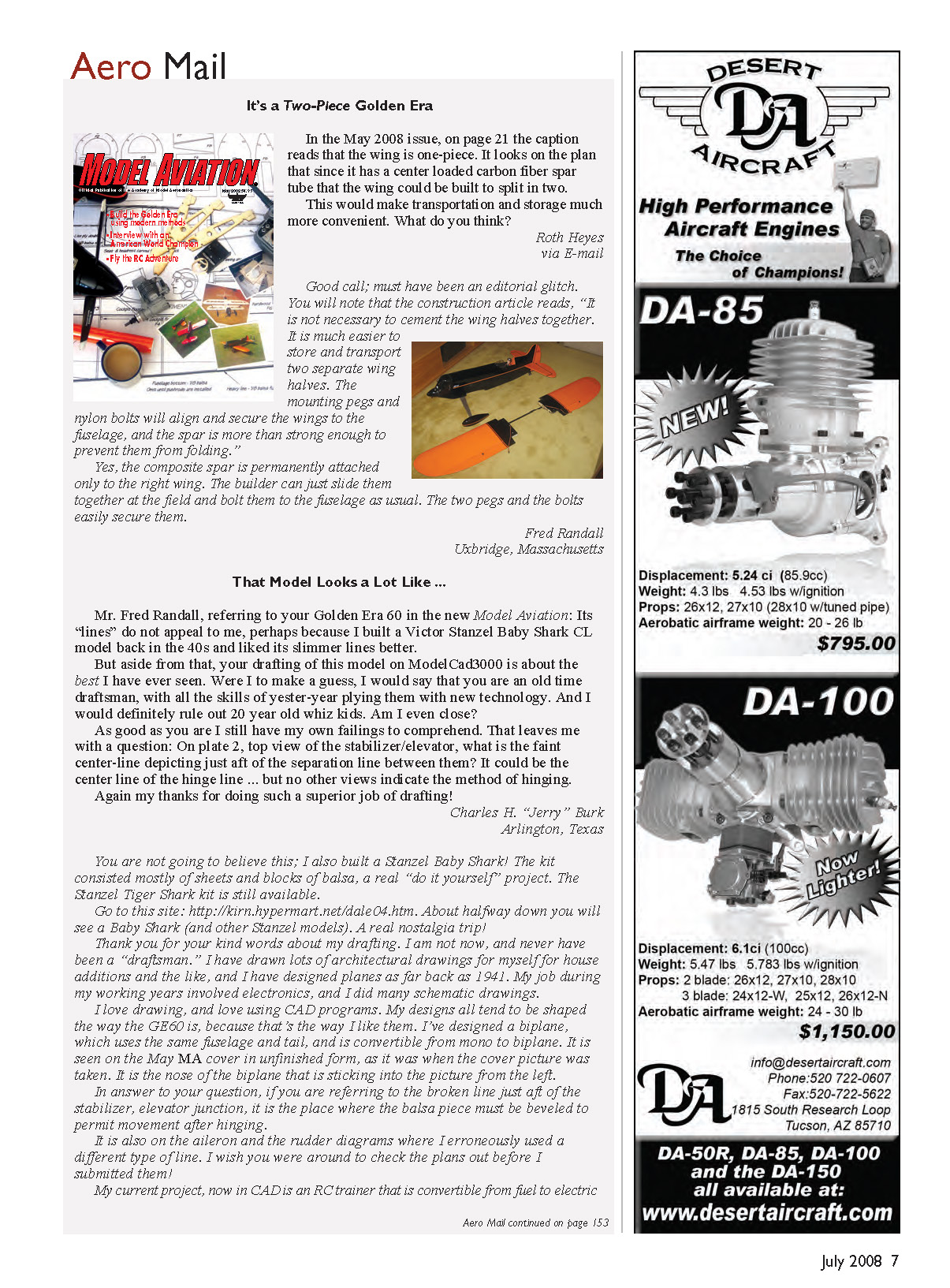
In the May 2008 issue, on page 21 the caption reads that the wing is one-piece. It looks on the plan that since it has a center-loaded carbon fiber spar tube that the wing could be built to split in two.
This would make transportation and storage much more convenient. What do you think?
Roth Heyes via E-mail
Good call; must have been an editorial glitch. You will note that the construction article reads, "It is not necessary to cement the wing halves together. It is much easier to store and transport two separate wing halves. The mounting pegs and nylon bolts will align and secure the wings to the fuselage, and the spar is more than strong enough to prevent them from folding."
Yes, the composite spar is permanently attached only to the right wing. The builder can just slide them together at the field and bolt them to the fuselage as usual. The two pegs and the bolts easily secure them.
Fred Randall Uxbridge, Massachusetts
That Model Looks a Lot Like ...
Mr. Fred Randall, referring to your Golden Era 60 in the new Model Aviation: Its "lines" do not appeal to me, perhaps because I built a Victor Stanzel Baby Shark CL model back in the ’40s and liked its slimmer lines better.
But aside from that, your drafting of this model on ModelCad3000 is about the best I have ever seen. Were I to make a guess, I would say that you are an old-time draftsman, with all the skills of yesteryear, plying them with new technology. And I would definitely rule out 20-year-old whiz kids. Am I even close?
As good as you are I still have my own failings to comprehend. That leaves me with a question: On plate 2, top view of the stabilizer/elevator, what is the faint centerline depicting just aft of the separation line between them? It could be the center line of the hinge line ... but no other views indicate the method of hinging. Again my thanks for doing such a superior job of drafting!
Charles H. "Jerry" Burk Arlington, Texas
You are not going to believe this; I also built a Stanzel Baby Shark! The kit consisted mostly of sheets and blocks of balsa, a real "do it yourself" project. The Stanzel Tiger Shark kit is still available.
Go to this site: http://kirn.hypermart.net/dale04.htm. About halfway down you will see a Baby Shark (and other Stanzel models). A real nostalgia trip!
Thank you for your kind words about my drafting. I am not now, and never have been a "draftsman." I have drawn lots of architectural drawings for myself for house additions and the like, and I have designed planes as far back as 1941. My job during my working years involved electronics, and I did many schematic drawings. I love drawing, and love using CAD programs. My designs all tend to be shaped the way the GE60 is, because that's the way I like them. I've designed a biplane, which uses the same fuselage and tail, and is convertible from mono to biplane. It is seen on the May MA cover in unfinished form, as it was when the cover picture was taken. It is the nose of the biplane that is sticking into the picture from the left.
In answer to your question, if you are referring to the broken line just aft of the stabilizer–elevator junction, it is the place where the balsa piece must be beveled to permit movement after hinging. It is also on the aileron and the rudder diagrams where I erroneously used a different type of line. I wish you were around to check the plans out before I submitted them!
My current project, now in CAD, is an RC trainer that is convertible from fuel to electric and back (I guess for people that have a hard time making decisions). And no, I am definitely not a 20-year-old whiz kid. Thanks for your letter, and keep 'em flying!
Fred Randall Uxbridge, Massachusetts
Futaba 7C 2.4 FASST
Specification Clarification
In our review of the Futaba 7C FASST radio-control system in the April issue, the author indicated (in a sidebar) that the system was best suited for aircraft ranging from 2 to 16 pounds.
That was based on which aircraft the author felt the receiver and servo package suited best (because of the receiver specifications and number of available channels). It was not meant to indicate that the system is capable of controlling only models in that size range.
As with any equipment used in a model, you must select the size and capabilities that best match each particular aircraft and the pilot’s style and performance wishes.
The 7C 2.4 GHz FASST transmitter is capable of controlling any size model a pilot wants to fly. The author regrets the confusion and has tested the transmitter with an indoor 10-ounce foamie and a 27%-scale aerobatics model, both with remarkable success.
—MA staff
The Storch and Other Modelers
Just a quick note to say I enjoyed Doug Crumley’s article on the Fieseler Fi‑156 Storch in the February 2008 Model Aviation.
I am a third-year sport RC airplane flyer with a young family. Therefore, I have no time and resources for this type of scale building. However, I have a few persons like you in my local club able to build great, scale airplanes. It makes it fun to go to the field on the weekends. Anyway, good luck on your building and keep up the great work.
Drew Shattuck Bristow, Virginia
This is to thank you for the well-written article about the Storch kit that you did for the February ’08 issue of Model Aviation. If you are not retired it makes me wonder if your days have more than 24 hours in them!
I have a real appreciation for competitive events. I know that building scale models will take up much of the time that most competitors in other events would use for practice and competition.
You don’t know me. I am just an old man from S.W. Indiana that has been an AMA member since 1993. I love scale RC but I fly sport electric; it’s a lot easier and a lot less forgiving. I always read anything that is in MA about scale. No matter if it’s RC, control line, or free flight, it makes no difference to me as long as it’s scale.
Roy Glenn Southampton, New Jersey
Your article in the March 2008 MA ("2007 US Scale Masters Championships") is by far the best scale competition article I have ever read. To hear what the competitor is going through was a wonderful idea, and you really pulled it off. Again keep up the great work and keep ’em flying!
Jim Block Evansville, Indiana
Stahlwerk Success Story
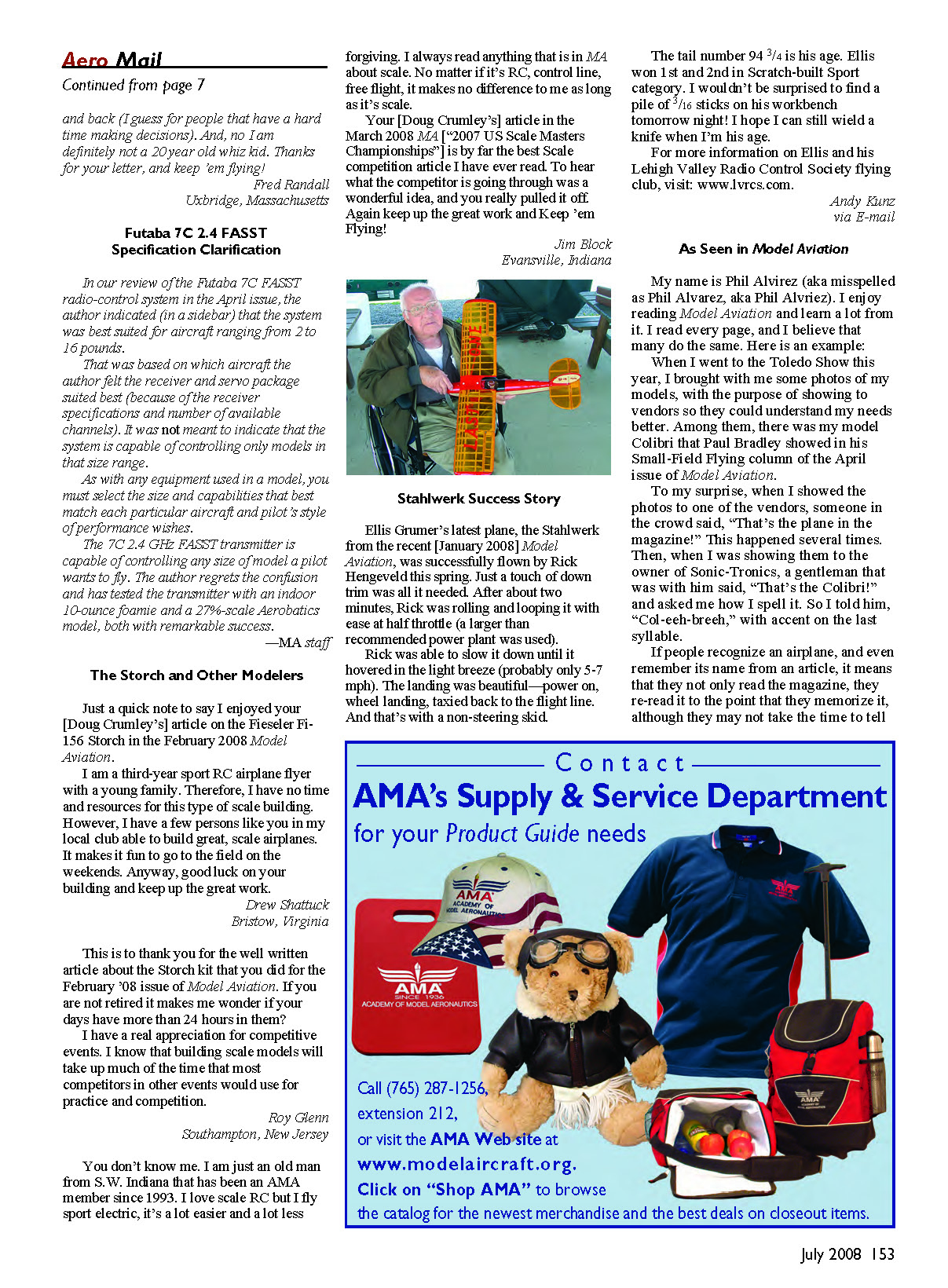
Ellis Grumer’s latest plane, the Stahlwerk from the January 2008 Model Aviation, was successfully flown by Rick Hengeveld this spring. Just a touch of down trim was all it needed. After about two minutes, Rick was rolling and looping it with ease at half throttle (a larger-than-recommended power plant was used).
Rick was able to slow it down until it hovered in the light breeze (probably only 5–7 mph). The landing was beautiful—power on, wheel landing, taxied back to the flight line. And that’s with a non-steering skid.
The tail number 94 3/4 is his age. Ellis won 1st and 2nd in the Scratch-built Sport category. I wouldn’t be surprised to find a pile of 3/16" sticks on his workbench tomorrow night! I hope I can still wield a knife when I’m his age.
For more information on Ellis and his Lehigh Valley Radio Control Society flying club, visit: www.lvrsc.com.
Andy Kunz via E-mail
As Seen in Model Aviation
My name is Phil Alvarez (occasionally misspelled as Phil Alvierz). I enjoy reading Model Aviation and I learn a lot from it. I read every page, and I believe that many do the same. Here is an example:
When I went to the Toledo Show this year, I brought with me some photos of my models, with the purpose of showing them to vendors so they could understand my needs better. Among them was my model Colibri that Paul Bradley showed in his Small-Field Flying column in the April issue of Model Aviation.
To my surprise, when I showed the photos to one of the vendors, someone in the crowd said, "That’s the plane in the magazine!" This happened several times. Then, when I was showing them to the owner of Sonic-Tronics, a gentleman with him said, "That’s the Colibri!" and asked me how I spell it. So I told him, "Col‑eeh‑bree," with the accent on the last syllable.
If people recognize an airplane, and even remember its name from an article, it means that they not only read the magazine, they re-read it to the point that they memorize it, although they may not take the time to tell you so. Paul Bradley's column is an example. Keep up the good work!
Phil Alvarez Windsor, Canada
Aero Mail - July 2008
A Picture of the Future
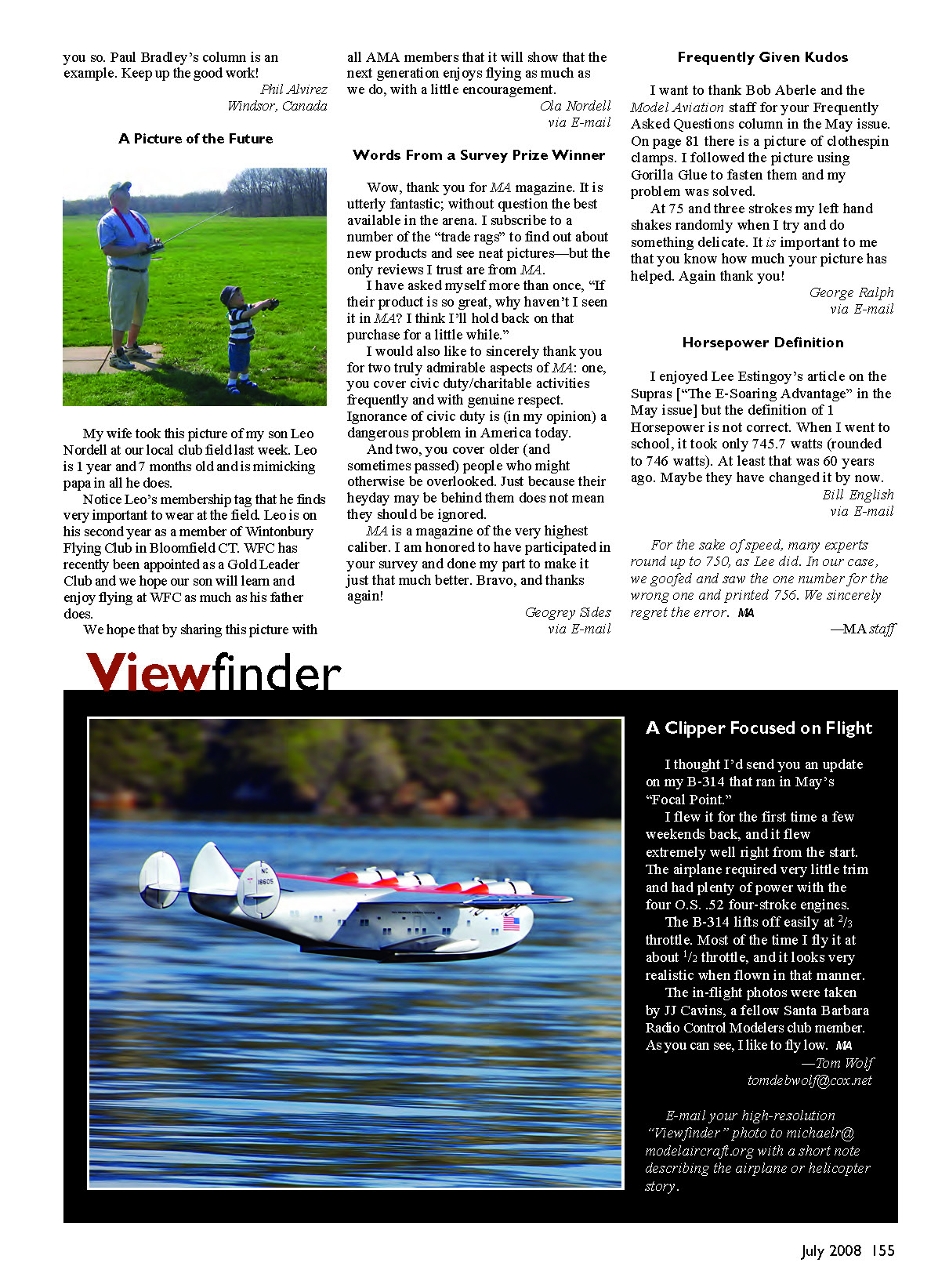
My wife took this picture of my son Leo Nordell at our local club field last week. Leo is 1 year and 7 months old and is mimicking papa in all he does.
Notice Leo's membership tag that he finds very important to wear at the field. Leo is in his second year as a member of Wintonbury Flying Club in Bloomfield, CT. WFC has recently been appointed a Gold Leader Club and we hope our son will learn and enjoy flying at WFC as much as his father does.
We hope that by sharing this picture with all AMA members that it will show that the next generation enjoys flying as much as we do, with a little encouragement.
Ola Nordell via E-mail
Words From a Survey Prize Winner
Wow, thank you for MA magazine. It is utterly fantastic; without question the best available in the arena. I subscribe to a number of the "trade rags" to find out about new products and see near pictures—but the only reviews I trust are from MA.
I have asked myself more than once, "If their product is so great, why haven't I seen it in MA? I think I'll hold back on that purchase for a little while."
I would also like to sincerely thank you for two truly admirable aspects of MA: one, you cover civic duty/charitable activities frequently and with genuine respect. Ignorance of civic duty is (in my opinion) a dangerous problem in America today.
And two, you cover older (and sometimes passed) people who might otherwise be overlooked. Just because their heyday may be behind them does not mean they should be ignored.
MA is a magazine of the very highest caliber. I am honored to have participated in your survey and done my part to make it just that much better. Bravo, and thanks again!
George Sides via E-mail
Frequently Given Kudos
I want to thank Bob Aberle and the Model Aviation staff for your Frequently Asked Questions column in the May issue. On page 81 there is a picture of clothespin clamps. I followed the picture using Gorilla Glue to fasten them and my problem was solved.
At 75 and three strokes my left hand shakes randomly when I try to do something delicate. It is important to me that you know how much your picture has helped. Again, thank you!
George Ralph via E-mail
Horsepower Definition
I enjoyed Lee Estingoy's article on the Supras ("The E‑Soaring Advantage" in the May issue) but the definition of 1 horsepower is not correct. When I went to school, it took only 745.7 watts (rounded to 746 watts). At least that was 60 years ago. Maybe they have changed it by now.
Bill English via E-mail
For the sake of speed, many experts round up to 750, as Lee did. In our case, we goofed and saw one number for the wrong one and printed 756. We sincerely regret the error.
—MA staff
Transcribed from original scans by AI. Minor OCR errors may remain.

