
Aero Mail
Motor Clarification
I read with great interest the "Clean Horsepower" article by Lee Estingoy (Sept. 2010, MA). I hope this is the first of a series of articles by Lee. It whet my appetite, but left me with a lot of questions.
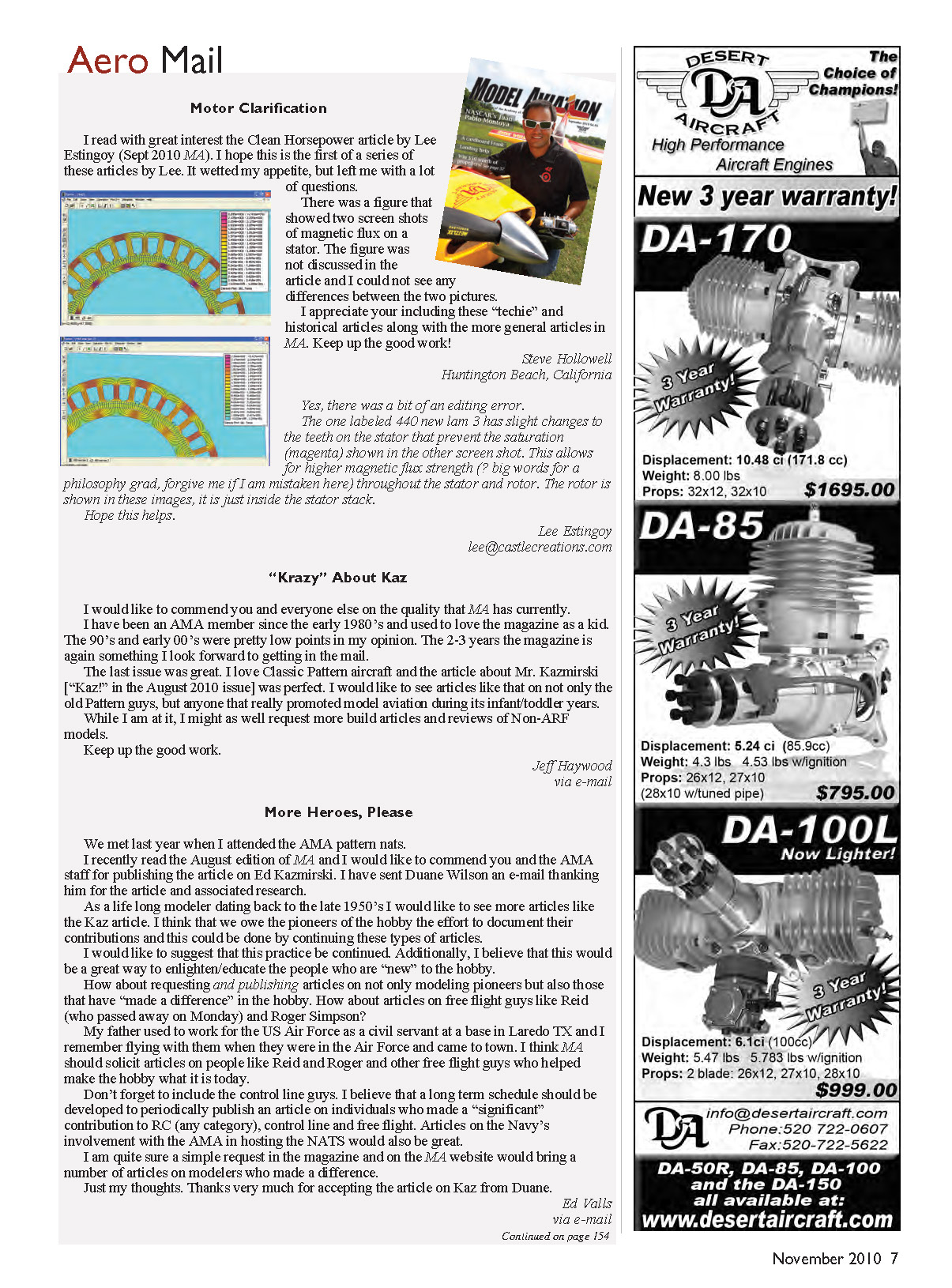
There was a figure that showed two screen shots of magnetic flux on a stator. The figure was not discussed in the article and I could not see any differences between the two pictures.
I appreciate your including these "techie" and historical articles along with the more general articles in MA. Keep up the good work!
Steve Hollowell Huntington Beach, California
Yes, there was a bit of an editing error.
The one labeled "440 new lam 3" has slight changes to the teeth on the stator that prevent the saturation (magenta) shown in the other screen shot. This allows for higher magnetic flux strength (—big words for a philosophy grad; forgive me if I am mistaken here) throughout the stator and rotor. The rotor is shown in these images; it is just inside the stator stack.
Hope this helps.
Lee Estingoy [email protected]
"Krazy" About Kaz
I would like to commend you and everyone else on the quality that MA has currently. I have been an AMA member since the early 1980s and used to love the magazine as a kid. The 1990s and early 2000s were pretty low points in my opinion. The last 2–3 years the magazine is again something I look forward to getting in the mail.
The last issue was great. I love classic pattern aircraft and the article about Mr. Kazmirski ("Kaz!" in the August 2010 issue) was perfect. I would like to see articles like that on not only the old pattern guys, but anyone who really promoted model aviation during its infant/toddler years.
While I am at it, I might as well request more build articles and reviews of non-ARF models.
Keep up the good work.
Jeff Haywood via e-mail
More Heroes, Please
We met last year when I attended the AMA pattern Nats.
I recently read the August edition of MA and I would like to commend you and the AMA staff for publishing the article on Ed Kazmirski. I have sent Duane Wilson an e-mail thanking him for the article and associated research.
As a lifelong modeler dating back to the late 1950s, I would like to see more articles like the Kaz article. I think that we owe the pioneers of the hobby the effort to document their contributions, and this could be done by continuing these types of articles.
I would like to suggest that this practice be continued. Additionally, I believe that this would be a great way to enlighten and educate the people who are new to the hobby. How about requesting and publishing articles on not only modeling pioneers but also those who have "made a difference" in the hobby? How about articles on free-flight guys like Reid (who passed away on Monday) and Roger Simpson?
My father used to work for the U.S. Air Force as a civil servant at a base in Laredo, TX, and I remember flying with them when they were in the Air Force and came to town. I think MA should solicit articles on people like Reid and Roger and other free-flight guys who helped make the hobby what it is today.
Don't forget to include the control-line guys. I believe that a long-term schedule should be developed to periodically publish an article on individuals who made a significant contribution to RC (any category), control line, and free flight. Articles on the Navy's involvement with the AMA in hosting the Nats would also be great.
I am quite sure a simple request in the magazine and on the MA website would bring a number of articles on modelers who made a difference.
Just my thoughts. Thanks very much for accepting the article on Kaz from Duane.
Ed Valls via e-mail
Sweet!
Regarding Tom Derby’s comments in the Aero Mail in the August 2010 issue of Model Aviation:
"Cool" is an adjective that is used in "describing qualities of the entity denoted," according to Webster’s dictionary. Cool: "very good, pleasing, etc.; excellent." Quotes again from Webster’s.
Cool is a slang word that probably originates from the 1950s. I don’t need the dictionary to understand what this word means to me. It is a word that has been a part of my generation a long time. I grew up in the late 1960s/early 1970s. I know extremely successful people who commonly use this word all the time, albeit usually in an informal situation more than not. It creates a sort of common bond, if you will.
I think we are in a very cool hobby with a lot of cool people.
This word does not belong solely to the current younger generation as Tom suggests. No offense, kids. However, if you manage to get the attention of the younger generation by the use of the word cool in your articles, all the better. We certainly need more younger people getting involved in this hobby.
I didn’t see "cool" mentioned once in your August 2010 "The Inside Loop." Too bad. Freedom of speech, Michael!!!
And Tom, lighten up, will ya? This is a hobby, not a college English class.
The best part of this cool hobby is that we can agree to disagree, lay down our pens (computer keyboards), and head out to the field and have fun flying together!
George Springer Asheville, North Carolina
The Family You Choose
I wanted to drop you a note, perhaps for the "Aero Mail" column.
There is and has been a lot of conversation over the years about the family of aeromodeling. This is a true statement, but I wanted to relate a recent incident in my own life.
We are all born into our own families and by and large we love them, but we do not always like them. There are always issues. But the point is we are born into these units. We have no choice.
By comparison, we have the luxury of choosing our friends. With any luck at all we choose wisely.
I had the recent misfortune to experience what I am calling my adventures in cardiology. On the morning of Friday, June 25, 2010, I had the misfortune of experiencing a heart attack while on a business trip in Detroit, Michigan. It was serious—the "big one," as some might say.
Not only was I not at home and away from family, but my primary contact person, my wife, was out of town on business as well, and her cell phone had crashed. So there was apparently no way to contact her. Add to this the fact that the emergency room staff was telling my work colleague to get my wife there as quickly as possible. You can imagine the circumstances.
Since I had no way of contacting my family and my work colleagues were already doing what they could, I had only one recourse left to me. Because of my participation in many different aspects of modeling within the AMA, I have had the good fortune to develop a modeling family across the country. So I did the only thing I could think of: I asked the ER staff to contact the family that I picked out—modelers who have become family.
I do not want to name names, but there is a wonderful couple with whom I have been friends for 15 years or more, living just 15 minutes from the hospital, and I asked the staff to contact them. To make a long story short, in less than one hour my friends had more of my friends from Wisconsin, Michigan, Tennessee, West Virginia, and Pennsylvania burning up the phone lines trying to find my wife and daughters.
Between all of these wonderful people and my work colleagues, a phone chain of my wife's customers and colleagues, and the satellite phone that comes with OnStar, my wife was found and started on her way to Michigan.
The first phone call I received came from my friend in Tennessee, asking if there was anything he could do to help. Before the afternoon was half over my Detroit friends were by the side of my bed in intensive care to check on me. By 6:00 that evening my wife had made the almost nine-hour drive from where she was working to where I was recovering.
My point is this: I have, through the grace of a higher power and the skill of the doctors in Detroit, survived to fly more airplanes. But the support of the family that I got to pick—my modeling family—is of a value that cannot be measured.
To all of you who helped in that critical 12-hour period, thanks. I love you too.
Jim Rediske via e-mail
Transcribed from original scans by AI. Minor OCR errors may remain.

