
Aero Mail
Very Moved
We read with considerable interest the article by Jim Buxton ("Wittman's Pursuit") in the January 2011 issue of Model Aviation regarding his questions and your answers about the indoor hand-launch glider duration record.
You, Ron, may not recall, but way back around 1957 you encountered two model-airplane–loving kids who happened to live near you in Inglewood, CA. We don't recall the year exactly, but 1957 is close.
You were flying what I think was an Unlimited rubber model in the field on the east end of the Hawthorne airport runway (east side of Crenshaw). We also frequented that field a lot, trying to get our models to fly.
We were blown away by the performance of your model and watched with great interest. Up to that point in time we had no one with any model-airplane experience to guide our efforts.
You were kind enough to respond to our questions, and when it was apparent that we had a deep interest in model airplanes you invited us to your home to offer some pointers. We lived on Lemoli. We can't remember your street, perhaps Cherry, but it was close to our house. We think the neighborhood was called Imperial Village.
You moved sometime during the year that followed, but during the time you lived in that neighborhood you imparted a ton of knowledge to us — things as basic as using fine sandpaper to trim tissue to the fundamentals of sanding balsa. You also took us to several indoor gatherings at Wilmington and the National Guard armory near the Coliseum.
Words can't begin to describe the positive impact you had on those kids. We both used the skills and knowledge you imparted to really establish our lifelong passion for model airplanes.
There have been so many times over the years that have lapsed since those days that we have both commented that something we were doing was based on knowledge you had imparted to us. I don't recall the year that the Free Flight movie "180 is Max" came out, but when we saw it we both commented that the story could have been about our meeting you.
There have been many contests attended and a rather large collection of hardware that are a direct result of your kindness in showing a couple of neighborhood kids the basics of the model-airplane hobby.
We were so pleased to see Jim Buxton's article in Model Aviation. It gave us an opportunity to connect once again with the mentor that did so much for our model-airplane hobby.
Paul and Ralph Bradley via e-mail
I received this email from these folks and am very moved. I've spent much of my 66 years in modeling competing (and still do) and also helping others into model airplanes, especially younger ones, and many of them have gone on to win nationals and set AMA records.
When they launch their plane for the first time, the look on their faces and the look they give you when they bring it back just gives you a great feeling.
If a person gets just one letter like this one in his lifetime, it makes giving a helping hand all worth it! This is really why we do it.
Thank you for the article. I enjoyed helping Jim Buxton set a new record; you folks did a fantastic job on this article and look what it can do.
Ron Wittman via e-mail
Supporting the Troops Overseas
Hi. I am Airman First Class Eric B. Goble. I am a crew chief on C-130H Hercules aircraft, currently deployed to Kandahar Airfield, Afghanistan. My family has been into model aviation since I was born 23 years ago, so naturally I am a huge fan of the sport. My father sends me Model Aviation magazine every month, and that helps make it easier here.
A1C Eric B. Goble 451 EAMXS Kandahar Airfield, Afghanistan
Serious Jamboree Sponsor
I was very excited to see last month’s (December 2010) issue of Model Aviation arrive at my door. I was in attendance for the entire event (the IRCHA Jamboree), and it was by far the best ever. The time-delay photo of the night-flying helicopter made a great cover shot!
After I read through the entire article, I did notice that there was one important fact missing from the coverage of the event. The Saturday festivities, which included the “One Competition,” the night fly, and the fireworks display, were co-sponsored by GAUI Helicopters and Scorpion Precision Industries.
Georges Van Gansen, the owner of Scorpion, flew over from Hong Kong to be at the event all week, and in addition to the sponsorship of the event, brought a bunch of Scorpion hats, shirts, jackets, and lock-strap battery straps to pass out to the pilots. In addition to GAUI and Scorpion sponsoring these events, their respective U.S. distributors, Empire Hobbies and Innov8tive Designs, also assisted in putting on a great show.
Georges put in a lot of effort and finances to help IRCHA 2010 be the best ever, and I just wanted to make sure he got proper credit for his contributions to the event.
As a side note, the three top finishers of the event, Bobby Watts (1st place), Kyle Dahl (2nd place), and Daniel Katzav (3rd place) were all flying electric helicopters that were powered with Scorpion motors!
Thank you so much for your great coverage of the event and your continued support of the RC hobby!
Lucien Miller Innov8tive Designs, Inc. Vista, California
Gyro Fancy
Great article ("Improve Your Approach" by Ben Lanterman in the December 2010 MA). I have a Great Planes Cub modified to an L-4. It has been such an ordeal to get airborne that I have flown it only 4–5 times in the last two years.
After reading your article, I went down to my favorite hobby shop and bought a JR G770 3D gyro and installed it.
It absolutely transformed the takeoff! I lined it up, selected Heading Hold, and it ran dead straight despite a right crosswind. I was so enthralled I forgot to deselect Heading Hold until after a very ugly 180-degree turn.
I made several takeoffs afterward, never touching the rudder and remembering to deselect HH after getting airborne; it just makes the plane a joy to fly. Well worth the money. I may try the E-Flite G110 next on another plane.
Thanks for such an informative and helpful article.
Al Shukle via e-mail
About Those Propellers ...
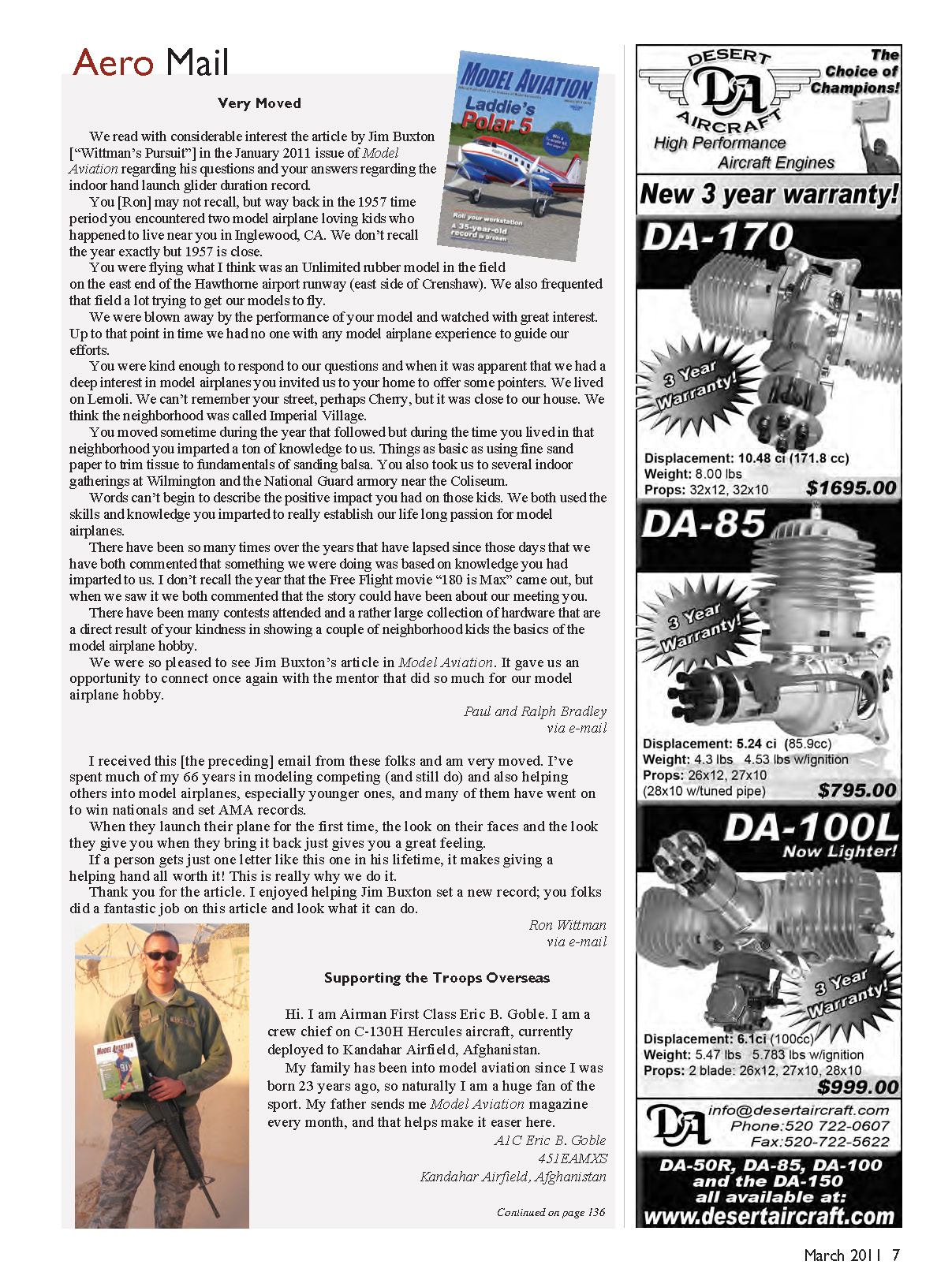
You have outdone yourself with the cover for the December 2010 Model Aviation magazine! "Wow" is an understatement. I was impressed with it as soon as I saw it come out of my mailbox. Beautiful! You should take a bow.
On page 150 is a lead-in to "Landing Next Month..." where a beautiful photo of the Basler BT-67 is shown. I notice the picture shows five-bladed propellers, apparently replicating the full-size aircraft. Not being an aeronautical engineer, I have never fully understood how many blades an aircraft engine needs, and the pitch needed, diameter, etc.
Four blades for the WWII P-47 apparently worked great, even at 30,000 feet, but required engine turbocharging to get enough air into the combustion chamber. (I have built the giant-scale 86-inch P-47 of Top Flite.) But it looks like turbo engines need even more "bite" to get top speed and performance from the plane.
Do you have any plans for a short article on prop selection for propeller-driven model planes? At the low elevation our models fly, it is apparent 2-blade props work just fine. However, they don't look scale. Would my Top Flite 86-inch P-47 fly with a four-blade prop? And, just for curiosity, why don't manufacturers make 4-blade props?
2011 will be my 13th year in the hobby, and I love it! Model Aviation magazine is a great source of information and inspiration for me. Keep up the good work!
Herman Burton via e-mail
The main reasons for using multi-bladed propellers on full-size aircraft are that their smaller diameter (for a given amount of engine power) reduces tip speed, and also minimizes the necessary landing gear strut length.
You probably know that the F4U "Corsair" employed its inverted-gull wings to permit use of its huge 3-bladed prop without needing long, gawky (and heavily stressed) landing-gear struts. Had the Corsair (or Thunderbolt, or Mustang) used 2-bladed props on their high-powered engines, those would have required significantly larger diameters to handle the power—and thus longer landing gear to provide sufficient ground clearance.
Yet 2-bladed propellers are more efficient thrust producers than multi-bladers. That's because the fundamental equation for propeller thrust does not include the number of blades. In simple terms, thrust depends on both rpm and diameter.
It's proportional to the square of the rpm, and to the fourth power of the diameter. For example (in model-airplane sizes), increasing engine speed from 10,000 rpm to 14,140 rpm will double the thrust; and idling down to 5,000 rpm will result in one fourth the thrust developed at 10,000.
But diameter has a more profound effect. If you could spin a 12-inch prop at the same rpm as a 10-incher (an increase in diameter of 20%), it would develop 1.2 x 1.2 x 1.2 x 1.2 times as much thrust—an increase of more than double.
Of course, propeller diameter influences power absorption, and hence rpm. But in model sizes, and considering only thrust, it's often more efficient to use bigger-diameter props.
Off the top of my head, consider a "typical" sport .049 engine. On a 6-inch prop that might turn 15,000 rpm. Reducing the diameter to 5 inches might raise the speed to 18,000 (engine porting would be the determining factor here).
Using the relationships given above, the rpm increase by itself would result in 144% greater thrust. However, the diameter decrease (by itself) would cause the thrust to drop to 48% of what it was with the 6-incher. The end result—1.44 x 0.48 = about 70% of the thrust produced by the 6-inch prop at 15K rpm.
Now for pitch. Its effects are largely independent of diameter. As a very rough (but quite useful) approximation, the propeller pitch in inches times its rpm in thousands equals the maximum speed (in mph) through the air that can be achieved.
For example, a model with a 5-inch-pitch prop that's turning at 10,000 rpm cannot exceed 50 mph in flight. (In actual fact the speed would be lower.) If you want to fly faster, you can speed up the engine or increase the pitch.
(Of course, merely changing the pitch will slow the engine; so reducing the diameter will be needed to keep rpm up.)
These are dynamic relationships. Change one variable and the others change too.
Two further important considerations:
- Model propeller efficiency also varies. Some brands are much more efficient than others. Merely calling for a 10-5 prop is not enough to ensure maximal performance.
- Engine-powered model airplanes generally have quite high power-to-weight ratios. This permits them to fly acceptably well with rather inefficient propeller/engine combinations.
I try for maximum efficiency in my own models, and usually employ much smaller engine sizes in them than "the average modeler" does: .19s and .25s in control-liners where most flyers use .35 to .40 power, for example.
Joe Wagner [email protected]
Control Line in Vegas
Many of us came to Las Vegas from different states. My son, Steve (862-221-1055), and I came from New Jersey where on the East Coast control-line planes are as popular as R/C planes. In fact, in Pennsylvania, Brodak is the largest manufacturer and seller of control-line products.
We are long-time control-line modelers. I have been flying in the hobby for 50 years. I am now retired and living in Las Vegas with my family and would love to continue my lifelong control-line interest.
However, in the short time we have been here, we found out that there is no flying allowed in any parks for control-line planes. As per AMA and the safety concerns, you take a very high risk flying in a ballpark field.
Clark County, Nevada, told us that the only place in Las Vegas dedicated for model planes is a place called Bennett Field. That's how we came to meet new friends in the hobby who have the same interest and respect for fellow modelers. We asked LVRC President Tom Brandt if he could advise us on where control line could be flown.
This is where we stand now: looking for a dedicated flying site that is both safe and available to all who take an interest in control line.
Let's not stop an active interest in model aviation in Las Vegas due to lack of a flying site. Control line will grow here once it has a permanent flying site. Then we can hold contests and other fun events. Fellow modelers from California and Arizona have already shown interest in coming here to support us.
I hope we all can work together to encourage a control-line field in Las Vegas.
Reuben Mac Bride [email protected] (862) 221-1948
Transcribed from original scans by AI. Minor OCR errors may remain.

