
Aero Mail
Although it may sound like an advertisement for a product, I would really recommend that folks who are new to flying helicopters invest in the RealFlight simulator to get a feel for the controls. That simulator saved me countless dollars and hours and it paid for itself in the first week—even before considering the fun of flying all different types of aircraft.
I quickly learned that the trouble determining orientation when the helicopter was not too far away was not restricted to the simulator—real life was almost as bad, and actually worse if there’s a bright sun.
Anyway, back to my main point—I really enjoyed your article because my experience was the same as yours, so it was reassuring to know I wasn’t alone in that sensation.
Derek Burney via E-mail
About the May 1982 MA
I enjoy and look forward to seeing the magazine covers for “25 Years Ago in MA” (in the “In the Air” section). It’s one of the first things I flip to because 25 years ago I got back into RC after my four years in college; I’m watching to see if I remember any of the covers!
I noticed that May’s was the same as March’s, and I believe that March was correct—sort of readable. And I think January didn’t have the spot.
Would it be possible to include an “about the cover” note in the “25 Years Ago in MA”?
Jim Blanner Edina, Minnesota
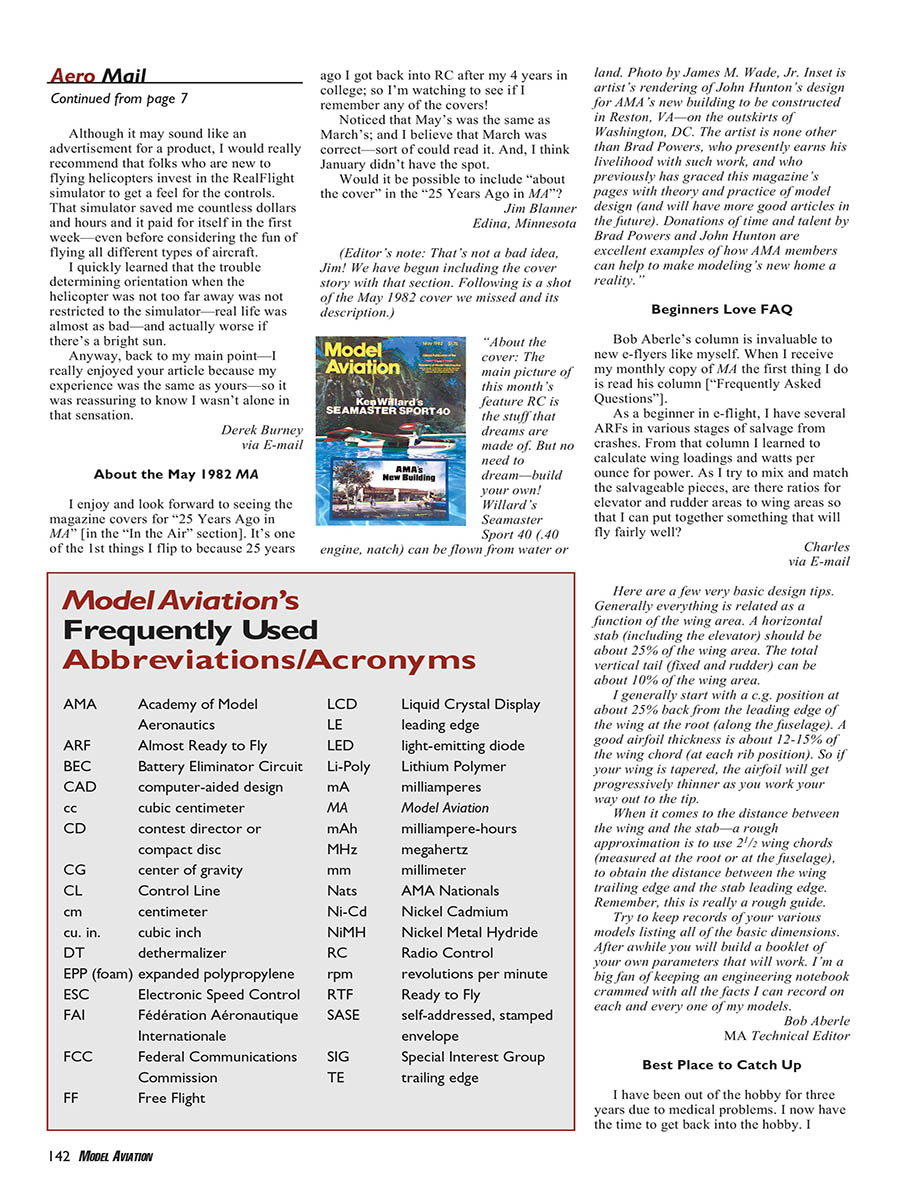
(Editor’s note: That’s not a bad idea, Jim! We have begun including the cover story with that section. Following is a shot of the May 1982 cover we missed and its description.)
About the cover: The main picture of this month’s feature RC is the stuff that dreams are made of. But no need to dream—build your own! Willard’s Seamaster Sport 40 (.40 engine, natch) can be flown from water or land. Photo by James M. Wade, Jr. Inset is artist’s rendering of John Hunton’s design for AMA’s new building to be constructed in Reston, VA—on the outskirts of Washington, DC. The artist is none other than Brad Powers, who presently earns his livelihood with such work, and who previously has graced this magazine’s pages with theory and practice of model design (and will have more good articles in the future). Donations of time and talent by Brad Powers and John Hunton are excellent examples of how AMA members can help to make modeling’s new home a reality.
Beginners Love FAQ
Bob Aberle’s column is invaluable to new e-flyers like myself. When I receive my monthly copy of MA the first thing I do is read his column, “Frequently Asked Questions.”
As a beginner in e-flight, I have several ARFs in various stages of salvage from crashes. From that column I learned to calculate wing loadings and watts per ounce for power. As I try to mix and match the salvageable pieces, are there ratios for elevator and rudder areas to wing areas so that I can put together something that will fly fairly well?
Charles via E-mail
Here are a few very basic design tips. Generally everything is related as a function of the wing area. A horizontal stab (including the elevator) should be about 25% of the wing area. The total vertical tail (fixed fin plus rudder) can be about 10% of the wing area. I generally start with a CG position at about 25% back from the leading edge of the wing at the root (along the fuselage). A good airfoil thickness is about 12–15% of the wing chord (at each rib position). So if your wing is tapered, the airfoil will get progressively thinner as you work your way out to the tip.
When it comes to the distance between the wing and the stab—a rough approximation is to use 2.5 wing chords (measured at the root or at the fuselage) to obtain the distance between the wing trailing edge and the stab leading edge. Remember, this is really a rough guide.
Try to keep records of your various models listing all of the basic dimensions. After a while you will build a booklet of your own parameters that will work. I’m a big fan of keeping an engineering notebook crammed with all the facts I can record on each and every one of my models.
Bob Aberle MA Technical Editor
Best Place to Catch Up
I have been out of the hobby for three years due to medical problems. I now have the time to get back into the hobby. I
Transcribed from original scans by AI. Minor OCR errors may remain.

