
Aero Mail
Corrections
The caption under the bottom right photo on page 51 of the August issue is incorrect. It shows Darren Eaton flying his biplane knife edge past the judges.
Steve Lew took the photo on page 28 of the June issue, in the "Exploring EPA Superfund Sites" article, and it is posted on the club's Web site (www.rcrcc.com/). We apologize for any confusion this may have caused.
—MA staff
Airplanes of The Aviator
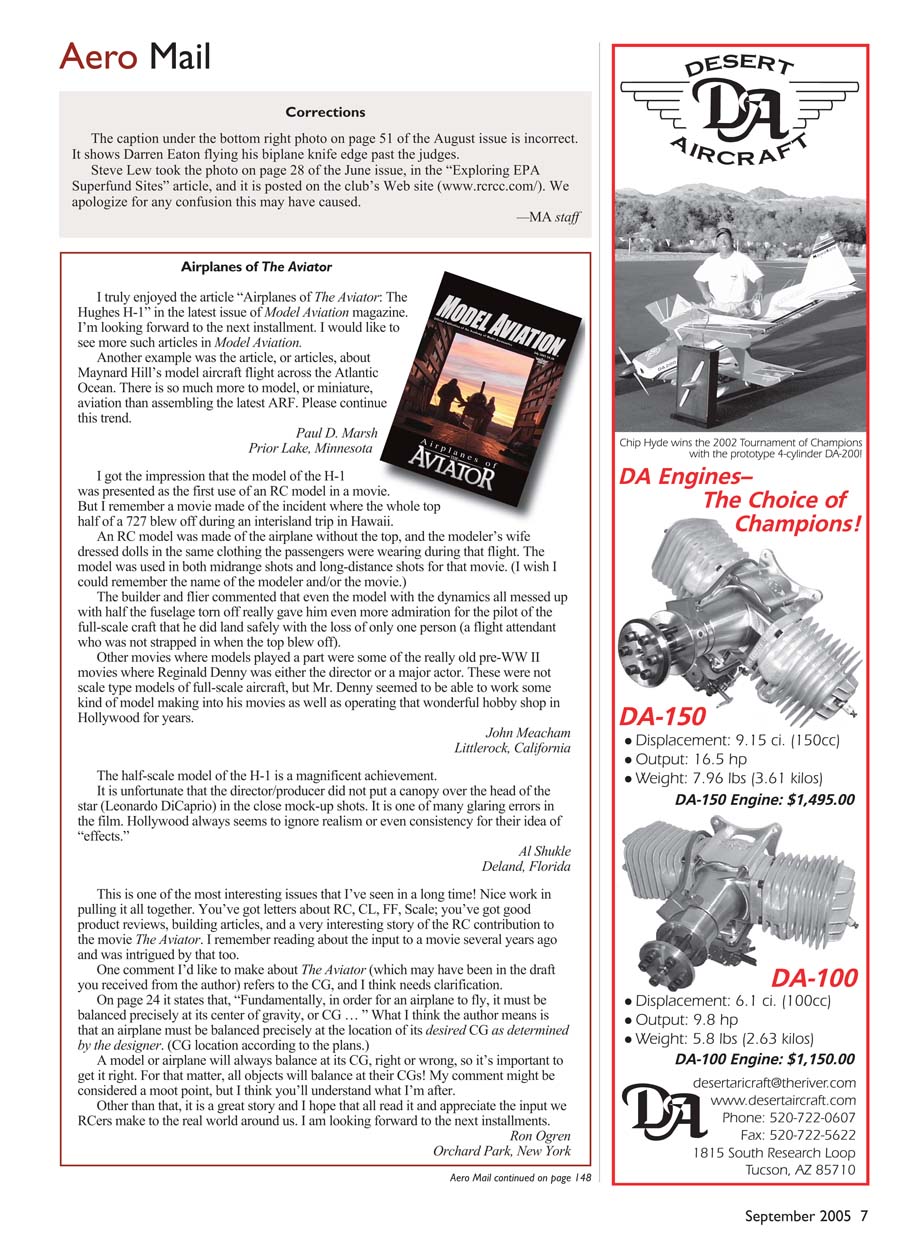
I truly enjoyed the article "Airplanes of The Aviator: The Hughes H-1" in the latest issue of Model Aviation magazine. I'm looking forward to the next installment. I would like to see more such articles in Model Aviation.
Another example was the article, or articles, about Maynard Hill's model aircraft flight across the Atlantic Ocean. There is so much more to model, or miniature, aviation than assembling the latest ARF. Please continue this trend.
Paul D. Marsh Prior Lake, Minnesota
I got the impression that the model of the H-1 was presented as the first use of an RC model in a movie. But I remember a movie made of the incident where the whole top half of a 727 blew off during an interisland trip in Hawaii.
An RC model was made of the airplane without the top, and the modeler's wife dressed dolls in the same clothing the passengers were wearing during that flight. The model was used in both midrange shots and long-distance shots for that movie. (I wish I could remember the name of the modeler and/or the movie.)
The builder and flier commented that even the model with the dynamics all messed up with half the fuselage torn off really gave him even more admiration for the pilot of the full-scale craft that he did land safely with the loss of only one person (a flight attendant who was not strapped in when the top blew off).
Other movies where models played a part were some of the really old pre-WW II movies where Reginald Denny was either the director or a major actor. These were not scale type models of full-scale aircraft, but Mr. Denny seemed to be able to work some kind of model making into his movies as well as operating that wonderful hobby shop in Hollywood for years.
John Meacham Littlerock, California
The half-scale model of the H-1 is a magnificent achievement.
It is unfortunate that the director/producer did not put a canopy over the head of the star (Leonardo DiCaprio) in the close mock-up shots. It is one of many glaring errors in the film. Hollywood always seems to ignore realism or even consistency for their idea of "effects."
Al Shukle Deland, Florida
This is one of the most interesting issues that I've seen in a long time! Nice work in pulling it all together. You've got letters about RC, CL, FF, Scale; you've got good product reviews, building articles, and a very interesting story of the RC contribution to the movie The Aviator. I remember reading about the input to a movie several years ago and was intrigued by that too.
One comment I'd like to make about The Aviator (which may have been in the draft you received from the author) refers to the CG, and I think needs clarification.
On page 24 it states that, "Fundamentally, in order for an airplane to fly, it must be balanced precisely at its center of gravity, or CG ..." What I think the author means is that an airplane must be balanced precisely at the location of its desired CG as determined by the designer. (CG location according to the plans.)
A model or airplane will always balance at its CG, right or wrong, so it's important to get it right. For that matter, all objects will balance at their CGs! My comment might be considered a minor point, but I think you'll understand what I'm after.
Other than that, it is a great story and I hope that all read it and appreciate the input we RCers make to the real world around us. I am looking forward to the next installments.
Ron Ogren Orchard Park, New York
Aero Mail
Future Audiences
I agree with David Lutzow in "The Unfriendly Skies?", a July 2005 issue letter to the editor. He started, as I did, with Control Line and Free Flight. I joined an RC flying club in 1998 and found that most were older than me—and I'm 62!
I grew up in Fort Wayne, Indiana, which had a flying field at the park with a fence and runways for both 25 feet and 60 feet. I would ride my bike with a profile model with a Cox .049 and learned to fly. I built my own models. I even did Free Flight and lost the airplane to a tree.
Anyway, my current RC club is all old guys—with only a few exceptions. I finally convinced the club that they need to get young boys to start the hobby of flying airplanes—particularly Control Line—as most of us have started with, and learn how to start a gas engine and not be afraid. (The airplanes I have prepared all have mufflers, so they are not so scary.)
Our club is sponsoring a "Fun Fly" which includes Control Line flying for the first time. In my business career, I was product manager for Cox Hobbies in 1974 and felt like a kid in a toy store. I know all about Control Line 1/2A airplanes, even cardboard flying saucers!
Our club's Fun Fly will include our training of young boys how to fly Control Line or RC. They can get into flying with Control Line for a lot less than Radio Control.
We will still give them demonstrations of Radio Control with buddy boxes and show jets and helicopters at the Fun Fly. But I am delighted to be a part of getting younger people involved in the hobby: "Ages 10 and older."
Your magazine needs to promote more for younger people; otherwise, we old guys will die off and you guys will have no audience left.
Steven A. Zieg Temecula, California
(Editor's note: MA is aware of the need to grow this great sport through content that hopefully appeals to newcomers, to include people of all ages. Knowing that many young people today go to the Internet as a primary source of information, MA launched an online supplement in 2004: Sport Aviator. You can find it at www.sportaviator.com. You don't have to subscribe or pay a fee; it's free and available to all.)
Good News and Bad News
In the July 2005 Letters to the Editor, George White alluded to an apparent weakness in the Free Flight part of district vice presidents and also a paucity of published Free Flight articles.
I would point out to George that there is a bad news aspect to getting event reports published in MA, which is competition for column space in the district report. There is also a fair bit of time associated with getting event reports submitted in MA, with
Aero Mail
great opportunity to better serve our members and demonstrate the value they get from the number-one modeling magazine.
We are excited about this redesign and hope that you feel the same way. We encourage you to contact us with your thoughts, feelings, and suggestions to make MA even better and more informative.
Three Sarpolus Pieces: Featured in this issue is a set of articles by Dick Sarpolus, one of which is a basic how-to about using sheet foam for model construction. It is certainly no secret that this type of building has become popular in the past couple years to make a variety of aircraft types. Dick writes about the advantages, the sources, and the techniques required to make your own sheet-foam models.
The most visible of these aircraft are the 3-D-aerobatic-type models that have become all the rage. Dick has adapted his famous Hammer aesthetics to a profile 3-D-type airplane, and it is featured as this month's RC construction article.
Matt Sarpolus—Dick's 14-year-old grandson—helped out greatly with flight-testing the design. Matt is a gifted flier and has the reflexes and skill set required to be able to perform the 3-D maneuvers better than his grandfather. (Those are Dick's words—not mine.)
Dick is famous for his design series of CL 1/2A profile sport models. He has adapted the formula used to make those models fly so well to the sheet-foam concept and has turned out a number of 1/2A foam electric-powered models. The CL feature this month is about his electric-powered foamie Skyraider.
Dick and his friend, CAD specialist Ray Borden, visited me with their fleets of 1/2A electric-powered models. I am blessed to have a back yard that is large enough to accept control lines as long as 40 feet (maximum of an 80-foot-diameter circle), so we had ample opportunity to engage in an extended flying/development session.
I was asked by Dick to fly one CL Stunt pattern with the models and make suggestions about how to optimize the flight trim of the airplanes and rate the performance of various types of power setups. That's a fancy way of saying that I played hooky from work for an entire morning and had a ball flying someone else's models!
The experience did open my eyes to the vast future potential and the immediate reality of the advantages of electric power for CL modeling. I was able to do everything, maneuverwise, with the airplanes that I could do with a glow-powered model of a similar type and size.
I learned that certain motor/battery combinations were better than others in output, and I found that gear-drive setups and direct-drive units work well—so well in fact that I was able to practice maneuver timing as if I were practicing with my regular glow-powered models.
And all of this was accomplished in my back yard without the neighbors even knowing we were there. Amazing.
New Contact Info: Along with the redesign, I have a new E-mail address. I've finally been dragged—kicking and screaming—into the high-speed Internet world, and I have had to change Internet providers in the process. My new address is [email protected].
Of course I can still be reached via telephone at (610) 614-1747, or even by the old snail-mail system at Box 68, Stockertown PA 18083. Ah, technology ... MA
Transcribed from original scans by AI. Minor OCR errors may remain.

