
Aerobatics
Eric Henderson 303 Shady Ln., Marlton NJ 08053 E-mail: [email protected]
The 2003 AMA Radio Control Aerobatics Nationals open contest held July 13–18 was my ninth consecutive Nationals attendance, the eighth at the AMA Headquarters site in Muncie, Indiana, and my 11th total in 21 years. This was to be my second one as the Model Aviation columnist covering the event. A new transmission, two oil leaks, a leaking power-steering box, and one bent 16-inch rim later, we were on our way.
The drive to the Nationals cannot help but bring back myriad memories. The miles in my mind are filled with the anticipation of reunions and contest challenges. I wonder what I forgot and what will be new when I get there!
There is a degree of magic associated with any national event. Some entrants are there for the experience itself and can be easily identified by the number of hats and shirts they buy for their friends back home. Some are definitely there for the social interaction and will spend the week reveling in recalling the stories of yesteryear’s Nationals. All attend because it is the “Nats.”
A large contingent comes to compete seriously. They have a desire to be the best in the U.S. open Nats. They have practiced every week since last year’s Nats. They have practiced every day for weeks leading up to the event, and some even came out a week early to get acclimated and, of course, practice.
Contest overview
Jeff Hill was the precision Aerobatics event director for the third year in a row. There are four classes contested: Intermediate (402), Advanced (403), Masters (404), and Fédération Aéronautique Internationale (FAI) F3A (406).
Jeff’s plan required the use of three flying sites at the AMA facility. Each had two flightlines that were employed in the morning and the afternoon for three days in a row. Each site used 12 judges per day: six in the morning and six in the afternoon. That’s a total of 108 judges in the first three days and 10 for the finals. Add to that a scribe for each judge per half day. I’ll wager that Jeff can spell “logistics.”
F3A and Masters used a league system for three days to select finalists for the fourth day. The pilots were divided into four groups per class. The Masters pilots flew in the morning and the F3A pilots flew in the afternoon. Each group was seeded based on last year’s performances.
In Masters there were 10 pilots per group; in F3A there were six pilots per group. Eight top-seeded contestants were distributed among the four groups so that no set of fliers had a bias of “dominant” competitors. After three days the top 20% flew in a final of three rounds. In actuality, 10 pilots were selected for F3A and 10 were chosen for Masters to make sure that the league system and groupings had not unfairly kept “bubble” pilots out of the finals.
In Masters they flew the second year of the 2002–2004 schedule. In F3A they flew the last year of the P‑03 schedule in the qualifying rounds and a different schedule called F‑03 for the F3A finals. The pilots carried their best scores forward to finals day, when three flights were made. The league is used to select finalists by taking one best score from each day and a fourth remaining best result from any day. Thus it was vitally important to fly well every day and in every round.
Arrival
Joe Lachowski, Michelle (my better half), and I set out for the Nats at 7:10 a.m. Friday morning (July 11) from Cherry Hill, New Jersey. We arrived in Muncie at 8:30 p.m., which was 7:30 local time.
Just as we arrived there was another of those heavy rainstorms that had been drenching and flooding the Midwest for weeks. We found Tom Weedon and his trailer, and we headed (waded) out for a meal. Tom had volunteered not to fly and to do the scoring on the Intermediate and Advanced site.
We had the customary reunion steak dinner, and then we were treated to the most spectacular rainbow I have ever seen. The colors were so strong that there was a shadow (a second rainbow).
All of the hotels in Muncie were full that night, so we headed up I‑69 to Marion, Indiana, for a good night's sleep. The next morning we drove to Fort Wayne, Indiana, and were later joined by Earl Vincent, who drove in from Myrtle Beach, South Carolina.
I can't begin to tell you how gracious and accommodating the Fort Wayne Flying Circuits were. Instead of feeling like intruders on their site, we felt like honored guests. I had more fun there than I did the rest of the week!
That evening we headed back to Muncie and participated in my favorite part of the Nats: the reunions. It is the greatest experience to see people with whom you have been bonded by this great sport of ours. We ran into Dorothy and Roy Speights, then Ken Velez and Myra, Jim Woodward, and others. Gary Harris was there with the North and South Carolina crowd. Many of us headed off for yet another steak dinner!
Most of the people I've mentioned stayed in tents, trailers, or RVs. AMA has laid on power and water, so now quite a big community is building up there every year.
Practice and pilots' meeting
Sunday is when the event starts to take shape. The AMA site was open for practice, and many pilots converged on the three sites to get in just one more flight and get oriented on their flightlines.
It was one of those Bill Murray “Groundhog Day” loops that you live again and again. Some are good and some are not so good! The temperature was hovering just below 80°, with light wind and hotel-picture-perfect puffy-clouded skies.
While a questionably merry band of pilots was being judge-schooled by Don Ramsey at AMA Headquarters, the rest of us settled in for some practice flights at the sites. The frequency pins were allocated to the sites the way they would be on Monday.
My traveling buddy Joe Lachowski was a casualty of failed-elevator syndrome, and he created a new “box marker” on the left of Site 1. It was tough to watch. We gave Joe some room to mourn the loss of his new Temptation, and we were rewarded with him pulling out his backup Focus and proceeding to fly some nice stuff. This sport really does test you, and Joe passed the test that day.
Meeting the faces is always a rich thing to take away from the Nats. Chip Hyde's biplane was at our site, as was Dave Villwock's. Chip answered many questions about his model. It was great to be able to take pictures of two Double Visions together.
Andrew Jesky scared us all when his ailerons went nuts. He chopped the gas and landed quickly. It seemed like a problem with vibration when the engine was opened up. He was last seen pulling out his backup model to fly as the sun was setting.
Lee Davis had the prototype Focus 2 on display. It was so new that it had no equipment in it. It looked right, and I can't wait for mine. I promise not to change this one at all!
The pilots' meeting was held at 5 p.m. Mickey Losardo gave a terrific live rendition of the national anthem. My youngest son had signed up for the Navy the week before the event, and I had many mixed feelings as I gazed at our flag fluttering in the breeze. He is into naval aviation, and our sport influenced his decision. Jeff Hill asked us to remember deceased Tournament of Champions (TOC) founder Bill Bennett for all of his contributions to our sport.
My day ended with precontest sound tests, which were available to all contestants. Most took advantage of the service. My Temptation with an O.S. 1.60 engine, an ES carbon pipe, and a 17 x 13 APC propeller got an 88-decibel rating over grass. That really made my day!
Donny Wright was doing a roaring trade, selling some neat stretch airplane covers. He quickly ran out of them and was last seen ordering a fresh FedEx batch for Monday.
Monday, July 14
Flying began at 8 a.m. All transmitters were required to be in the impound by 7:45 a.m. No engine runs were permitted before 8 a.m. The weather was a little unsettled but cleared quickly, and the contest got off with only a few weather delays.
Masters and Intermediate classes had the morning slot last year, so F3A and Advanced got to fly in the morning this year. After lunch Masters flew on Sites 1 and 3, and Intermediate flew on Site 4. The first day began with a slight breeze that was only blowing slightly harder by midafternoon. I had F3A flights that were approximately an hour apart, so I was able to scoot over to the other sites to get some pictures of the groups who were flying.
Chip Hyde had to abandon his second flight because of a nonstarting engine. His first score was removed because he wasn't wearing a contestant tag. He protested this, and his protest was upheld when it was revealed that as a late entry he did not have a tag in his packet.
In AMA classes 402–404 you get three minutes to start your model's engine, then you make the flight. In F3A you get 10 minutes to get it all done. (The watch is stopped for interruptions such as sound tests, models landing, etc.) The F3A pilots took from 8 a.m. to 10:30 a.m. to complete their two rounds. The 40 Masters pilots made for a really big group to process and took the whole afternoon slot.
The league system does not make it easy to see who is winning until Wednesday. Kris Kovanda won two rounds in Intermediate and set the standard for his class. In Advanced, Michael Hill took Round One and Robert Fortino took Round Two. The battle lines were drawn.
Tuesday, July 15
This was a weather day in terms of rain and big winds; it was a “whether” day in the sense of whether you would make the finals or not. If you got the slot before the storm, you had a chance. If you got the flying slot after the storm, you flew sideways and your chances of a good Day Two score were slim—to say the least.
The work that Lamar Blair did on the new YS 160 DZ prototype paid off for Chip in F3A. He won a round but elected not to fly in the gale after the midmorning storm. This left him in a situation in which he had to make two stellar flights on Wednesday or he was out of the running.
The wind was so strong that several pilots chose not to fly. Some low clouds also tested quite a few fliers. My hat is off to those who handled the wind and the clouds and scored well in their rounds. (We probably need to look at the wind limits again. The ones we currently use were relevant to an entirely different type of flying 15 years ago.)
Kris Kovanda dropped a round to Joe Dunnaway in Intermediate, and a diminutive 14-year-old A.C. Glenn kept chugging away in second place, looking for a round to win. We were worried that the wind would blow him away! Michael Hill and Robert Fortino took a round each in Advanced, and Robert was mathematically in front.
Wednesday, July 16
It was a big day for all of the contestants. Advanced was having a close-fought battle and would be decided in the last round. Intermediate was a dogfight for second place.
By 4:30 p.m., the 402 and 403 pilots' contests were over. Their final results and awards awaited them at the evening banquet. For Masters and F3A pilots, the day was going to be long. The higher-scoring competitors basically knew who was going to be in the finals. Those on the finals-grouping cusp (the bubble) had to wait to see who would get another day of flying.
A.C. Glenn was rewarded with a last-round win in Intermediate, and you could not get the smile off of his young face. Chip Hyde came through with two strong flights in F3A. However, he did not have it all his own way, and the “quiet man” Don Szczur did not stop in his quest for a national championship and continued to fly like a TOC veteran.
I took the chance to fly my number-two model — a Mintor 1.70-powered Hydeout — in the last two rounds of F3A. The engine started on the first back flip for each flight; it is definitely a viable Pattern power plant. It never missed a beat, even though it was running rich on its eighth and ninth runs. The twin-plug head does its job, and the engine has the grunt!
The National Society of Radio Controlled Aerobatics (NSRCA) banquet agenda consists of a meal followed by a short general meeting to report on the NSRCA Annual General Meeting, then the real fun begins.
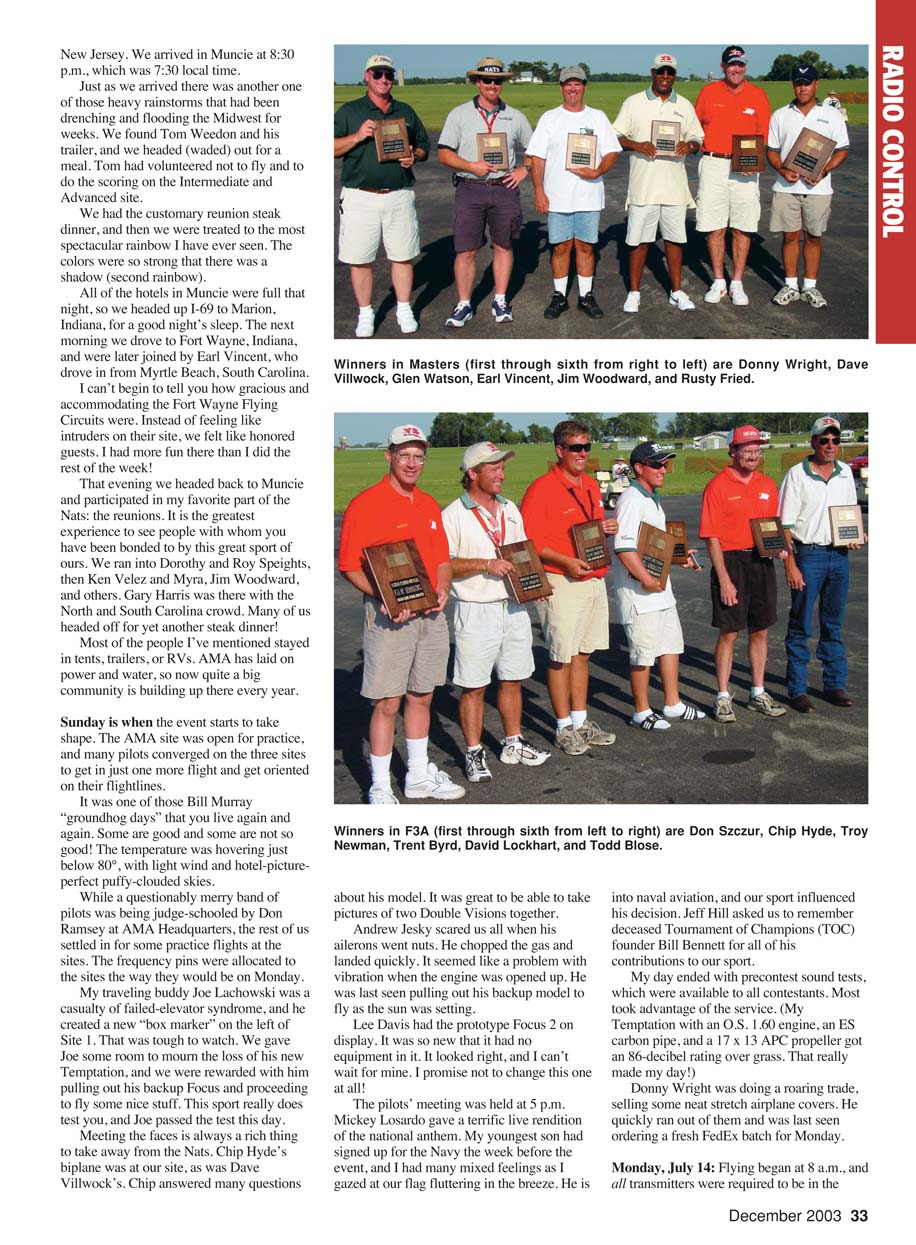
NSRCA President Tony Stillman ran the show well and kept us entertained with a raffle and auction. The banquet had much better food this year, and the auction and raffle raised approximately $5,000.
Trophy winners at the banquet:
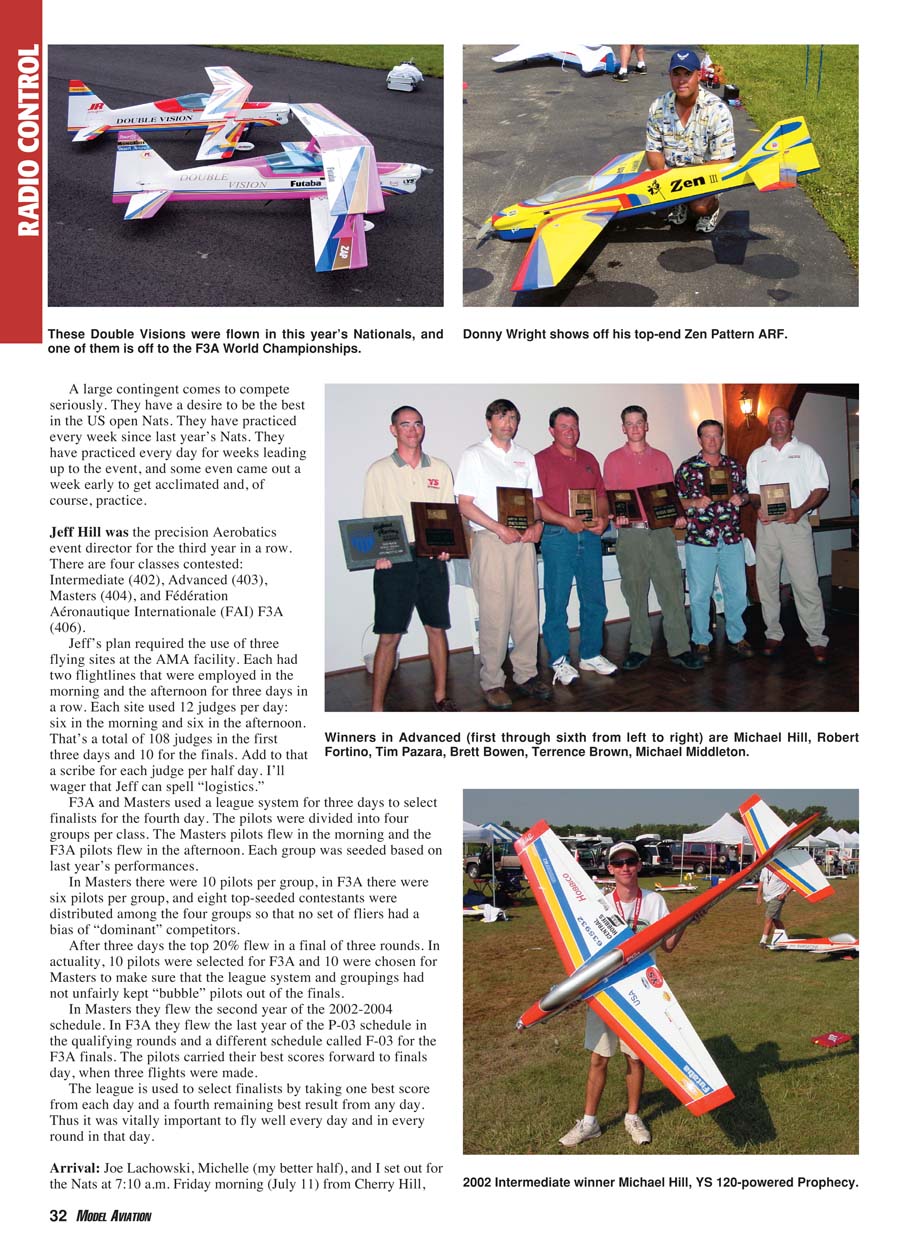
- Intermediate (402): Kris Kovanda, A.C. Glenn, Joe Dunnaway, Michael Radeke.
- Advanced (403): Michael Hill, Robert Fortino, Tim Pazara, Brett Bowen, Terrance Brown, Michael Middleton.
The big buzz on banquet night is always who will be in the finals. The names are read in alphabetical order with no scores revealed so that the next day the judges do not carry any preconceived notions of who should win.
Masters finalists:
- Jerry Budd
- Jeff Carrish
- Rusty Fried
- B.W. Ponder
- Dave Villwock
- Earl Vincent
- Joe Walker
- Jim Woodward
- Donny Wright
- Warm-up pilot: John Fuqua
Masters judges:
- Eric Henderson
- Charlie Barrera
- Lamar Blair
- Roy Speights
- Paul Nesbitt
- Earl Haury
F3A finalists:
- Todd Blose
- Trent Byrd
- Peter Collinson
- Mike Harrison
- Bryan Hebert
- Chip Hyde
- Andrew Jesky
- Dave Lockhart
- Troy Newman
- Don Szczur
- Warm-up pilot: Raiko Potter
F3A judges:
- Ron Barr
- Don Ramsey
- Greg Frohriech
- Bob Noll
- Juan Romero
- Luis Rodriguez
Thursday, July 17 (Finals)
On finals day, two events were run in parallel. The scores show that a close-fought battle took place in F3A between Chip Hyde and Don Szczur. Don carried 1,000 points into the finals versus Chip's 988 points. Chip won two of the three final rounds, but Don won the title by a margin of 0.7 point in a 3,000-point pool. All Don could say when he received his plaque was, “This is like magic,” and he smiled—a lot.
Donny Wright led Masters all the way. He carried a 1,000 into the finals against Earl Vincent's 992. Earl had a balky engine that cost him a set of takeoff points in Round One of the finals and kept him edgy for the next two flights.
Donny surrendered the 1,000 baton points in that last round to Jim Woodward, who succeeded in winning a round in the Masters finals on his first attempt. Second through fourth places were separated by only seven points out of 3,000.
Jeff Hill presented the trophies for F3A and Masters classes at Site 3. In the interval before the presentations, Don Szczur flew his Focus with 3-D wings, then Chip followed with a low-altitude rolling demonstration with his Double Vision biplane. This made U.S. team manager Tony Stillman hold his breath more than a few times.
Trophy winners in Masters (404):
- Donny Wright
- Dave Villwock
- Glen Watson
- Earl Vincent
- James Woodward
- Rusty Fried
Trophy winners in F3A (406):
- Don Szczur
- Chip Hyde
- Troy Newman
- Trent Byrd
- David Lockhart
- Todd Blose
- Andrew Jesky
So what was the big news at this year's Nats? The biplanes are viable as long as you have the patience to screw in all of those fasteners! The YS 160 DZ is a big, stump-pulling horse. Jerry Budd showed us that the Webra 160 will launch anything vertical.
The Mintor 3M 1.40s and 1.70s are here as part of the two-stroke's resurgence. YS fights back well with the DZ. The O.S. 1.40s were back and running well. The O.S. 1.60s will also get the job done.
The biggest news is that a Focus and a Zen 120 won the top classes, and both are Almost Ready to Flys (ARFs). You can say goodbye to the perceived price barrier!
See you at the Nats next year with your ARF!
MA
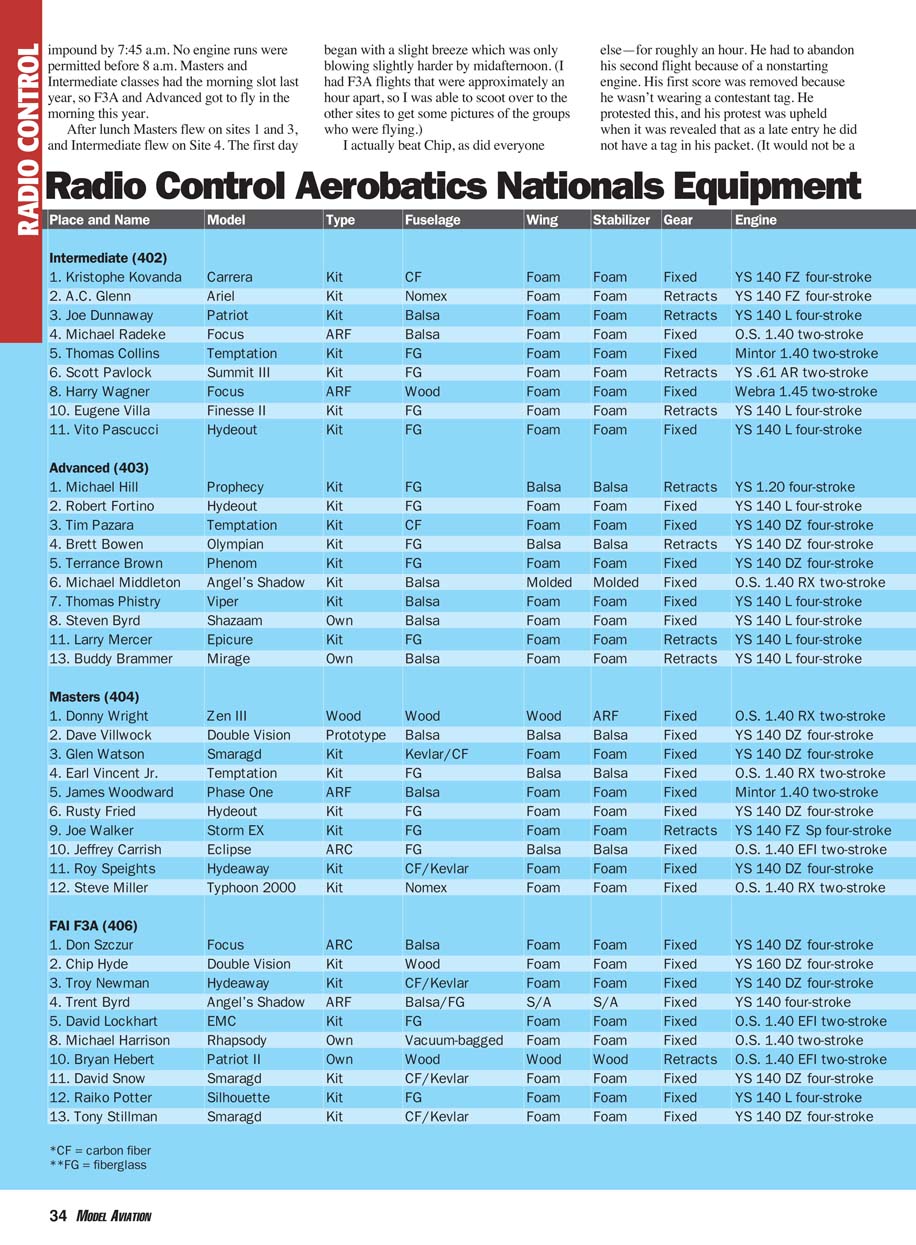
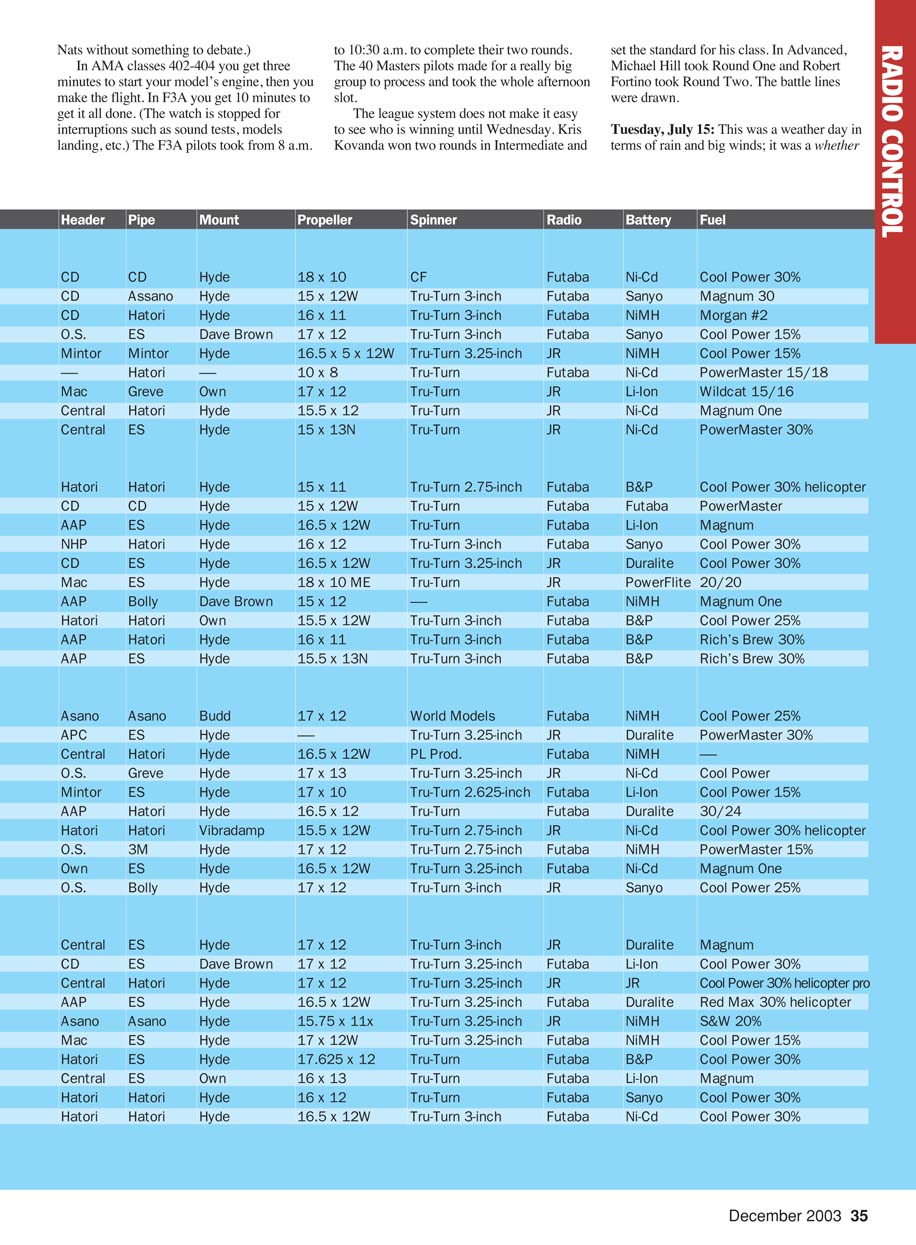
Radio Control Aerobatics Nationals Equipment
Intermediate (402)
- 1. Kristophe Kovanda — Carrera — Kit — CF — Foam — Foam — Fixed — YS 140 FZ four-stroke
- 2. A. C. Glenn — Ariel — Kit — Nomex — Foam — Foam — Retracts — YS 140 FZ four-stroke
- 3. Joe Dunnaway — Patriot — Kit — Balsa — Foam — Foam — Retracts — YS 140 L four-stroke
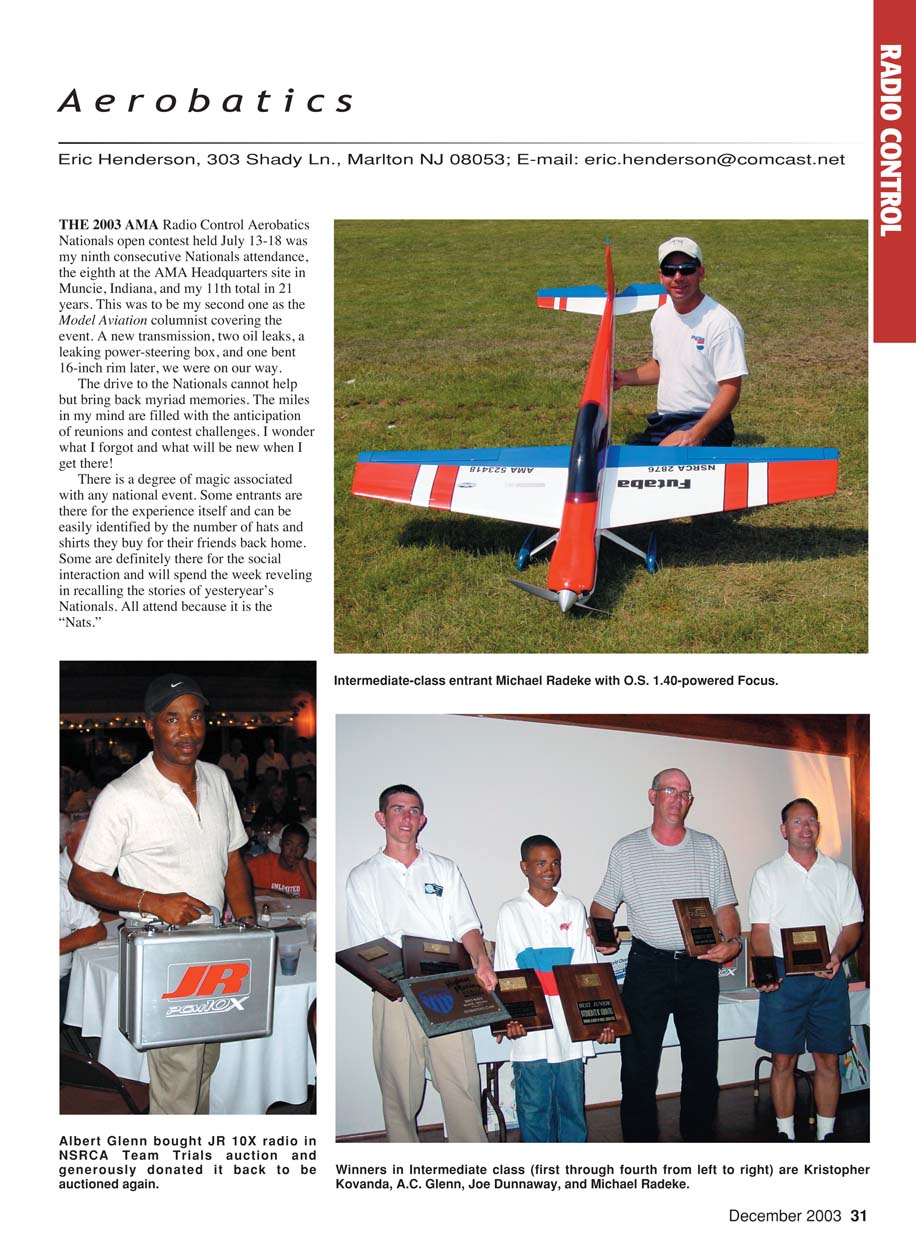
- 4. Michael Radeke — Focus — ARF — Balsa — Foam — Foam — Fixed — O.S. 1.40 two-stroke
- 5. Thomas Collins — Temptation — Kit — FG — Foam — Foam — Fixed — Mintor 1.40 two-stroke
- 6. Scott Pavlock — Summit III — Kit — FG — Foam — Foam — Retracts — YS .61 AR two-stroke
- 8. Harry Wagner — Focus — ARF — Wood — Foam — Foam — Fixed — Webra 1.45 two-stroke
- 10. Eugene Villa — Finesse II — Kit — FG — Foam — Foam — Retracts — YS 140 L four-stroke
- 11. Vito Pascucci — Hydeout — Kit — FG — Foam — Foam — Fixed — YS 140 L four-stroke
Advanced (403)
- 1. Michael Hill — Prophecy — Kit — FG — Balsa — Balsa — Retracts — YS 1.20 four-stroke
- 2. Robert Fortino — Hydeout — Kit — FG — Foam — Foam — Fixed — YS 140 L four-stroke
- 3. Tim Pazara — Temptation — Kit — CF — Foam — Foam — Fixed — YS 140 DZ four-stroke
- 4. Brett Bowen — Olympian — Kit — FG — Balsa — Balsa — Retracts — YS 140 DZ four-stroke
- 5. Terrance Brown — Phenom — Kit — FG — Foam — Foam — Fixed — YS 140 DZ four-stroke
- 6. Michael Middleton — Angel's Shadow — Kit — Balsa — Molded — Molded — Fixed — O.S. 1.40 RX two-stroke
- 7. Thomas Phistry — Viper — Kit — Balsa — Foam — Foam — Fixed — YS 140 L four-stroke
- 8. Steven Byrd — Shazaam — Own — Balsa — Foam — Foam — Fixed — YS 140 L four-stroke
- 11. Larry Mercer — Epicure — Kit — FG — Foam — Foam — Retracts — YS 140 L four-stroke
- 13. Buddy Brammer — Mirage — Own — Balsa — Foam — Foam — Retracts — YS 140 L four-stroke
Masters (404)
- 1. Donny Wright — Zen III — Wood — Wood — Wood — ARF — Fixed — O.S. 1.40 RX two-stroke
- 2. Dave Villwock — Double Vision — Prototype — Balsa — Balsa — Balsa — Fixed — YS 140 DZ four-stroke
- 3. Glen Watson — Smaragd — Kit — Kevlar/CF — Foam — Foam — Fixed — YS 140 DZ four-stroke
- 4. Earl Vincent Jr. — Temptation — Kit — FG — Balsa — Balsa — Fixed — O.S. 1.40 RX two-stroke
- 5. James Woodward — Phase One — ARF — Balsa — Foam — Foam — Fixed — Mintor 1.40 two-stroke
- 6. Rusty Fried — Hydeout — Kit — FG — Foam — Foam — Fixed — YS 140 DZ four-stroke
- 9. Joe Walker — Storm EX — Kit — FG — Foam — Foam — Retracts — YS 140 FZ Sp four-stroke
- 10. Jeffrey Carrish — Eclipse — ARC — FG — Balsa — Balsa — Fixed — O.S. 1.40 EFI two-stroke
- 11. Roy Speights — Hydeaway — Kit — CF/Kevlar — Foam — Foam — Fixed — YS 140 DZ four-stroke
- 12. Steve Miller — Typhoon 2000 — Kit — Nomex — Foam — Foam — Fixed — O.S. 1.40 RX two-stroke
FAI F3A (406)
- 1. Don Szczur — Focus — ARC — Balsa — Foam — Foam — Fixed — YS 140 DZ four-stroke
- 2. Chip Hyde — Double Vision — Kit — Wood — Foam — Foam — Fixed — YS 160 DZ four-stroke
- 3. Troy Newman — Hydeaway — Kit — CF/Kevlar — Foam — Foam — Fixed — YS 140 DZ four-stroke
- 4. Trent Byrd — Angel's Shadow — ARF — Balsa/FG — S/A — S/A — Fixed — YS 140 four-stroke
- 5. David Lockhart — EMC — Kit — FG — Foam — Foam — Fixed — O.S. 1.40 EFI two-stroke
- 6. Michael Harrison — Rhapsody — Own — Vacuum-bagged — Foam — Foam — Fixed — O.S. 1.40 two-stroke
- 10. Bryan Hebert — Patriot II — Own — Wood — Wood — Wood — Retracts — O.S. 1.40 EFI two-stroke
- 11. David Snow — Smaragd — Kit — CF/Kevlar — Foam — Foam — Fixed — YS 140 DZ four-stroke
- 12. Raiko Potter — Silhouette — Kit — FG — Foam — Foam — Fixed — YS 140 L four-stroke
- 13. Tony Stillman — Smaragd — Kit — CF/Kevlar — Foam — Foam — Fixed — YS 140 DZ four-stroke
Notes:
- CF = carbon fiber
- FG = fiberglass
No Nats is without something to debate.
Transcribed from original scans by AI. Minor OCR errors may remain.

