
AEROTOWING MADE EASY
by Eric Henderson
A high-performance sailplane will stay aloft for hours once you can find the right conditions. The problem a glider pilot faces, apart from finding a thermal, is how to get enough altitude to enter one at the right point. If entered too low, the slower-rising air may not have enough energy to help the airplane climb.
Occasionally you might find a thermal with a lot of energy near the ground into which you could hand-launch a large sailplane. These thermals are not common, so the model usually needs help to reach a higher entry point.
There are several ways to help a glider reach the right entry point. In most cases this involves a towline pulled by a runner or a winch—called a "hand" or "winch tow." A more exciting way to give a model operating altitude is to copy the full-scale practice of an aerotow, using a powered airplane as the tug.
There are two places where a towline can be attached to a glider. The hand or winch towline is attached under the fuselage, just in front of the CG. The aerotow line is hooked to the front of the nose.
Setting It Up
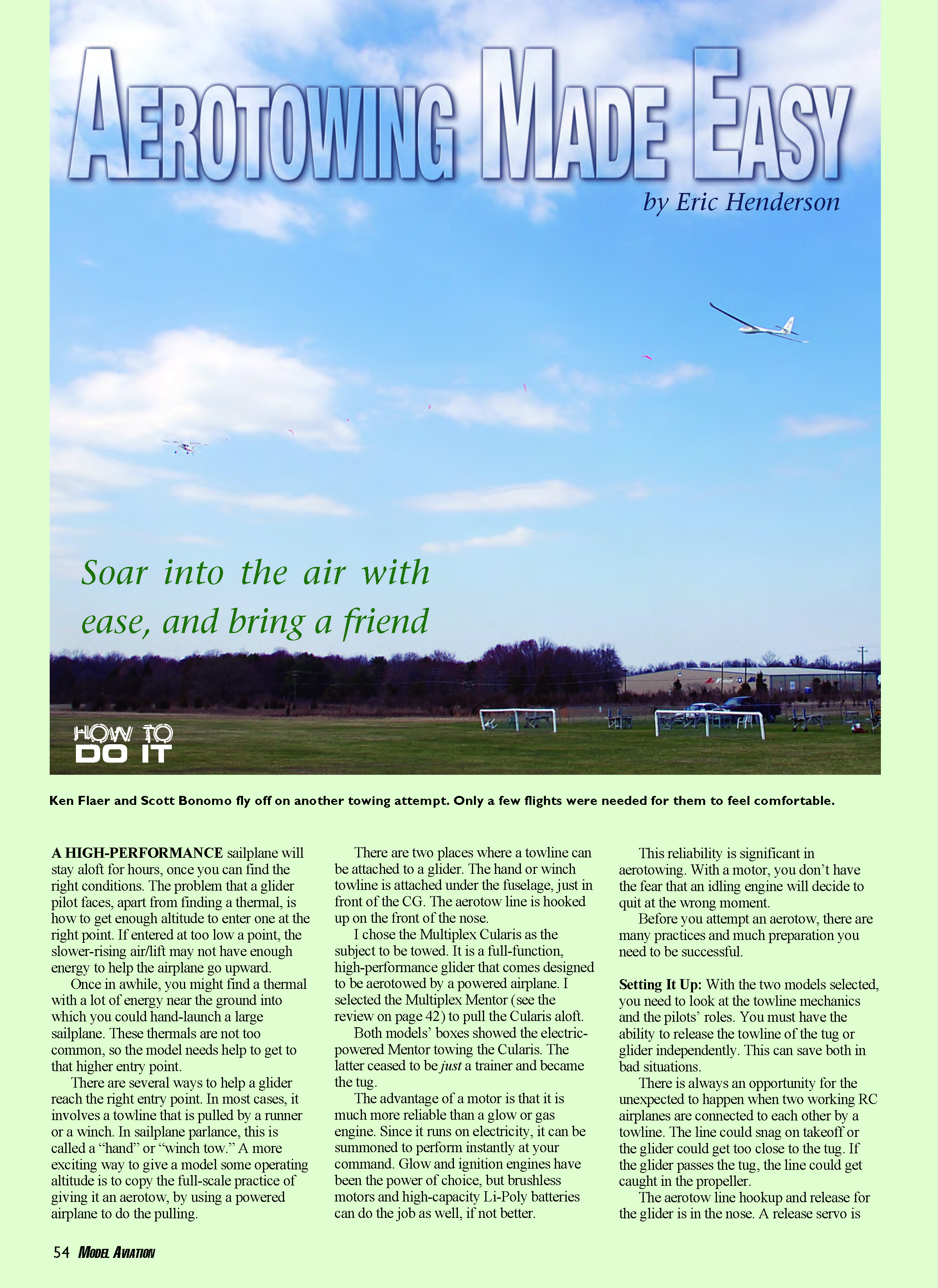
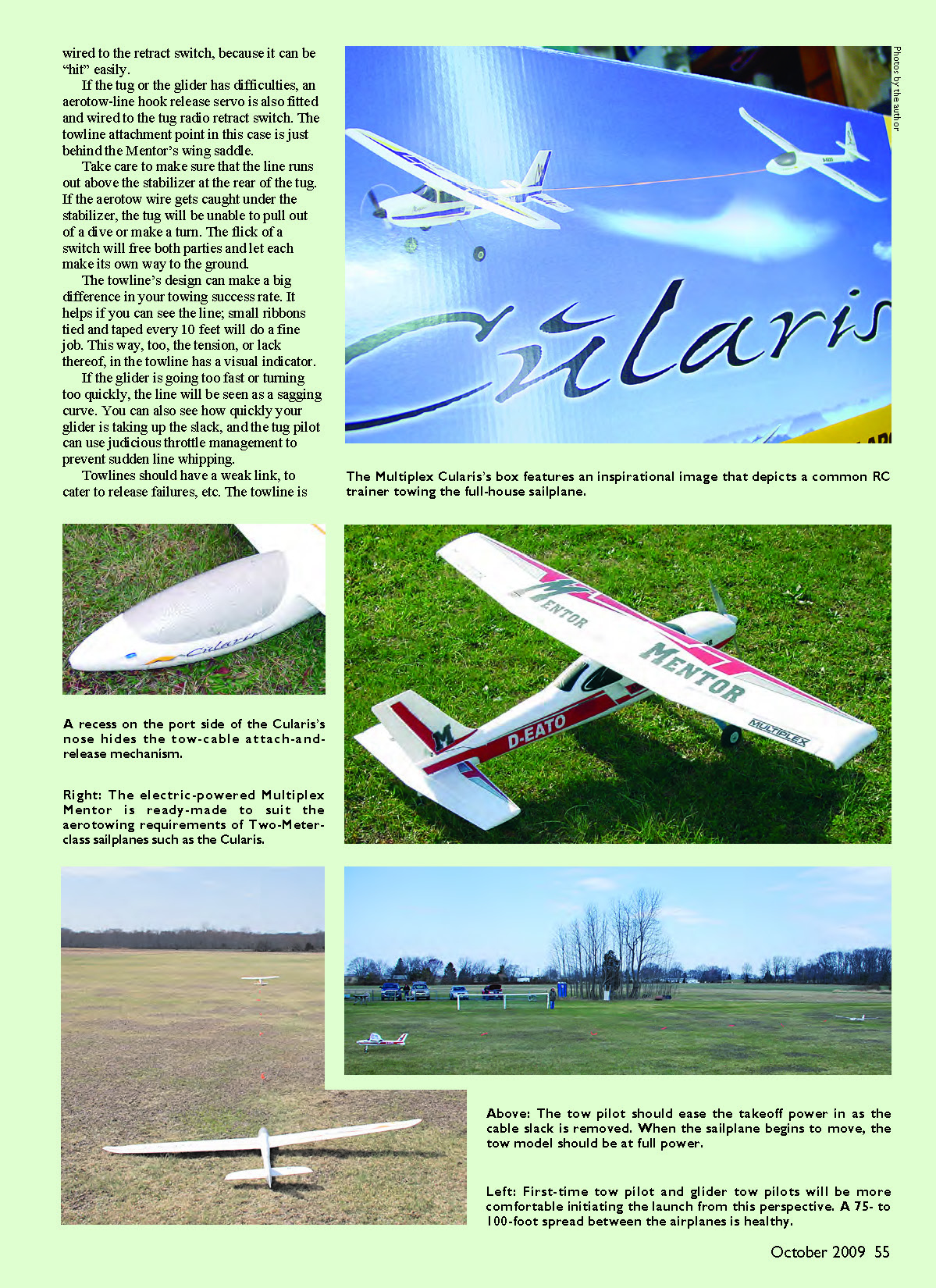
I chose the Multiplex Cularis as the subject to be towed. It is a full-function, high-performance glider designed to be aerotowed. I selected the Multiplex Mentor as the tug. Both kits show the electric-powered Mentor towing the Cularis; the Mentor ceases to be just a trainer and becomes the tug.
The advantage of an electric motor is reliability. It runs on electricity and can be summoned instantly at your command. Glow and gas engines have been traditional choices, but brushless motors and high-capacity Li-Poly batteries can do the job as well or better. This reliability is significant in aerotowing—you don't have the fear that an idling engine will quit at the wrong moment.
Before you attempt an aerotow, there are many practices and preparations you need to be successful.
Towline mechanics and pilot roles
With the two models selected, inspect the towline mechanics and define the pilots' roles. You must be able to release the towline of the tug or the glider independently. This can save both aircraft in bad situations.
There is always the opportunity for the unexpected when two RC airplanes are connected by a towline. The line could snag on takeoff, the glider could get too close to the tug, or if the glider passes the tug the line could get caught in the propeller.
The aerotow hookup and release for the glider is in the nose. A release servo is wired to the retract switch because it can be "hit" easily. If the tug or the glider has difficulties, an aerotow-line hook release servo should also be fitted and wired to the tug radio retract switch. The towline attachment point on the Mentor is just behind the wing saddle. Make sure the line runs out above the tug's stabilizer; if the line gets caught under the stabilizer, the tug may be unable to pull out of a dive or make a turn. The flick of a switch will free both parties and let each make its own way to the ground.
Towline design and handling
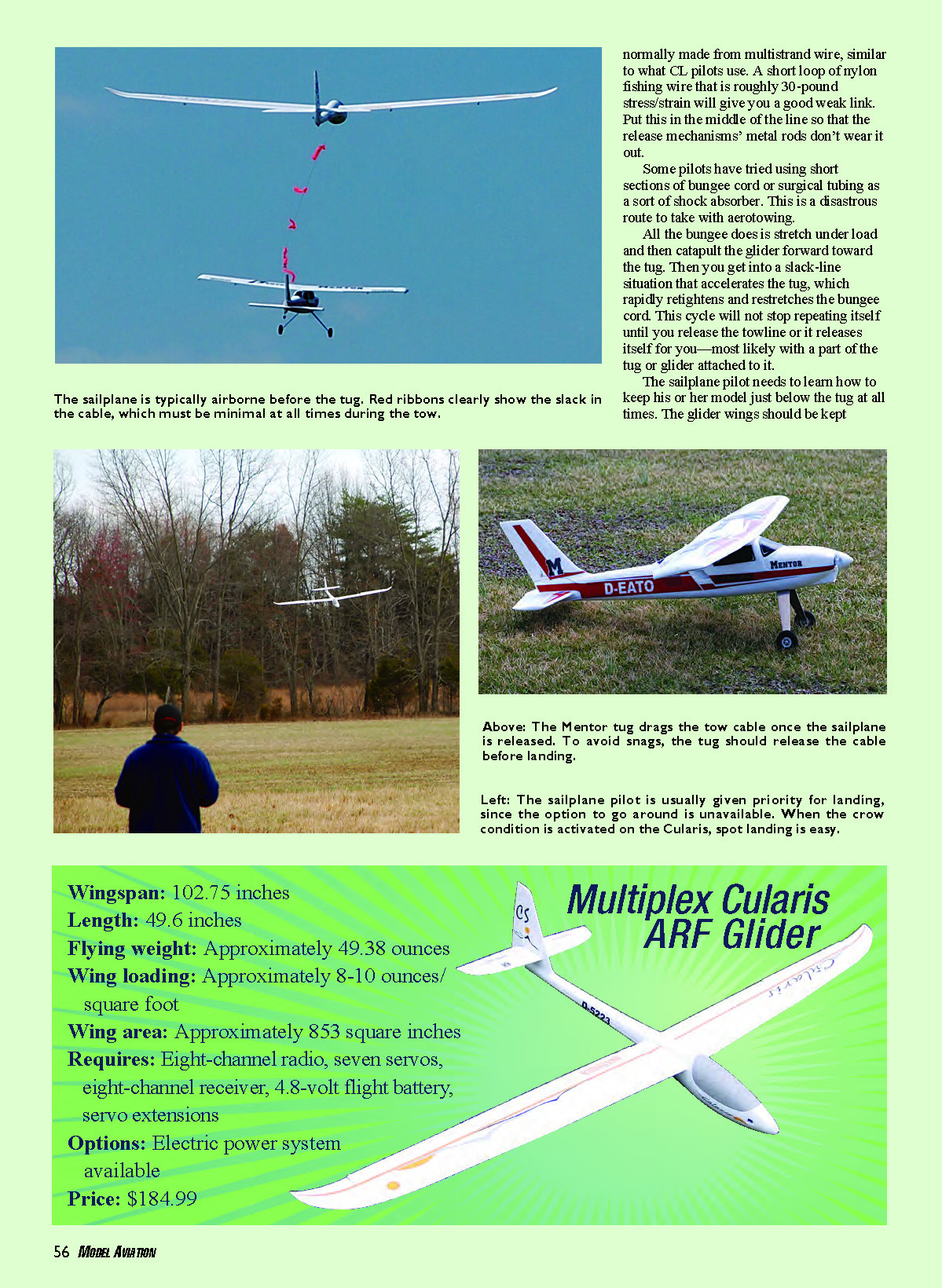
The towline's design can make a big difference in your towing success rate. It helps if you can see the line—small ribbons tied and taped every 10 feet work well. This gives a visual indicator of line tension or slack.
If the glider is going too fast or turning too quickly, the line will sag into a curve. You can also see how quickly your glider is taking up slack, and the tug pilot can use judicious throttle management to prevent sudden line whipping.
Towlines should have a weak link to cater for release failures. The towline is normally made from multistrand wire similar to what control-line pilots use. A short loop of nylon fishing line rated roughly 30 lb makes a good weak link; place it in the middle of the line so release mechanisms' metal rods don't wear it out.
Some pilots have tried using short sections of bungee cord or surgical tubing as shock absorbers. This is disastrous for aerotowing. The bungee stretches under load and then catapults the glider forward toward the tug, creating a slack-line situation that accelerates the tug and then rapidly retightens the bungee. This cycle repeats until the towline or an aircraft is damaged.
Flying technique for the sailplane pilot
The sailplane pilot needs to keep the model just below the tug at all times. The glider wings should be kept level—not banked toward the inside or outside of the tug's turn. The tug will lead the glider around the sky, similar to how a speedboat pulls an inner tube. If the skier turns too much into the boat, the tow rope goes slack. It is the same for the glider. By keeping the wings level you keep the glider "out there" and under good line tension.
The sailplane pilot needs strong mental discipline—it's instinctive and tempting to turn in toward the tug to fall into formation, but that will often create slack in the line. If the line goes loose, the tug is "unloaded" and will accelerate until the line goes taut. It will be like the proverbial guard dog running after the mailman until the chain reaches its limit.
A useful drill for the tug pilot is to fly while pulling a 1-foot-diameter balloon to get used to slower tug speed and the effects of another model's drag. Apart from hand or winch towing, the glider pilot can mainly prepare mentally.
Landing with a towline attached invites a line snag and a bad nose-in crash for the sailplane, and the tug can also be caught out dragging a line. The glider can fly with the towline still in place, but it will be sluggish and prone to losing height quickly. Dump the aerotow line at the earliest practical opportunity depending on remaining height. It is much less expensive to replace a towline than an airplane.
Be environmentally conscious: make every effort to find your towlines in the event of an emergency line dump to avoid harm to wildlife.
In general, the tug has power and should give landing preference to the sailplane in an emergency—unless the tug is also in trouble (for example, no battery power left).
Multiplex Cularis — equipment and setup
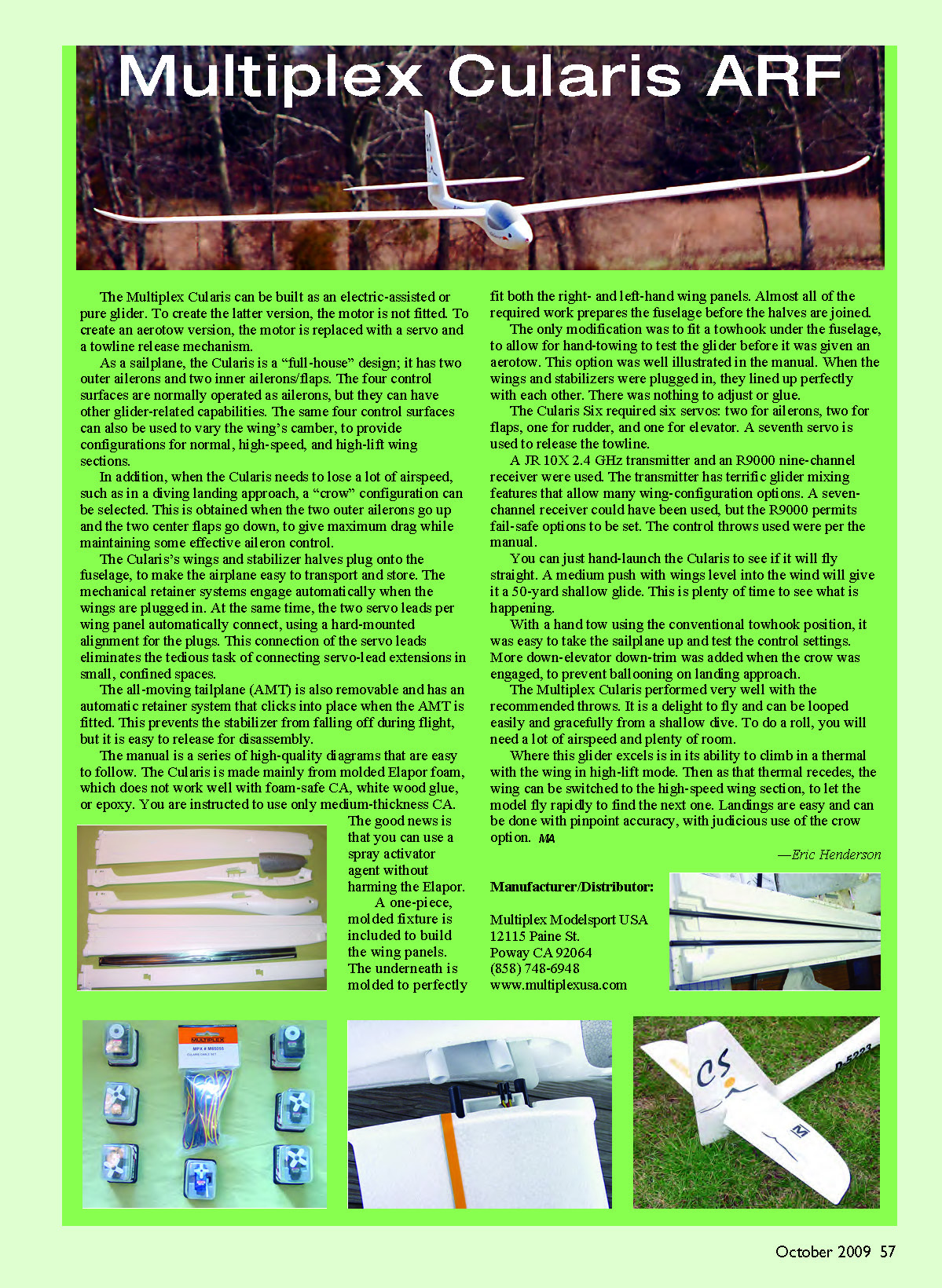
The Multiplex Cularis can be built as an electric-assisted or pure glider. To create the pure glider version, the motor is not fitted. To create an aerotow version, the motor bay can be used for a servo and a towline release mechanism.
As a sailplane, the Cularis is a "full-house" design: two outer ailerons and two inner ailerons/flaps. The four control surfaces are normally operated as ailerons, but they can also be used to vary wing camber for normal, high-speed, and high-lift configurations.
When the Cularis needs to lose a lot of airspeed—such as in a diving landing approach—a "crow" configuration can be selected: the two outer ailerons go up while the center flaps go down to give maximum drag while maintaining some aileron control.
The Cularis’s wings and stabilizer halves plug onto the fuselage for easy transport and storage. Mechanical retainers engage automatically when the wings are plugged in, and the two servo leads per wing panel automatically connect using hard-mounted alignment plugs. This eliminates tedious extension-connecting in tight spaces. The all-moving tailplane (AMT) is also removable with an automatic retainer that clicks into place when fitted.
The manual contains high-quality diagrams that are easy to follow. The Cularis is mainly molded from Elapor foam, which does not work well with foam-safe CA, white wood glue, or epoxy—use only medium-thickness CA. You can use a spray activator without harming the Elapor.
A one-piece molded fixture is included to build the wing panels; the underside is molded to perfectly fit both right- and left-hand panels. Most work prepares the fuselage halves before joining.
The only modification I made was to fit a towhook under the fuselage for hand-towing tests before attempting aerotow; this option is illustrated in the manual. When the wings and stabilizers were plugged in they lined up perfectly—no adjustments or glue required.
The Cularis required six servos: two for ailerons, two for flaps, one for rudder, and one for elevator. A seventh servo is used to release the towline.
I used a JR 10X 2.4 GHz transmitter and an R9000 nine-channel receiver. The transmitter has excellent glider-mixing features that allow many wing-configuration options. A seven-channel receiver could have been used, but the R9000 permits fail-safe options to be set. Control throws followed the manual.
You can hand-launch the Cularis to see if it flies straight. A medium push with wings level into the wind will give a 50-yard shallow glide—plenty of time to check behavior.
With a hand tow using the conventional towhook position, it was easy to test control settings. More down-elevator trim was added when the crow was engaged to prevent ballooning on landing approach.
The Multiplex Cularis performed very well with the recommended throws. It is a delight to fly and can be looped easily from a shallow dive. Rolls require a lot of airspeed and space. The glider excels at climbing in thermals in high-lift mode; when the thermal recedes, switch to the high-speed wing section to quickly find the next one. Landings are easy and can be done with pinpoint accuracy using the crow option.
Secrets of Aerotowing Success: checklist
Following is an expanded checklist of what you need to know and do to make aerotowing work for you.
- Pretest and trim both airplanes.
- Have a flight plan. If both pilots know what to expect, success chances rise dramatically.
- Have a spotter to watch the tug and another to watch the glider. Listen to your spotter; if you hear a release command, comply first and ask questions later.
- Practice bailout signals and responses.
- Use a towline designed for the job. A few well-positioned ribbons will help you see the line at a distance.
- Practice flying the tug with a loaded towline before taking on a model (for example, pull a balloon as drag).
- For takeoff positioning, place the tow and sailplane directly into the wind, even if that is not straight down the runway. Ensure the towline is above the tug's stabilizer.
- A primary rule of aerotow is to gain height as quickly as possible without stalling the tug.
- Keep the glider wing level at all times during the tow.
- Always keep the sailplane lower than the tug.
- Do not let the glider catch up with the tug. Steer to the side with the rudder and keep the wings level to correct the problem.
- Practice post-release towline management. Do one pass to drop the line, then land.
- Try to fly when the sky is clear of other models—especially loud ones. They can make it hard to hear your spotter and the towline can become a hazard to other pilots.
- If you are the tug pilot, do not watch the glider after you are disconnected. Concentrate on getting your airplane down and clearing the towline for the glider pilot and other pilots to land. After that is done, you can watch the results of the aerotow.
- Remember to switch off the tug's electrics. It is easy to forget electric-powered models' shutdowns because they are so quiet.
Flight report
With an empty sky, the aerotow team was ready. Scott Bonomo was the glider guider and Ken Flaer, the New Jersey Pine Barons club instructor, was the willing tug captain. Neither had done towing before, but both were happy to try something different.
With all other club pilots watching and their models on the ground, the Mentor and the Cularis were placed at the center of the runway and aimed into the wind. The Mentor's motor hummed to life and the tug took up tension on the aerotow line. All you could hear was a slight rustling as the towline rolled through the grass. The Cularis gently started to move and twitched straight as the aerotow line came up to full tension and the nose started following the tug.
Gliders sit with one wing resting on the runway before they get moving. The sailplane wing begins to "work" at exceptionally low airspeeds. The Cularis’s low wing dragged only a little and then picked itself up as air started to flow over it. You can pick up a dragging wing by momentarily using inside rudder: if the glider drags the left wingtip, give a short left rudder input. This causes the fuselage to act like a sailboat’s keel and roll the airplane slightly, immediately picking up the dragging wing.
As is common with gliders, the Cularis’s takeoff run was much shorter than the tug’s. The Cularis pilot flew lower to the ground while full power got the Mentor airborne.
The glider pilot had selected the standard wing camber section, which gave a little more drag. Some down-elevator was used to prevent it from getting too high.
The tug made a slow left-hand climbing turn at approximately 100 feet. The sailplane gently skidded around behind with wings kept level. The Cularis pilot hit the retract switch at roughly 400 feet, released the towline, and began to fly on his own. This was a deliberately short flight to prove the concept.
The tug pilot immediately noticed the glider release by the Mentor's increase in speed. He throttled back to half power, made a circuit, and landed. The Cularis pilot later made a controlled "crow" landing in the middle of the runway.
The pilots and I celebrated with big grins and soon lined up for a second flight. Both men found their airplanes easy to fly and were impressed with the Multiplex combination of foam and electric power.
Aerotowing is fun and adds a new dimension to what you can do with a couple of radio-controlled models. Everything worked perfectly and, best of all, we had pictures to prove it.
—Eric Henderson [email protected]
Transcribed from original scans by AI. Minor OCR errors may remain.

