
De-Fence
At Cobb County Radio Control Modelers Club (CCRC) in Acworth, Georgia, the flightline safety fence was a deteriorating PVC pipe structure. Eighteen-year-old Joshua Jibilian, a club member for roughly nine years, suggested to club president Karl Durant that the safety fence be replaced.
As a member of Boy Scout Troop 306, Joshua intended to replace the fence to fulfill an Eagle Scout public service project requirement. He volunteered to coordinate “De‑Fence” activity and Karl approved.
Before construction could start, De‑Fence needed to be approved by Cobb County officials. Joshua assisted with the necessary paperwork to show the project location, materials to be used, and a specific fence design.
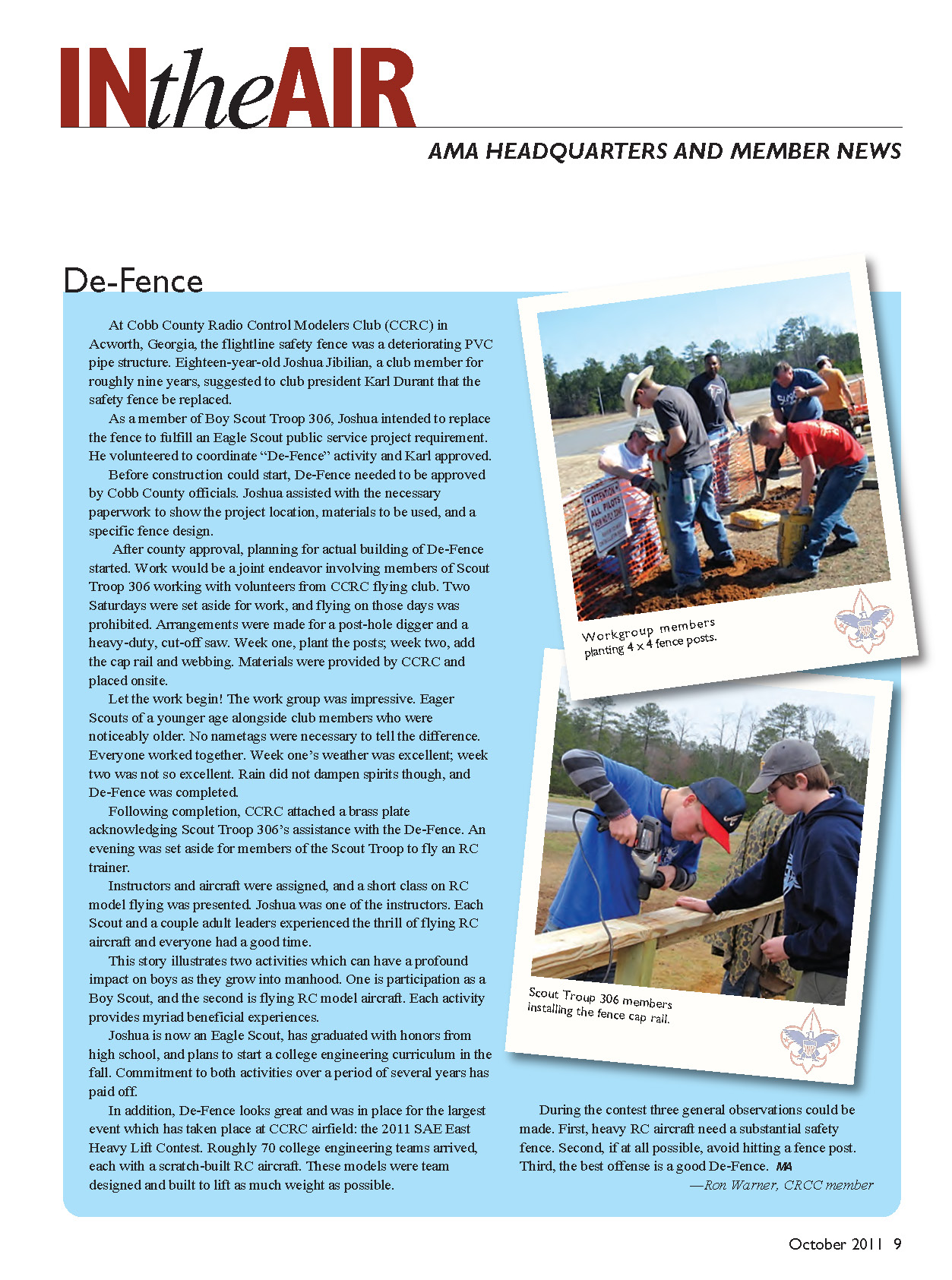
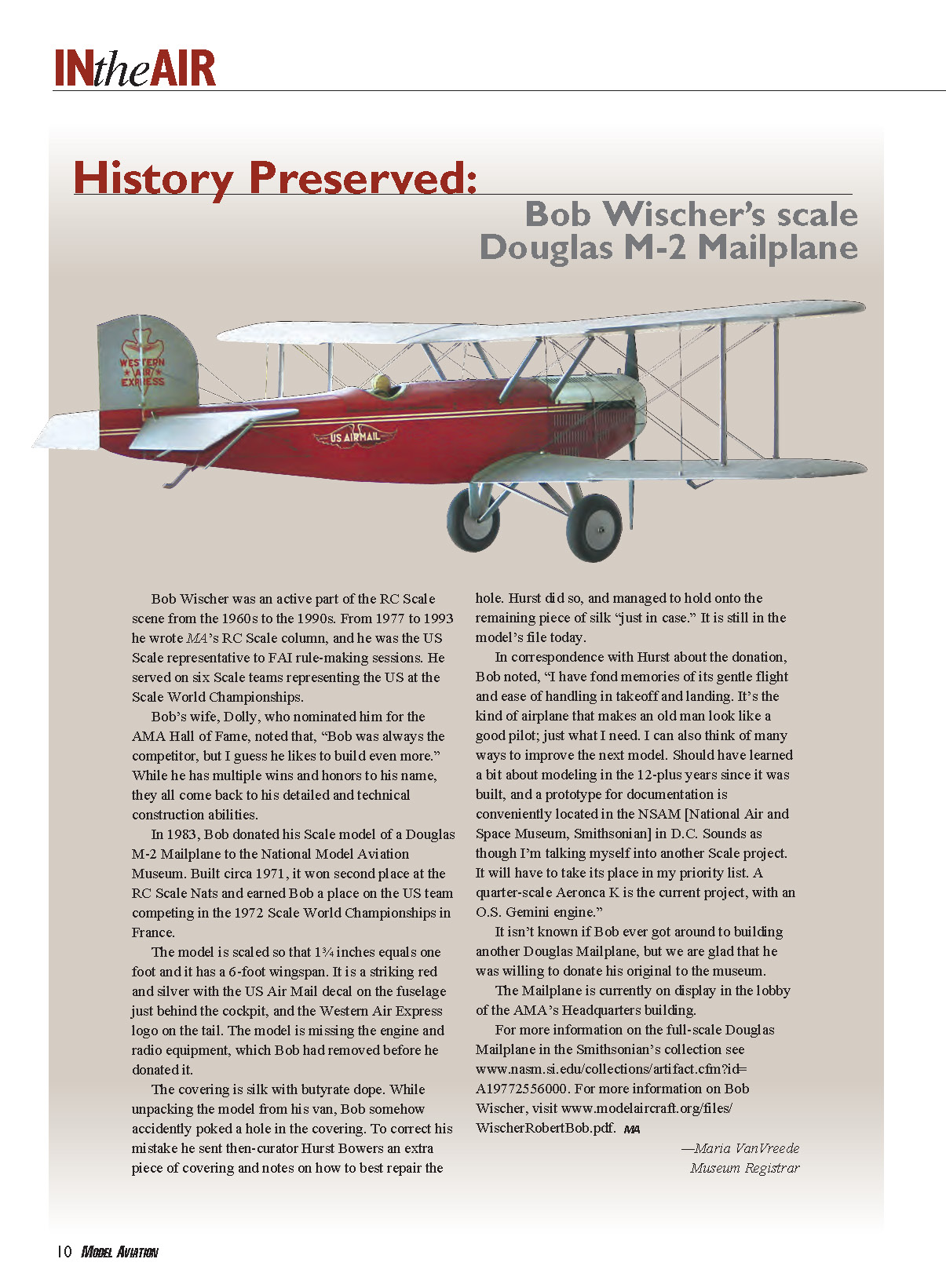
After county approval, planning for actual building of De‑Fence started. Work would be a joint endeavor involving members of Scout Troop 306 working with volunteers from CCRC flying club. Two Saturdays were set aside for work, and flying on those days was prohibited. Arrangements were made for a post‑hole digger and a heavy‑duty, cut‑off saw. Week one, plant the posts; week two, add the cap rail and webbing. Materials were provided by CCRC and placed onsite.
Let the work begin! The work group was impressive. Eager Scouts of a younger age alongside club members who were noticeably older. No name tags were necessary to tell the difference. Everyone worked together. Week one’s weather was excellent; week two was not so excellent. Rain did not dampen spirits though, and De‑Fence was completed.
Following completion, CCRC attached a brass plate acknowledging Scout Troop 306’s assistance with the De‑Fence. An evening was set aside for members of the Scout Troop to fly an RC trainer.
Instructors and aircraft were assigned, and a short class on RC model flying was presented. Joshua was one of the instructors. Each Scout and a couple adult leaders experienced the thrill of flying RC aircraft and everyone had a good time.
This story illustrates two activities which can have a profound impact on boys as they grow into manhood. One is participation as a Boy Scout, and the second is flying RC model aircraft. Each activity provides myriad beneficial experiences.
Joshua is now an Eagle Scout, has graduated with honors from high school, and plans to start a college engineering curriculum in the fall. Commitment to both activities over a period of several years has paid off.
In addition, De‑Fence looks great and was in place for the largest event which has taken place at CCRC airfield: the 2011 SAE East Heavy Lift Contest. Roughly 70 college engineering teams arrived, each with a scratch‑built RC aircraft. These models were team designed and built to lift as much weight as possible.
During the contest three general observations could be made. First, heavy RC aircraft need a substantial safety fence. Second, if at all possible, avoid hitting a fence post. Third, the best offense is a good De‑Fence.
—Ron Warner, CRCC member
In the Air
History Preserved:
Bob Wischer’s scale Douglas M-2 Mailplane
Bob Wischer was an active part of the RC Scale scene from the 1960s to the 1990s. From 1977 to 1993 he wrote MA’s RC Scale column, and he was the US Scale representative to FAI rule-making sessions. He served on six Scale teams representing the US at the Scale World Championships.
Bob’s wife, Dolly, who nominated him for the AMA Hall of Fame, noted that, “Bob was always the competitor, but I guess he likes to build even more.” While he has multiple wins and honors to his name, they all come back to his detailed and technical construction abilities.
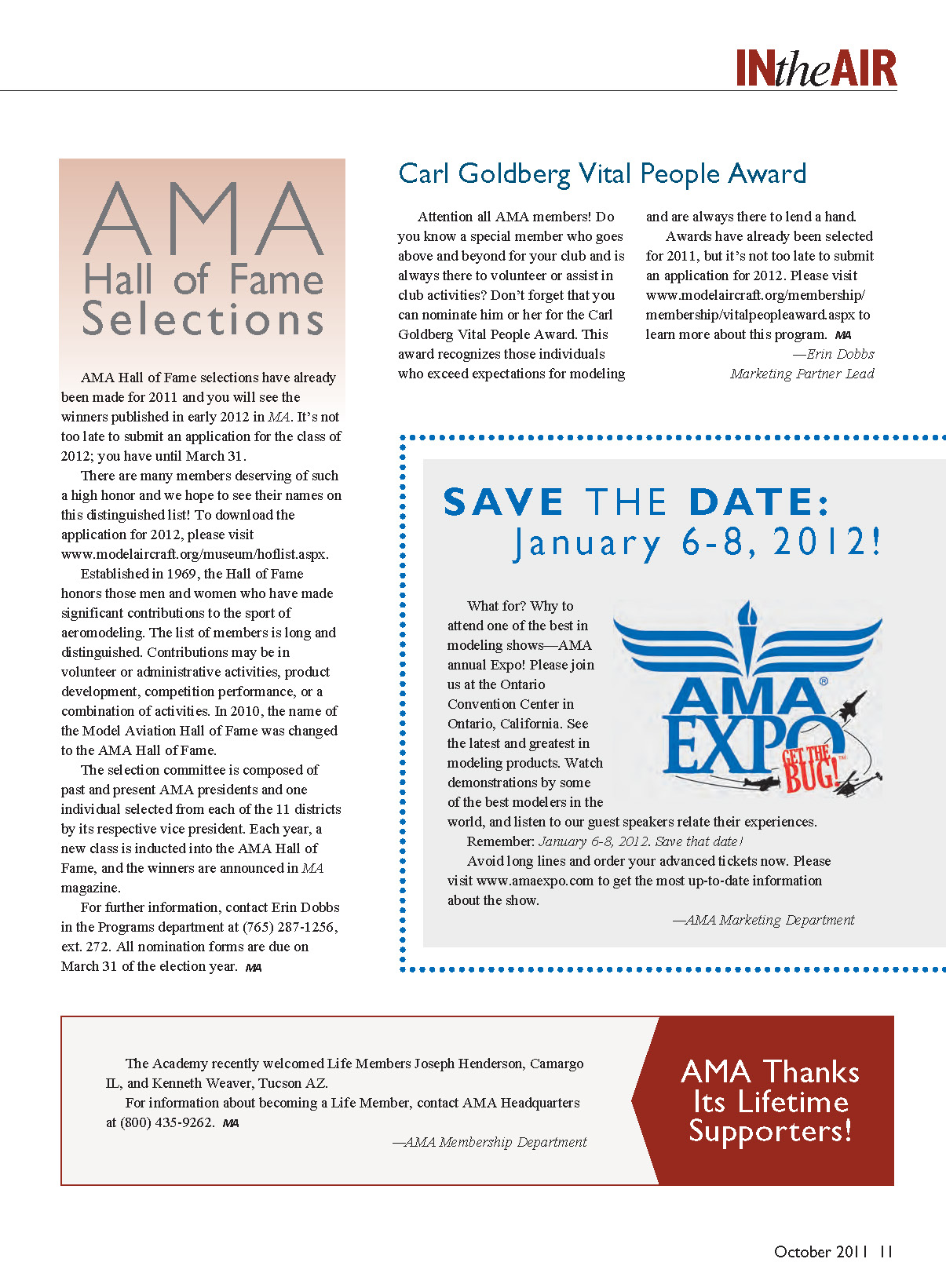
In 1983, Bob donated his Scale model of a Douglas M-2 Mailplane to the National Model Aviation Museum. Built circa 1971, it won second place at the RC Scale Nats and earned Bob a place on the US team competing in the 1972 Scale World Championships in France.
The model is scaled so that 1 3/4 inches equals one foot and it has a 6-foot wingspan. It is a striking red and silver with the US Air Mail decal on the fuselage just behind the cockpit, and the Western Air Express logo on the tail. The model is missing the engine and radio equipment, which Bob had removed before he donated it.
The covering is silk with butyrate dope. While unpacking the model from his van, Bob somehow accidentally poked a hole in the covering. To correct his mistake he sent the curator Hurst Bowers an extra piece of covering and notes on how to best repair the hole. Hurst did so, and managed to hold onto the remaining piece of silk “just in case.” It is still in the model’s file today.
In correspondence with Hurst about the donation, Bob noted, “I have fond memories of its gentle flight and ease of handling in takeoff and landing. It’s the kind of airplane that makes an old man look like a good pilot; just what I need. I can also think of many ways to improve the next model. Should have learned a bit about modeling in the 12-plus years since it was built, and a prototype for documentation is conveniently located in the NSAM [National Air and Space Museum, Smithsonian] in D.C. Sounds as though I’m talking myself into another Scale project. It will have to take its place in my priority list. A quarter-scale Aeronca K is the current project, with an O.S. Gemini engine.”
It isn’t known if Bob ever got around to building another Douglas Mailplane, but we are glad that he was willing to donate his original to the museum.
The Mailplane is currently on display in the lobby of the AMA’s Headquarters building.
For more information on the full-scale Douglas Mailplane in the Smithsonian’s collection see www.nasm.si.edu/collections/artifact.cfm?id=A19772556000. For more information on Bob Wischer, visit www.modelaircraft.org/files/WischerRobertBob.pdf. —Maria VanVreede Museum Registrar
In the Air
AMA Hall of Fame Selections
AMA Hall of Fame selections have already been made for 2011 and you will see the winners published in early 2012 in MA. It’s not too late to submit an application for the class of 2012; you have until March 31.
There are many members deserving of such a high honor and we hope to see their names on this distinguished list! To download the application for 2012, please visit www.modelaircraft.org/museum/hoflist.aspx.
Established in 1969, the Hall of Fame honors those men and women who have made significant contributions to the sport of aeromodeling. The list of members is long and distinguished. Contributions may be in volunteer or administrative activities, product development, competition performance, or a combination of activities. In 2010, the name of the Model Aviation Hall of Fame was changed to the AMA Hall of Fame.
The selection committee is composed of past and present AMA presidents and one individual selected from each of the 11 districts by its respective vice president. Each year, a new class is inducted into the AMA Hall of Fame, and the winners are announced in MA magazine.
For further information, contact Erin Dobbs in the Programs department at (765) 287-1256, ext. 272. All nomination forms are due on March 31 of the election year.
Carl Goldberg Vital People Award
Attention all AMA members! Do you know a special member who goes above and beyond for your club and is always there to volunteer or assist in club activities? Don’t forget that you can nominate him or her for the Carl Goldberg Vital People Award. This award recognizes those individuals who exceed expectations for modeling and are always there to lend a hand.
Awards have already been selected for 2011, but it’s not too late to submit an application for 2012. Please visit www.modelaircraft.org/membership/membership/vitalpeopleaward.aspx to learn more about this program.
—Erin Dobbs Marketing Partner Lead
What for? Why to attend one of the best in modeling shows—AMA annual Expo! Please join us at the Ontario Convention Center in Ontario, California. See the latest and greatest in modeling products. Watch demonstrations by some of the best modelers in the world, and listen to our guest speakers relate their experiences.
Remember: January 6-8, 2012. Save that date!
Avoid long lines and order your advanced tickets now. Please visit www.amaexpo.com to get the most up-to-date information about the show.
—AMA Marketing Department
The Academy recently welcomed Life Members Joseph Henderson, Camargo IL, and Kenneth Weaver, Tucson AZ.
For information about becoming a Life Member, contact AMA Headquarters at (800) 435-9262.
—AMA Membership Department
In the Air
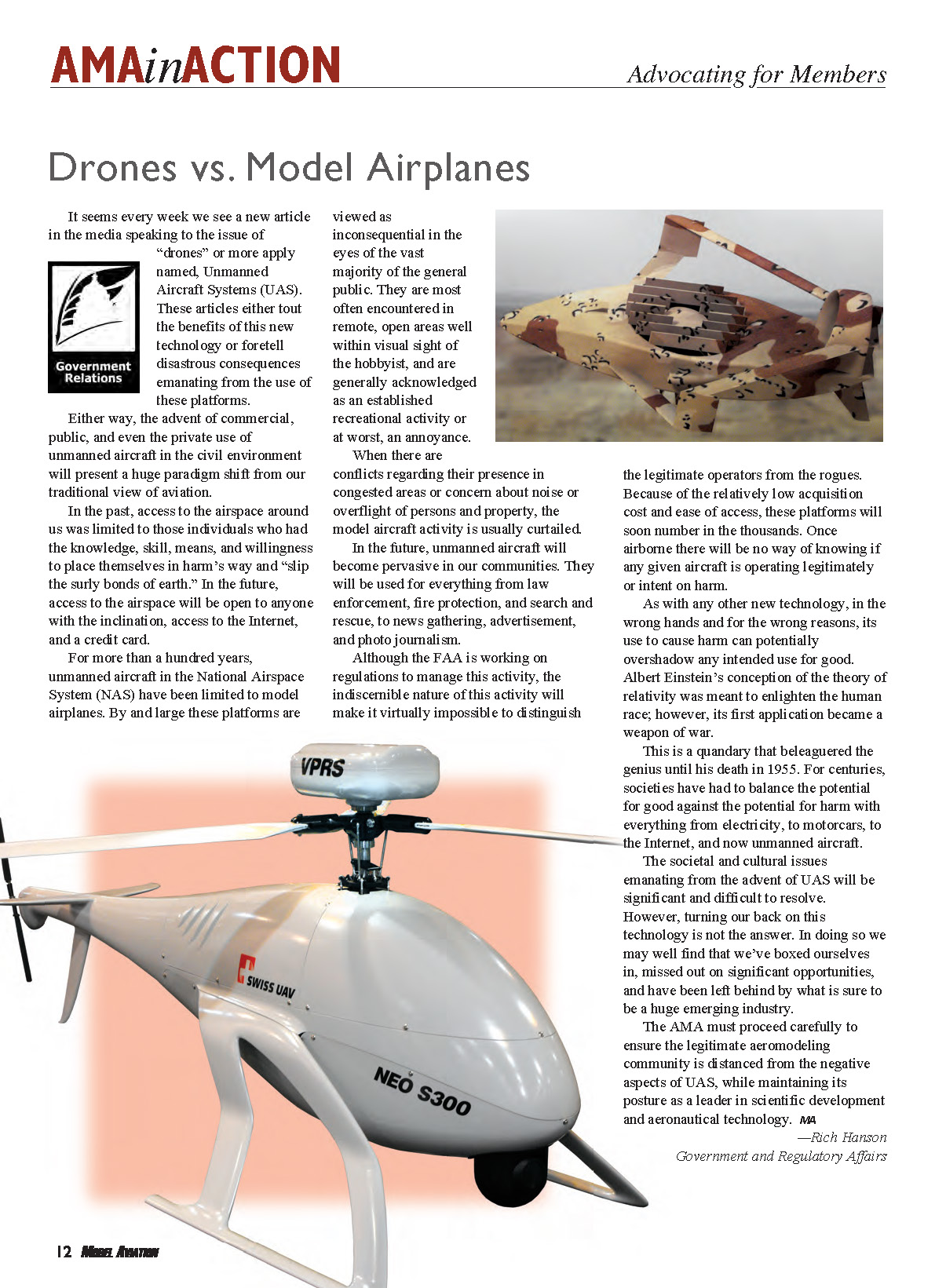
It seems every week we see a new article in the media speaking to the issue of "drones" or more aptly named, Unmanned Aircraft Systems (UAS). These articles either tout the benefits of this new technology or foretell disastrous consequences emanating from the use of these platforms.
Either way, the advent of commercial, public, and even the private use of unmanned aircraft in the civil environment will present a huge paradigm shift from our traditional view of aviation.
In the past, access to the airspace around us was limited to those individuals who had the knowledge, skill, means, and willingness to place themselves in harm's way and "slip the surly bonds of earth." In the future, access to the airspace will be open to anyone with the inclination, access to the Internet, and a credit card.
For more than a hundred years, unmanned aircraft in the National Airspace System (NAS) have been limited to model airplanes. By and large these platforms are viewed as inconsequential in the eyes of the vast majority of the general public. They are most often encountered in remote, open areas well within visual sight of the hobbyist, and are generally acknowledged as an established recreational activity or at worst, an annoyance.
When there are conflicts regarding their presence in congested areas or concern about noise or overflight of persons and property, the model aircraft activity is usually curtailed.
In the future, unmanned aircraft will become pervasive in our communities. They will be used for everything from law enforcement, fire protection, and search and rescue, to news gathering, advertisement, and photojournalism.
Although the FAA is working on regulations to manage this activity, the indiscernible nature of this activity will make it virtually impossible to distinguish the legitimate operators from the rogues. Because of the relatively low acquisition cost and ease of access, these platforms will soon number in the thousands. Once airborne there will be no way of knowing if any given aircraft is operating legitimately or intent on harm.
As with any other new technology, in the wrong hands and for the wrong reasons, its use to cause harm can potentially overshadow any intended use for good. Albert Einstein's conception of the theory of relativity was meant to enlighten the human race; however, its first application became a weapon of war.
This is a quandary that beleaguered the genius until his death in 1955. For centuries, societies have had to balance the potential for good against the potential for harm with everything from electricity, to motorcars, to the Internet, and now unmanned aircraft.
The societal and cultural issues emanating from the advent of UAS will be significant and difficult to resolve. However, turning our back on this technology is not the answer. In doing so we may well find that we've boxed ourselves in, missed out on significant opportunities, and have been left behind by what is sure to be an enormous industry.
The AMA must proceed carefully to ensure the legitimate aeromodelling community is distanced from the negative aspects of UAS, while maintaining its posture as a leader in scientific development and aeronautical technology.
—Rich Hanson Government and Regulatory Affairs
Transcribed from original scans by AI. Minor OCR errors may remain.

