
Turbine-Powered Models Permitted in Experimental Class
At its October meeting, AMA’s Executive Council approved changes to AMA’s Experimental Radio Controlled Aircraft Program. These changes and additions were initially proposed by the JPO (Jet Pilots’ Organization) and submitted to the AMA Safety Committee, which subsequently recommended them to the Executive Council.
Until the passage of these changes, turbine-powered models were not allowed to be flown in the Experimental class (which includes models weighing 55–100 pounds). The new regulations lift that restriction. Appendix A of the Experimental rules now reads:
“An Experimental Turbine Powered Class model shall be a model that has a dry weight of 55 pounds or less. The flight weight, with full fuel tanks, shall be greater than 55 pounds, but no more than 75 pounds.”
Additional items beyond the inspection and operational requirements of the Experimental aircraft program are now part of the process. These include a division of turbine aircraft and their pilots into two classifications.
Another change in the Experimental rules drops the restriction that models of this classification cannot be flown in competition Scale events. However, rules in AMA’s Competition Regulations still state a maximum of 55 pounds for event 512: RC Expert Sport Scale. The Scale Contest Board is considering a proposal to modify that rule.
Implementation of the changes to the Experimental class regarding competitive events is subject to the Scale Contest Board’s approval. If approval is granted, turbine-powered models weighing as much as 75 pounds and propeller-driven models weighing as much as 100 pounds (with fuel) will be permitted, subject to the Experimental aircraft program rules.
For program details, go to www.modelaircraft.org, select “Membership Services,” and choose “AMA Documents (PDF)” to review document 520-A. You may also contact AMA Headquarters at (765) 287-1256, ext. 251.
—AMA Safety Committee
Teamwork is Key in Alabama Club’s Procuring a New Site
In 2003 the Alabaster Radio Control Association (Alabaster, Alabama) was notified that it would lose its club flying field by January 2004. The group immediately appointed a “new site” committee to locate a new field as soon as possible.
Since the committee was unable to locate any potential sites, then-club president Ray Antonio contacted the city of Alabaster to see if there were any opportunities within the city for a new field. That contact opened the door to more meetings.
The club went through meetings with various city officials, including members of the Parks and Recreation board; informal and formal presentations, which included flight demonstrations and DVDs for city councilmen; and a presentation of the club’s proposed plans for the property and what the club could do for the community of Alabaster.
After months of effort by members, the club was notified that the city of Alabaster would permit the Alabaster R/C Association to use property at Limestone Park for an RC flying field. The formal agreement was signed March 19, 2004.
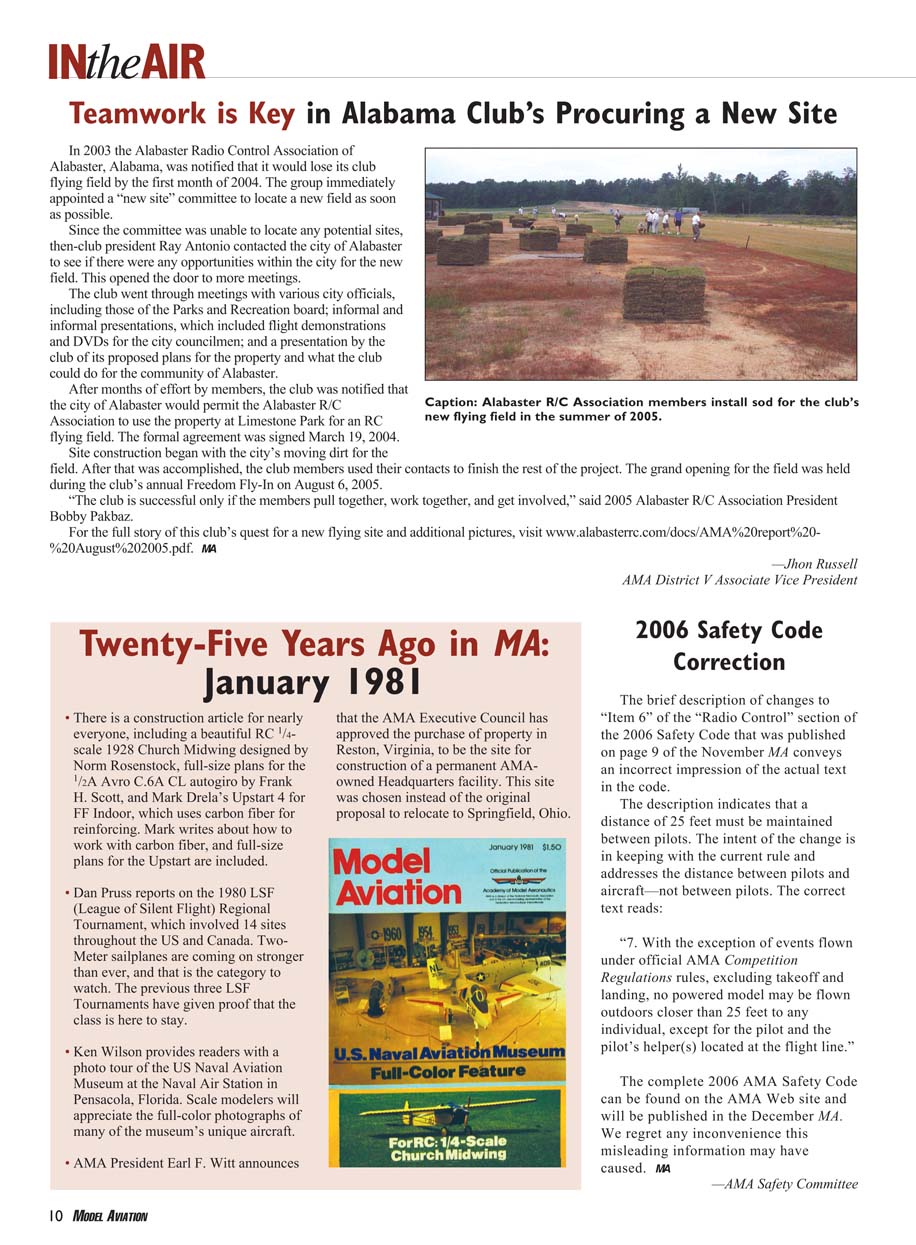
Site construction began with the city moving dirt for the field. After that was accomplished, club members used their contacts to finish the rest of the project. The grand opening for the field was held during the club’s annual Freedom Fly-In on August 6, 2005.
“The club is successful only if the members pull together, work together, and get involved,” said 2005 Alabaster R/C Association President Bobby Pakbaz.
For the full story of this club’s quest for a new flying site and additional pictures, visit www.alabasterrc.com/docs/AMA%20report%20-%20August%202005.pdf.
—John Russell AMA District V Associate Vice President
IN the AIR
New AMA Plans Price Structure
The updated prices for MA plans classifications are:
- A: $5
- B: $9
- C: $14
- D: $19
- E: $28
Specials will be determined based on the square footage of the plans.
The AMA Plans Service makes the following disclaimers:
- Plans prices in the John Pond Old Time Plan Service catalog are no longer valid after January 1, 2006. Call AMA Headquarters for correct pricing or visit the AMA website.
- AMA shipping and handling rates will remain the same.
- Orders received with insufficient payment will be returned unfilled to the sender.
- The AMA Plans Service does not certify that plans sold will meet the eligibility requirements for a particular competition event. The buyer must determine eligibility. See published rules for the specific event or consult the appropriate SIG for assistance in this area.
- Plans prices shown on the AMA website prior to January 1, 2006, are no longer valid.
See page 191 for more information about MA plans.
—John Zgunda Plans Service Coordinator
District VIII Member Receives AMA Fellow Award
District VIII Associate Vice President Doug “Chief” Powell (Wichita Falls, Texas) was given AMA’s most prestigious honor—the AMA Fellow award—at the Southwest Aeromodelling Conference (SWAC) in Fort Worth, Texas, on November 11, 2005.
Doug has served for more than 10 years as the RC contest coordinator for District VIII and was one of the founders and former vice president of the Radio Control Combat Association (RCCA)—an AMA SIG. He was the first chairman of the RC Combat Contest Board and was a member of the Special Events Contest Board.
Appointed an AVP for District VIII in 2003, Doug has been the moderator of the district’s e-mail list since its inception. He wrote:
"This puts my name on a list with a whole lot of guys whom I have looked up to, admired, and respected for as long as I can remember gluing pieces of balsa wood together. I sincerely thank AMA and the entire Executive Council for this great honor."
—MA staff
Wind Tunnel Technology at AMA Museum
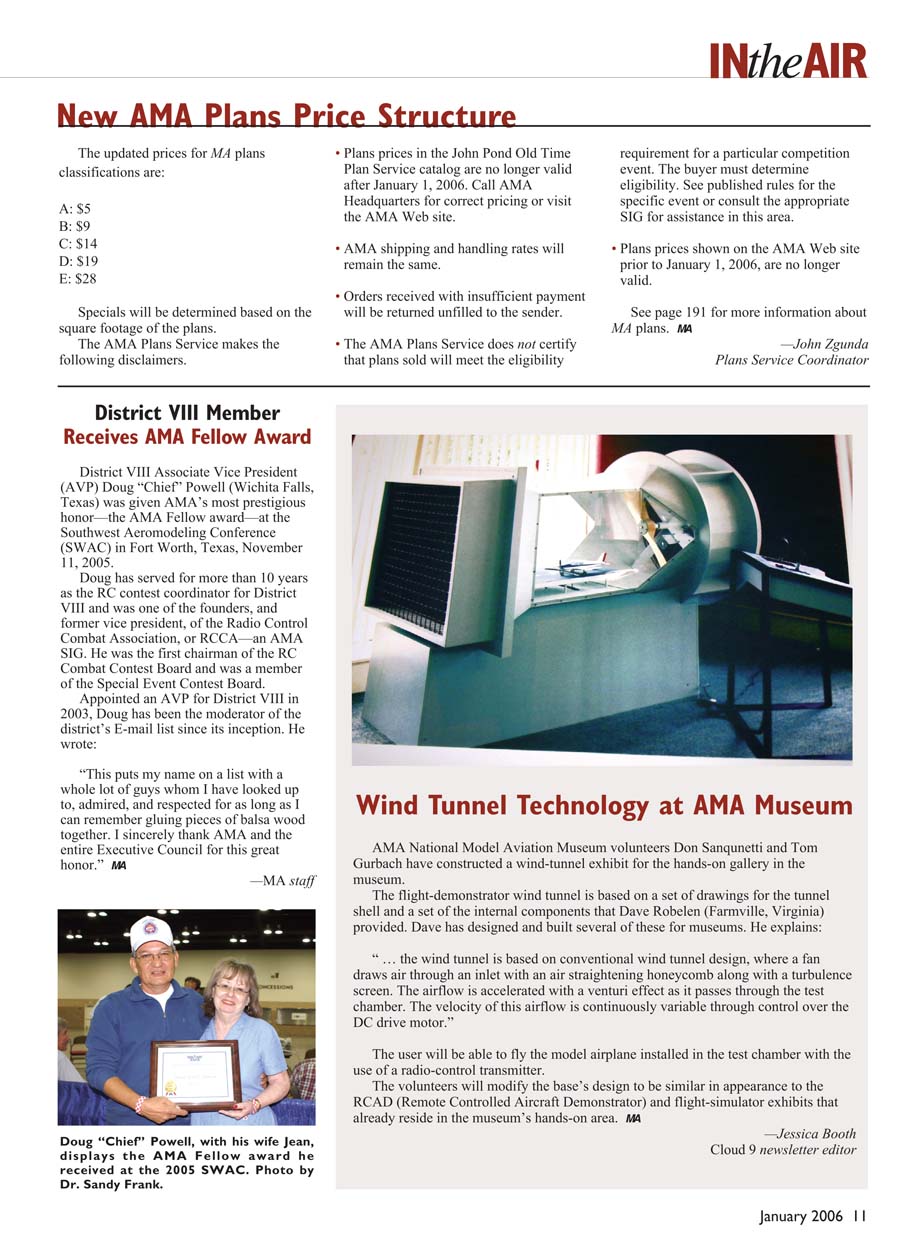
AMA National Model Aviation Museum volunteers Don Sanqunetti and Tom Gurbach have constructed a wind-tunnel exhibit for the hands-on gallery in the museum.
The flight-demonstrator wind tunnel is based on a set of drawings for the tunnel shell and a set of internal components that Dave Robelen (Farmville, Virginia) provided. Dave has designed and built several of these for museums. He explains:
"… the wind tunnel is based on conventional wind tunnel design, where a fan draws air through an inlet with an air-straightening honeycomb along with a turbulence screen. The airflow is accelerated with a venturi effect as it passes through the test chamber. The velocity of this airflow is continuously variable through control over the DC drive motor."
The user will be able to fly the model airplane installed in the test chamber with the use of a radio-control transmitter.
The volunteers will modify the base’s design to be similar in appearance to the RCAD (Remote Controlled Aircraft Demonstrator) and flight-simulator exhibits that already reside in the museum’s hands-on area.
—Jessica Booth Cloud 9 newsletter editor
Transcribed from original scans by AI. Minor OCR errors may remain.

