
AMA Plans Service FAQ
Contact
- Q: Who do I call for plans?
A: AMA Plans Coordinator John Zgunda. He can be reached at (765) 287-1256, ext. 507. Members may use the toll-free number 800-I-FLY-AMA (800-435-9262) or e-mail [email protected].
Availability and offerings
- Q: What plans do you offer?
A: There are two main collections available: the John Pond Plans Collection and the Model Aviation Plans Service. AMA also offers other plans that are unlisted, so please call for availability and pricing.
- Q: Are all AMA plans for sale?
A: No. We avoid infringing on other plan services’ copyrights. Our intention is to serve our members—not put other plans companies out of business. We will supply addresses or telephone numbers for other plans services.
Ordering and payment
- Q: How can I get an order form?
A: You can download an order form from the AMA website, and there is one in your MA (Model Aviation).
- Q: What type of payment is accepted?
A: Mail-in orders can be paid by check, money order, or Visa/MasterCard. Only Visa and MasterCard will be accepted at the AMA Convention. Sorry, we do not accept other credit cards.
Catalogs and pricing
- Q: Is there a catalog for the AMA Plans Service?
A: The Old Time Plans Service catalog dated 1999–2000 is used for the Pond plans, but the prices therein are incorrect. A few catalogs are available from the AMA Plans Service for $10, or you can view or download a copy from the AMA website at no charge. You can also download an MA plans list from the AMA website or purchase a printed copy for $2 from the AMA Plans Service.
Plan services
- Q: Can plans be reduced or enlarged?
A: Yes. Plans can usually be resized to produce the wingspan you want. Call for special requests and a price quote.
- Q: The plans I want are not listed. What can I do?
A: Sometimes we can find a vendor who can fulfill your needs. We will be glad to pass on the information at no charge.
Returns and shipping
- Q: What is the exchange and refund policy for plans?
A: Once shipped, all sales are final. We do our best to ensure quality, but we cannot guarantee satisfaction; e.g., kit plans are not always complete with templates.
- Q: How will the plans be shipped?
A: Plans are rolled and sent via USPS Priority Mail. Foreign mail is folded and shipped in a box.
- Q: How long will it take for me to get my plans?
A: Normal shipping time is two to three weeks.
- Q: Do you have "walk-in" sales at AMA Headquarters in Muncie, Indiana?
A: Yes. Plans ordered before 10 a.m. can be picked up after 2 p.m. There is no shipping charge this way, but Indiana sales tax will be added.
- Q: Is there a "show special" for AMA Convention 2006?
A: Yes. All orders taken at the convention will feature free shipping.
- Q: Can I see the plans before I order?
A: Not at this time.
- Q: Are pictures of models available?
A: You can view photos of airplanes built from MA plans at www.modelaircraft.org/plans.asp. There are no pictures of models built from the John Pond Plans Collection.
—AMA Headquarters
Emergency Safety Alert: Lithium Battery Fires
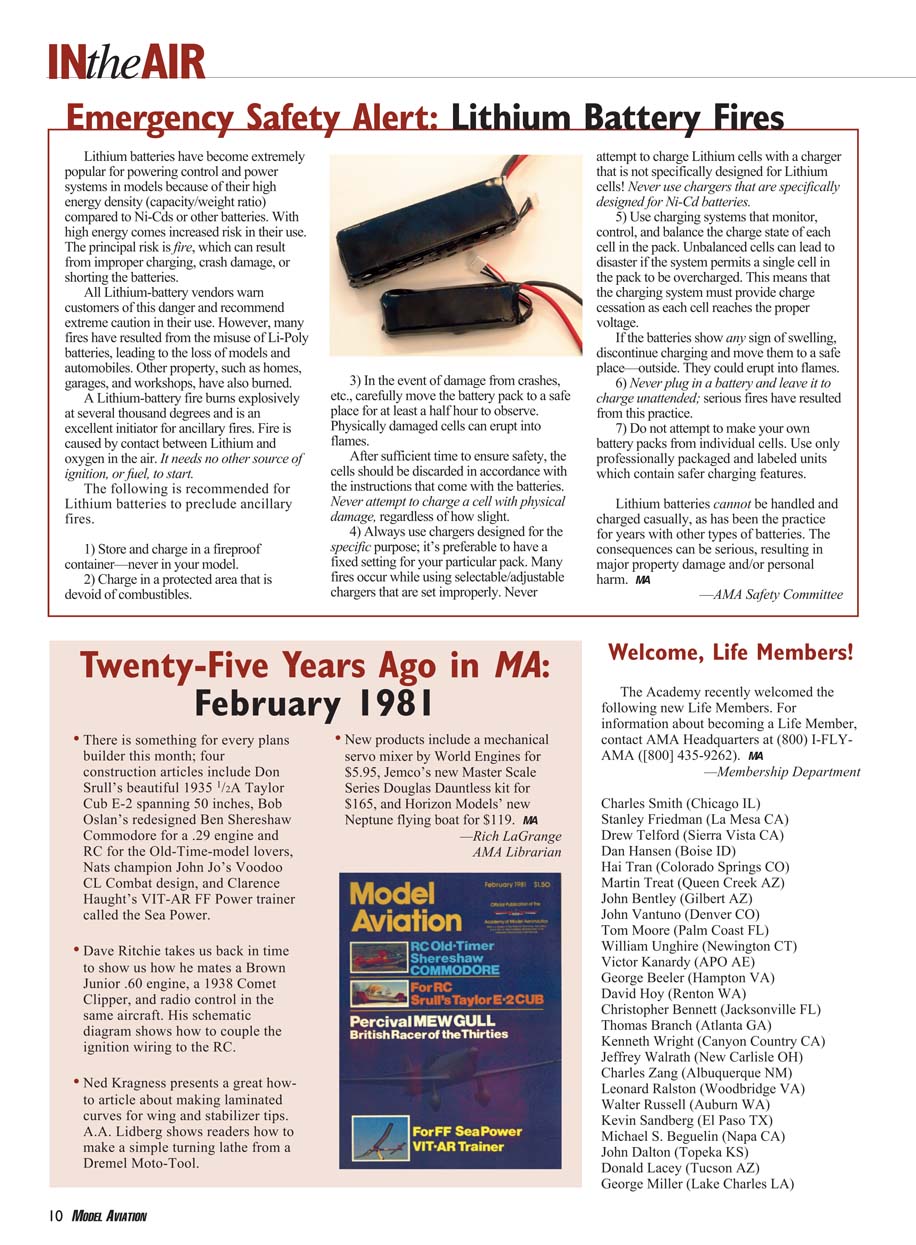
Lithium batteries have become extremely popular for powering control and power systems in models because of their high energy density (capacity/weight ratio) compared to Ni-Cads or other batteries. With high energy comes increased risk in their use. The principal risk is fire, which can result from improper charging, crash damage, or shorting the batteries.
All lithium-battery vendors warn customers of this danger and recommend extreme caution in their use. However, many fires have resulted from the misuse of Li-Poly batteries, leading to the loss of models and automobiles. Other property, such as homes, garages, and workshops, have also burned.
A lithium-battery fire burns explosively at several thousand degrees and is an excellent initiator for ancillary fires. Fire is caused by contact between lithium and oxygen in the air. It needs no other source of ignition or fuel to start.
The following is recommended for lithium batteries to preclude ancillary fires:
- Store and charge in a fireproof container—never in your model.
- Charge in a protected area that is devoid of combustibles.
- In the event of damage from crashes, etc., carefully move the battery pack to a safe place for at least a half hour to observe. Physically damaged cells can erupt into flames. After sufficient time to ensure safety, the cells should be discarded in accordance with the instructions that come with the batteries. Never attempt to charge a cell with physical damage, regardless of how slight.
- Always use chargers designed for the specific purpose; it's preferable to have a fixed setting for your particular pack. Many fires occur while using selectable/adjustable chargers that are set improperly. Never attempt to charge lithium cells with a charger that is not specifically designed for lithium cells. Never use chargers that are specifically designed for Ni-Cd batteries.
- Use charging systems that monitor, control, and balance the charge state of each cell in the pack. Unbalanced cells can lead to disaster if the system permits a single cell in the pack to be overcharged. The charging system must provide charge cessation as each cell reaches the proper voltage. If the batteries show any sign of swelling, discontinue charging and move them to a safe place—outside. They could erupt into flames.
- Never plug in a battery and leave it to charge unattended; serious fires have resulted from this practice.
- Do not attempt to make your own battery packs from individual cells. Use only professionally packaged and labeled units which contain safer charging features.
Lithium batteries cannot be handled and charged casually, as has been the practice for years with other types of batteries. The consequences can be serious, resulting in major property damage and/or personal harm.
—AMA Safety Committee
Skyscrapers Celebrate 70 Years of Free Flight
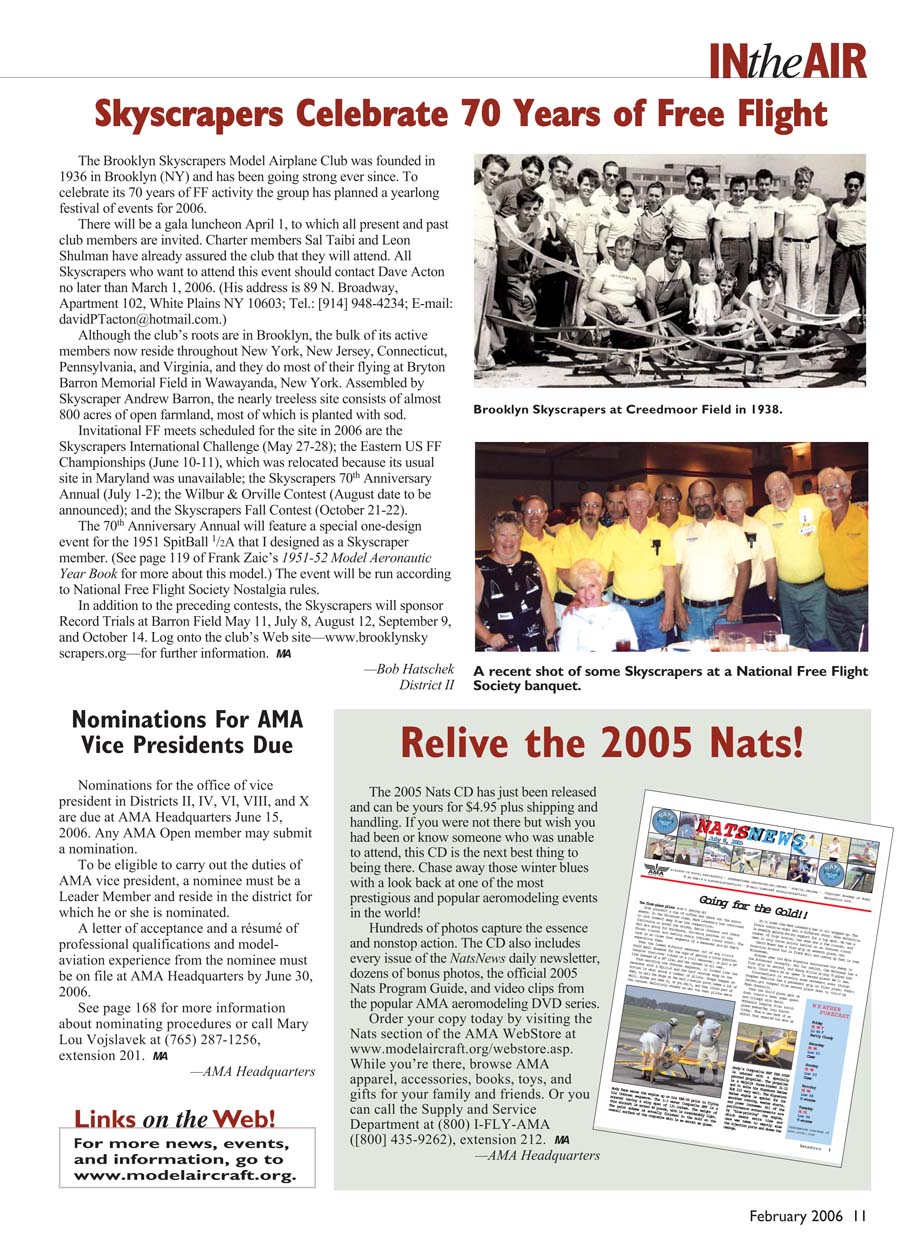
The Brooklyn Skyscrapers Model Airplane Club was founded in 1936 in Brooklyn, NY, and has been going strong ever since. To celebrate its 70 years of FF activity the group has planned a yearlong festival of events for 2006.
There will be a gala luncheon April 1, to which all present and past club members are invited. Charter members Sal Taibi and Leon Shulman have already assured the club that they will attend. All Skyscrapers who want to attend this event should contact Dave Acton no later than March 1, 2006.
Contact:
- Address: 89 N. Broadway, Apt. 102, White Plains, NY 10603
- Tel.: (914) 948-4234
- E-mail: [email protected]
Although the club's roots are in Brooklyn, the bulk of its active members now reside throughout New York, New Jersey, Connecticut, Pennsylvania, and Virginia. They do most of their flying at Bryton Barron Memorial Field in Wawayanda, New York. Assembled by Skyscraper Andrew Barron, the nearly treeless site consists of almost 800 acres of open farmland, most of which is planted with sod.
Invitational FF meets scheduled for 2006 at Barron Field:
- Skyscrapers International Challenge — May 27–28
- Eastern U.S. FF Championships — June 10–11 (relocated because the usual site in Maryland was unavailable)
- Skyscrapers 70th Anniversary Annual — July 1–2 (will feature a special one-design event for the 1951 Spitball 1/2A; see page 119 of Frank Zaic's 1951–52 Model Aeronautic Year Book)
- Wilbur & Orville Contest — August (date to be announced)
- Skyscrapers Fall Contest — October 21–22
Record Trials at Barron Field:
- May 11
- July 8
- August 12
- September 9
- October 14
For further information, visit the club's website: www.brooklynskyscrapers.org.
—Bob Hatschek District II
Transcribed from original scans by AI. Minor OCR errors may remain.

