
EC Members Receive Awards
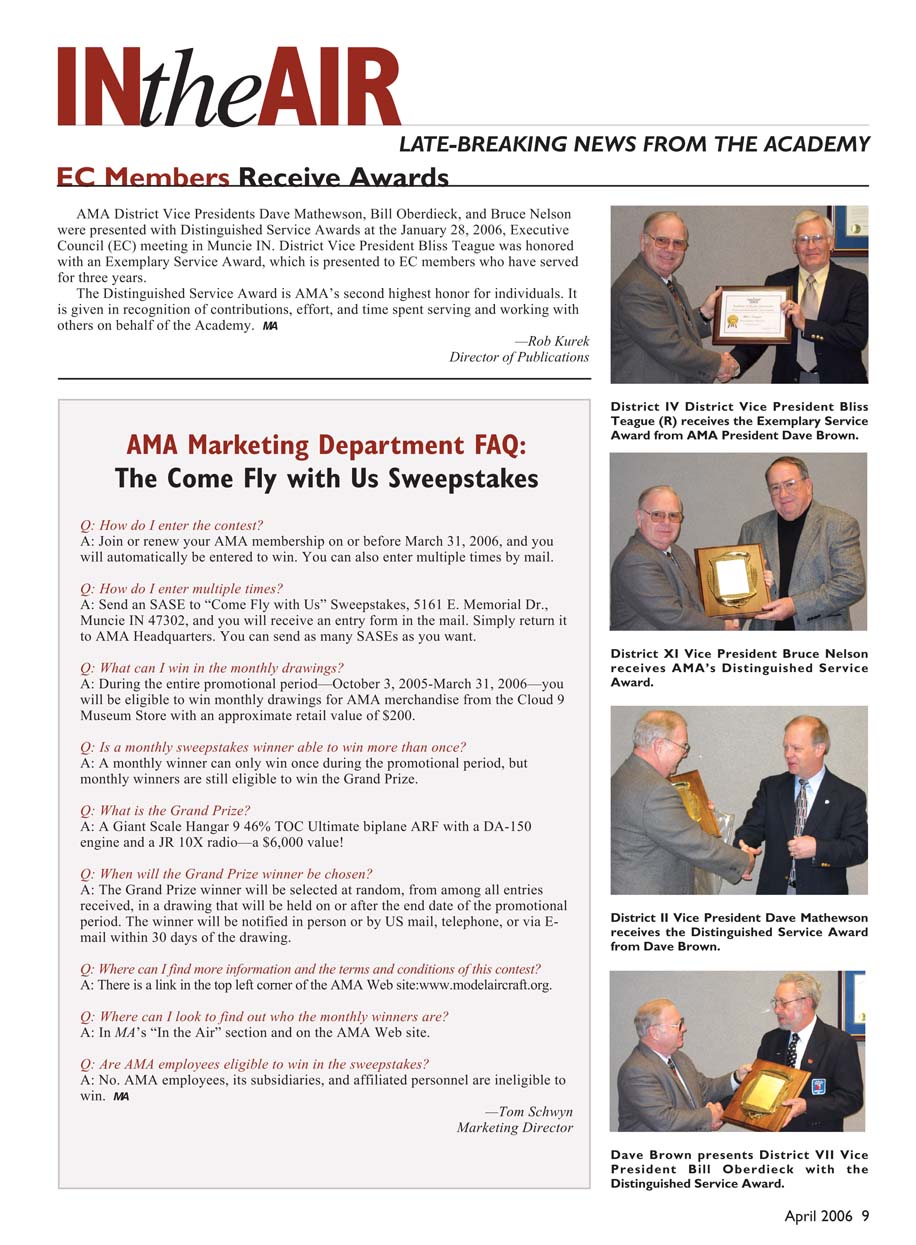
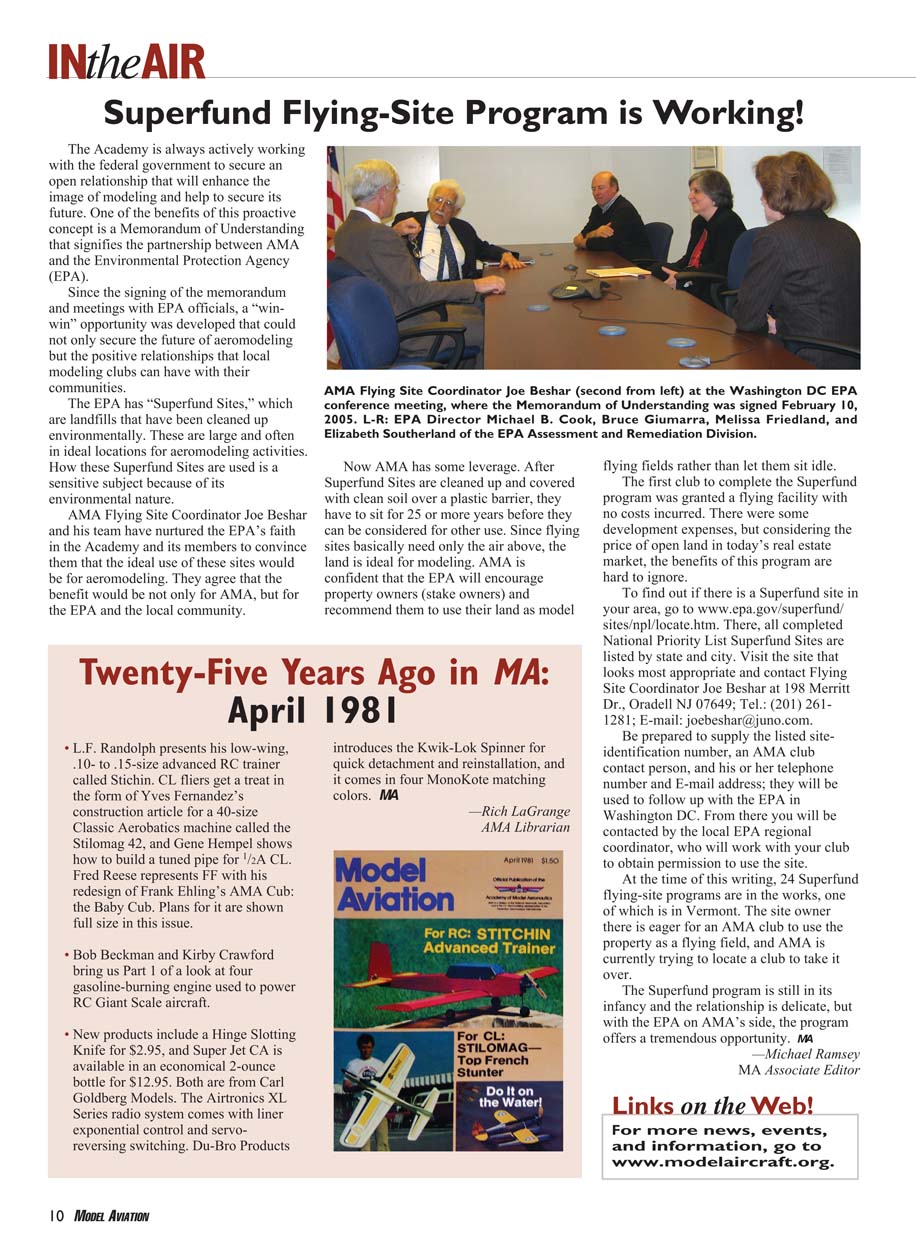
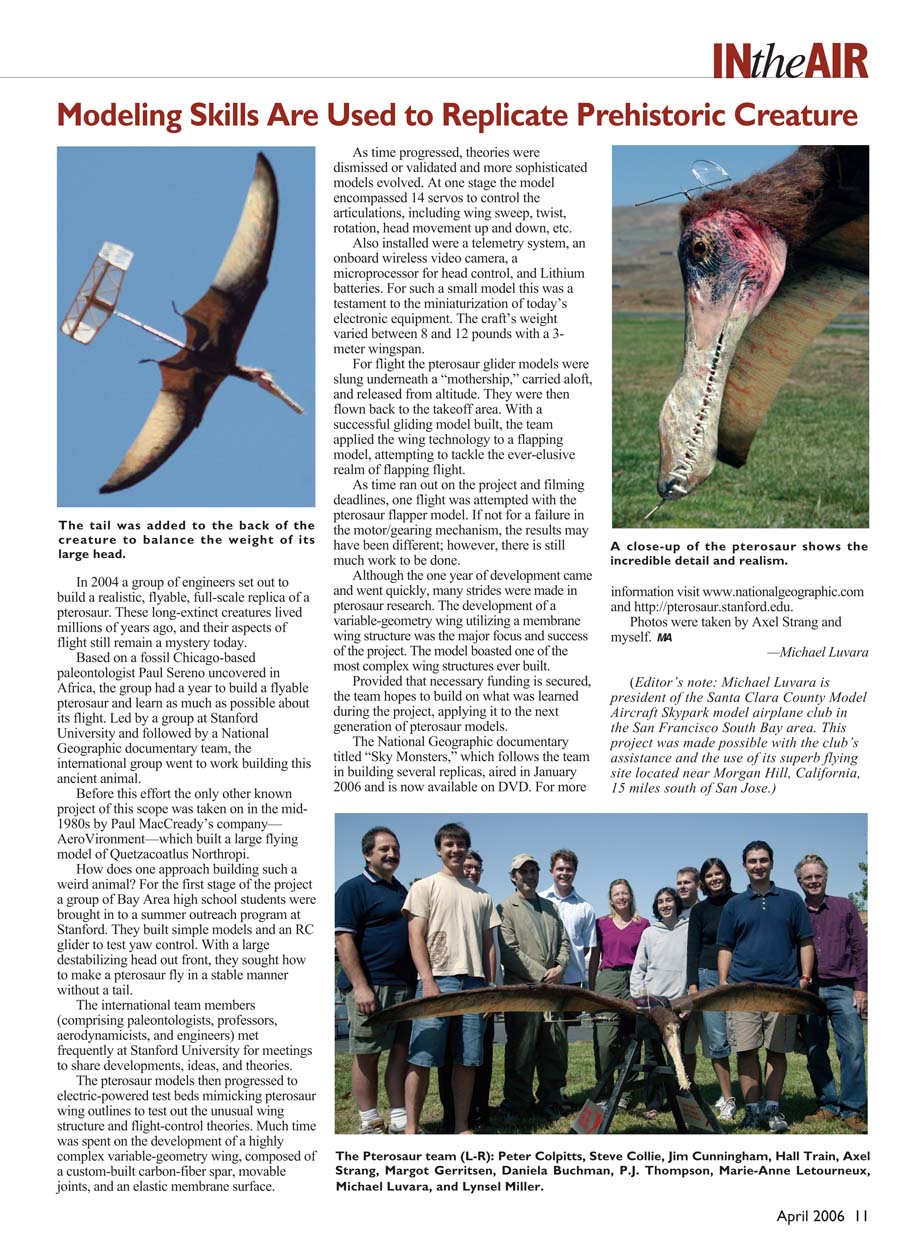
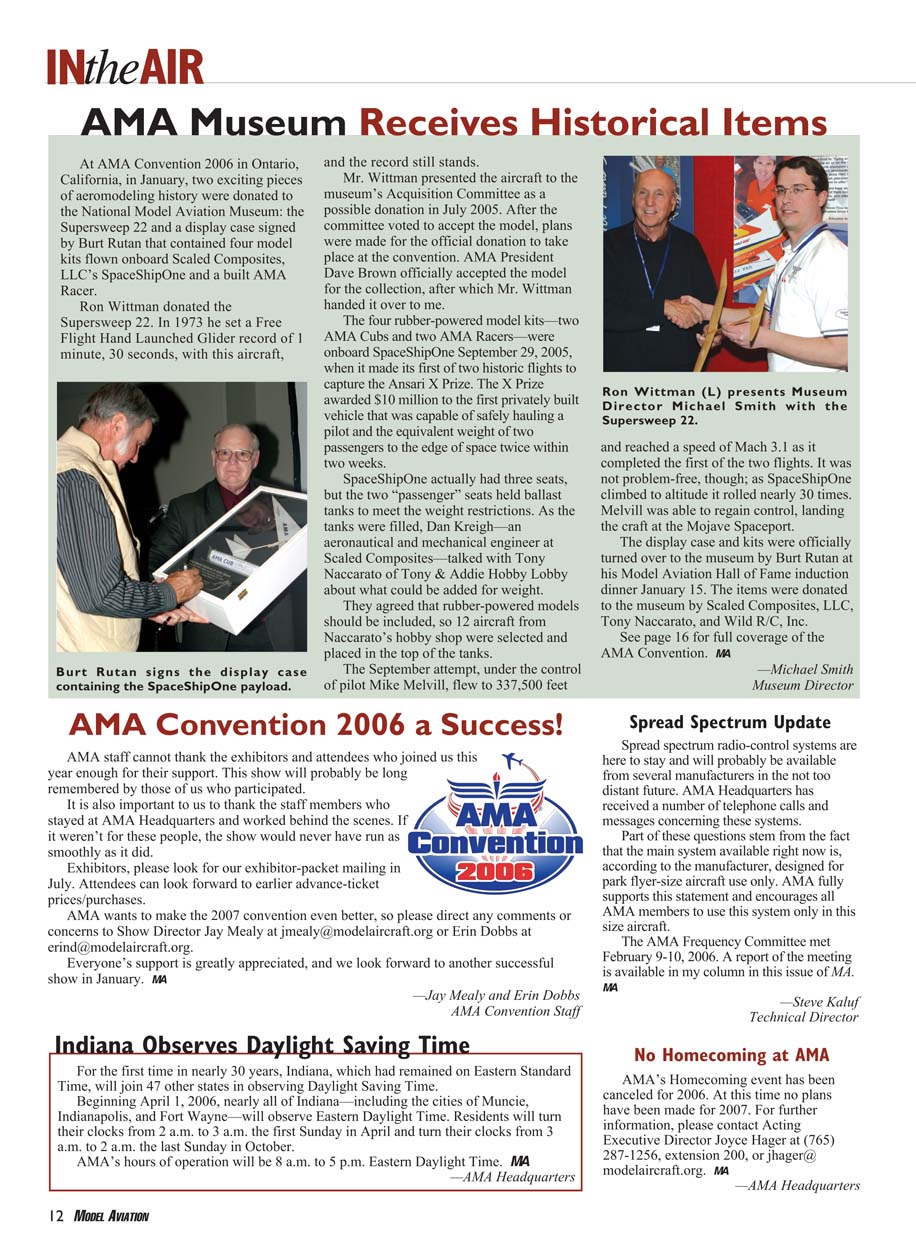
AMA District Vice Presidents Dave Mathewson, Bill Oberdieck, and Bruce Nelson were presented with Distinguished Service Awards at the January 28, 2006, Executive Council (EC) meeting in Muncie, IN. District Vice President Bliss Teague was honored with an Exemplary Service Award, which is presented to EC members who have served for three years.
The Distinguished Service Award is AMA’s second-highest honor for individuals. It is given in recognition of contributions, effort, and time spent serving and working with others on behalf of the Academy.
Rob Kurek — Director of Publications
Superfund Flying-Site Program is Working!
The Academy is actively working with the federal government to secure an open relationship that will enhance the image of modeling and help secure its future. One benefit of this proactive approach is a Memorandum of Understanding that signifies the partnership between AMA and the Environmental Protection Agency (EPA).
Since the signing of the memorandum and subsequent meetings with EPA officials, a "win-win" opportunity was developed that could not only secure the future of aeromodeling but also foster positive relationships between local modeling clubs and their communities.
The EPA has "Superfund Sites," which are landfills that have been cleaned up environmentally. These sites are often large and in ideal locations for aeromodeling activities. How Superfund Sites are used is a sensitive subject because of their environmental nature.
AMA Flying Site Coordinator Joe Beshar and his team have nurtured the EPA's confidence in the Academy and its members, convincing the agency that the ideal use of these sites would be as model flying fields. The EPA agrees that the benefit would extend to AMA, the EPA, and the local community.
After Superfund Sites are cleaned up and covered with clean soil over a plastic barrier, they typically must sit for 25 or more years before being considered for other uses. Since flying sites basically need only the air above, the land is ideal for modeling. AMA is confident that the EPA will encourage property owners (site owners) and recommend them use their land as model flying fields rather than let them sit idle.
The first club to complete the Superfund program was granted a flying facility with no land costs incurred. There were some development expenses, but considering the price of open land in today's real estate market, the benefits of this program are significant.
To find out if there is a Superfund site in your area, visit:
There, all completed National Priorities List (NPL) Superfund Sites are listed by state and city. Visit the site that looks most appropriate and contact Flying Site Coordinator Joe Beshar:
- Address: 198 Merritt Dr., Oradell, NJ 07649
- Tel: (201) 261-1281
- E-mail: [email protected]
Be prepared to supply:
- the listed site-identification number,
- an AMA club contact person,
- that person’s telephone number, and
- that person’s e-mail address.
These will be used to follow up with the EPA in Washington, DC. From there you will be contacted by the local EPA regional coordinator, who will work with your club to obtain permission to use the site.
At the time of this writing, 24 Superfund flying-site programs are in the works, one of which is in Vermont. The site owner there is eager for an AMA club to use the property as a flying field, and AMA is currently trying to locate a club to take it over.
The Superfund program is still in its infancy and the relationship is delicate, but with the EPA on AMA's side, the program offers a tremendous opportunity.
Michael Ramsey — MA Associate Editor
Modeling Skills Are Used to Replicate Prehistoric Creature
In 2004 a group of engineers set out to build a realistic, flyable, full-scale replica of a pterosaur. These long-extinct creatures lived millions of years ago, and aspects of their flight remain a mystery today.
Based on a fossil that Chicago-based paleontologist Paul Sereno uncovered in Africa, the group had a year to build a flyable pterosaur and learn as much as possible about its flight. Led by a team at Stanford University and documented by National Geographic, the international group went to work building this ancient animal.
Before this effort, the only other known project of this scope was undertaken in the mid-1980s by Paul MacCready’s company—AeroVironment—which built a large flying model of Quetzalcoatlus northropi.
How does one approach building such an unusual animal? For the first stage of the project, a group of Bay Area high school students were brought into a summer outreach program at Stanford. They built simple models and an RC glider to test yaw control. With a large destabilizing head out front, the students sought ways to make a pterosaur fly in a stable manner without a tail.
The international team—comprising paleontologists, professors, aerodynamicists, and engineers—met frequently at Stanford to share developments, ideas, and theories.
The pterosaur models then progressed to electric-powered test beds mimicking pterosaur wing outlines to test the unusual wing structure and flight-control theories. Much time was spent developing a highly complex variable-geometry wing, composed of a custom-built carbon-fiber spar, movable joints, and an elastic membrane surface.
As time progressed, theories were dismissed or validated and more sophisticated models evolved. At one stage the model encompassed 14 servos to control articulations, including wing sweep, twist, rotation, head movement, and more.
Also installed were a telemetry system, an onboard wireless video camera, a microprocessor for head control, and lithium batteries. For such a small model this was a testament to the miniaturization of today’s electronic equipment. The craft’s weight varied between 8 and 12 pounds with a 3-meter wingspan.
For flight tests, the pterosaur glider models were slung underneath a “mothership,” carried aloft, and released from altitude. They were then flown back to the takeoff area. With a successful gliding model built, the team applied the wing technology to a flapping model, attempting to tackle the challenging realm of flapping flight.
As the project and filming deadlines approached, one flight was attempted with the pterosaur flapper model. A failure in the motor/gearing mechanism prevented a successful result, but there is still much work to be done.
Although the one year of development passed quickly, many strides were made in pterosaur research. The development of a variable-geometry membrane wing was the major focus and success of the project. The model featured one of the most complex wing structures ever built.
Provided necessary funding is secured, the team hopes to build on what was learned, applying it to the next generation of pterosaur models.
The National Geographic documentary titled “Sky Monsters,” which follows the team in building several replicas, aired in January 2006 and is now available on DVD. For more information visit:
Photos were taken by Axel Strang and the author.
Michael Luvara
(Editor’s note: Michael Luvara is president of the Santa Clara County Model Aircraft Skypark model airplane club in the San Francisco South Bay area. This project was made possible with the club’s assistance and the use of its superb flying site located near Morgan Hill, California, 15 miles south of San Jose.)
AMA Museum Receives Historical Items
At AMA Convention 2006 in Ontario, California, in January, two exciting pieces of aeromodeling history were donated to the National Model Aviation Museum: the Supersweep 22 and a display case signed by Burt Rutan that contained four model kits flown onboard Scaled Composites, LLC’s SpaceShipOne and a built AMA Racer.
Ron Wittman donated the Supersweep 22. In 1973 he set a Free Flight Hand-Launched Glider record of 1 minute, 30 seconds with this aircraft, and the record still stands.
Mr. Wittman presented the aircraft to the museum’s Acquisition Committee as a possible donation in July 2005. After the committee voted to accept the model, plans were made for the official donation to take place at the convention. AMA President Dave Brown officially accepted the model for the collection, after which Mr. Wittman handed it over to museum staff.
The four rubber-powered model kits—two AMA Cubs and two AMA Racers—were onboard SpaceShipOne on September 29, 2005, when it made the first of two historic flights to capture the Ansari X Prize. The X Prize awarded $10 million to the first privately built vehicle capable of safely hauling a pilot and the equivalent weight of two passengers to the edge of space twice within two weeks.
SpaceShipOne actually had three seats, but the two “passenger” seats held ballast tanks to meet the weight restrictions. As the tanks were filled, Dan Kreigh—an aeronautical and mechanical engineer at Scaled Composites—talked with Tony Naccarato of Tony & Addie Hobby Lobby about what could be added for weight.
They agreed that rubber-powered models should be included, so 12 aircraft from Naccarato’s hobby shop were selected and placed in the tops of the tanks.
The September attempt, under the control of pilot Mike Melvill, flew to 337,500 feet and reached a speed of Mach 3.1 as it completed the first of the two flights. It was not problem-free; as SpaceShipOne climbed to altitude it rolled nearly 30 times. Melvill was able to regain control, landing the craft at the Mojave Air and Space Port.
The display case and kits were officially turned over to the museum by Burt Rutan at his Model Aviation Hall of Fame induction dinner on January 15. The items were donated to the museum by Scaled Composites, LLC; Tony Naccarato; and Wild R/C, Inc.
See page 16 for full coverage of the AMA Convention.
Michael Smith — Museum Director
New York Club Receives Prestigious AMA Award
On August 28, 2005, AMA recognized the Southern Tier Aero Radio Society (STARS) of Cuba, New York, for having a momentous impact on the world of RC aircraft. AMA members and pilots from the following New York cities came to share in this historic event:
- Ithaca
- Jamestown
- Corning
- Rochester
- Buffalo
- Honeoye
- Franklinville
- Wayland
- Wellsville
- Olean
In addition, there were AMA members from three Pennsylvania cities—Eldred, Bradford, and Warren—and MAAC members from the Fort Erie and Kitchener, Ontario, Canada, area.
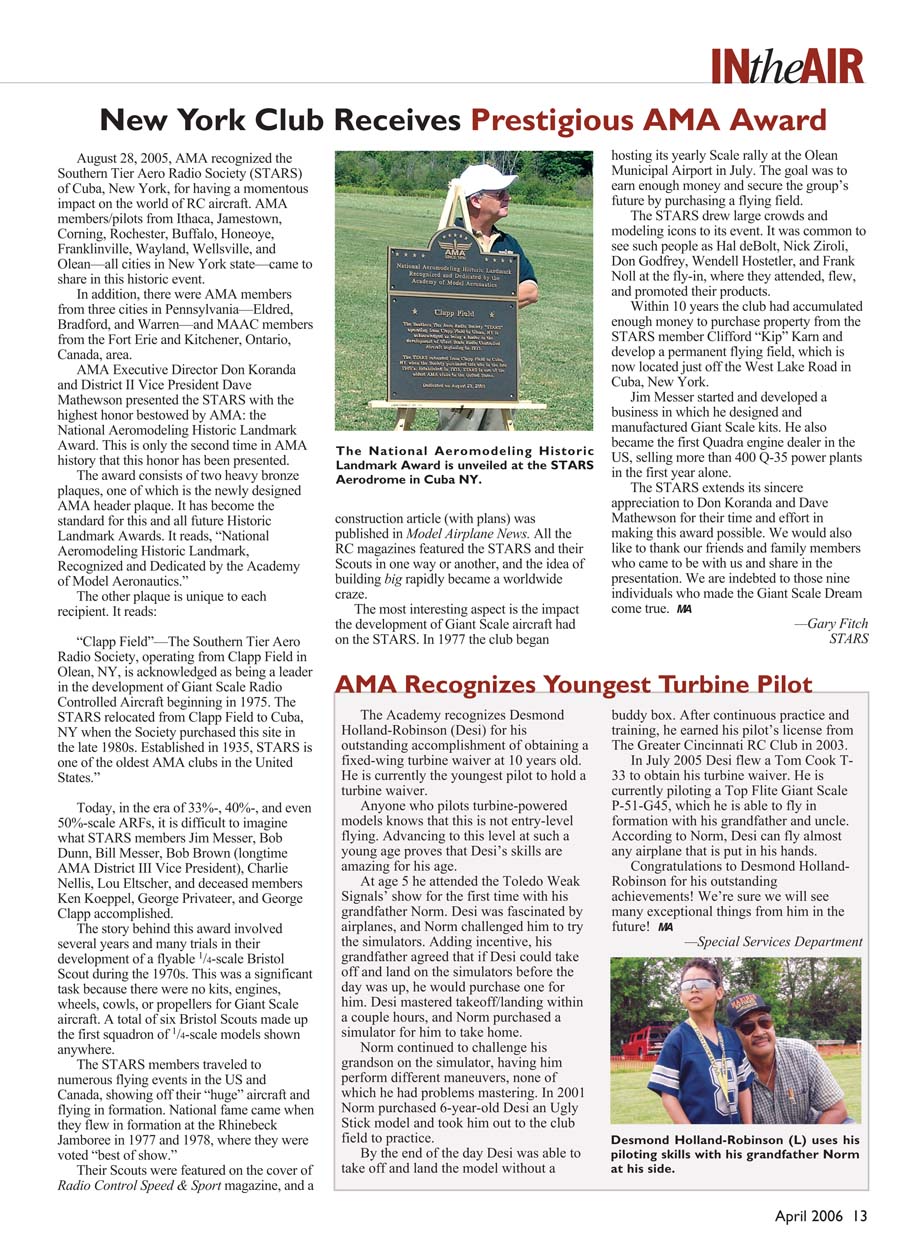
AMA Executive Director Don Koranda and District II Vice President Dave Mathewson presented the STARS with the highest honor bestowed by AMA: the National Aeromodeling Historic Landmark Award. This is only the second time in AMA history that this honor has been presented.
The award consists of two heavy bronze plaques, one of which is the newly designed AMA header plaque. It has become the standard for this and all future Historic Landmark Awards and reads: “National Aeromodeling Historic Landmark, Recognized and Dedicated by the Academy of Model Aeronautics.”
The other plaque is unique to each recipient. For the STARS it reads:
“‘Clapp Field’—The Southern Tier Aero Radio Society, operating from Clapp Field in Olean, NY, is acknowledged as being a leader in the development of Giant Scale Radio Controlled Aircraft beginning in 1975. The STARS relocated from Clapp Field to Cuba, NY when the Society purchased this site in the late 1980s. Established in 1935, STARS is one of the oldest AMA clubs in the United States.”
Today, in the era of 33%-, 40%-, and even 50%-scale ARFs, it is difficult to imagine what STARS members accomplished: Jim Messer, Bob Dunn, Bill Messer, Bob Brown (longtime AMA District III Vice President), Charlie Nellis, Lou Eltscher, and deceased members Ken Koeppel, George Privatteer, and George Clapp.
The story behind this award involved several years and many trials in their development of a flyable 1/4-scale Bristol Scout during the 1970s. This was a significant task because there were no kits, engines, wheels, cowls, or propellers for Giant Scale aircraft. A total of six Bristol Scouts were built by this first squadron of 1/4-scale models.
STARS members traveled to numerous flying events in the U.S. and Canada, showing off their “huge” aircraft and flying in formation. National fame came when they flew in formation at the Rhinebeck Jamboree in 1977 and 1978, where they were voted “best of show.”
Their Scouts were featured on the cover of Radio Control Speed & Sport magazine, and a construction article (with plans) was published in Model Airplane News. All the RC magazines featured the STARS and their Scouts in one way or another, and the idea of building big rapidly became a worldwide craze.
The club began hosting its yearly Scale rally at the Olean Municipal Airport in July 1977. The goal was to earn enough money to purchase a flying field. The STARS drew large crowds and modeling icons to its event; attendees included Hal DeBolt, Nick Zirolli, Don Godfrey, Wendell Hostetler, and Frank Noll.
Within 10 years the club had accumulated enough money to purchase property from STARS member Clifford “Kip” Karn and develop a permanent flying field, now located just off West Lake Road in Cuba, New York.
Jim Messer started and developed a business designing and manufacturing Giant Scale kits. He also became the first Quadra engine dealer in the U.S., selling more than 400 Q-35 power plants in the first year alone.
The STARS extend sincere appreciation to Don Koranda and Dave Mathewson for their time and effort in making this award possible. They also thank friends and family who attended the presentation and the nine individuals who made the Giant Scale dream come true.
Gary Fitch — STARS
Transcribed from original scans by AI. Minor OCR errors may remain.

