
Frequently Asked Questions About AMA's Competition/Technical Department
Q. How do I contact the Competition Department?
A. Call AMA Headquarters at (765) 287-1256. When the automated attendant comes on, enter extension 230 to speak to Technical Director Steve Kaluf ([email protected]), 232 to speak to Michelle Lamb ([email protected]) regarding sanctions and the “Contest Calendar,” or 231 to speak to Lisa Johnson ([email protected]) about FAI teams. You can also fax the department at (765) 286-3303.
Q. How do I sanction an event?
A. A licensed Contest Director (CD) needs to apply for the event sanction. Steps:
- Sanctioned event applications are available from the Competition Department.
- Forward the application to the Contest Coordinator for the district in which the event will be held.
- The Contest Coordinator will check the dates and area, draw protection, and forward the application to the Competition Department for processing.
- Once processed, a sanction certificate will be mailed to the CD.
Q. Who is my District Contest Coordinator?
A. This information is published monthly in Model Aviation (MA) in “Focus on Competition,” in the “Competition Directory” section.
Q. Why would I need additional insurance for a sanctioned event?
A. The AMA sanction certificate is the normal means of providing proof of $2,500,000 of insurance coverage for the event sponsor. If you need to extend this coverage to landowners or other organizations whose property will be used for the event, you may obtain an additional insurance certificate to provide to these entities.
In cases where the flying-site owner already has a certificate of insurance under a club charter, no further application is necessary. Any club activity, including the sanctioned event, is automatically covered.
Q. What are the reasons for sanctioning?
A. Reasons include:
- Protected draw area and date protection for like events.
- Additional insurance for a chartered or non-chartered club if it flies at a site not listed in AMA's club records; supplemental insurance is also for additional sponsors who may require it.
- A written text listing in the “Contest Calendar” section of MA (subject to lead-time requirements).
Q. What is the deadline for the magazine and what is the lead time?
A. The “Contest Calendar” deadline is the 14th of every month. Material for this section must be submitted 90 days prior to the event for at least one listing in the magazine.
Q. Are AMA rule books available?
A. Yes. The official version of Competition Regulations is available on the AMA website at www.modelaircraft.org/compreg.asp. If you are unable to print the rule book from the website or don’t have Internet access, you can purchase a copy from the Competition Department. Cost: $5 for the entire document or $2.50 per section.
Q. What or who is the FAI?
A. FAI stands for Fédération Aéronautique Internationale—the world sanctioning body for sport aviation, including full-scale aircraft and models. U.S. participation in World Championship events is under the auspices of the FAI, which uses the rules set forth in the FAI Sporting Code (the rule book for international competitions).
Q. What are FAI programs?
A. These are internationally recognized events. Members participate in the programs to become members of teams that compete in World Championships held in various countries.
The programs (there are 15) are devised by the participants of each event along with a Team Selection Committee (elected participants from each district). AMA supports the Team Selection Committee by distributing information, tabulating votes, and offering guidelines and procedures. AMA also supports the various teams monetarily and administratively.
Q. What is an FAI stamp and how do I get one?
A. An FAI stamp is placed on the National Aeronautic Association license and allows one to fly in international FAI events. It can be obtained through the Competition Department.
Q. Can I pay for my FAI stamp and my program entry fees by credit card?
A. Yes. Contact the Competition Department. You may pay with MasterCard or Visa.
Q. Are FAI Sporting Codes available?
A. Yes. You may purchase the entire Sporting Code for $12 or $5 per section. The Sporting Code is also available on the FAI website at www.fai.org/aeromodelling/documents/SC4.
AMA Helps Clubs Help New Modelers
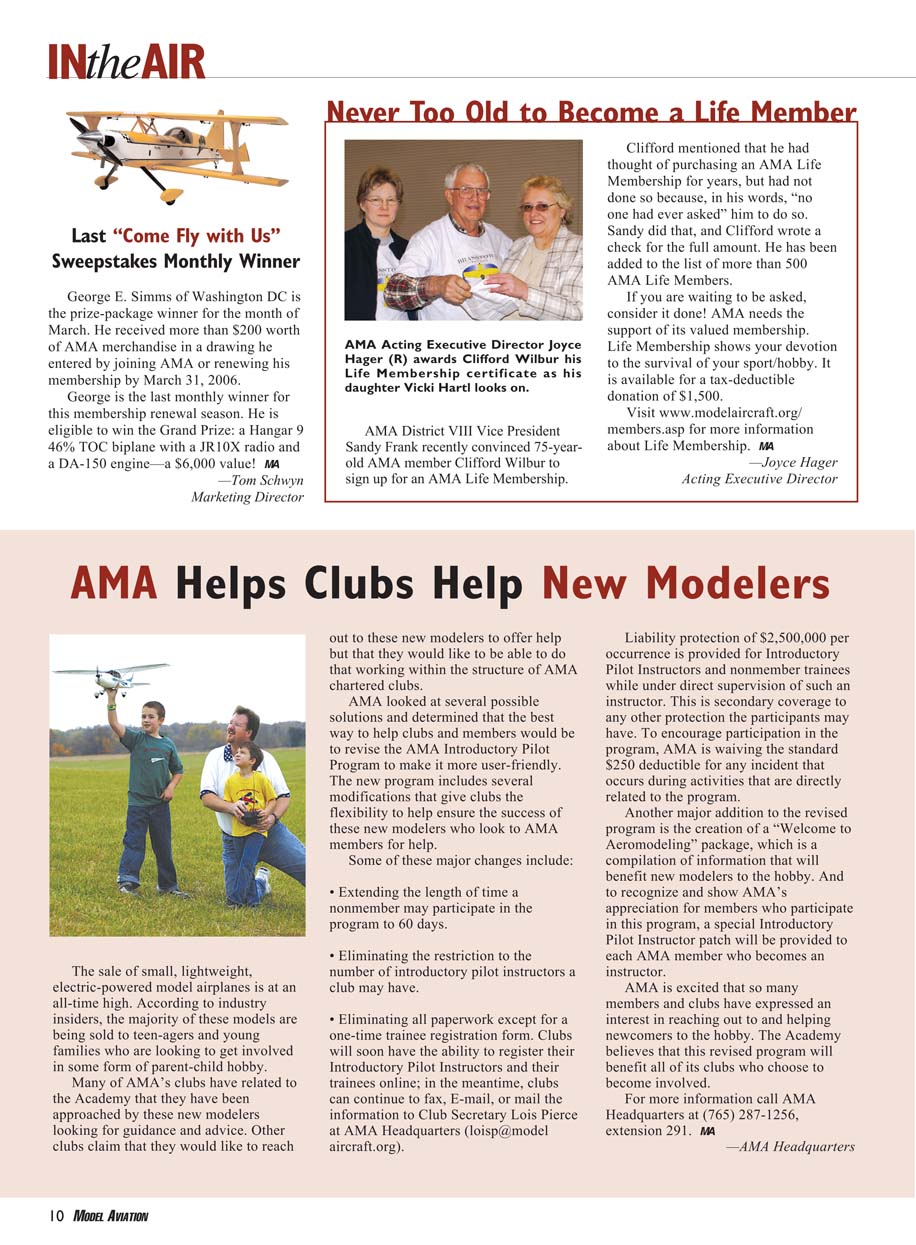
The sale of small, lightweight, electric-powered model airplanes is at an all-time high. According to industry insiders, the majority of these models are being sold to teenagers and young families who are looking to get involved in a parent–child hobby.
Many of AMA’s clubs have told the Academy that they have been approached by these new modelers looking for guidance and advice. Other clubs say they would like to reach out to these new modelers but want to do so within the structure of AMA-chartered clubs.
AMA reviewed several possible solutions and determined that the best way to help clubs and members was to revise the AMA Introductory Pilot Program to make it more user-friendly. The new program includes several modifications that give clubs the flexibility to help ensure the success of new modelers who look to AMA members for help.
Some major changes include:
- Extending the length of time a nonmember may participate in the program to 60 days.
- Eliminating the restriction on the number of Introductory Pilot Instructors a club may have.
- Eliminating all paperwork except for a one-time trainee registration form. Clubs will soon have the ability to register their Introductory Pilot Instructors and trainee information online; in the meantime, clubs can continue to fax, e-mail, or mail the information to Club Secretary Lois Pierce at AMA Headquarters ([email protected]).
Liability protection of $2,500,000 per occurrence is provided for Introductory Pilot Instructors and nonmember trainees while under the direct supervision of such an instructor. This is secondary coverage to any other protection the participants may have. To encourage participation in the program, AMA is waiving the standard $250 deductible for any incident that occurs during activities directly related to the program.
Another major addition to the revised program is the creation of a “Welcome to Aeromodelling” package, a compilation of information that will benefit new modelers. To recognize and show AMA’s appreciation for members who participate in this program, a special Introductory Pilot Instructor patch will be provided to each AMA member who becomes an instructor.
AMA is pleased that so many members and clubs have expressed interest in reaching out to and helping newcomers to the hobby. The Academy believes this revised program will benefit all clubs that choose to become involved.
For more information, call AMA Headquarters at (765) 287-1256, extension 291. MA — AMA Headquarters
AMA Represents Members Before Subcommittee
On March 29, 2006, AMA Programs Director Jay Mealy testified before the U.S. House of Representatives Committee on Transportation and Infrastructure Subcommittee on Aviation regarding unmanned aerial vehicles (UAVs) and the National Airspace System (NAS). The session was held in the Rayburn House Office Building in Washington, D.C.
The Honorable John L. Mica said the following in his opening statements:
"From the early days of flight, to the development of jet engines, to the introduction of helicopters, and now unmanned aerial vehicles and unmanned aerial systems [UASs], progress continues and the safe integration of new technologies in the National Airspace System must be assured."
Congressman Mica went on to say:
"While historically UASs have been used primarily by the Department of Defense in military settings outside of U.S. borders, there is growing demand for both government and commercial operations of unmanned aircraft in the integrated NAS."
Complexities and challenges face numerous government agencies in their assigned task of accommodating the needs of all potential NAS users and, most important, ensuring the safety of the system. Because of the similarities and confusion surrounding the definition and use of UAVs and model aircraft, the Academy felt strongly that our members and the sport needed to be represented at this hearing.
Jay Mealy, a longtime full-scale pilot, has worked continuously with the Federal Aviation Administration (FAA) and was invited to testify at the hearing. Knowing the magnitude of the potential impact on model-aircraft activities that could stem from regulation of UAVs, Jay defined the sport and AMA members for the benefit of the committee and reported on the long-standing cooperation that has existed between the FAA and the Academy.
Government agencies and private-sector representatives were provided the opportunity to speak on behalf of their individual interests, and the hearing brought to light the major challenge facing the governing authorities in allocating uses of the NAS.
In a statement defining the Academy's position, Jay said:
"Our request to this committee is that model airplanes be permitted to continue operating within the National Airspace System as we have for more than 70 years, as we commit to tirelessly working with all pertinent government agencies—in particular the FAA—as we always have, to guarantee the safe and sound operation of model aircraft in this country.
"We request that model aircraft not be innocently sucked into a black hole of regulation, a place in which, based on its long and successful history, it does not deserve to be."
To read the entire transcript of the meeting, visit www.house.gov/transportation/ and click on the link "Hearing on Unmanned Aerial Vehicles (UAVs) and the National Airspace System." MA — MA Staff
Transcribed from original scans by AI. Minor OCR errors may remain.

