
In the Air — 2006/09
Up to Day 10 of Nats 2006
After months of planning and hours of practicing, the summer is here and the 2006 Nats is in full swing. As this is being written, AMA’s National Flying Site is bursting with activity across the 1,000-plus acres.
RC Scale Aerobatics (July 4)
The contest roared to life July 4 with RC Scale Aerobatics. International Miniature Aerobatic Club competitors from every district flew in this sequence-judged event.
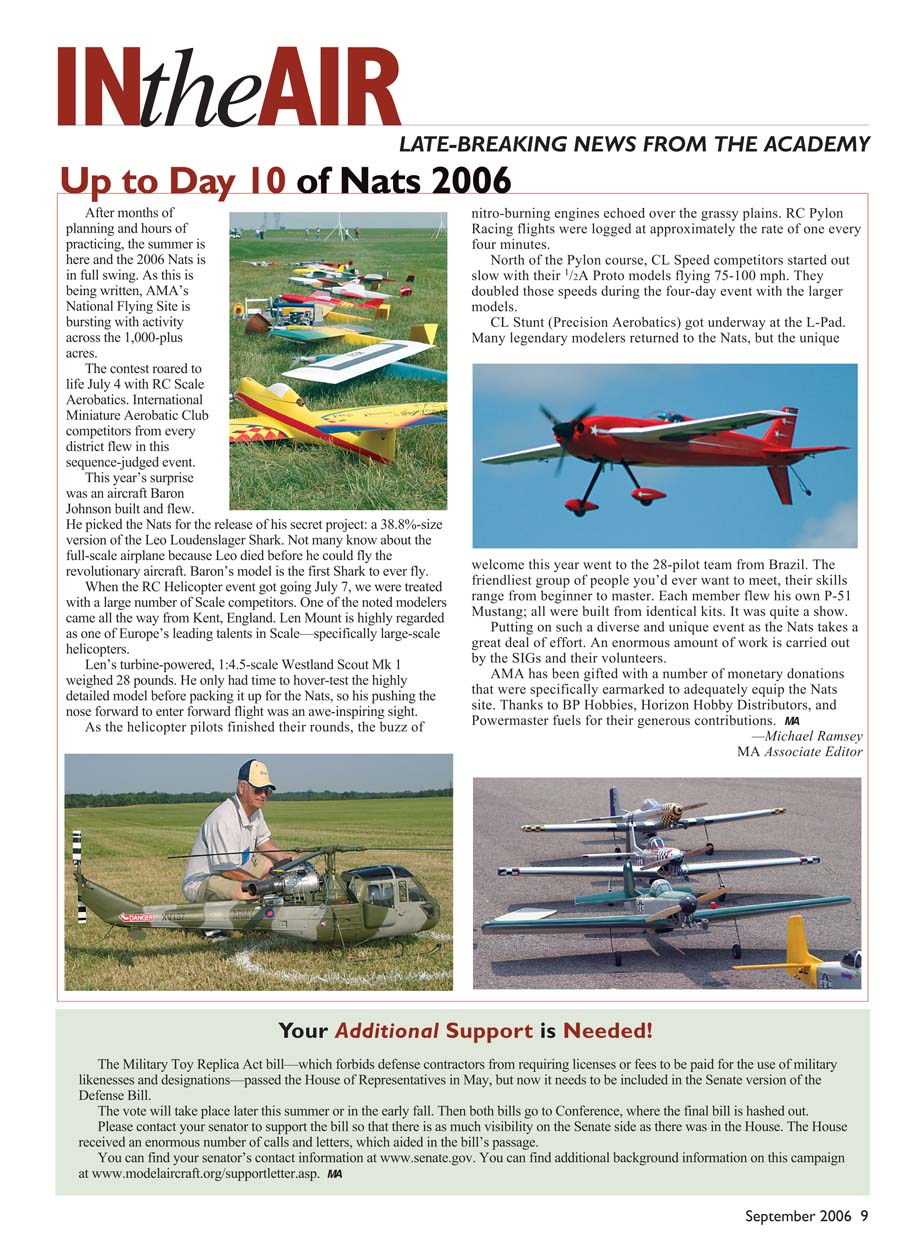
This year’s surprise was an aircraft Baron Johnson built and flew. He picked the Nats for the release of his secret project: a 38.8%-size version of the Leo Loudenslager Shark. Not many know about the full-scale airplane because Leo died before he could fly the revolutionary aircraft. Baron’s model is the first Shark to ever fly.
RC Helicopter (July 7)
When the RC Helicopter event got going July 7, we were treated to a large number of Scale competitors. One of the noted modelers came all the way from Kent, England. Len Mount is highly regarded as one of Europe’s leading talents in Scale—specifically large-scale helicopters.
Len’s turbine-powered, 1:4.5-scale Westland Scout Mk 1 weighed 28 pounds. He only had time to hover-test the highly detailed model before packing it up for the Nats, so his pushing the nose forward to enter forward flight was an awe-inspiring sight.
Pylon Racing and CL Events
As the helicopter pilots finished their rounds, the buzz of nitro-burning engines echoed over the grassy plains. RC Pylon Racing flights were logged at approximately the rate of one every four minutes.
North of the Pylon course, CL Speed competitors started out slow with their 1/2A Proto models flying 75–100 mph. They doubled those speeds during the four-day event with the larger models.
CL Stunt (Precision Aerobatics)
CL Stunt (Precision Aerobatics) got underway at the L-Pad. Many legendary modelers returned to the Nats, but the unique welcome this year went to the 28-pilot team from Brazil. The friendliest group of people you’d ever want to meet, their skills range from beginner to master. Each member flew his own P-51 Mustang; all were built from identical kits. It was quite a show.
Putting on such a diverse and unique event as the Nats takes a great deal of effort. An enormous amount of work is carried out by the SIGs and their volunteers. AMA has been gifted with a number of monetary donations that were specifically earmarked to adequately equip the Nats site. Thanks to the following for their generous contributions:
- BP Hobbies
- Horizon Hobby Distributors
- Powermaster Fuels
—Michael Ramsey, MA Associate Editor
Your Additional Support Is Needed!
The Military Toy Replica Act bill—which forbids defense contractors from requiring licenses or fees to be paid for the use of military likenesses and designations—passed the House of Representatives in May, but now it needs to be included in the Senate version of the Defense Bill. The vote will take place later this summer or in the early fall. Then both bills go to Conference, where the final bill is hashed out.
Please contact your senator to support the bill so that there is as much visibility on the Senate side as there was in the House. The House received an enormous number of calls and letters, which aided in the bill’s passage.
- Find your senator’s contact information at: www.senate.gov
- Find additional background information on this campaign at: www.modelaircraft.org/supportletter.asp
MA
A New Pilot Takes Off
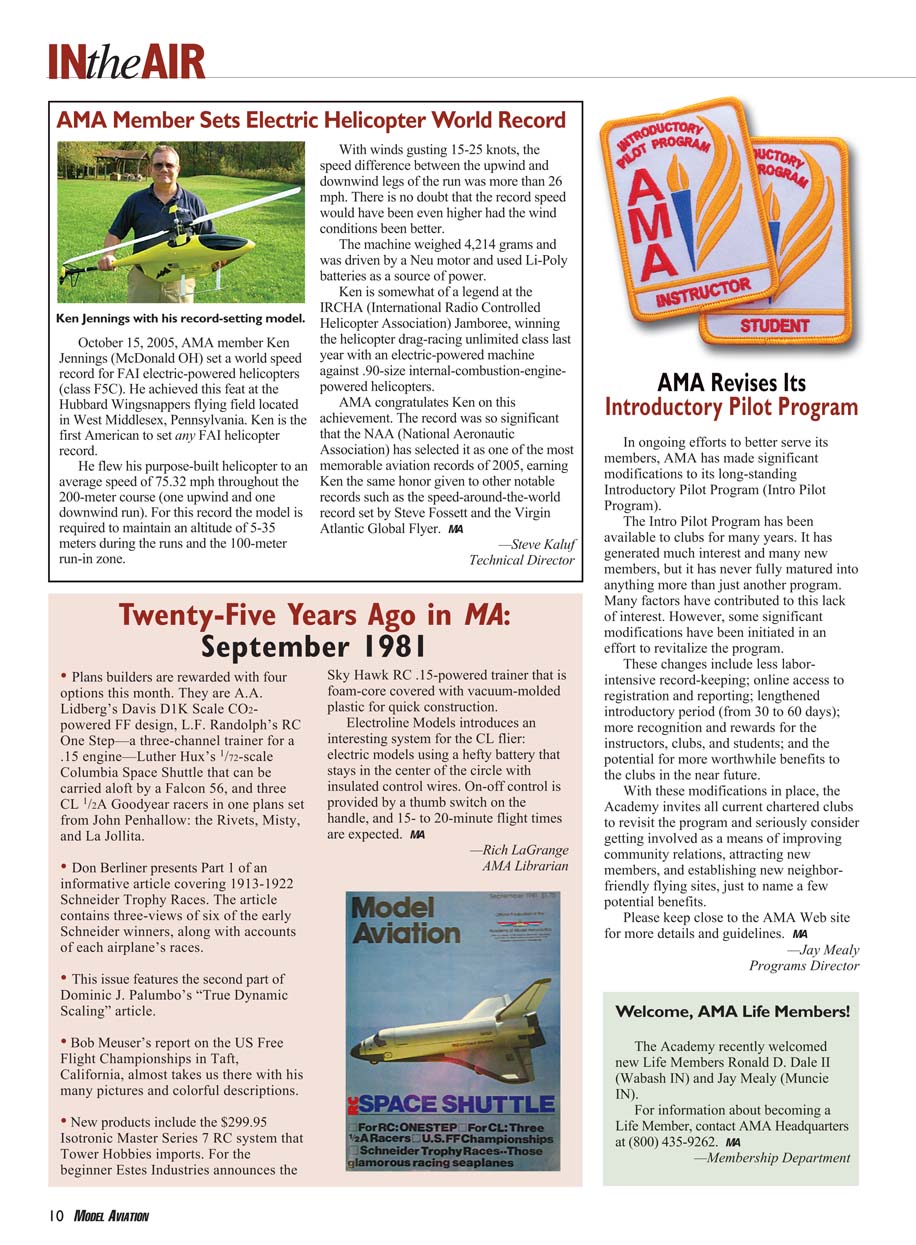
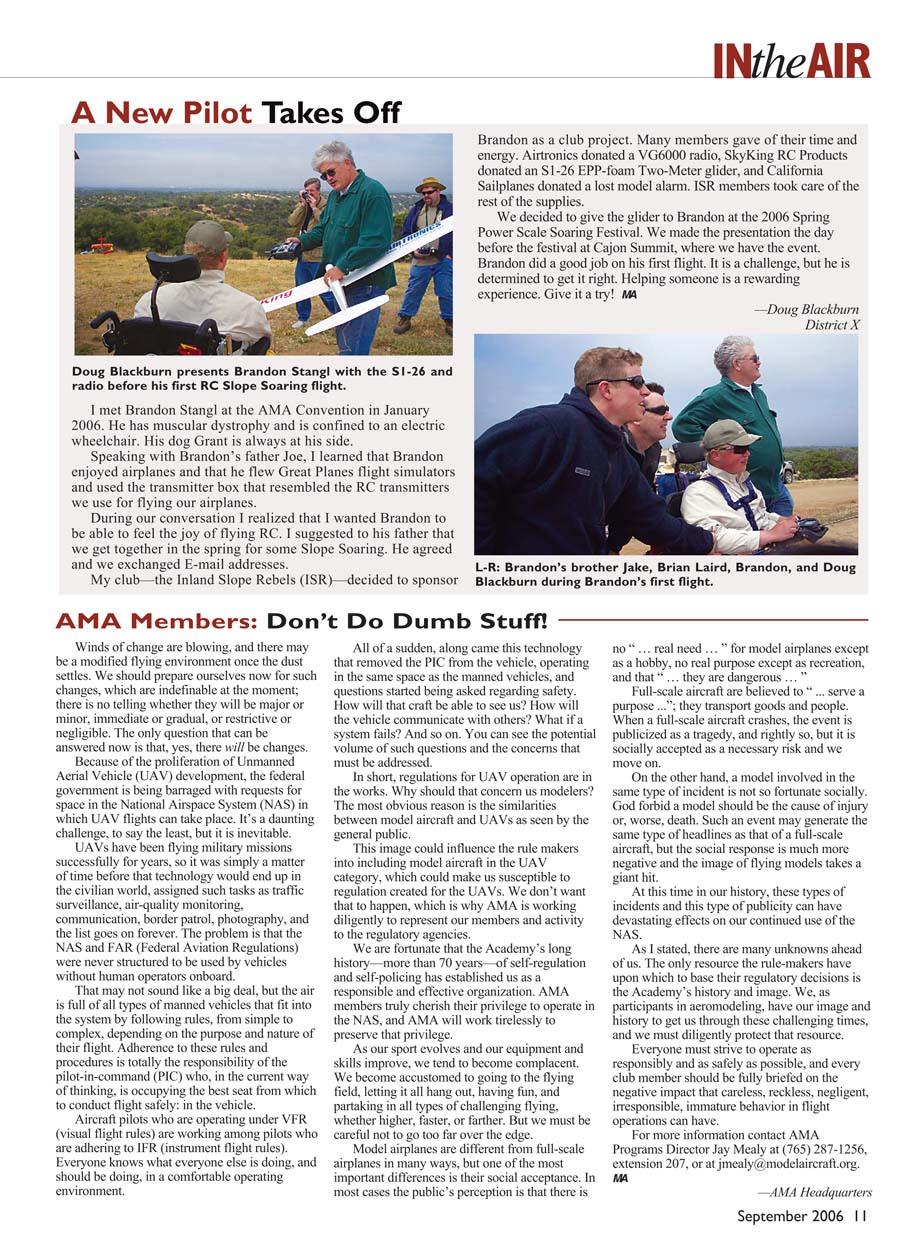
I met Brandon Stangl at the AMA Convention in January 2006. He has muscular dystrophy and is confined to an electric wheelchair. His dog Grant is always at his side.
Speaking with Brandon's father Joe, I learned that Brandon enjoyed airplanes and that he flew Great Planes flight simulators and used the transmitter box that resembled the RC transmitters we use for flying our airplanes.
During our conversation I realized that I wanted Brandon to be able to feel the joy of flying RC. I suggested to his father that we get together in the spring for some slope soaring. He agreed and we exchanged e-mail addresses.
My club—the Inland Slope Rebels (ISR)—decided to sponsor Brandon as a club project. Many members gave of their time and energy. Donations and contributions included:
- Airtronics: VG6000 radio
- SkyKing RC Products: SI-26 EPP-foam two-meter glider
- California Sailplanes: lost-model alarm
- ISR members: additional supplies and support
We decided to give the glider to Brandon at the 2006 Spring Power Scale Soaring Festival. We made the presentation the day before the festival at Cajon Summit, where we have the event. Brandon did a good job on his first flight. It is a challenge, but he is determined to get it right. Helping someone is a rewarding experience. Give it a try!
—Doug Blackburn, District X
AMA Members: Don’t Do Dumb Stuff!
Winds of change are blowing, and there may be a modified flying environment once the dust settles. We should prepare ourselves now for such changes, which are indefinable at the moment; there is no telling whether they will be major or minor, immediate or gradual, or restrictive or negligible. The only question that can be answered now is that, yes, there will be changes.
Because of the proliferation of Unmanned Aerial Vehicle (UAV) development, the federal government is being barraged with requests for space in the National Airspace System (NAS) in which UAV flights can take place. It's a daunting challenge, to say the least, but it is inevitable.
UAVs have been flying military missions successfully for years, so it was simply a matter of time before that technology would be used in the civilian world, assigned tasks such as:
- traffic surveillance
- air-quality monitoring
- communications
- border patrol
- photography
The problem is that the NAS and FAR (Federal Aviation Regulations) were never structured to be used by vehicles without human operators onboard.
That may not sound like a big deal, but the air is full of all types of manned vehicles that fit into the system of following rules, from simple to complex, depending on the purpose and nature of their flight. Adherence to these rules and procedures is totally the responsibility of the pilot-in-command (PIC) who, in the current way of thinking, is occupying the best seat from which to conduct flight safety: in the vehicle.
Aircraft pilots who are operating under VFR (visual flight rules) are working among pilots who are adhering to IFR (instrument flight rules). Everyone knows what everyone else is doing, and should be doing, in a comfortable operating environment.
All of a sudden, along came this technology that removed the PIC from the vehicle, operating in the same space as the manned vehicles, and questions started being asked regarding safety. How will that craft be able to see? How will the vehicle communicate with others? What if a system fails? And so on. You can see the potential volume of such questions and the concerns that must be addressed.
In short, regulations for UAV operation are in the works. Why should that concern us modelers? The most obvious reason is the similarities between model aircraft and UAVs as seen by the general public.
This image could influence the rule makers into including model aircraft in the UAV category, which could make us susceptible to regulation created for the UAVs. We don't want that to happen, which is why AMA is working diligently to represent our members and activity to the regulatory agencies.
We are fortunate that the Academy's long history—more than 70 years—of self-regulation and self-policing has established us as a responsible and effective organization. AMA members truly cherish their privilege to operate in the NAS, and AMA will work tirelessly to preserve that privilege.
As our sport evolves and our equipment and skills improve, we tend to become complacent. We become accustomed to going to the flying field, letting it all hang out, having fun, and partaking in all types of challenging flying, whether higher, faster, or farther. But we must be careful not to go too far over the edge.
Model airplanes are different from full-scale airplanes in many ways, but one of the most important differences is their social acceptance. In most cases the public's perception is that there is no “real need” for model airplanes except as a hobby, no real purpose except as recreation, and that “they are dangerous.”
Full-scale aircraft are believed to “serve a purpose”—they transport goods and people. When a full-scale aircraft crashes, the event is publicized as a tragedy, and rightly so, but it is socially accepted as a necessary risk and we move on.
On the other hand, a model involved in the same type of incident is not so fortunate socially. God forbid a model should be the cause of injury or worse, death. Such an event may generate the same type of headlines as that of a full-scale aircraft, but the social response is much more negative and the image of flying models takes a hard hit.
At this time in our history, these types of incidents and this type of publicity can have devastating effects on our continued use of the NAS.
As I stated, there are many unknowns ahead of us. The only resource the rule-makers have upon which to base their regulatory decisions is the Academy's history and image. We as participants in aeromodeling have our image and history, and we must do all that we can to preserve and protect that resource.
Everyone must strive to operate as responsibly and as safely as possible, and every club member should be fully briefed on the negative impact that careless, reckless, negligent, irresponsible, immature behavior in flight operations can have.
For more information contact AMA Programs Director Jay Mealy at (765) 287-1256, extension 207, or at [email protected].
—AMA Headquarters
Transcribed from original scans by AI. Minor OCR errors may remain.

