
Plan Now to Attend the 2008 Nats!
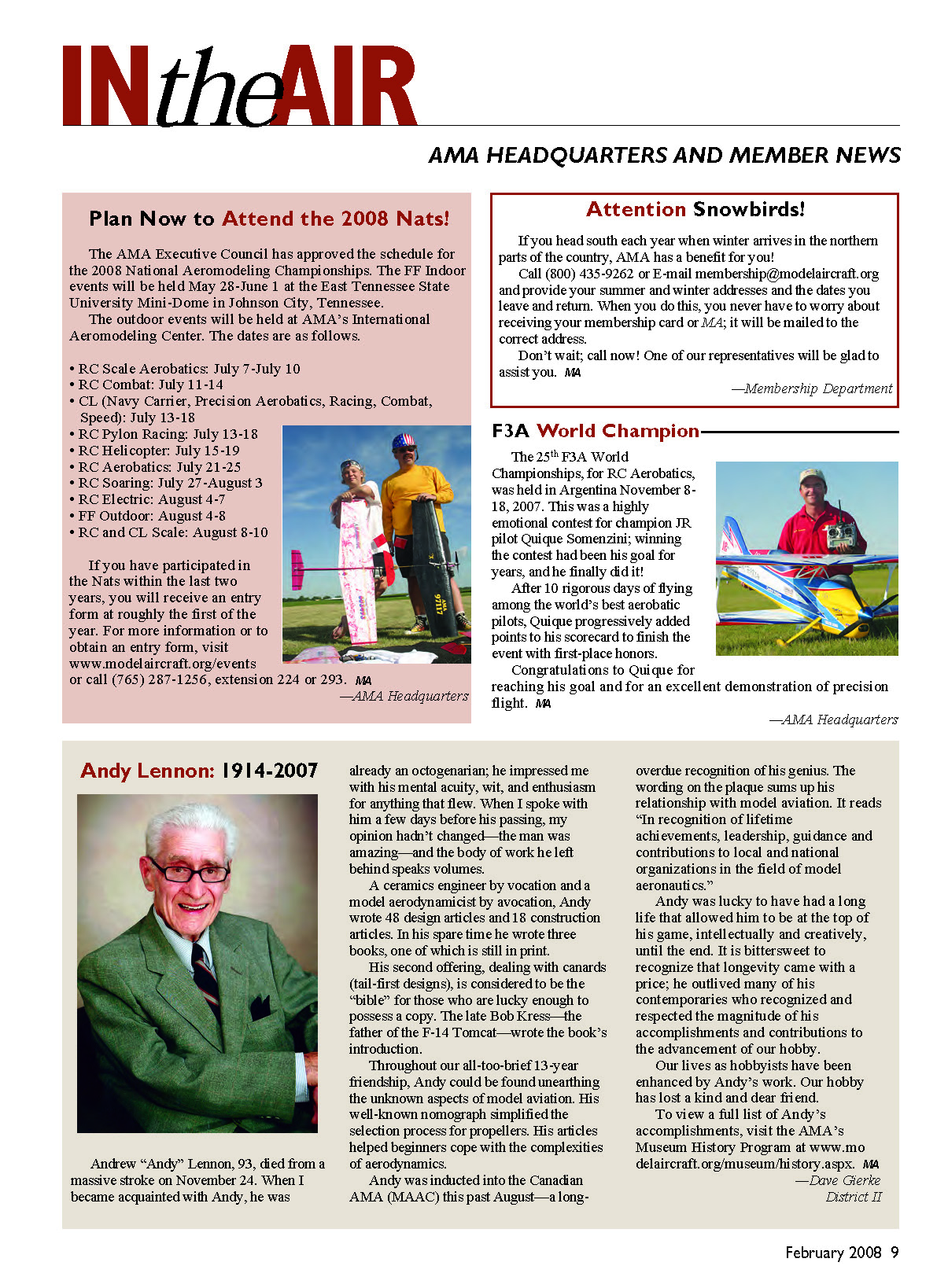
The AMA Executive Council has approved the schedule for the 2008 National Aeromodeling Championships. The FF Indoor events will be held May 28–June 1 at the East Tennessee State University Mini-Dome in Johnson City, Tennessee.
The outdoor events will be held at AMA’s International Aeromodeling Center. The dates are as follows:
- RC Scale Aerobatics: July 7–July 10
- RC Combat: July 11–14
- CL (Navy Carrier, Precision Aerobatics, Racing, Combat, Speed): July 13–18
- RC Pylon Racing: July 13–18
- RC Helicopter: July 15–19
- RC Aerobatics: July 21–25
- RC Soaring: July 27–August 3
- RC Electric: August 4–7
- FF Outdoor: August 4–8
- RC and CL Scale: August 8–10
If you have participated in the Nats within the last two years, you will receive an entry form at roughly the first of the year. For more information or to obtain an entry form, visit www.modelaircraft.org/events or call (765) 287-1256, extension 224 or 293.
— AMA Headquarters
Outstanding Aeromodeling Contributions Recognized
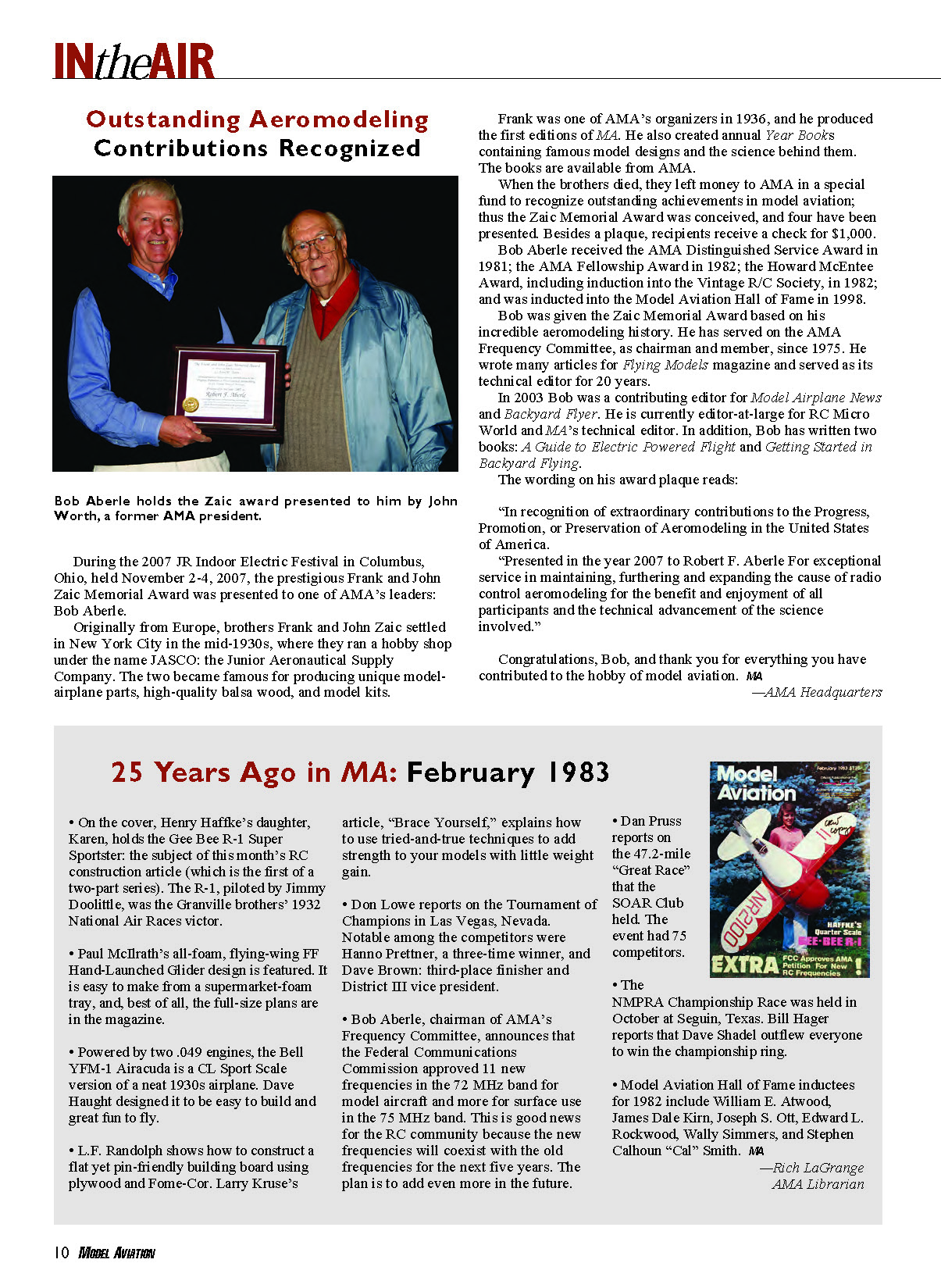
During the 2007 JR Indoor Electric Festival in Columbus, Ohio, held November 2–4, 2007, the prestigious Frank and John Zaic Memorial Award was presented to one of AMA’s leaders: Bob Aberle.
Originally from Europe, brothers Frank and John Zaic settled in New York City in the mid-1930s, where they ran a hobby shop under the name JASCO: the Junior Aeronautical Supply Company. The two became famous for producing unique model-airplane parts, high-quality balsa wood, and model kits.
Frank was one of AMA’s organizers in 1936, and he produced the first editions of MA. He also created annual Year Books containing famous model designs and the science behind them. The books are available from AMA.
When the brothers died, they left money to AMA in a special fund to recognize outstanding achievements in model aviation; thus the Zaic Memorial Award was conceived, and four have been presented. Besides a plaque, recipients receive a check for $1,000.
Bob Aberle received the AMA Distinguished Service Award in 1981; the AMA Fellowship Award in 1982; the Howard McEntee Award, including induction into the Vintage R/C Society, in 1982; and was inducted into the Model Aviation Hall of Fame in 1998.
Bob was given the Zaic Memorial Award based on his incredible aeromodeling history. He has served on the AMA Frequency Committee, as chairman and member, since 1975. He wrote many articles for Flying Models magazine and served as its technical editor for 20 years.
In 2003 Bob was a contributing editor for Model Airplane News and Backyard Flyer. He is currently editor-at-large for RC Micro World and MA’s technical editor. In addition, Bob has written two books: A Guide to Electric Powered Flight and Getting Started in Backyard Flying.
The wording on his award plaque reads:
"In recognition of extraordinary contributions to the Progress, Promotion, or Preservation of Aeromodeling in the United States of America.
Presented in the year 2007 to Robert F. Aberle For exceptional service in maintaining, furthering and expanding the cause of radio control aeromodeling for the benefit and enjoyment of all participants and the technical advancement of the science involved."
Congratulations, Bob, and thank you for everything you have contributed to the hobby of model aviation.
MA — AMA Headquarters
FMA Direct Relocates
FMA Direct opened facilities at a new location Monday, October 15, 2007. The offices and warehouse had been separate for eight years, and the move to new quarters brought all operations under one roof.
Founded by Fred Marks, FMA Direct began serving aeromodelers in 1972. In recent years the company has come to be recognized for innovative products of the highest quality and caliber of performance.
Starting its own distribution business in 1996, FMA Direct has developed an excellent reputation. More than 300 products are available to businesses and hobbyists through the product catalog, and the company serves more than 30,000 customers, with more than a half million products in the field.
The new facility is located at 5713 Industry Ln., Suite 50, Frederick, MD 21704. The telephone ((800) 343-2934) and fax ((301) 668-7619) numbers have not changed.
MA — AMA Headquarters
Hall of Fame Members' Solid Models
Before RC came along, solid scale airplane models were exceedingly popular among model builders. Never meant to fly, they were mostly exercises in craftsmanship. They let modelers build and display 3-D representations of their favorite airplanes: Gee Bees, Grumman Gulfhawks, Sikorsky Clippers, P-38s, Schneider Trophy racers, Spitfires, B-25s, Stukas, S.E.5s, Spads, Fokker triplanes, etc.
Yet some solid models had more practical purposes. Many were used as training aids for military-aircraft identification. Others were attention-grabbers in travel agencies and airline-ticket offices.
In mid-1952 it was my good fortune to work with three other expert modelers—Howard “Hi” Johnson, Clarence Lee, and Bob Palmer—to design and construct unusual scale model airplanes for the US Air Force. We weren't especially well known at that time, but each of us was eventually inducted into AMA’s Model Aviation Hall of Fame (not for our solid-model project, but for later contributions to model aviation).
We built three models of the Douglas C-124A Globemaster. At that time it was the Air Force's newest and most capacious cargo carrier. It could lift more than 37 tons of payload: trucks, tanks, earthmovers, motor cranes, and much more.
However, the airplane could hold far more than it was capable of taking off with, and placement of heavy items such as bulldozers and tanks was crucial for keeping the loaded C-124A's CG within safe limits.
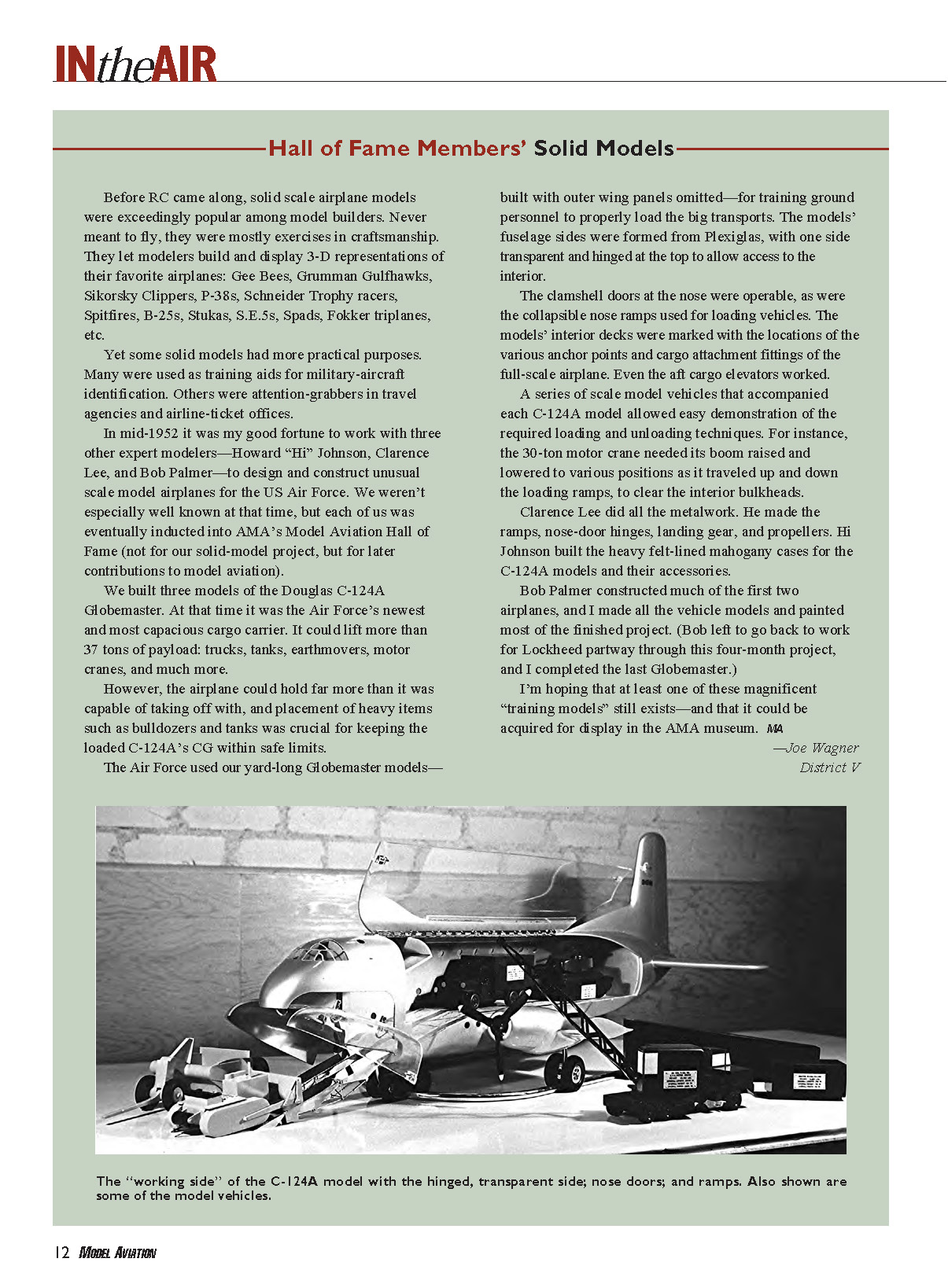
The Air Force used our yard-long Globemaster models—built with outer wing panels omitted—for training ground personnel to properly load the big transports. The models' fuselage sides were formed from Plexiglas, with one side transparent and hinged at the top to allow access to the interior.
The clamshell doors at the nose were operable, as were the collapsible nose ramps used for loading vehicles. The models' interior decks were marked with the locations of the various anchor points and cargo attachment fittings of the full-scale airplane. Even the aft cargo elevators worked.
A series of scale model vehicles that accompanied each C-124A model allowed easy demonstration of the required loading and unloading techniques. For instance, the 30-ton motor crane needed its boom raised and lowered to various positions as it traveled up and down the loading ramps, to clear the interior bulkheads.
Clarence Lee did all the metalwork. He made the ramps, nose-door hinges, landing gear, and propellers. Hi Johnson built the heavy felt-lined mahogany cases for the C-124A models and their accessories.
Bob Palmer constructed much of the first two airplanes, and I made all the vehicle models and painted most of the finished project. (Bob left to go back to work for Lockheed partway through this four-month project, and I completed the last Globemaster.)
I'm hoping that at least one of these magnificent “training models” still exists—and that it could be acquired for display in the AMA museum.
— Joe Wagner, District V
Transcribed from original scans by AI. Minor OCR errors may remain.

