
IN the AIR - 2009/08
A Worldlier IRCHA Jamboree
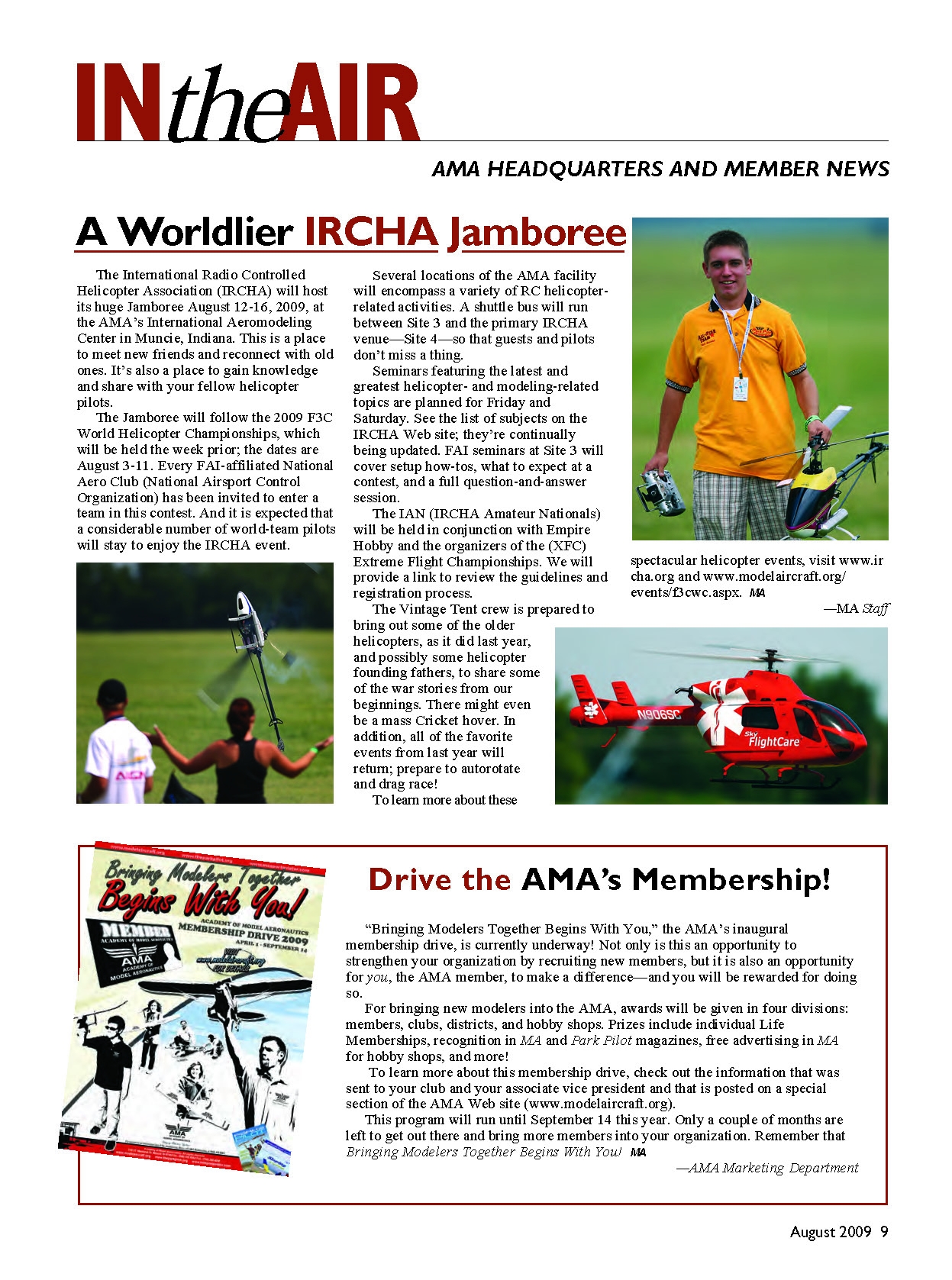
The International Radio Controlled Helicopter Association (IRCHA) will host its huge Jamboree August 12–16, 2009, at the AMA’s International Aeromodeling Center in Muncie, Indiana. This is a place to meet new friends and reconnect with old ones. It’s also a place to gain knowledge and share with your fellow helicopter pilots.
The Jamboree will follow the 2009 F3C World Helicopter Championships, which will be held the week prior; the dates are August 3–11. Every FAI-affiliated national aero club (National Airsport Control Organization) has been invited to enter a team in this contest. It is expected that a considerable number of world-team pilots will stay to enjoy the IRCHA event.
Several locations at the AMA facility will encompass a variety of RC helicopter-related activities. A shuttle bus will run between Site 3 and the primary IRCHA venue—Site 4—so that guests and pilots don’t miss a thing.
Seminars featuring the latest helicopter- and modeling-related topics are planned for Friday and Saturday. See the list of subjects on the IRCHA website; they’re continually being updated. FAI seminars at Site 3 will cover setup how-tos, what to expect at a contest, and a full question-and-answer session.
The IAN (IRCHA Amateur Nationals) will be held in conjunction with Empire Hobby and the organizers of the XFC (Extreme Flight Championships). A link will be provided to review the guidelines and registration process.
The Vintage Tent crew is prepared to bring out some of the older helicopters, as it did last year, and possibly some helicopter founding fathers to share war stories from our beginnings. There might even be a mass Cricket hover. In addition, all of last year’s favorite events will return; prepare to autorotate and drag race!
To learn more about these helicopter events, visit:
—MA Staff
Boeing Incorporates Model Aircraft in Demonstration of New Emergency Response Technology
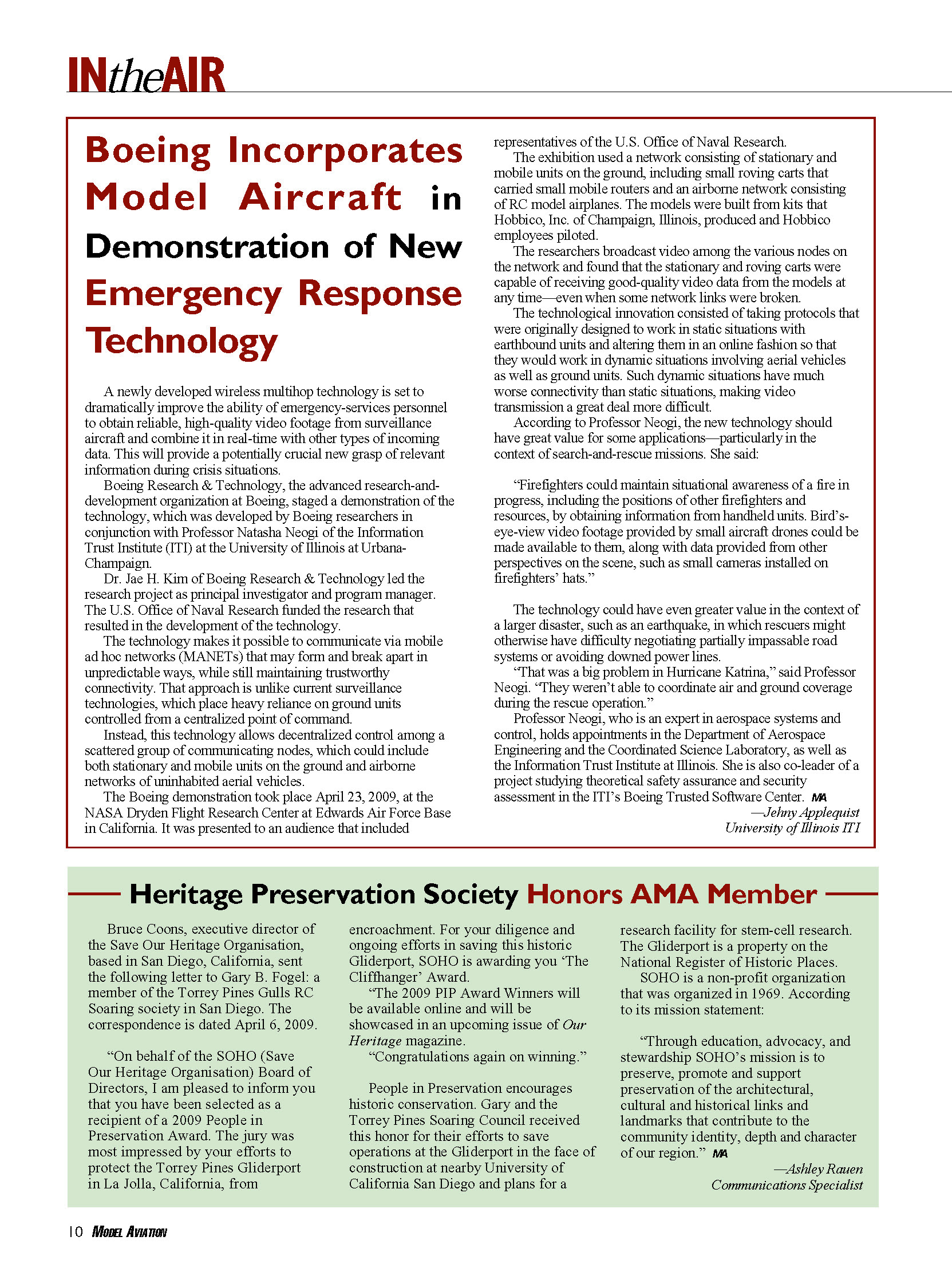
A newly developed wireless multihop technology is set to dramatically improve the ability of emergency-services personnel to obtain reliable, high-quality video footage from surveillance aircraft and combine it in real time with other types of incoming data. This will provide a potentially crucial new grasp of relevant information during crisis situations.
Boeing Research & Technology, the advanced research-and-development organization at Boeing, staged a demonstration of the technology developed by Boeing researchers in conjunction with Professor Natasha Neogi of the Information Trust Institute (ITI) at the University of Illinois at Urbana-Champaign.
Dr. Jae H. Kim of Boeing Research & Technology led the research project as principal investigator and program manager. The U.S. Office of Naval Research funded the research that resulted in the development of the technology.
The technology makes it possible to communicate via mobile ad hoc networks (MANETs) that may form and break apart in unpredictable ways while still maintaining trustworthy connectivity. That approach differs from current surveillance technologies, which place heavy reliance on ground units controlled from a centralized point of command.
Instead, this technology allows decentralized control among a scattered group of communicating nodes, which could include both stationary and mobile units on the ground and airborne networks of uninhabited aerial vehicles.
The Boeing demonstration took place April 23, 2009, at the NASA Dryden Flight Research Center at Edwards Air Force Base in California. It was presented to an audience that included representatives of the U.S. Office of Naval Research.
The exhibition used a network consisting of:
- stationary and mobile units on the ground, including small roving carts that carried small mobile routers, and
- an airborne network consisting of RC model airplanes built from kits produced by Hobbico, Inc. of Champaign, Illinois; Hobbico employees piloted the models.
The researchers broadcast video among the various nodes on the network and found that the stationary and roving carts were capable of receiving good-quality video data from the models at any time—even when some network links were broken.
The technological innovation consisted of taking protocols originally designed for static, earthbound situations and altering them online so they would work in dynamic situations involving aerial vehicles as well as ground units. Such dynamic situations have much worse connectivity than static situations, making video transmission far more difficult.
According to Professor Neogi, the new technology should have great value for some applications—particularly in the context of search-and-rescue missions. She said: “Firefighters could maintain situational awareness of a fire in progress, including the positions of other firefighters and resources, by obtaining information from handheld units. Bird’s-eye-view video footage provided by small aircraft drones could be made available to them, along with data provided from other perspectives on the scene, such as small cameras installed on firefighters’ hats.”
The technology could have even greater value in the context of a larger disaster, such as an earthquake, in which rescuers might otherwise have difficulty negotiating partially impassable road systems or avoiding downed power lines.
“That was a big problem in Hurricane Katrina,” said Professor Neogi. “They weren’t able to coordinate air and ground coverage during the rescue operation.”
Professor Neogi, an expert in aerospace systems and control, holds appointments in the Department of Aerospace Engineering and the Coordinated Science Laboratory, as well as the Information Trust Institute at Illinois. She is also co-leader of a project studying theoretical safety assurance and security assessment in the ITI’s Boeing Trusted Software Center.
—Jehny Applequist University of Illinois ITI MA
"Behind the Scenes" AMA Museum Tours
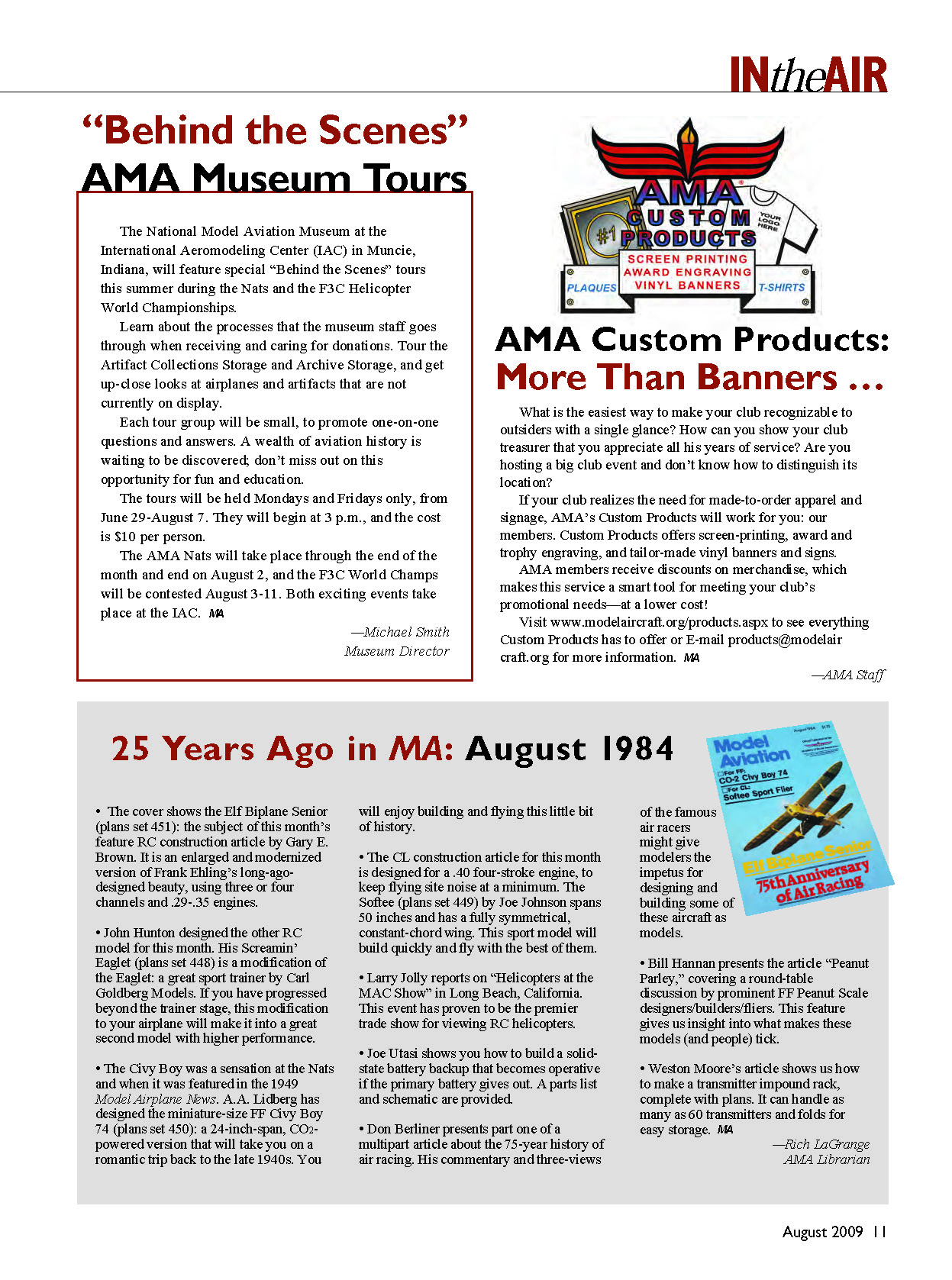
The National Model Aviation Museum at the International Aeromodeling Center (IAC) in Muncie, Indiana, will feature special "Behind the Scenes" tours this summer during the Nats and the F3C Helicopter World Championships.
Learn about the processes the museum staff follows when receiving and caring for donations. Tour the Artifact Collections Storage and Archive Storage, and get up-close looks at airplanes and artifacts that are not currently on display.
Each tour group will be small to promote one-on-one questions and answers. A wealth of aviation history is waiting to be discovered; don't miss this opportunity for fun and education.
Tour details:
- Dates: Mondays and Fridays only, June 29–August 7
- Time: Tours begin at 3 p.m.
- Cost: $10 per person
The AMA Nats will take place through the end of the month and end on August 2, and the F3C World Championships will be contested August 3–11. Both events take place at the IAC.
—Michael Smith Museum Director
Louisiana Club Flies With Boy Scouts
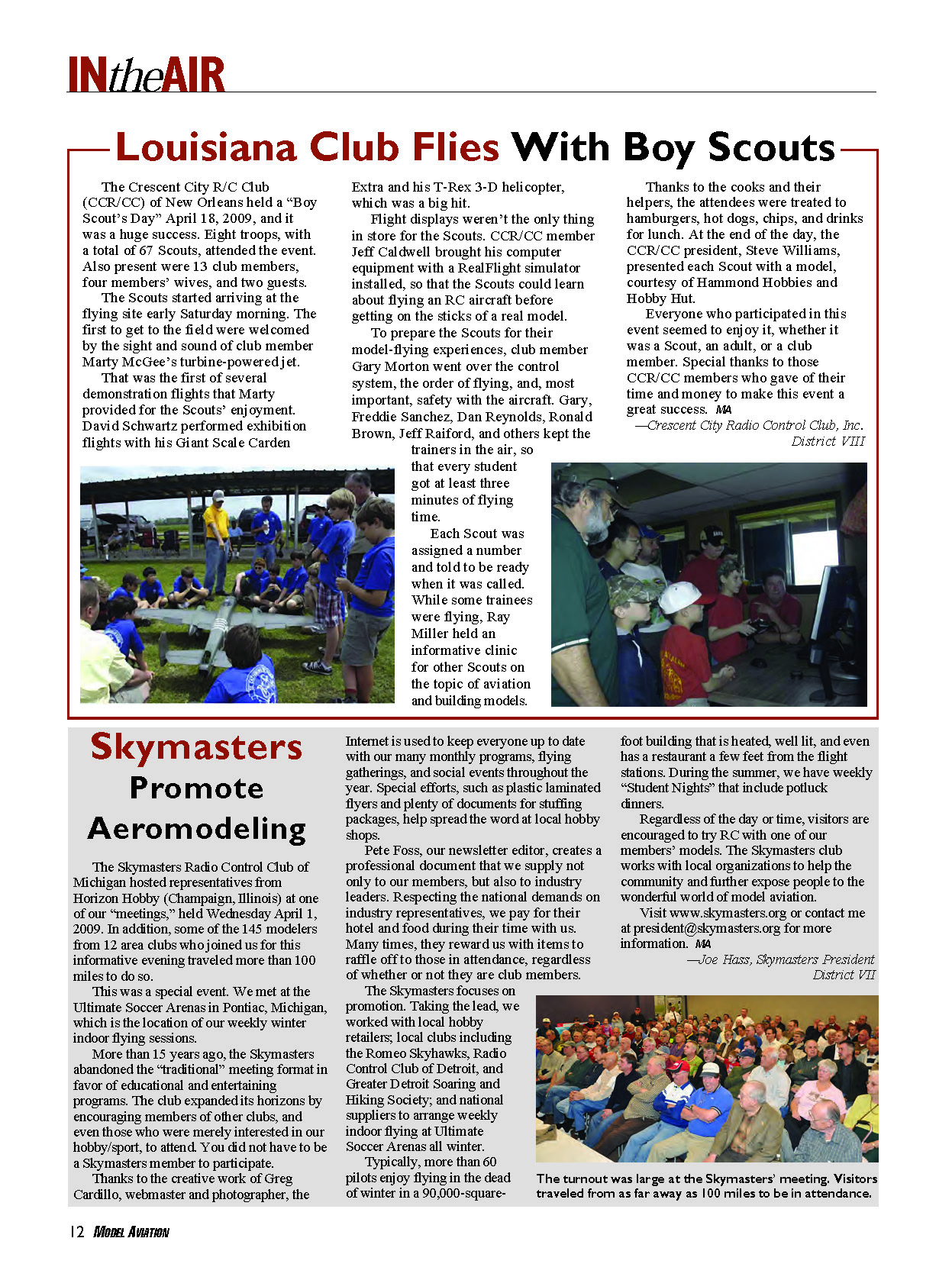
The Crescent City R/C Club (CCR/CC) of New Orleans held a "Boy Scout's Day" on April 18, 2009, and it was a huge success. Eight troops, with a total of 67 Scouts, attended the event. Also present were 13 club members, four members' wives, and two guests.
The Scouts started arriving at the flying site early Saturday morning. The first to get to the field were welcomed by the sight and sound of club member Marty McGee’s turbine-powered jet. That was the first of several demonstration flights Marty provided for the Scouts’ enjoyment.
David Schwartz performed exhibition flights with his Giant Scale Carden Extra and his T-Rex 3-D helicopter, which was a big hit.
Flight displays weren’t the only thing in store for the Scouts. CCR/CC member Jeff Caldwell brought his computer equipment with a RealFlight simulator installed so the Scouts could learn about flying an RC aircraft before getting on the sticks of a real model.
To prepare the Scouts for their model-flying experiences, club member Gary Morton went over the control system, the order of flying, and, most important, safety with the aircraft. Gary, Freddie Sanchez, Dan Reynolds, Ronald Brown, Jeff Raiford, and others kept the trainers in the air so every student got at least three minutes of flying time.
Each Scout was assigned a number and told to be ready when it was called. While some trainees were flying, Ray Miller held an informative clinic for other Scouts on aviation and building models.
Thanks to the cooks and their helpers, attendees were treated to hamburgers, hot dogs, chips, and drinks for lunch. At the end of the day, CCR/CC president Steve Williams presented each Scout with a model, courtesy of Hammond Hobbies and Hobby Hut.
Everyone who participated seemed to enjoy the event—Scouts, adults, and club members alike. Special thanks to those CCR/CC members who gave of their time and money to make the day a great success.
—Crescent City Radio Control Club, Inc. District VIII
Transcribed from original scans by AI. Minor OCR errors may remain.

