
Safety Code Amendments for 2010
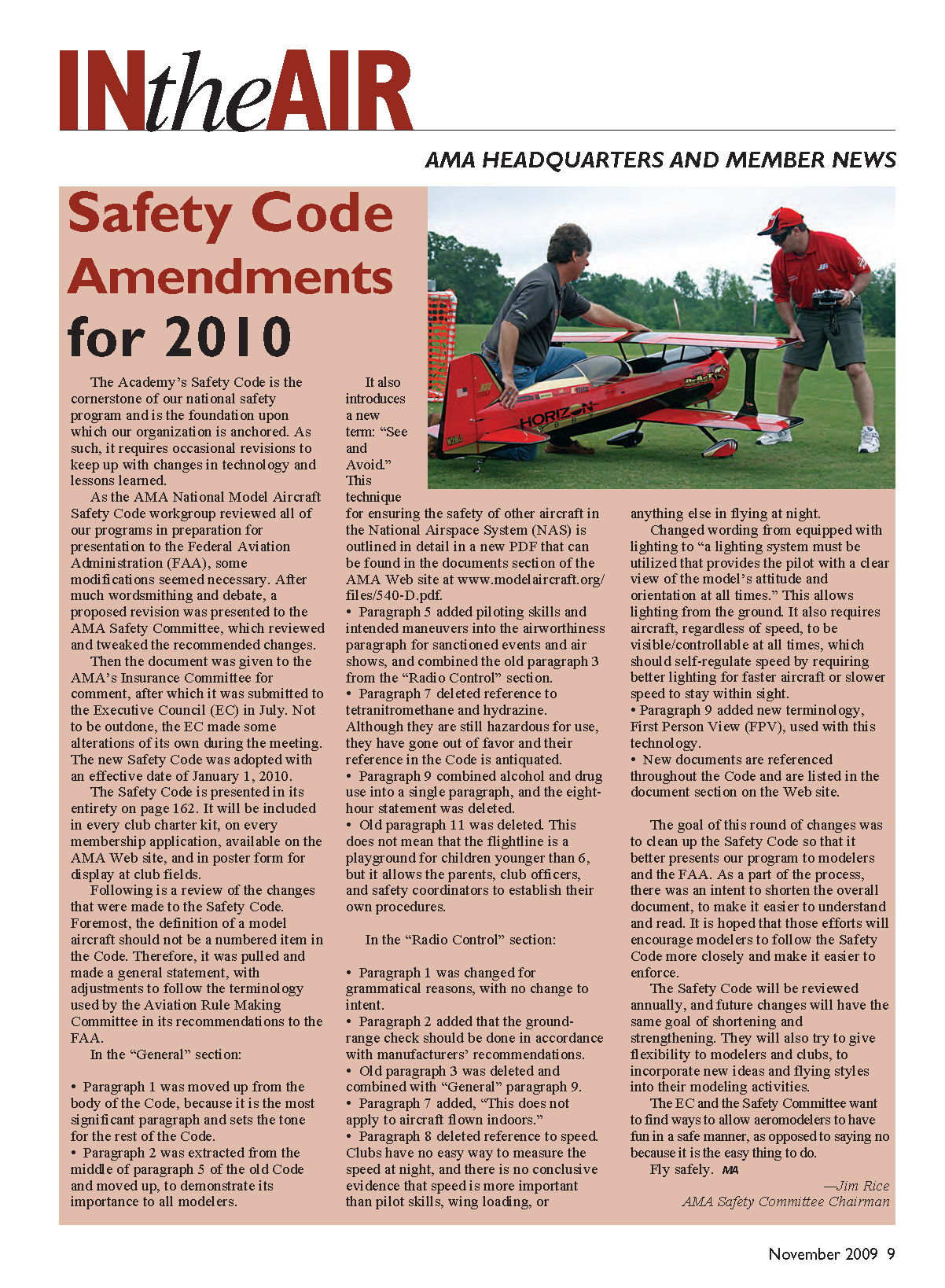
The Academy’s Safety Code is the cornerstone of our national safety program and the foundation upon which our organization is anchored. As such, it requires occasional revisions to keep up with changes in technology and lessons learned.
As the AMA National Model Aircraft Safety Code workgroup reviewed all of our programs in preparation for presentation to the Federal Aviation Administration (FAA), some modifications seemed necessary. After much wordsmithing and debate, a proposed revision was presented to the AMA Safety Committee, which reviewed and tweaked the recommended changes.
Then the document was given to the AMA’s Insurance Committee for comment, after which it was submitted to the Executive Council (EC) in July. The EC made some alterations of its own during the meeting. The new Safety Code was adopted with an effective date of January 1, 2010.
The Safety Code is presented in its entirety on page 162. It will be included in every club charter kit, on every membership application, available on the AMA Web site, and in poster form for display at club fields.
Following is a review of the changes that were made to the Safety Code. Foremost, the definition of a model aircraft should not be a numbered item in the Code. Therefore, it was pulled and made a general statement, with adjustments to follow the terminology used by the Aviation Rule Making Committee in its recommendations to the FAA.
In the "General" section:
- Paragraph 1 was moved up from the body of the Code because it is the most significant paragraph and sets the tone for the rest of the Code.
- Paragraph 2 was extracted from the middle of paragraph 5 of the old Code and moved up to demonstrate its importance to all modelers.
It also introduces a new term: “See and Avoid.” This technique for ensuring the safety of other aircraft in the National Airspace System (NAS) is outlined in detail in a new PDF that can be found in the documents section of the AMA Web site at www.modelaircraft.org/files/540-D.pdf.
- Paragraph 5 added piloting skills and intended maneuvers into the airworthiness paragraph for sanctioned events and air shows, and combined the old paragraph 3 from the “Radio Control” section.
- Paragraph 7 deleted reference to tetranitromethane and hydrazine. Although they are still hazardous for use, they have gone out of favor and their reference in the Code is antiquated.
- Paragraph 9 combined alcohol and drug use into a single paragraph, and the eight-hour statement was deleted.
- Old paragraph 11 was deleted. This does not mean that the flightline is a playground for children younger than 6, but it allows parents, club officers, and safety coordinators to establish their own procedures.
In the "Radio Control" section:
- Paragraph 1 was changed for grammatical reasons, with no change to intent.
- Paragraph 2 added that the ground-range check should be done in accordance with manufacturers’ recommendations.
- Old paragraph 3 was deleted and combined with “General” paragraph 9.
- Paragraph 7 added, “This does not apply to aircraft flown indoors.”
- Paragraph 8 deleted reference to speed. Clubs have no easy way to measure speed at night, and there is no conclusive evidence that speed is more important than pilot skills, wing loading, or anything else in flying at night. Wording was changed from “equipped with lighting” to “a lighting system must be utilized that provides the pilot with a clear view of the model’s attitude and orientation at all times.” This allows lighting from the ground. It also requires aircraft, regardless of speed, to be visible and controllable at all times, which should self-regulate speed by requiring better lighting for faster aircraft or slower speed to stay within sight.
- Paragraph 9 added new terminology, First Person View (FPV), used with this technology.
- New documents are referenced throughout the Code and are listed in the document section on the Web site.
The goal of this round of changes was to clean up the Safety Code so that it better presents our program to modelers and the FAA. As part of the process, there was an intent to shorten the overall document to make it easier to understand and read. It is hoped that those efforts will encourage modelers to follow the Safety Code more closely and make it easier to enforce.
The Safety Code will be reviewed annually, and future changes will have the same goal of shortening and strengthening. They will also try to give flexibility to modelers and clubs, to incorporate new ideas and flying styles into their modeling activities.
The EC and the Safety Committee want to find ways to allow aeromodelers to have fun in a safe manner, as opposed to saying no because it is the easy thing to do.
Fly safely.
— Jim Rice AMA Safety Committee Chairman
25 Years Ago in MA: November 1984
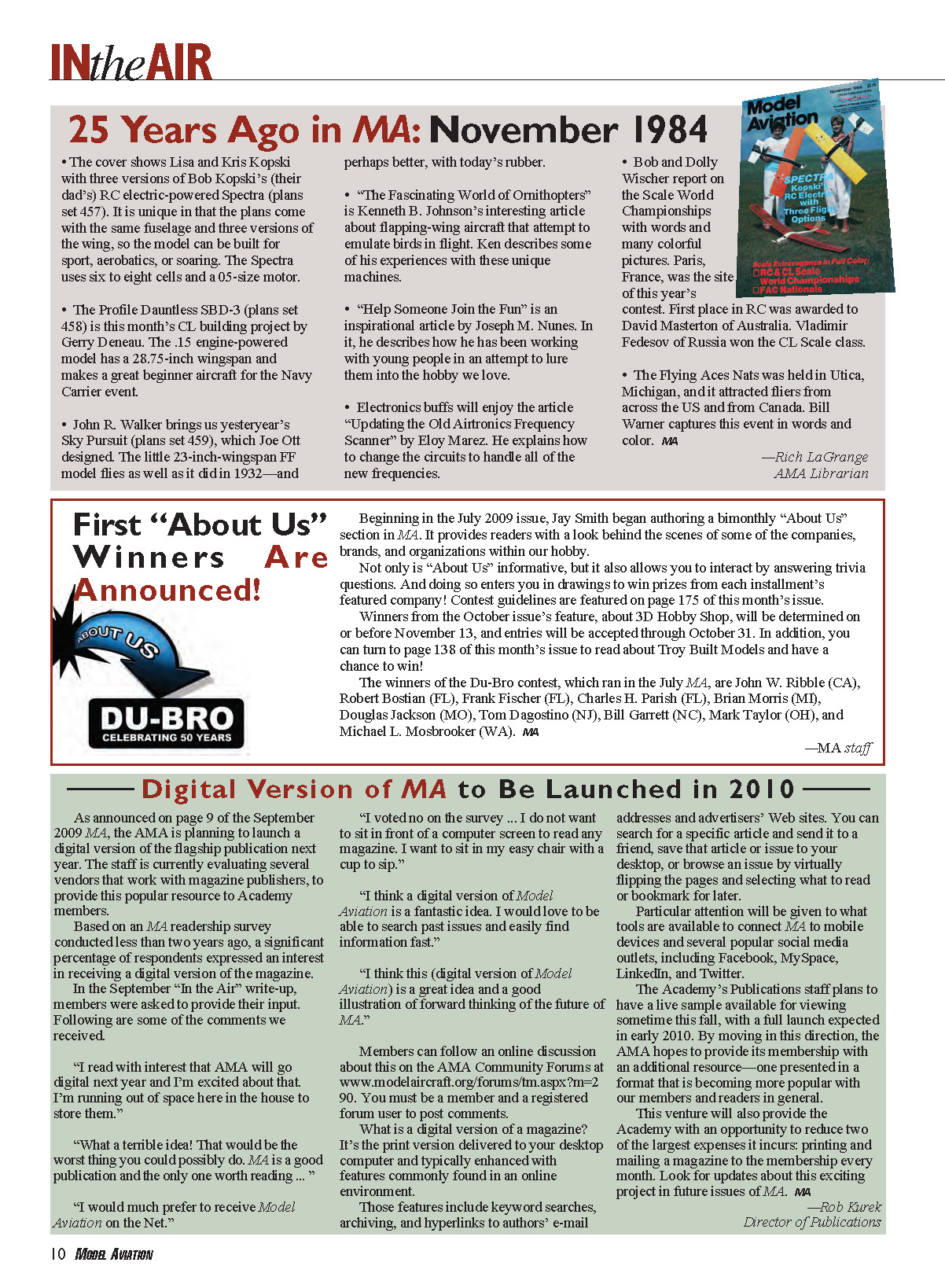
- The cover shows Lisa and Kris Kopski with three versions of Bob Kopski's (their dad's) RC electric-powered Spectra (plans set 457). It is unique in that the plans come with the same fuselage and three versions of the wing, so the model can be built for sport, aerobatics, or soaring. The Spectra uses six to eight cells and a .05-size motor.
- The Profile Dauntless SBD-3 (plans set 458) is this month's CL building project by Gerry Deneau. The .15 engine-powered model has a 28.75-inch wingspan and makes a great beginner aircraft for the Navy Carrier event.
- John R. Walker brings us yesteryear's Sky Pursuit (plans set 459), which Joe Ott designed. The little 23-inch-wingspan FF model flies as well as it did in 1932—and perhaps better, with today's rubber.
- "The Fascinating World of Ornithopters" is Kenneth B. Johnson's interesting article about flapping-wing aircraft that attempt to emulate birds in flight. Ken describes some of his experiences with these unique machines.
- "Help Someone Join the Fun" is an inspirational article by Joseph M. Nunes. In it, he describes how he has been working with young people in an attempt to lure them into the hobby we love.
- Electronics buffs will enjoy the article "Updating the Old Airtronics Frequency Scanner" by Eloy Marez. He explains how to change the circuits to handle all of the new frequencies.
- Bob and Dolly Wischer report on the Scale World Championships with words and many colorful pictures. Paris, France, was the site of this year's contest. First place in RC was awarded to David Masterson of Australia. Vladimir Fedesov of Russia won the CL Scale class.
- The Flying Aces Nats was held in Utica, Michigan, and it attracted fliers from across the US and from Canada. Bill Warner captures this event in words and color.
— Rich LaGrange AMA Librarian
First "About Us" Winners Are Announced!
Beginning in the July 2009 issue, Jay Smith began authoring a bimonthly "About Us" section in MA. It provides readers with a look behind the scenes of some of the companies, brands, and organizations within our hobby.
Not only is "About Us" informative, but it also allows you to interact by answering trivia questions. Doing so enters you in drawings to win prizes from each installment's featured company. Contest guidelines are featured on page 175 of this month's issue. Winners from the October issue's feature, about 3D Hobby Shop, will be determined on or before November 13, and entries will be accepted through October 31. In addition, you can turn to page 138 of this month's issue to read about Troy Built Models and have a chance to win!
The winners of the Du-Bro contest, which ran in the July MA, are John W. Ribble (CA), Robert Bostian (FL), Frank Fischer (FL), Charles H. Parish (FL), Brian Morris (MI), Douglas Jackson (MO), Tom Dagostino (NJ), Bill Garrett (NC), Mark Taylor (OH), and Michael L. Mosbrooker (WA).
— MA staff
Digital Version of MA to Be Launched in 2010
As announced on page 9 of the September 2009 MA, the AMA is planning to launch a digital version of the flagship publication next year. The staff is currently evaluating several vendors that work with magazine publishers to provide this popular resource to Academy members.
Based on an MA readership survey conducted less than two years ago, a significant percentage of respondents expressed an interest in receiving a digital version of the magazine.
In the September "In the Air" write-up, members were asked to provide their input. Following are some of the comments we received.
- "I read with interest that AMA will go digital next year and I'm excited about that. I'm running out of space here in the house to store them."
- "What a terrible idea! That would be the worst thing you could possibly do. MA is a good publication and the only one worth reading ..."
- "I would much prefer to receive Model Aviation on the Net."
- "I voted no on the survey ... I do not want to sit in front of a computer screen to read any magazine. I want to sit in my easy chair with a cup to sip."
- "I think a digital version of Model Aviation is a fantastic idea. I would love to be able to search past issues and easily find information fast."
- "I think this (digital version of Model Aviation) is a great idea and a good illustration of forward thinking of the future of MA."
Members can follow an online discussion about this on the AMA Community Forums at www.modelaircraft.org/forums/tm.asp?m=290. You must be a member and a registered forum user to post comments.
What is a digital version of a magazine? It's the print version delivered to your desktop computer and typically enhanced with features commonly found in an online environment.
Those features include keyword searches, archiving, and hyperlinks to authors' e-mail addresses and advertisers' Web sites. You can search for a specific article and send it to a friend, save that article or issue to your desktop, or browse an issue by virtually flipping the pages and selecting what to read or bookmark for later.
Particular attention will be given to what tools are available to connect MA to mobile devices and several popular social media outlets, including Facebook, MySpace, LinkedIn, and Twitter.
The Academy's Publications staff plans to have a live sample available for viewing sometime this fall, with a full launch expected in early 2010. By moving in this direction, the AMA hopes to provide its membership with an additional resource—one presented in a format that is becoming more popular with members and readers in general.
This venture will also provide the Academy with an opportunity to reduce two of the largest expenses it incurs: printing and mailing a magazine to the membership every month. Look for updates about this exciting project in future issues of MA.
— Rob Kurek Director of Publications
2009 F3D World Championships: Faster, Bigger, Tougher
The first record was set when the entry list revealed 22 attending national teams with 55 pilots plus their callers. Robbert van den Bosch (Netherlands) set the second world record in Round Four; his model took 56.33 seconds to complete the nominal 4-kilometer (km) distance (10 laps, close to 2.5 miles)—equivalent to 255.64 km/h (158.85 mph).
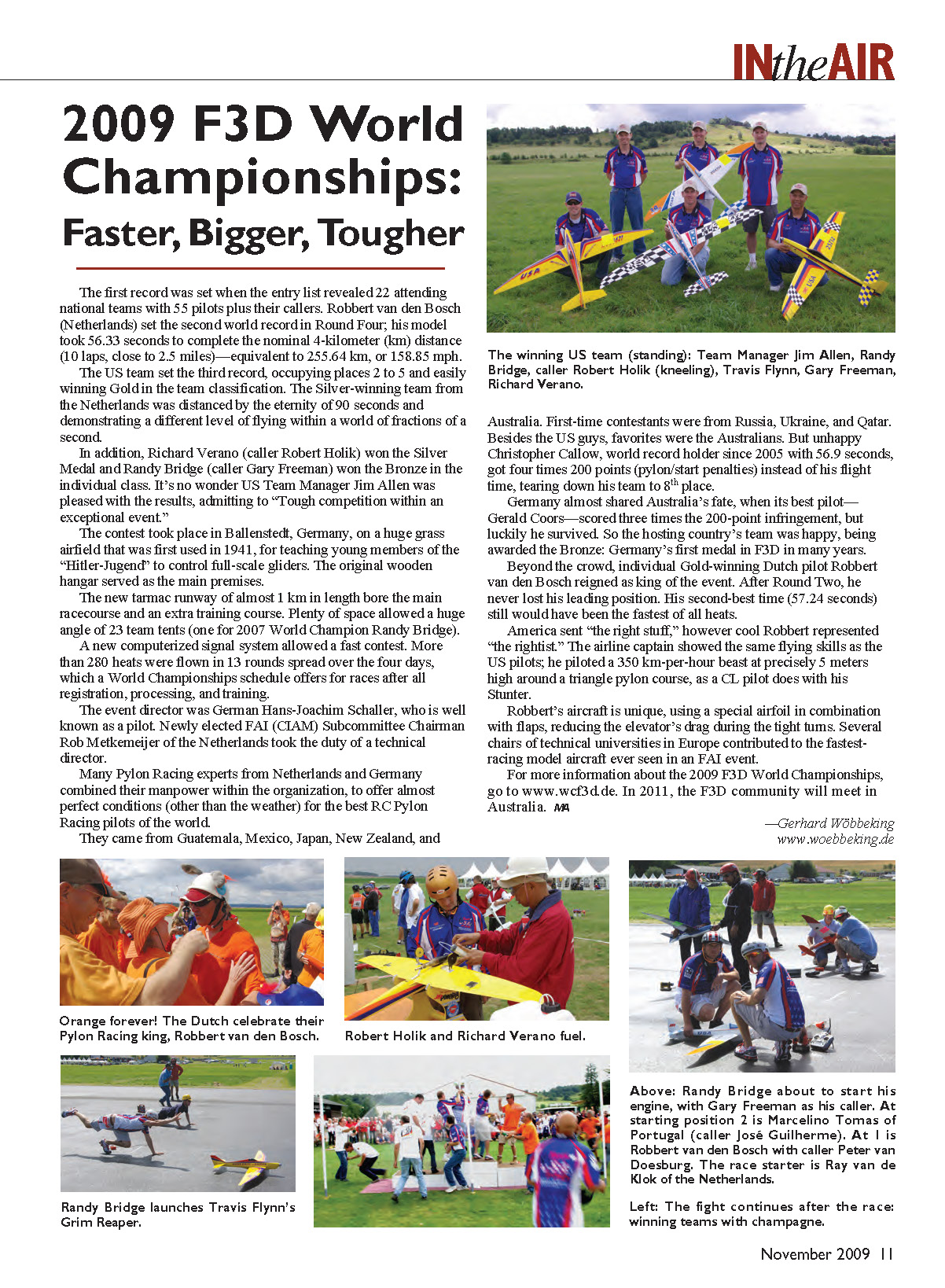
The US team set the third record, occupying places 2 to 5 and easily winning Gold in the team classification. The Silver-winning team from the Netherlands was distanced by 90 seconds — an eternity in a world of fractions of a second.
In addition, Richard Verano (caller Robert Holik) won the Silver Medal and Randy Bridge (caller Gary Freeman) won the Bronze in the individual class. It's no wonder US Team Manager Jim Allen was pleased with the results, admitting to "Tough competition within an exceptional event."
The contest took place in Ballenstedt, Germany, on a huge grass airfield that was first used in 1941 to teach young members of the "Hitler-Jugend" to control full-scale gliders. The original wooden hangar served as the main premises.
The new tarmac runway of almost 1 km in length bore the main racecourse and an extra training course. Plenty of space allowed a huge array of 23 team tents (one for 2007 World Champion Randy Bridge).
A new computerized signal system allowed a fast contest. More than 280 heats were flown in 13 rounds spread over the four days, which a World Championships schedule offers for races after all registration, processing, and training.
The event director was German Hans-Joachim Schaller, who is well known as a pilot. Newly elected FAI (CIAM) Subcommittee Chairman Rob Metkemeijer of the Netherlands took the duty of technical director.
Many pylon-racing experts from the Netherlands and Germany combined their manpower within the organization to offer almost perfect conditions (other than the weather) for the best RC pylon-racing pilots in the world.
They came from Guatemala, Mexico, Japan, New Zealand, and Australia. First-time contestants were from Russia, Ukraine, and Qatar. Besides the US team, favorites were the Australians. But unhappy Christopher Callow, world record holder since 2005 with 56.9 seconds, got four times 200 points (pylon/start penalties) instead of his flight time, tearing his team down to 8th place.
Germany almost shared Australia's fate when its best pilot—Gerald Coors—scored three times the 200-point infringement, but luckily he survived. The hosting country's team was happy to be awarded the Bronze; Germany's first medal in F3D in many years.
Beyond the crowd, individual Gold-winning Dutch pilot Robbert van den Bosch reigned as king of the event. After Round Two, he never lost his leading position. His second-best time (57.24 seconds) still would have been the fastest of all heats.
America sent "the right stuff," however cool Robbert represented "the rightist." The airline captain showed the same flying skills as the US pilots; he piloted a 350 km-per-hour beast at precisely 5 meters high around a triangle pylon course, as a CL pilot does with his Stunter.
Robbert's aircraft is unique, using a special airfoil in combination with flaps, reducing the elevator's drag during the tight turns. Several chairs of technical universities in Europe contributed to the fastest-racing model aircraft ever seen in an FAI event.
For more information about the 2009 F3D World Championships, go to www.wcf3d.de. In 2011, the F3D community will meet in Australia.
— Gerhard Wöbbeking www.woebbeking.de
AMPS Holds Make-A-Wish Event
You never know when the background noise of talk radio will lead to something unexpected. For Ernie Faulkner, a member of the Arizona Model Pilots Society (AMPS), that happened while he was listening to an interview involving a local children's hospital and some kids with serious medical challenges.
After hearing the radio segment, Ernie asked himself how he could have an impact on their lives. A couple of phone calls later, he was in contact with the event coordinator of the Arizona Make-A-Wish Foundation, Mark Korthals.
According to the group's Web site, it began in 1980 with the wish of a little boy from Phoenix, Arizona, who had leukemia. The foundation has grown to become the world's largest wish-granting organization, with 72 chapters in the US and its territories.
Ernie and Mark discussed hosting a family affair at the AMPS model airfield, where the Make-A-Wish kids and their siblings could have the opportunity to fly model aircraft and examine other models up close.
AMPS members were instantly excited about the idea. The date was set and plans were made.
A club board member made use of his ample contacts list and obtained a commitment from the Deer Valley Airport Restaurant, which is near the club field, to provide food for the event. A couple of local businesses provided small balsa gliders for each of the kids, and club members signed up for setup, kitchen, parking, and flying duties.
The forecast for April 25, 2009, was for gusty conditions. Club members arrived early for setup and were ready to go when the first guests arrived slightly earlier than planned. Great timing! By the time the wind became a bit of a problem, more than 50 Make-A-Wish kids and their brothers and sisters had flown model aircraft.
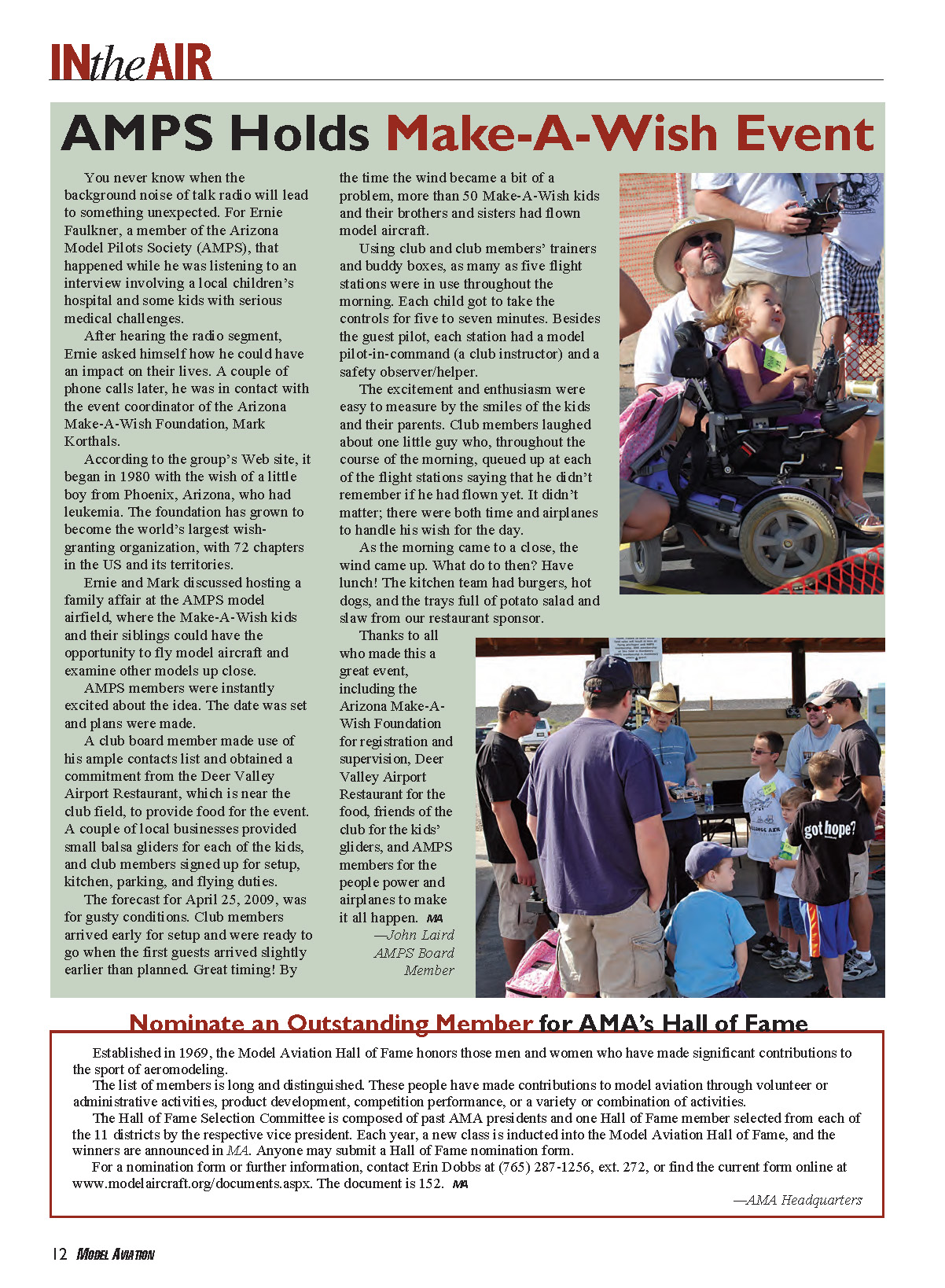
Using club and club members' trainers and buddy boxes, as many as five flight stations were in use throughout the morning. Each child got to take the controls for five to seven minutes. Besides the guest pilot, each station had a model pilot-in-command (a club instructor) and a safety observer/helper.
The excitement and enthusiasm were easy to measure by the smiles of the kids and their parents. Club members laughed about one little guy who, throughout the course of the morning, queued up at each of the flight stations saying that he didn't remember if he had flown yet. It didn't matter; there were both time and airplanes to handle his wish for the day.
As the morning came to a close, the wind came up. What to do then? Have lunch! The kitchen team had burgers, hot dogs, and trays full of potato salad and slaw from our restaurant sponsor.
Thanks to all who made this a great event, including the Arizona Make-A-Wish Foundation for registration and supervision, Deer Valley Airport Restaurant for the food, friends of the club for the kids' gliders, and AMPS members for the people power and airplanes to make it all happen.
— John Laird AMPS Board Member
Transcribed from original scans by AI. Minor OCR errors may remain.

