
AMPS Awards Academic Scholarship
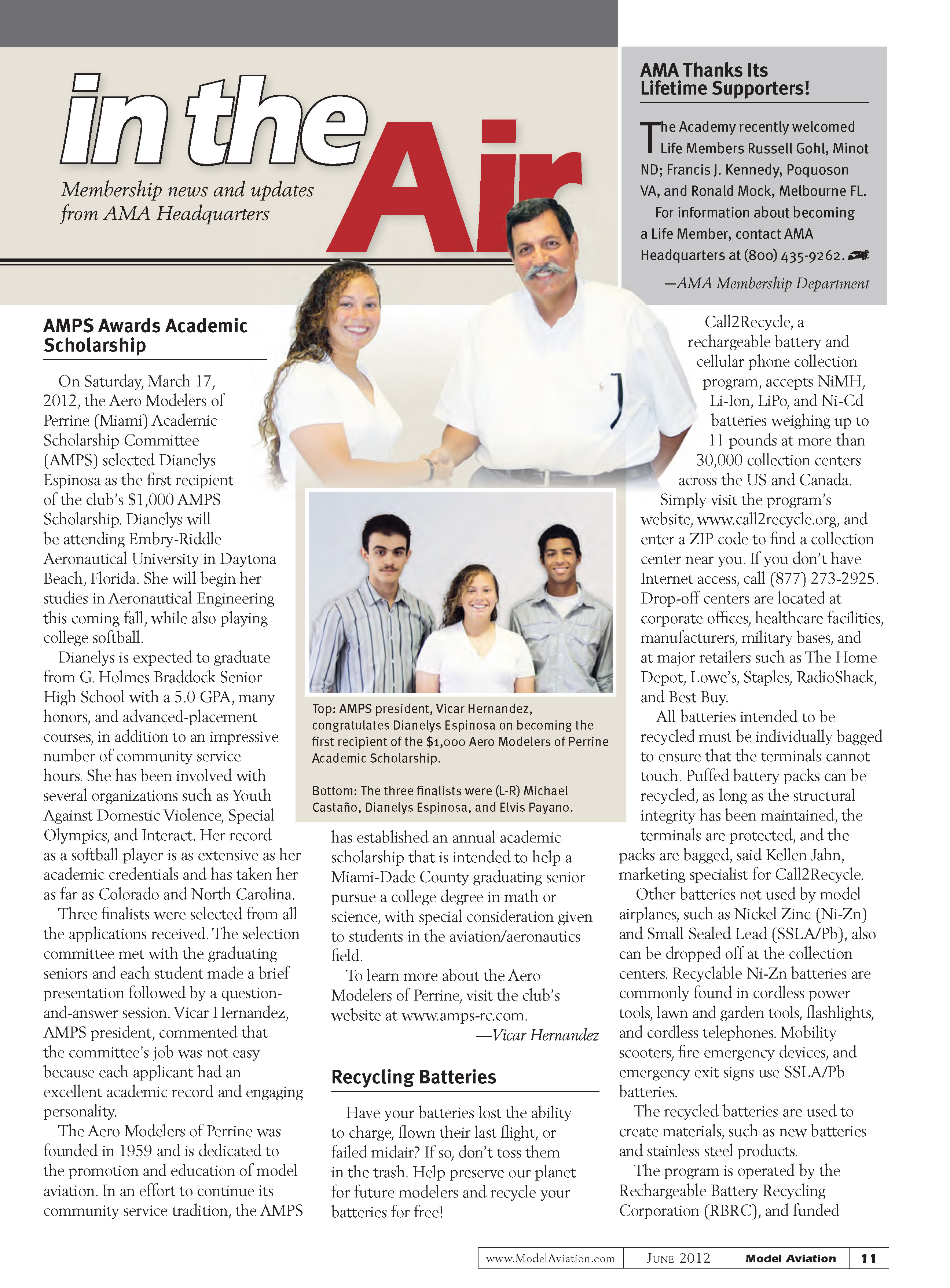
On Saturday, March 17, 2012, the Aero Modelers of Perrine (Miami) Academic Scholarship Committee (AMPS) selected Dianelys Espinosa as the first recipient of the club’s $1,000 AMPS Scholarship. Dianelys will be attending Embry‑Riddle Aeronautical University in Daytona Beach, Florida. She will begin her studies in Aeronautical Engineering this coming fall while also playing college softball.
Dianelys is expected to graduate from G. Holmes Braddock Senior High School with a 5.0 GPA, many honors, and advanced‑placement courses, in addition to an impressive number of community service hours. She has been involved with several organizations, including:
- Youth Against Domestic Violence
- Special Olympics
- Interact
Her record as a softball player is as extensive as her academic credentials and has taken her as far as Colorado and North Carolina.
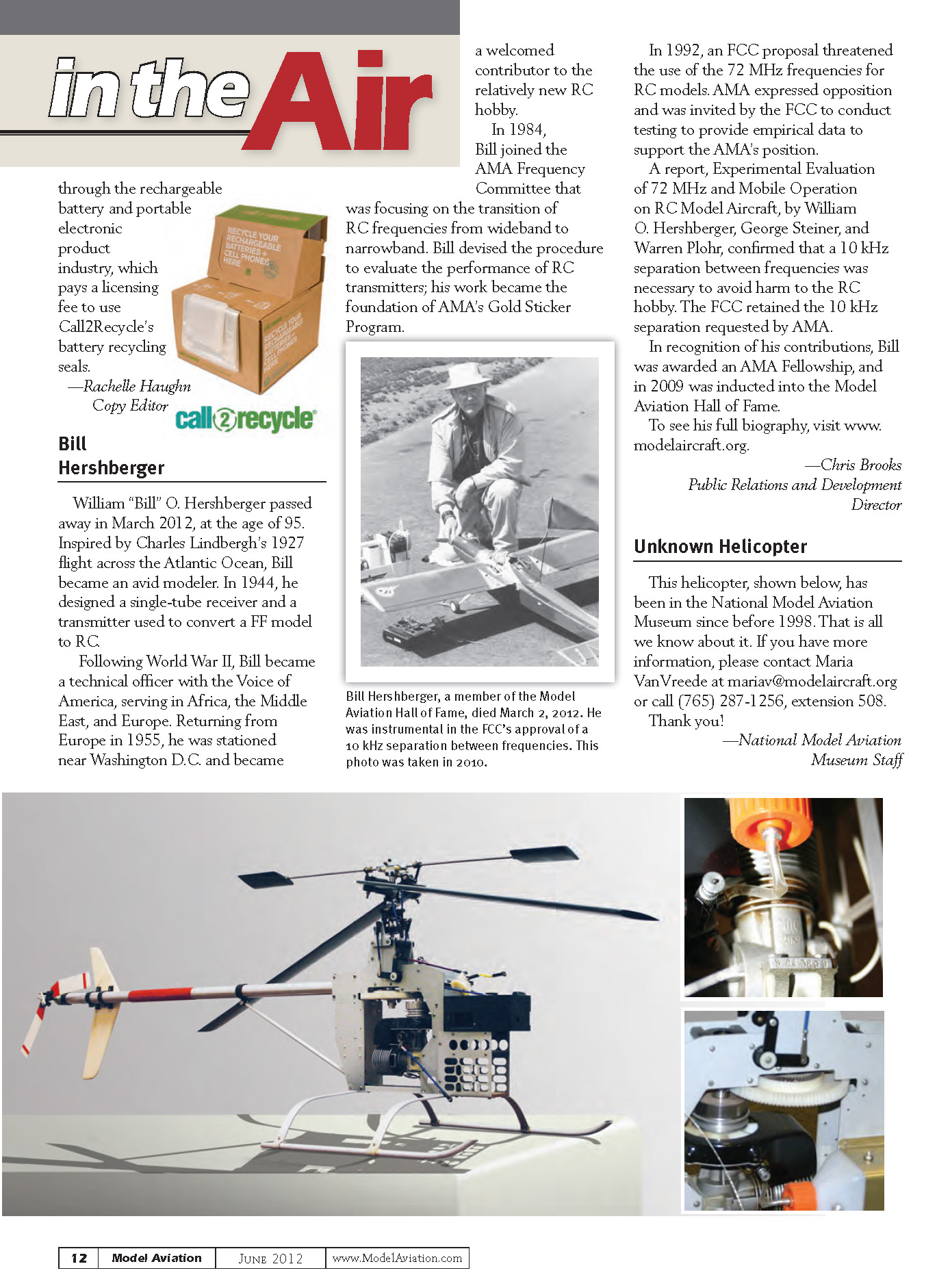
Three finalists were selected from all the applications received. The selection committee met with the graduating seniors; each student made a brief presentation followed by a question‑and‑answer session. Vicar Hernandez, AMPS president, commented that the committee’s job was not easy because each applicant had an excellent academic record and engaging personality.
The Aero Modelers of Perrine was founded in 1959 and is dedicated to the promotion and education of model aviation. In an effort to continue its community service tradition, AMPS has established an annual academic scholarship intended to help a Miami‑Dade County graduating senior pursue a college degree in math or science, with special consideration given to students in the aviation/aeronautics field.
To learn more about the Aero Modelers of Perrine, visit the club’s website: www.amps-rc.com
—Vicar Hernandez
Recycling Batteries
Have your batteries lost the ability to charge, flown their last flight, or failed midair? If so, don't toss them in the trash. Help preserve our planet for future modelers and recycle your batteries for free!
Call2Recycle, a rechargeable battery and cellular phone collection program, accepts the following battery types (up to 11 pounds) at more than 30,000 collection centers across the U.S. and Canada:
- NiMH
- Li‑Ion
- LiPo
- Ni‑Cd
To find a collection center, visit www.call2recycle.org and enter your ZIP code. If you don't have Internet access, call (877) 273‑2925.
Drop‑off centers are located at:
- corporate offices
- health‑care facilities
- manufacturers
- military bases
- major retailers such as The Home Depot, Lowe's, Staples, RadioShack, and Best Buy
All batteries intended for recycling must be individually bagged to ensure that the terminals cannot touch. Puffed battery packs can be recycled as long as the structural integrity has been maintained, the terminals are protected, and the packs are bagged, said Kellen Jahn, marketing specialist for Call2Recycle.
Other batteries not commonly used by model airplanes, such as Nickel Zinc (Ni‑Zn) and Small Sealed Lead (SSLA/Pb), also can be dropped off at the collection centers. Recyclable Ni‑Zn batteries are commonly found in cordless power tools, lawn and garden tools, flashlights, and cordless telephones. Mobility scooters, fire emergency devices, and emergency exit signs use SSLA/Pb batteries.
The recycled batteries are used to create materials such as new batteries and stainless steel parts through the rechargeable battery and portable electronic product industry, which pays a licensing fee to use Call2Recycle’s battery‑recycling seals.
—Rachelle Haughn Copy Editor
Bill Hershberger
William "Bill" O. Hershberger passed away in March 2012 at the age of 95. Inspired by Charles Lindbergh's 1927 flight across the Atlantic Ocean, Bill became an avid modeler. In 1944, he designed a single‑tube receiver and a transmitter used to convert a FF model to RC.
Following World War II, Bill became a technical officer with the Voice of America, serving in Africa, the Middle East, and Europe. Returning from Europe in 1955, he was stationed near Washington, D.C., and became a welcomed contributor to the relatively new RC hobby.
In 1984, Bill joined the AMA Frequency Committee, which was focusing on the transition of RC frequencies from wideband to narrowband. Bill devised the procedure to evaluate the performance of RC transmitters; his work became the foundation of AMA's Gold Sticker Program.
In 1992, an FCC proposal threatened the use of the 72 MHz frequencies for RC models. AMA expressed opposition and was invited by the FCC to conduct testing to provide empirical data to support AMA's position. The report Experimental Evaluation of 72 MHz and Mobile Operation on RC Model Aircraft, by William O. Hershberger, George Steiner, and Warren Plohr, confirmed that a 10 kHz separation between frequencies was necessary to avoid harm to the RC hobby. The FCC retained the 10 kHz separation requested by AMA.
In recognition of his contributions, Bill was awarded an AMA Fellowship and in 2009 was inducted into the Model Aviation Hall of Fame.
To see his full biography, visit www.modelaircraft.org
—Chris Brooks Public Relations and Development Director
Unknown Helicopter
This helicopter, shown below, has been in the National Model Aviation Museum since before 1998. That is all we know about it. If you have more information, please contact Maria VanVreede at [email protected] or call (765) 287‑1256, extension 508.
Thank you!
—National Model Aviation Museum Staff
Transcribed from original scans by AI. Minor OCR errors may remain.

