
In the Air 2014/03
Southeastern Michigan Modelers Again Help Foster-Care Residents
For the 42nd year, Operation Good Cheer provided Christmas gifts for infants, children, teens, and adults with disabilities who live in foster care in Michigan. After heavy snow and rain in 2012, aeromodelers were once again airborne in 2013 to fulfill the theme “Making Christmas Wishes Come True.”
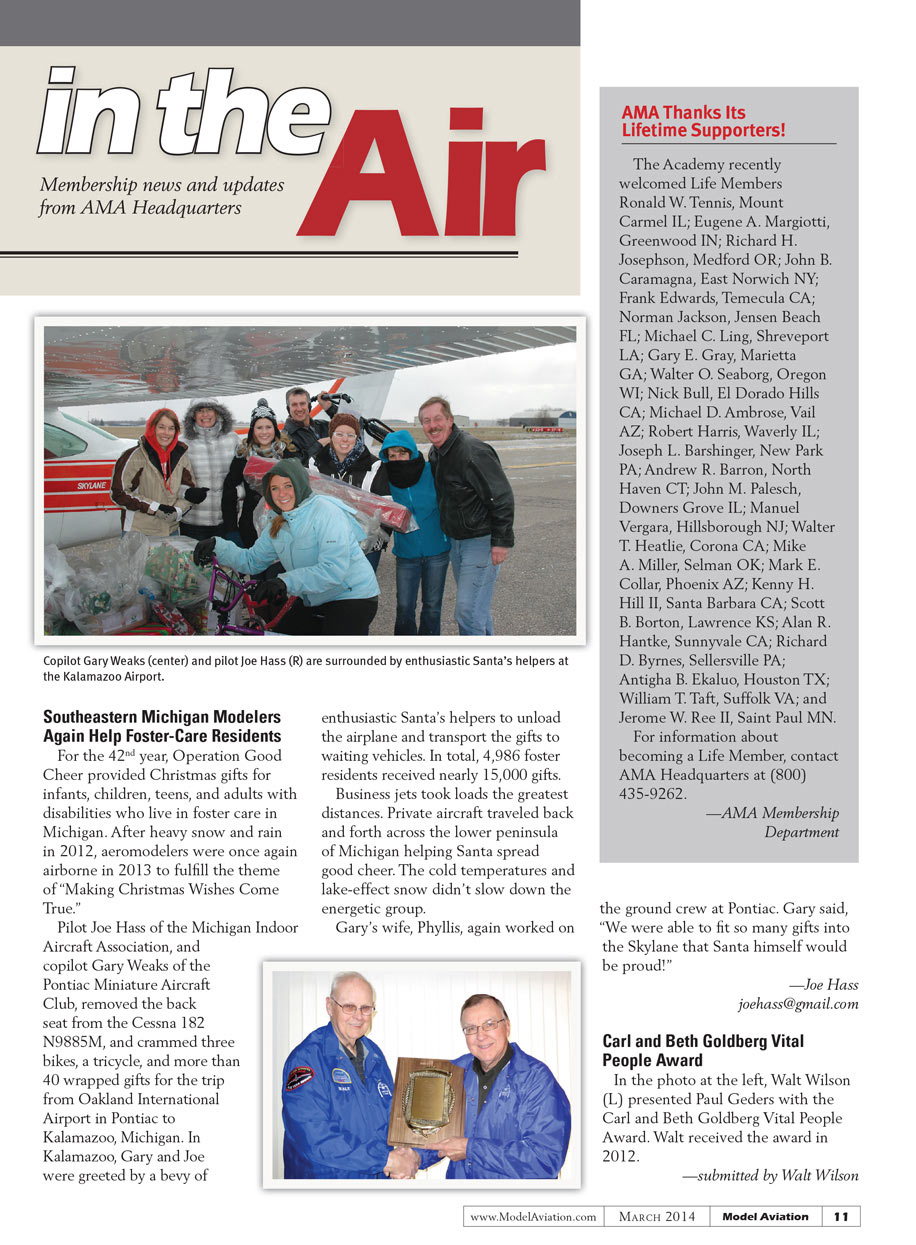
Pilot Joe Hass of the Michigan Indoor Aircraft Association, and copilot Gary Weaks of the Pontiac Miniature Aircraft Club, removed the back seat from the Cessna 182 N9885M and crammed three bikes, a tricycle, and more than 40 wrapped gifts for the trip from Oakland International Airport in Pontiac to Kalamazoo, Michigan.
In Kalamazoo, Gary and Joe were greeted by a bevy of enthusiastic Santa’s helpers to unload the airplane and transport the gifts to waiting vehicles. In total, 4,986 foster residents received nearly 15,000 gifts.
Business jets took loads the greatest distances. Private aircraft traveled back and forth across the lower peninsula of Michigan helping Santa spread good cheer. The cold temperatures and lake-effect snow didn’t slow down the energetic group.
Gary’s wife, Phyllis, again worked on the ground crew at Pontiac. Gary said, “We were able to fit so many gifts into the Skylane that Santa himself would be proud!”
—Joe Hass [email protected]
History Preserved
"The A-frame model is simple to build, and should fly far when properly adjusted," noted author Carl H. Claudy in his 1930 book Beginner's Book of Model Airplanes (They Fly!). He goes on to explain that A-frame pushers can take many forms, but "it cannot be contended that any one form is best—scarcely that any one is better than others. All shapes, sizes, plans, combinations have their points, their advantages and disadvantages; finding these by building many, trying combinations of this wing with that frame, this propeller with that tail structure, is one of the delights of model flying."
Vic Cunnyngham Sr. agreed. In the 1970s and 1980s, he researched and built reproductions of many A-frame pusher designs. After they were built, he would get the completed model approved and authenticated by the original designer or pilot, ensuring that future generations would be able to remember and recreate the early excitement of flying.
One of Vic's A-frame pushers was designed by Donald C. Burnham in 1929. Don flew it to a first-place finish in the Junior division, Outdoor competition, at the 1929 Nats in Detroit. The model features an undercamber wing section. Don noted that it "seems to give a better lift and glide than any other style of wing I have used."
Don also incorporated an adjustable front elevator into the model by building a series of small steps at the front of the A-frame pusher. Adjusting the elevator's leading edge (LE) on a different step changed the elevator's lift.
Vic changed this set of steps to a slope in his reproduction. He also strengthened the design by adding additional angled ribs at the center of the front elevator and on the wing where it rests against the frame.
Unlike Don's original design, Vic built the reproduction for rise-off-water, adding hydroplane floats designed by Bert Pond in 1929. Bert's signature is on one of the floats, offering luck to Vic and his endeavors. Similarly, Don's signature is on a paper adhered to the wing.
The A-frame pusher was donated to the museum in 1996. Thanks to Vic Cunnyngham Jr. for providing information and memories.
You can read more about Don Burnham and Vic Cunnyngham Sr. on the museum's blog at http://amablog.modelaircraft.org/amamuseum/2014/02/20/don-burnhams-1930-....
—National Model Aviation Museum staff
Transcribed from original scans by AI. Minor OCR errors may remain.

