
AMA Hobby Shop Program
Thank you to the following stores for joining the AMA Hobby Shop Program! These shops are now earning cash for signing up new AMA members.
- E Mergent RC Heli, Huntsville, Alabama
- Dreamworks Model Products, Daytona Beach, Florida
- FliteLine Hobbies, Ridgeville, South Carolina
- The Hobby House, Poughkeepsie, New York
- Samano’s Hobbies, League City, Texas
- Hobby Artz, Dickinson, North Dakota
- ClubHeli, LLC, Emmaus, Pennsylvania
- Hays Hobby Shop, Hays, Kansas
The following hobby shops won $100!
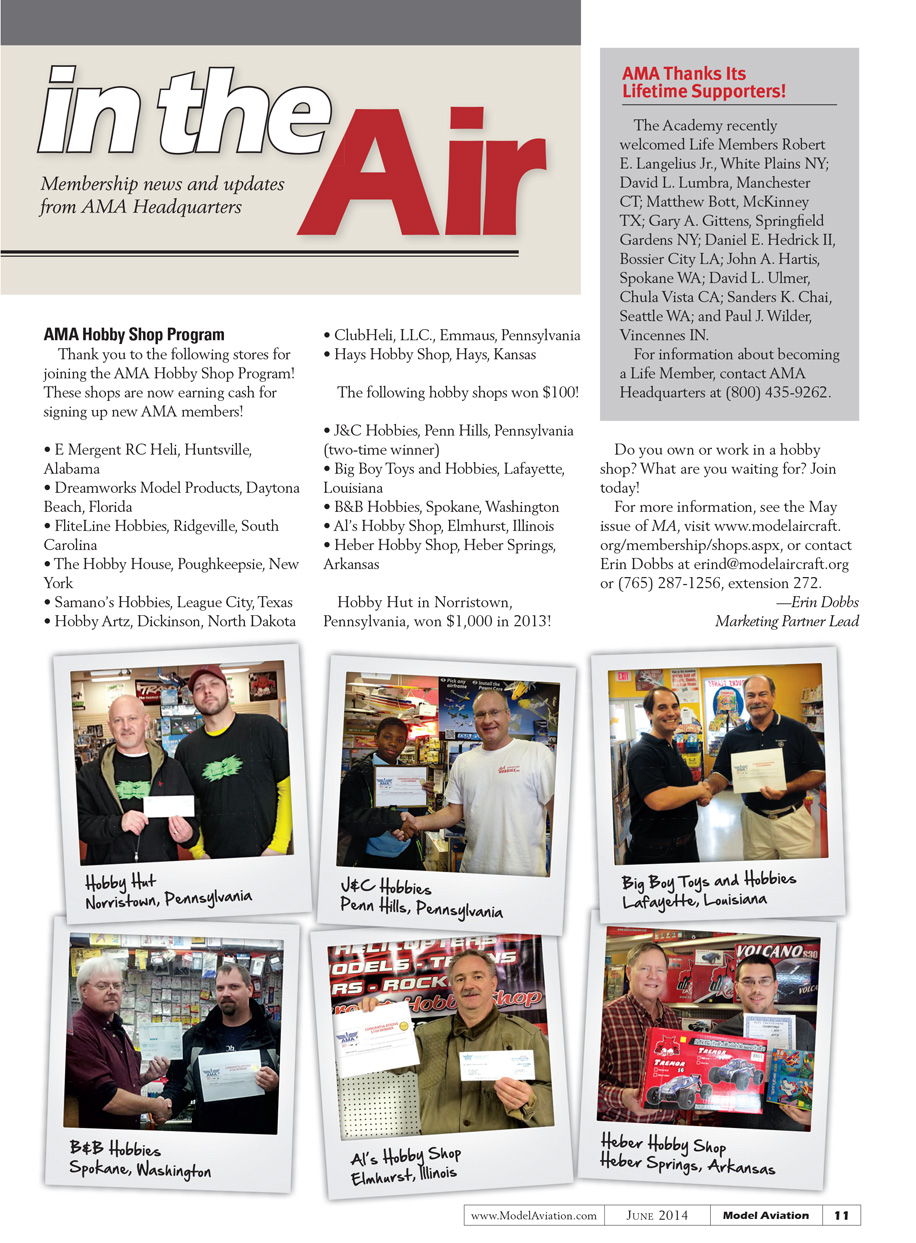
- J&C Hobbies, Penn Hills, Pennsylvania (two-time winner)
- Big Boy Toys and Hobbies, Lafayette, Louisiana
- B&B Hobbies, Spokane, Washington
- Al’s Hobby Shop, Elmhurst, Illinois
- Heber Hobby Shop, Heber Springs, Arkansas
Hobby Hut in Norristown, Pennsylvania, won $1,000 in 2013!
Do you own or work in a hobby shop? What are you waiting for? Join today!
For more information, see the May issue of Model Aviation (MA), visit www.modelaircraft.org/membership/shops.aspx, or contact Erin Dobbs at [email protected] or (765) 287-1256, extension 272.
—Erin Dobbs Marketing Partner Lead
White Mystery
Imagine that radio-control technology is new and there is no information or precedent for creating a system that could control a model airplane during flight. What type of control system would you create?
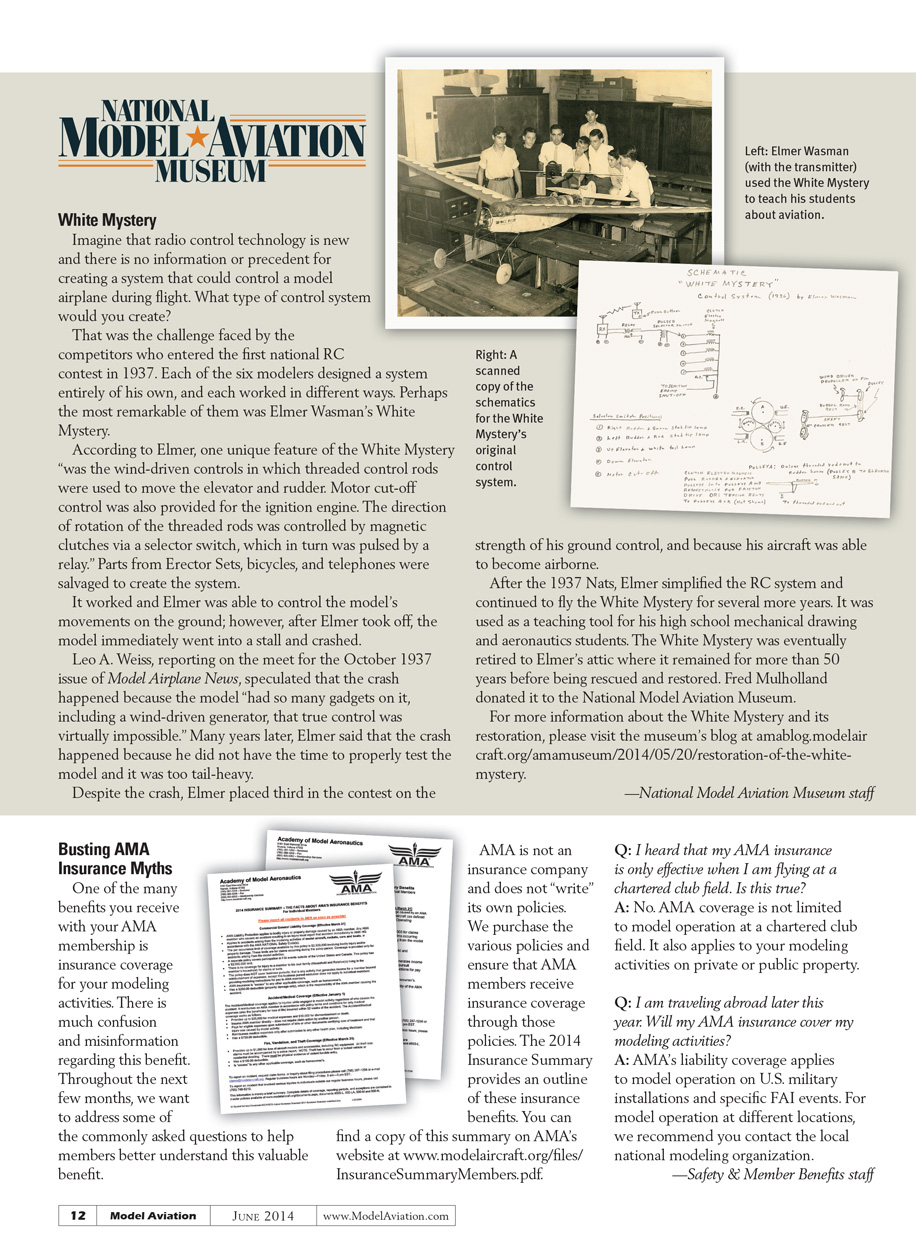
That was the challenge faced by the competitors who entered the first national RC contest in 1937. Each of the six modelers designed a system entirely of his own, and each worked in different ways. Perhaps the most remarkable of them was Elmer Wasman's White Mystery.
According to Elmer, one unique feature of the White Mystery "was the wind-driven controls in which threaded control rods were used to move the elevator and rudder. Motor cut-off control was also provided for the ignition engine. The direction of rotation of the threaded rods was controlled by magnetic clutches via a selector switch, which in turn was pulsed by a relay." Parts from Erector Sets, bicycles, and telephones were salvaged to create the system.
It worked and Elmer was able to control the model's movements on the ground; however, after Elmer took off, the model immediately went into a stall and crashed.
Leo A. Weiss, reporting on the meet for the October 1937 issue of Model Airplane News, speculated that the crash happened because the model "had so many gadgets on it, including a wind-driven generator, that true control was virtually impossible." Many years later, Elmer said that the crash happened because he did not have the time to properly test the model and it was too tail-heavy.
Despite the crash, Elmer placed third in the contest on the strength of his ground control and because his aircraft was able to become airborne.
After the 1937 Nats, Elmer simplified the RC system and continued to fly the White Mystery for several more years. It was used as a teaching tool for his high school mechanical drawing and aeronautics students. The White Mystery was eventually retired to Elmer's attic where it remained for more than 50 years before being rescued and restored. Fred Mulholland donated it to the National Model Aviation Museum.
For more information about the White Mystery and its restoration, please visit the museum's blog at amablog.modelaircraft.org/amamuseum/2014/05/20/restoration-of-the-white-mystery.
—National Model Aviation Museum staff
Transcribed from original scans by AI. Minor OCR errors may remain.

