
In the Air
LARKS Ta-Tinis
April 5-6, 2013, marked the date of the Lexington Aircraft Radio Control Society (LARKS) Spring Fling at the Sod Farm in Rembert, South Carolina. My wife, Mimi, and my daughter, Anne Marie, joined me on the leisurely drive from Apopka, Florida.
Upon arrival, I could not believe the expanse of land that had been obtained for the gathering, and it was donated! CD Steve Livingston and his crew put on a wonderful event and I was introduced to the Ta-Tinis.
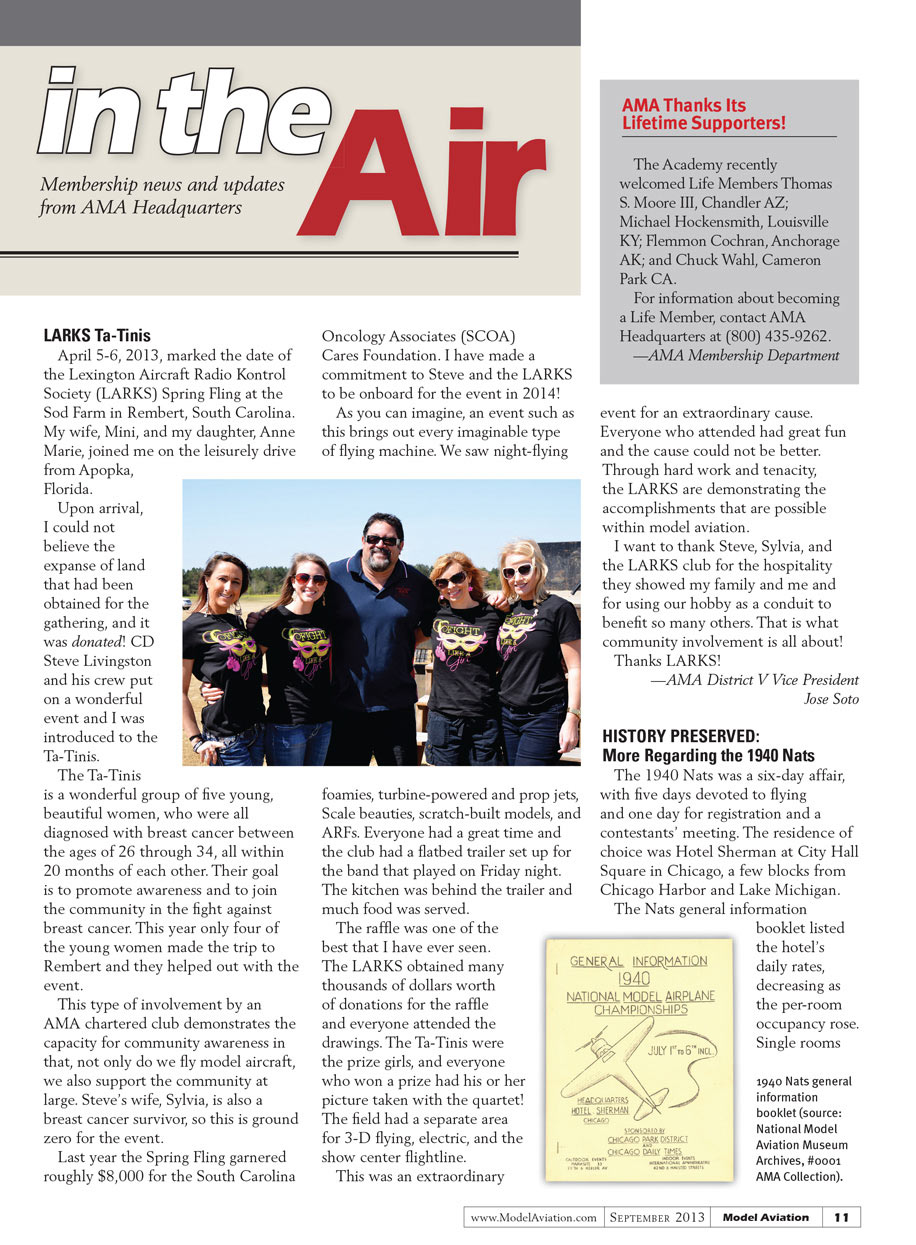
The Ta-Tinis is a wonderful group of five young, beautiful women, who were all diagnosed with breast cancer between the ages of 26 through 34, all within 20 months of each other. Their goal is to promote awareness and to join the community in the fight against breast cancer. This year only four of the young women made the trip to Rembert and they helped out with the event.
This type of involvement by an AMA chartered club demonstrates the capacity for community awareness in that, not only do we fly model aircraft, we also support the community at large. Steve’s wife, Sylvia, is also a breast cancer survivor, so this is ground zero for the event.
Last year the Spring Fling garnered roughly $8,000 for the South Carolina Oncology Associates (SCOA) Cares Foundation. I have made a commitment to Steve and the LARKS to be onboard for the event in 2014!
As you can imagine, an event such as this brings out every imaginable type of flying machine. We saw night-flying foamyies, turbine-powered and prop jets, Scale beauties, scratch-built models, and ARFs. Everyone had a great time and the club had a flatbed trailer set up for the band that played on Friday night. The kitchen was behind the trailer and much food was served.
The raffle was one of the best that I have ever seen. The LARKS obtained many thousands of dollars worth of donations for the raffle and everyone attended the drawings. The Ta-Tinis were the prize girls, and everyone who won a prize had his or her picture taken with the quartet! The field had a separate area for 3-D flying, electric, and the show center flightline.
This was an extraordinary event for an extraordinary cause. Everyone who attended had great fun and the cause could not be better. Through hard work and tenacity, the LARKS are demonstrating the accomplishments that are possible within model aviation.
I want to thank Steve, Sylvia, and the LARKS club for the hospitality they showed my family and me and for using our hobby as a conduit to benefit so many others. That is what community involvement is all about!
Thanks LARKS! — AMA District V Vice President Jose Soto
were $2.50 per day. If fliers dared to bunk 10 to a room, it was only $1 each. Those who chose to camp on-site set up their campers on the southwest corner of the outdoor flying field.
Competition was held at two venues. All flying was scheduled to start at 10 a.m. and end at 6 p.m. According to the daily program, the outdoor site was a park at 79th Street and Keeler Avenue, roughly 14 miles from the hotel. The indoor site was the International Amphitheatre at 42nd and Halsted, nearly 7 miles from the hotel.
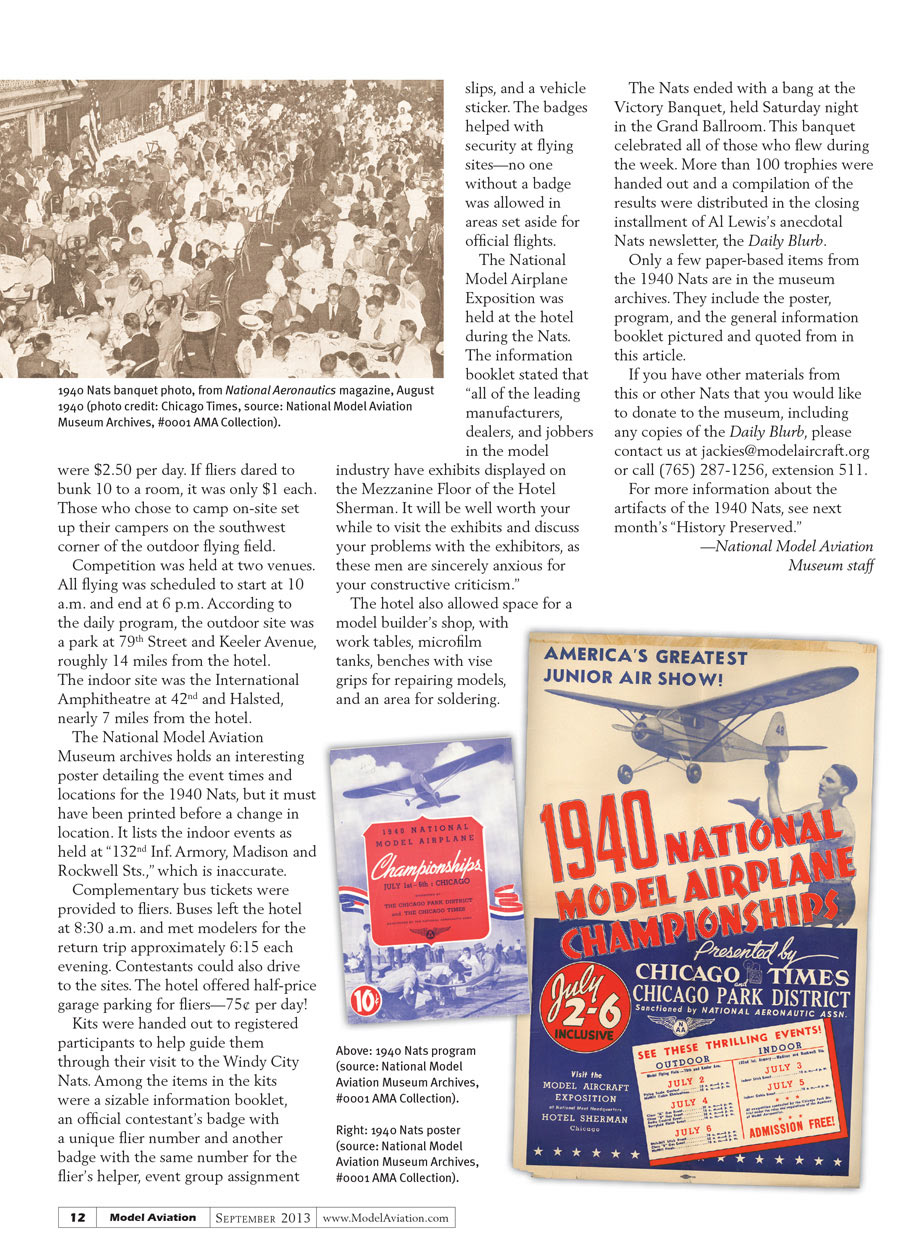
The National Model Aviation Museum archives holds an interesting poster detailing the event times and locations for the 1940 Nats, but it must have been printed before a change in location. It lists the indoor events as held at “132nd Inf. Armory, Madison and Rockwell Sts.,” which is inaccurate.
Complementary bus tickets were provided to fliers. Buses left the hotel at 8:30 a.m. and met modelers for the return trip approximately 6:15 each evening. Contestants could also drive to the sites. The hotel offered half-price garage parking for fliers—75¢ per day!
Kits were handed out to registered participants to help guide them through their visit to the Windy City Nats. Among the items in the kits were a sizable information booklet, an official contestant’s badge with a unique flier number and another badge with the same number for the flier’s helper, event group assignment slips, and a vehicle sticker. The badges helped with security at flying sites—no one without a badge was allowed in areas set aside for official flights.
The National Model Airplane Exposition was held at the hotel during the Nats. The information booklet stated that “all of the leading manufacturers, dealers, and jobbers in the model industry have exhibits displayed on the Mezzanine Floor of the Hotel Sherman. It will be well worth your while to visit the exhibits and discuss your problems with the exhibitors, as these men are sincerely anxious for your constructive criticism.”
The hotel also allowed space for a model builder’s shop, with work tables, microfilm tanks, benches with vise grips for repairing models, and an area for soldering.
The Nats ended with a bang at the Victory Banquet, held Saturday night in the Grand Ballroom. This banquet celebrated all of those who flew during the week. More than 100 trophies were handed out and a compilation of the results were distributed in the closing installment of Al Lewis’s anecdotal Nats newsletter, the Daily Blurb.
Only a few paper-based items from the 1940 Nats are in the museum archives. They include the poster, program, and the general information booklet pictured and quoted from in this article.
If you have other materials from this or other Nats that you would like to donate to the museum, including any copies of the Daily Blurb, please contact us at [email protected] or call (765) 287-1256, extension 511.
For more information about the artifacts of the 1940 Nats, see next month’s “History Preserved.”
—National Model Aviation Museum staff
Transcribed from original scans by AI. Minor OCR errors may remain.

