
In the Air
National Model Aviation Day
Across the country on August 17, 2013, gas-powered engines were fired up, hands got their first feel of the sticks, and money was raised for a good cause as part of the celebration of the inaugural National Model Aviation Day.
A total of 176 AMA clubs registered for this event, which collected thousands of dollars for the Wounded Warrior Project. Gatherings were held in many states including Alabama, Arkansas, California, Florida, Georgia, Idaho, Illinois, Indiana, Massachusetts, Michigan, Minnesota, North Carolina, Pennsylvania, Texas, and Virginia. Some were small events, some were large, but all had the same purpose: to celebrate what modelers love best—flying!
Frank Wercinski, president of the Radio Aero Modelers of Montgomery, Alabama, said, “The National Model Aviation Day has been great for us to be able to promote model aviation to the general public, build relationships with the media, and raise money for the Wounded Warrior Project. This was our first event that was aimed primarily at the public and it worked very well. We plan to make it even bigger and better next year.”
Some of the participating clubs raised a substantial amount of money for the Wounded Warrior Project. The Tri-County R/C Flyers, of Savannah, Georgia, for instance, raised nearly $2,000. At the time of this writing, more than $50,000 was raised by clubs across the country.
Many of the clubs that held events as part of National Model Aviation Day submitted photos of their activities. These gatherings included fly-ins, buddy-box flying, cookouts, model and full-scale aircraft displays, and some good, old-fashioned fun. These photos and videos can be viewed at www.nationalmodelaviationday.com.
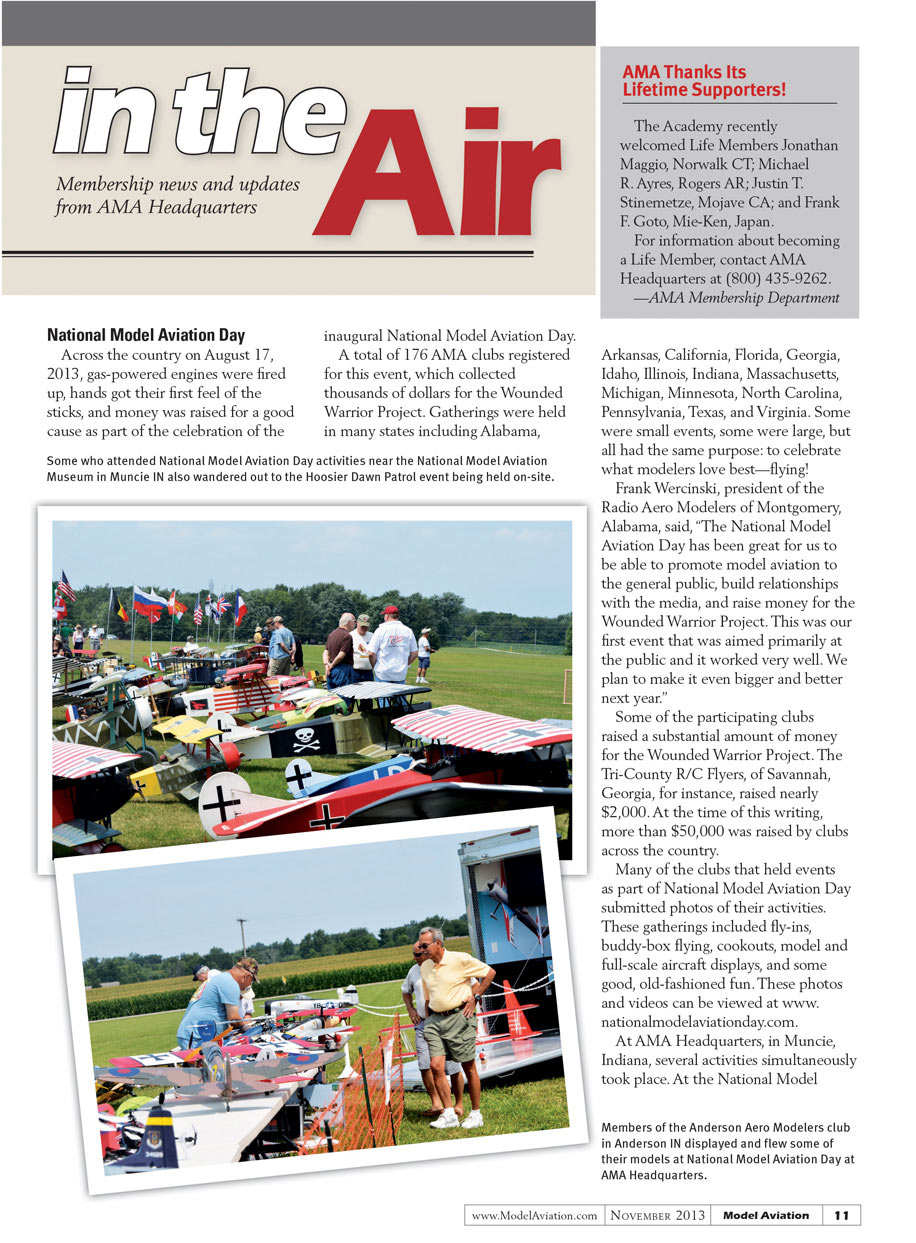
At AMA Headquarters, in Muncie, Indiana, several activities simultaneously took place. At the National Model Aviation Museum, there were air shows, demonstrations by the Anderson Aero Modelers of Anderson, Indiana, a flight simulator, free museum admission, and a guest speaker. Spectators witnessed the flights of several types of aircraft including multirotors, sailplanes, helicopters, warbirds, and even a kitbuilt flying superhero.
The guest speaker at the Muncie event, Norma Whitacre, of Bryant, Indiana, a military support advocate, discussed the importance of helping military personnel who suffer from post-traumatic stress disorder. Her stepson was killed in action in Afghanistan.
On-site, approximately 100 aircraft were flown at the Hoosier Dawn Patrol event. Many who attended the activities at the museum also enjoyed the impressive World War I aircraft in flight. The Fall Woody Contest for handcrafted, wooden sailplanes was held at another site at the International Aeromodeling Center.
Club donations for the Wounded Warrior Project were collected at AMA Headquarters. The Wounded Warrior Project helps veterans and service members who suffered physical or mental injuries or illnesses after September 11, 2001, while serving our country. To learn more or to donate, visit www.woundedwarriorproject.org.
Watch for details of the 2014 National Model Aviation Day at www.nationalmodelaviationday.com. —Rachelle Haughn [email protected]
Cedar City Radio Control Club
Since its formation in 1997, the main goal of the Cedar City Radio Control Club (CCRCC) in Cedar City, Utah, has been to bring a suitable, permanent flying site to the Cedar City/Iron County area. What has been an exercise in patience and perseverance has finally come to fruition.
In early 2003, members of the club’s executive board were approached by the Bureau of Land Management (BLM) and asked if the club would be willing to be part of a newly planned managed recreation area northwest of Cedar City that would come to be known as the Three Peaks Recreation Area.
The area included thousands of acres of public land that would eventually be developed to include an equestrian park with trails, mountain bike, ATV, and hiking trails, a large camping area, and a world-class shooting range. The club jumped at the chance, an agreement was reached, and a suitable area was selected for a flying site.
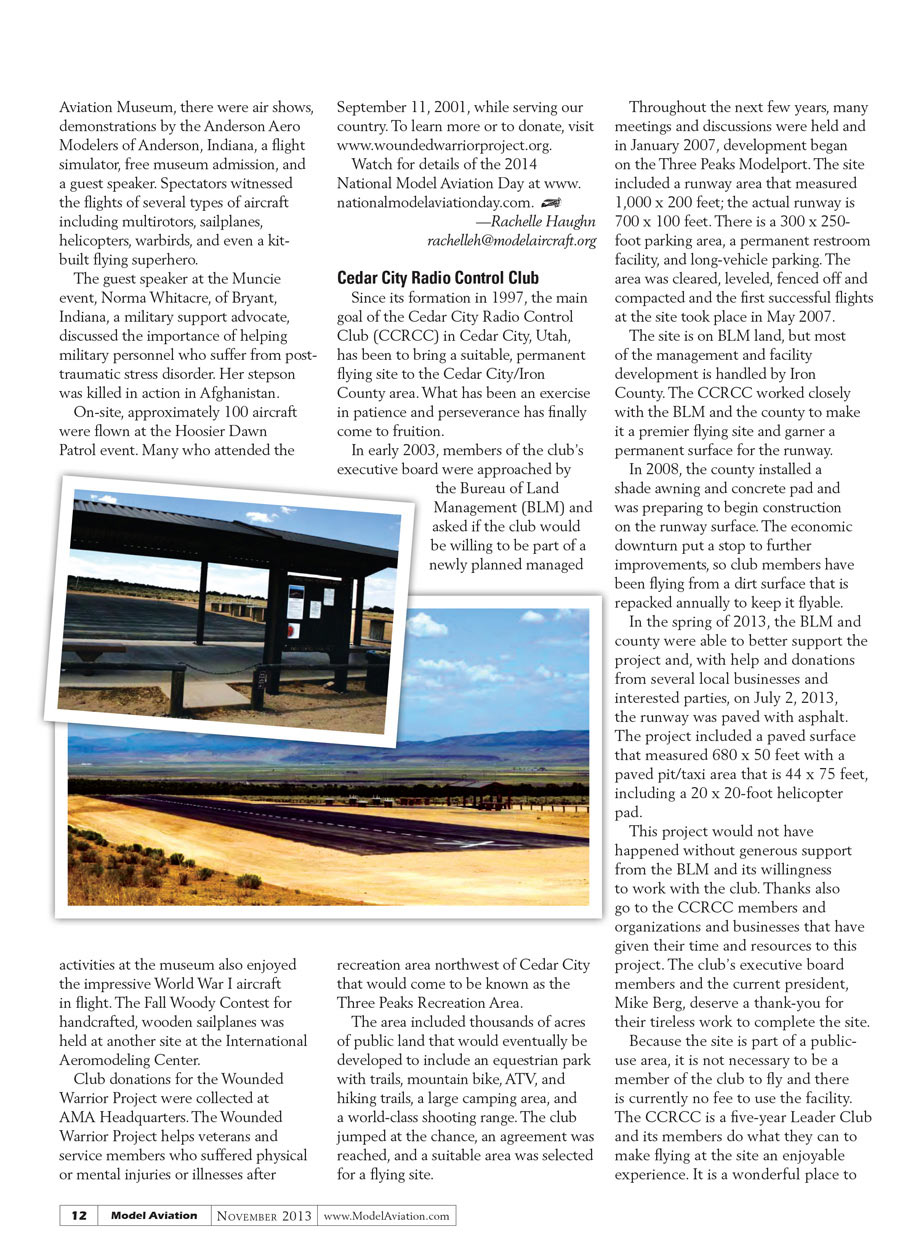
Throughout the next few years, many meetings and discussions were held and in January 2007, development began on the Three Peaks Modelport. The site included a runway area that measured 1,000 x 200 feet; the actual runway is 700 x 100 feet. There is a 300 x 250-foot parking area, a permanent restroom facility, and long-vehicle parking. The area was cleared, leveled, fenced off and compacted and the first successful flights at the site took place in May 2007.
The site is on BLM land, but most of the management and facility development is handled by Iron County. The CCRCC worked closely with the BLM and the county to make it a premier flying site and garner a permanent surface for the runway.
In 2008, the county installed a shade awning and concrete pad and was preparing to begin construction on the runway surface. The economic downturn put a stop to further improvements, so club members have been flying from a dirt surface that is re-packed annually to keep it flyable.
In the spring of 2013, the BLM and county were able to better support the project and, with help and donations from several local businesses and interested parties, on July 2, 2013, the runway was paved with asphalt. The project included a paved surface that measured 680 x 50 feet with a paved pit/taxi area that is 44 x 75 feet, including a 20 x 20-foot helicopter pad.
This project would not have happened without generous support from the BLM and its willingness to work with the club. Thanks also go to the CCRCC members and organizations and businesses that have given their time and resources to this project. The club’s executive board members and the current president, Mike Berg, deserve a thank-you for their tireless work to complete the site.
Because the site is part of a public-use area, it is not necessary to be a member of the club to fly and there is currently no fee to use the facility. The CCRCC is a five-year Leader Club and its members do what they can to make flying at the site an enjoyable experience. It is a wonderful place to
History Preserved: Winning Hardware
Leon Shulman prepared well for the 1940 Nats, working hard to improve his skills as he planned and built the FF Wedgy. The previous year, he placed third in Class A with a self-designed Skyrocket. He hoped to get a chance at the winners' circle with the Wedgy. The effort paid off.
Although the Wedgy nearly hit a cameraman attempting to get a shot of it during takeoff, the flight was more than 22 minutes long. Leon set a Class A Senior event record and placed first.
The hardware (in the first half of the 20th century, the term hardware was commonly used for trophies and plaques awarded at competitions) was presented at the final evening of the competition, during the Victory Banquet held in the Hotel Sherman. So many trophies were presented that Model Airplane News noted that the display “was enough to strike awe to the stoutest heart” and the awards ceremony took nearly four hours.
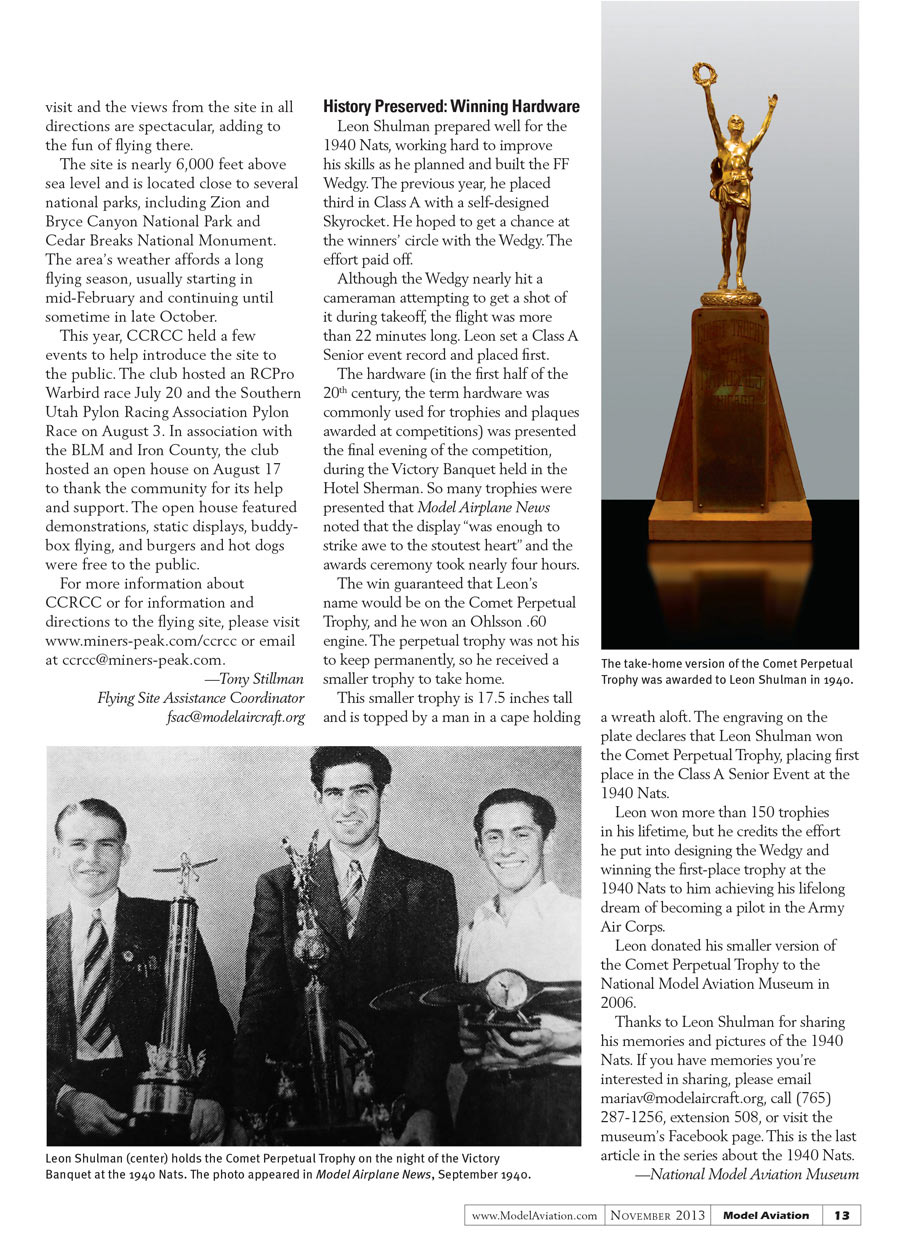
The win guaranteed that Leon’s name would be on the Comet Perpetual Trophy, and he won an Ohlsson .60 engine. The perpetual trophy was not his to keep permanently, so he received a smaller trophy to take home.
This smaller trophy is 17.5 inches tall and is topped by a man in a cape holding a wreath aloft. The engraving on the plate declares that Leon Shulman won the Comet Perpetual Trophy, placing first place in the Class A Senior Event at the 1940 Nats.
Leon won more than 150 trophies in his lifetime, but he credits the effort he put into designing the Wedgy and winning the first-place trophy at the 1940 Nats to him achieving his lifelong dream of becoming a pilot in the Army Air Corps.
Leon donated his smaller version of the Comet Perpetual Trophy to the National Model Aviation Museum in 2006.
Thanks to Leon Shulman for sharing his memories and pictures of the 1940 Nats. If you have memories you’re interested in sharing, please email [email protected], call (765) 287-1256, extension 508, or visit the museum’s Facebook page. This is the last article in the series about the 1940 Nats.
—National Model Aviation Museum
Transcribed from original scans by AI. Minor OCR errors may remain.

