
AMA to Offer Online Sanctioning in 2010
Beginning early next year, the Academy will provide its members with the opportunity to sanction events via the Internet. Existing documents, including the "Application for Event Sanction" and "Event Publication Information," can be completed on AMA's website at www.modelaircraft.org/documents.aspx.
This online initiative will give chartered clubs, Contest Directors, and District Contest Coordinators the advantage of processing and having events sanctioned in a much more timely fashion. Information will be updated on the website each business day and will be available 24/7.
As part of this launch, the online version of "Contest Calendar" will be revamped. Improvements aimed at giving viewers much more search functionality can be expected.
Many guidelines for submitting sanctioning and listing information will remain the same, such as receiving supplementary advertising opportunities in MA. You can find those guidelines on page 157 of this issue.
Look for more detailed information in the February 2010 MA and on the Academy's website. The staff looks forward to delivering a robust, highly interactive online event sanctioning experience. MA
—Rob Kurek Director of Publications
Claude McCullough Education Facility Nears Completion
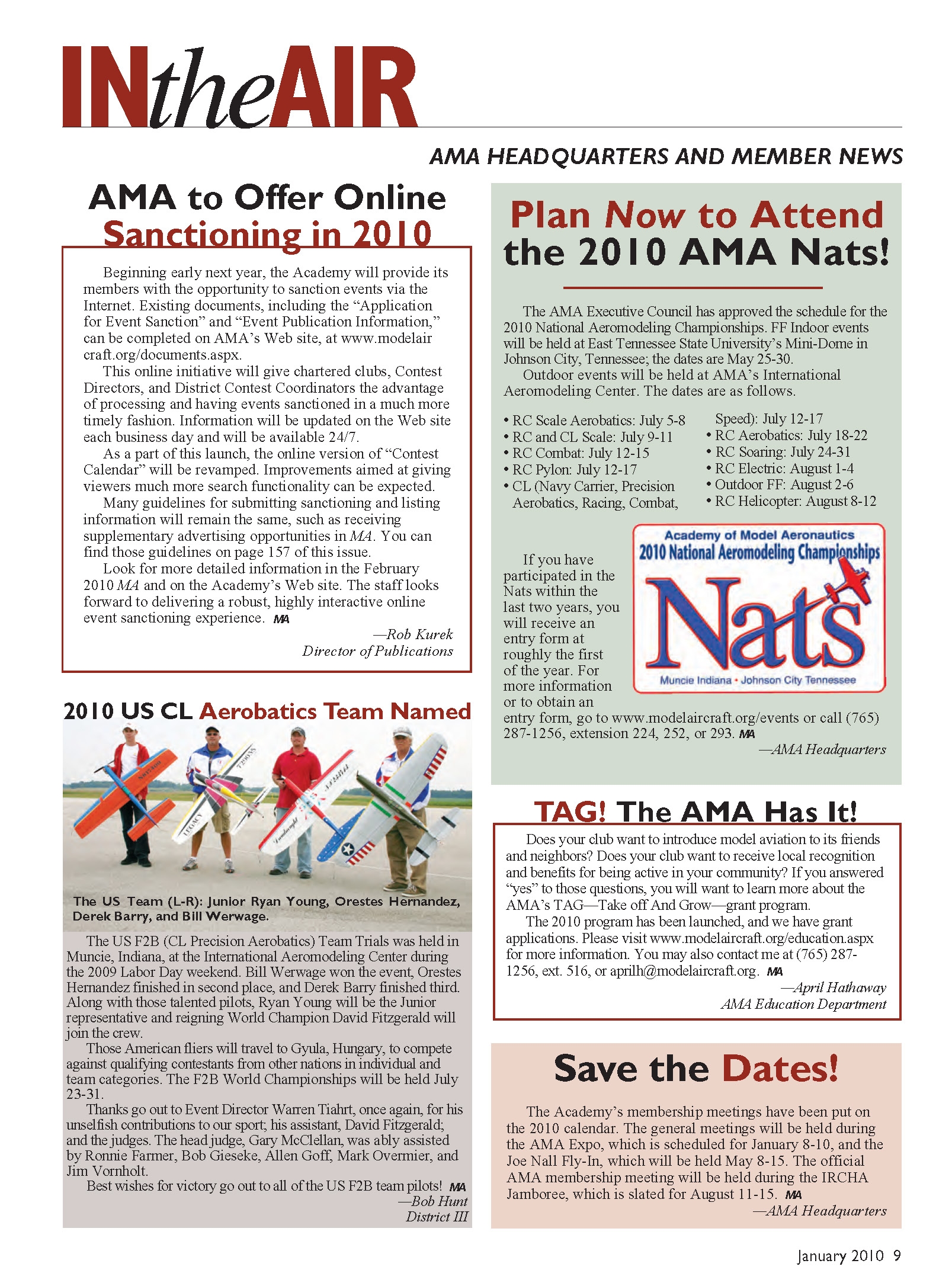
On April 3, 2009, the Claude McCullough Estate made a donation to the AMA for the construction of a new educational multipurpose facility. The groundbreaking, held July 6, marked the beginning of this exciting phase for the National Model Aviation Museum.
Now, with the project's completion in sight, we look forward to providing improved traditional and nontraditional educational programming.
Although the building is nearly finished, the museum would like to add bleachers and a sound system to further enhance our curriculum. If you would like to help with this project, please contact me at [email protected] or (765) 287-1256, extension 500.
Facility features
- A 40-by-40-foot main room that can seat 80 people, with additional seating on the patio when weather permits.
- Three large overhead doors that allow for open-air-style events.
- Vehicle-unloading access through two of the overhead doors.
- A retractable movie screen.
- Men's and women's restrooms.
- A drinking fountain.
- A separate cleanup sink.
In addition to educational programming, the space will be available for rent. Contact me for information or with questions. MA
—Michael Smith National Model Aviation Museum Director
The Joy of Learning
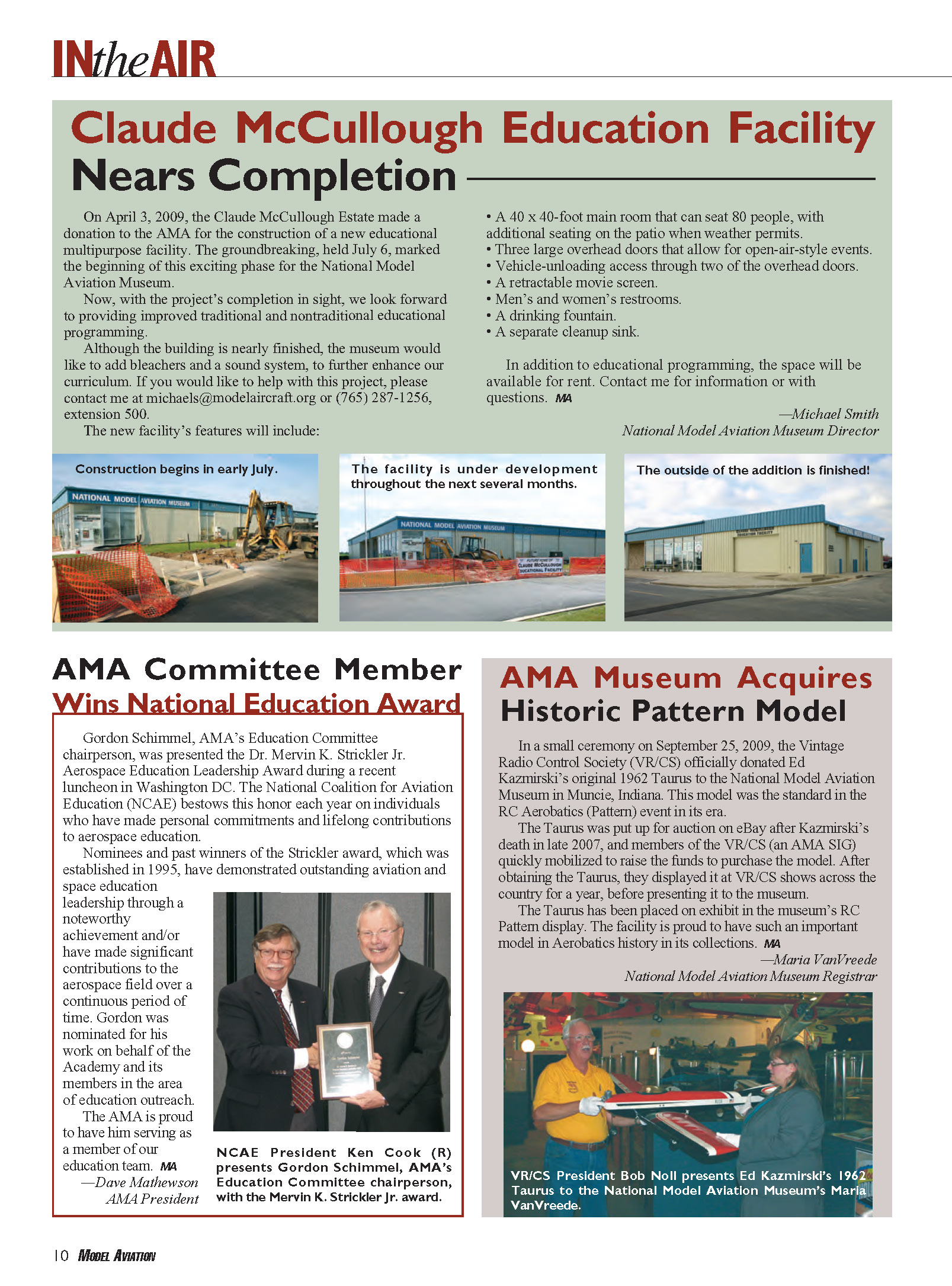
One of the most rewarding moments in my long aeromodeling career was watching these children when they discovered the joy of flying competition with their own aircraft. I felt the same joy 72 years ago, when I was in the first grade. The big kids (second- and third-graders) taught me how to fold and fly paper airplanes and compete during recess.
The AMA received a private school's invitation to put on a program for 21 students, ages 8–12, to teach them about model airplanes. We knew that competing with their own models would be a good teaching method, but how would small, younger girls compete with large, older boys?
The girls did quite well and had as much fun as the boys did! For a while, it looked like the girls were going to win everything. To make it fair to all participants, they competed for distance rather than endurance. In addition, we made a rule that the students couldn't launch their models higher than their heads.
The program started with a brief lecture about how things fly, and then we proceeded to the gymnasium where we divided into four groups. Each group had an experienced modeler to aid in assembling and trimming the provided hand-launched gliders.
At the end of 30 minutes, each group selected the flier who had the best chance of winning in the finals. The top four fliers were allowed 10 minutes to put in as many flights as they could with their teams' support.
Group members would mark the longest flight with a piece of masking tape and race the airplane back to their pilot for the next flight. The children voted that the finals were the most fun and renamed it "The Relay Race."
Indoor flight demonstrations included 3-D, helicopters, autogiros, ornithopters, and some of the best low-cost, out-of-the-box models. Then the exhibition was moved outside, continuing with a sound-emitting UFO and a radio-controlled X Kite that looked like a bird.
The AMA representatives who put on the program donated prizes and held a drawing for the students. The volunteers were Jim Ball, Tim Bailiff, Jeff Barker, Luke Bradshaw, John Gluth, Ron Hudson, Jack Wilson, and I.
Those of us who were involved in that experience will remember it for the rest of our lives. It is our hope that you will have a similar experience. MA
—Charles Mackey
Scouts to the Skies Camporee
The Naval Air Engineering Station at Lakehurst, New Jersey (aka Navy Lakehurst), is rich in aviation history and is most famously known for being the site of the Hindenburg disaster on May 6, 1937. The base’s current mission focuses on the Navy’s Aircraft Platform Interface, and it is the world leader in the research and development of Aircraft Launch and Recovery Equipment and Support Equipment.
Lakehurst is also home to the East Coast Indoor Modelers (ECIM), one of the oldest model aviation clubs in the nation. With such a historic backdrop, Lakehurst has become the site of the New Jersey Scouts to the Skies Boy Scout Camporee.
The first Camporee was held in 2003. It was the idea of Don Weissenburger, a Boy Scout leader who wanted to celebrate the 100th anniversary of the Wright brothers’ flight at Kitty Hawk, North Carolina.
With an invitation from the Lakehurst Base Commander and the direction of David Mitcho, the Camporee has grown. In 2009, more than 1,100 Boy Scouts, Cub Scouts, Venturers, and adult Scouters attended the gathering, which was held April 24–26.
This is an event at which Scouts of all ages can cultivate an interest in aviation and earn their Aviation Merit Badges. The Camporee is a true first step for many Scouts who might never have had such exposure to aviation.
David, a civilian employee at the base and a Scout Leader in the Mercer Area District of the Central New Jersey Council, began planning for the event a year before it took place. He pulled together a team of several dozen volunteers and organizations to make it possible. Without them, the Camporee could never have taken place. A big thank you to all who helped.
The Scouts’ gratitude was evident at the Camporee’s evening campfire, by their applause for the volunteers. Many organizations pitched in to help, including the US Navy, the US Air Force, the Lakehurst Historical Society, the AMA, Great Planes Model Distributors, and the ECIM, all of which provided materials, exhibits, and personnel to help the Scouts during the event.
Event highlights
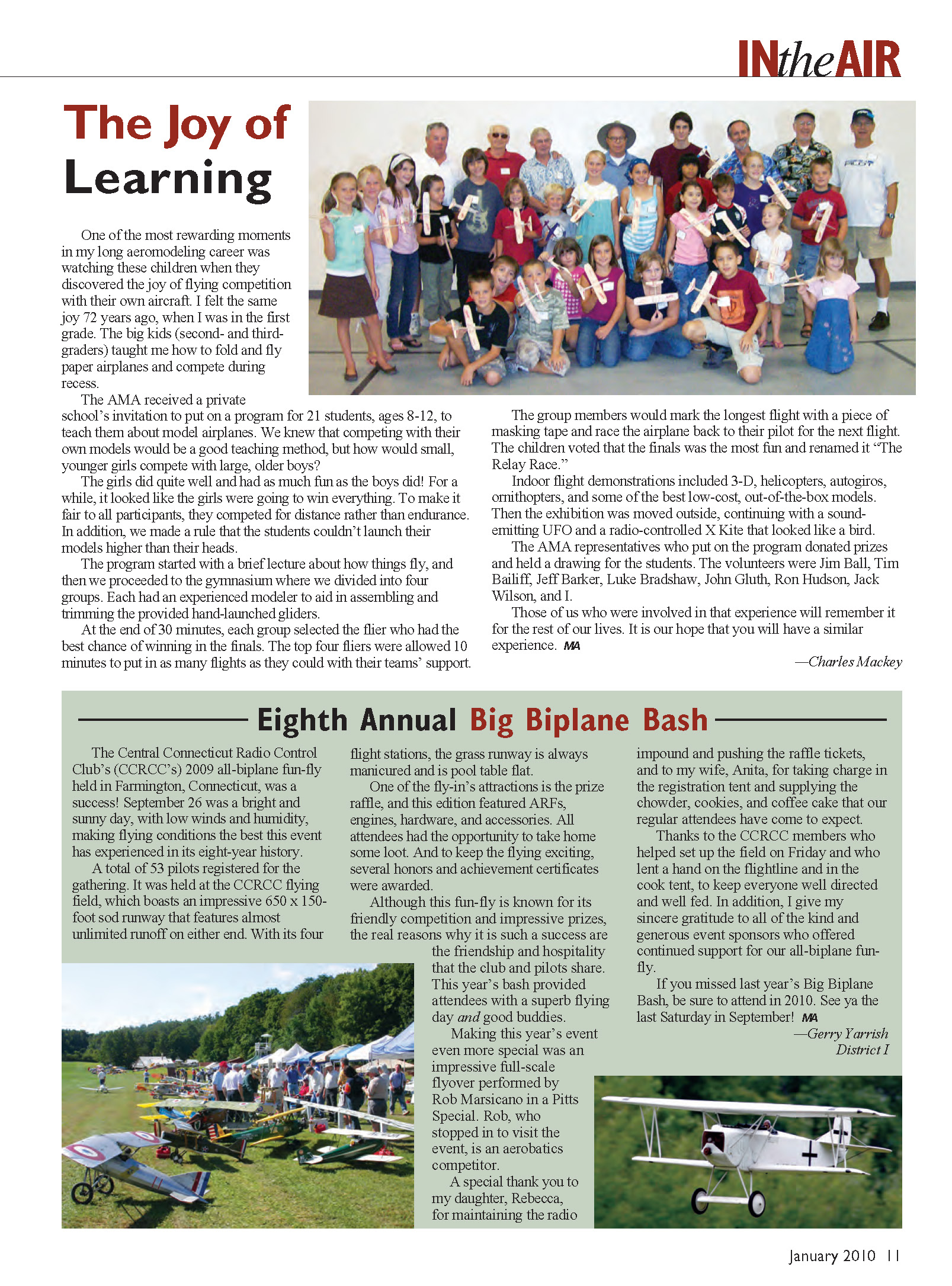
At the center of the Camporee was Lakehurst Hangar One, which housed many of the event’s 28 learning stations. At more than 966 feet long, 350 feet wide, and 224 feet high, the structure is immediately visible as you approach the base.
Throughout Hangar One, volunteers manned stations at which Scouts worked on requirements for the Aviation Merit Badge. They learned about weather, aviation history, aeronautics, flight controls, navigation, careers in aviation, and model aviation.
The Lakehurst Historical Society provided tours of the hangar, while the Navy offered tours of the scaled-down aircraft carrier mock-up inside. Scouts were privy to a below-deck view of all the mechanics that are used to launch and recover aircraft. Outside, Scouts launched model rockets, learned about jet engines, and tried the simulator that the Air Force brought.
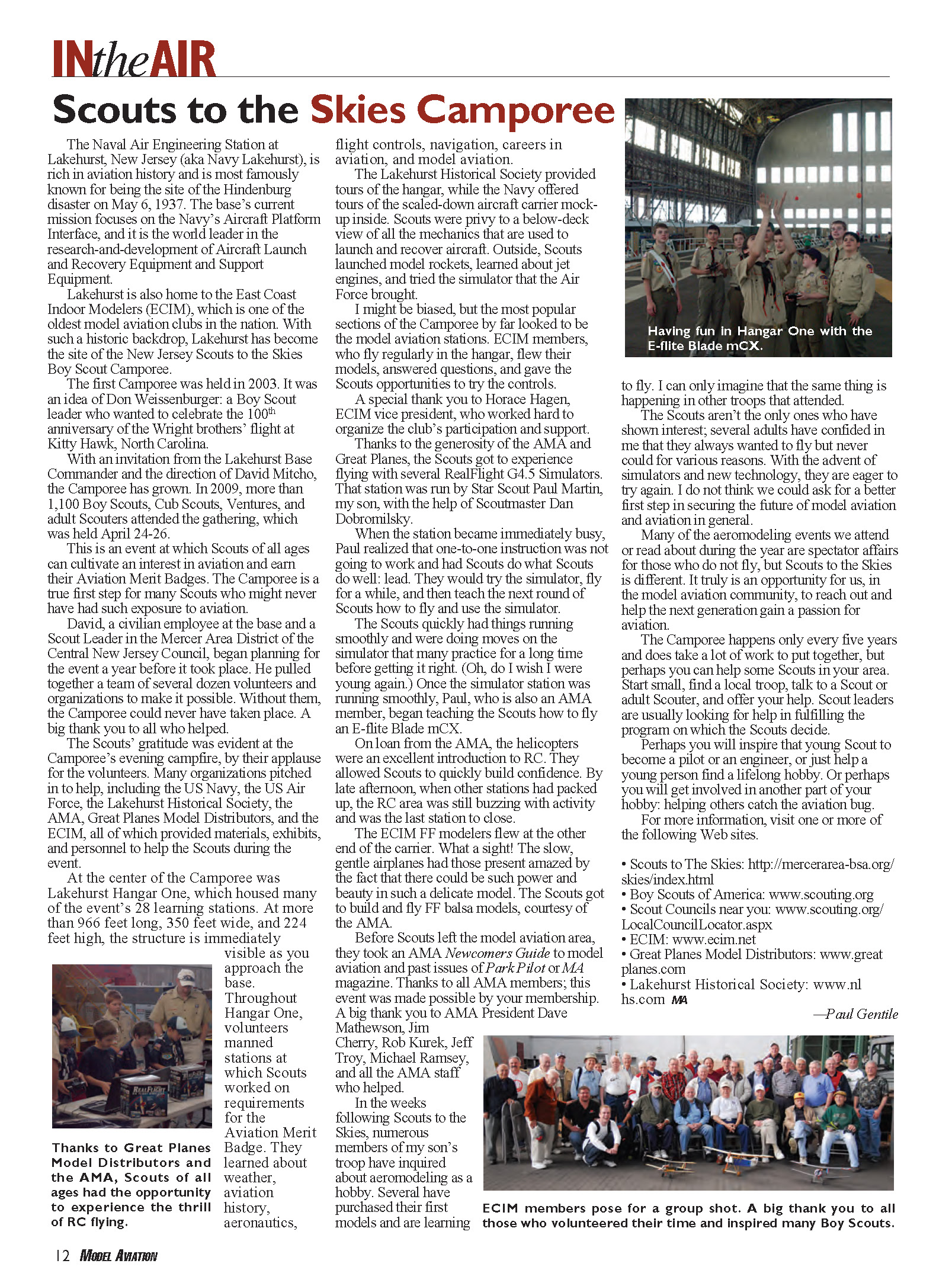
I might be biased, but the most popular sections of the Camporee by far looked to be the model aviation stations. ECIM members, who fly regularly in the hangar, flew their models, answered questions, and gave the Scouts opportunities to try the controls.
A special thank you to Horace Hagen, ECIM vice president, who worked hard to organize the club’s participation and support.
Thanks to the generosity of the AMA and Great Planes, the Scouts got to experience flying with several RealFlight G4.5 simulators. That station was run by Star Scout Paul Martin, my son, with the help of Scoutmaster Dan Dobromilsky.
When the station became immediately busy, Paul realized that one-to-one instruction was not going to work and had Scouts do what Scouts do well: lead. They would try the simulator, fly for a while, and then teach the next round of Scouts how to fly and use the simulator.
The Scouts quickly had things running smoothly and were doing maneuvers on the simulator that many practice a long time before getting right. Once the simulator station was running smoothly, Paul, who is also an AMA member, began teaching the Scouts how to fly an E-flite Blade mCX.
On loan from the AMA, the helicopters were an excellent introduction to RC. They allowed Scouts to quickly build confidence. By late afternoon, when other stations had packed up, the RC area was still buzzing with activity and was the last station to close.
The ECIM free-flight (FF) modelers flew at the other end of the carrier. What a sight! The slow, gentle airplanes had those present amazed by the fact that there could be such power and beauty in such a delicate model. The Scouts got to build and fly FF balsa models, courtesy of the AMA.
Before Scouts left the model aviation area, they took an AMA Newcomers Guide to model aviation and past issues of ParkPilot or MA magazine. Thanks to all AMA members; the event was made possible by your membership. A big thank you to AMA President Dave Mathewson, Jim Cherry, Rob Kurek, Jeff Troy, Michael Ramsey, and all the AMA staff who helped.
In the weeks following Scouts to the Skies, numerous members of my son’s troop have inquired about aeromodeling as a hobby. Several have purchased their first models and are learning to fly. I can only imagine that the same thing is happening in other troops that attended.
The Scouts aren’t the only ones who have shown interest; several adults have confided in me that they always wanted to fly but never could for various reasons. With the advent of simulators and new technology, they are eager to try again. I do not think we could ask for a better first step in securing the future of model aviation and aviation in general.
Many of the aeromodeling events we attend or read about during the year are spectator affairs for those who do not fly, but Scouts to the Skies is different. It truly is an opportunity for us, in the model aviation community, to reach out and help the next generation gain a passion for aviation.
The Camporee happens only every five years and does take a lot of work to put together, but perhaps you can help some Scouts in your area. Start small, find a local troop, talk to a Scout or adult Scouter, and offer your help. Scout leaders are usually looking for help in fulfilling a program on which the Scouts decide.
Perhaps you will inspire that young Scout to become a pilot or an engineer, or just help a young person find a lifelong hobby. Or perhaps you will get involved in another part of your hobby: helping others catch the aviation bug.
For more information, visit one or more of the following websites:
- Scouts to The Skies: http://mercercarea-bsa.org/skies/index.html
- Boy Scouts of America: www.scouting.org
- Scout Councils near you: www.scouting.org/LocalCouncilLocator.aspx
- ECIM: www.ecim.net
- Great Planes Model Distributors: www.greatplanes.com
- Lakehurst Historical Society: www.nlhs.com
MA
—Paul Gentile
Transcribed from original scans by AI. Minor OCR errors may remain.

