
AMA Host Experience
Following is a letter from Michael P. Nemzek (Dublin, Georgia) that describes some of the things that happened when he, his wife, and his poodle volunteered for a monthlong stint as host, hostess, and hostdog at the Academy’s International Aeromodeling Center in Muncie, Indiana.
June 6, 2010, 2:00 a.m. Sunday. The air-raid siren—I mean the weather radio siren—goes off. OMG! Welcome to Indiana. Tornado watch/warning, severe thunderstorm watch/warning, flash flood warning. Take your pick: if not one, then the other.
After a while we—Mike, Mary Jo, and Andy the killer poodle—got the drill down. Pull the RV’s slides in and make an executive decision on whether to head for the storm shelter or not (aka shower room). After a while the routine is automatic, though we don’t get blasé about it.
One night it rained so hard, it rained frogs. We know this because we found a green one hiding in the awning support. It’s bad when the frogs have to hide. Some places the teens go out cow tipping. Here the weather goes out and tips porta-potties. Our stay’s personal best was five in one night’s storm.
I am mainly a glow, Sunday sport-flyer type of person. One of the great things that I have learned is that our model airplane sport or hobby is much more than that. The precision or exactness of Free Flight is almost mind-boggling.
Truly great to see the pride and the ear-to-ear smile of a teenager from around Atlanta when he missed getting third place by only a point, and the next day getting first place in his category—and this against some of the old pros.
He and his family members will have fond memories of his accomplishments, plus memories of having to move their tent twice to avoid the weather. As a fellow Georgian, I’m proud of his accomplishments.
XFC
Holy cow! The flying was something out of this world. Looks to be a young man’s sport. My muscle memory doesn’t even have any memory of the muscle memory necessary to do the stuff we saw that weekend. Where else can you see helicopters doing stuff that makes them look like giant dragonflies on an overdose of crack?
Meeting two teams from Brazil and one team from Taiwan was a unique experience and a lot of fun. The fireworks on Saturday night after nature’s display was wonderful; the night flying that followed almost made me wonder if the Martians had landed.
NEFI
NEFI was a lot of fun. Bought a Radian sailplane and competed. Never flew anything like that before. Way cool, as the younger ones say. Can I help it if my model tried to attack the scorekeeper’s wife on the second day? These things have a mind of their own.
Got to meet Robert “Hoot” Gibson too—way, way super cool. In my personal opinion the word “hero” is bandied about so much as to be just about meaningless. Heck, it seems that if you even just show up for work and don’t get the boss too mad at you, you’re a hero nowadays. Even though he gives the impression that his accomplishments are just routine to me, he just about meets anyone’s requirements for being a true hero.
I, for one, appreciate what he has done in the service of and for our country and for being an ambassador for the AMA. I salute you, sir!
I cannot say how much we appreciate all the kindnesses that the staff of AMA HQ has shown us—their patience with my many questions and getting answers to them, and going out of their way when I requested help on different things.
Special mention goes to the chief of maintenance and his crew. Don’t know how they get done all that they do. John Hawley, you have great customer service skills that I have observed more than once.
Special mention also goes to Jim Cherry. I don’t know how he does all that he does. Part of it is in the professionalism of the people that he oversees. Now, can I get the overtime (OT) for the extra patrols I did during NEFI? Seriously—you and your staff have made our stay a great and memorable one.
Anyone that passes up the chance to do hosting doesn’t know what they are missing: missing the chance to interact with the staff of AMA, meeting our fellow members with their wide diversity of interests, and their passion for our hobby/sport. We had a great time and Andy said he did too, even if he did get rejected by a female boxer.
To learn more about the AMA Host/Hostess program, go to www.modelaircraft.org/news/seekinghost.aspx.
—AMA HQ
So Long, Dad!
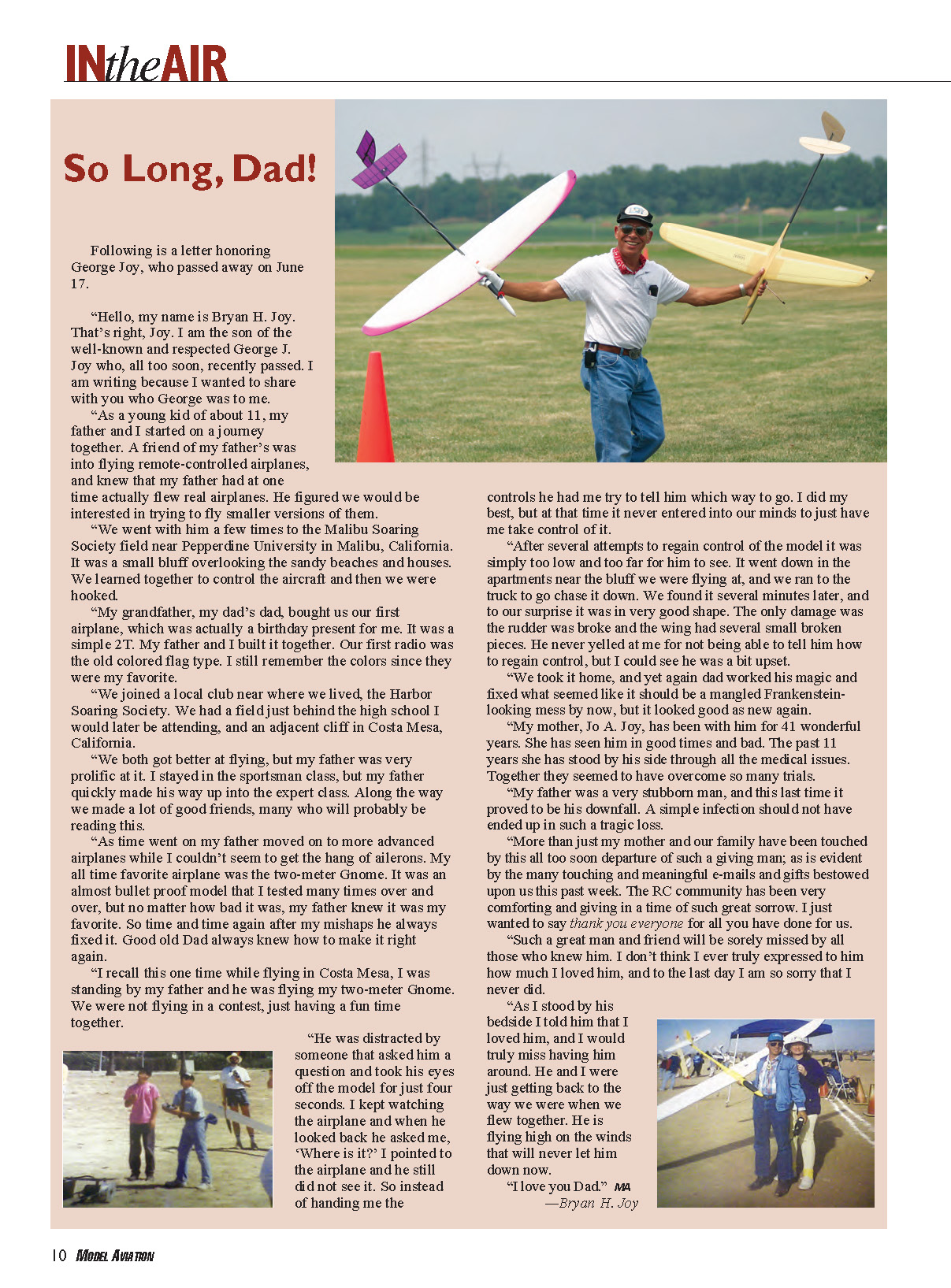
Following is a letter honoring George Joy, who passed away on June 17.
Hello, my name is Bryan H. Joy. That's right, Joy. I am the son of the well-known and respected George J. Joy who, all too soon, recently passed. I am writing because I wanted to share with you who George was to me.
As a young kid of about 11, my father and I started on a journey together. A friend of my father's was into flying remote-controlled airplanes, and knew that my father had at one time actually flown real airplanes. He figured we would be interested in trying to fly smaller versions of them.
We went with him a few times to the Malibu Soaring Society field near Pepperdine University in Malibu, California. It was a small bluff overlooking the sandy beaches and houses. We learned together to control the aircraft and then we were hooked.
My grandfather, my dad's dad, bought us our first airplane, which was actually a birthday present for me. It was a simple 2T. My father and I built it together. Our first radio was the old colored-flag type. I still remember the colors since they were my favorite.
We joined a local club near where we lived, the Harbor Soaring Society. We had a field just behind the high school I would later be attending, and an adjacent cliff in Costa Mesa, California.
We both got better at flying, but my father was very prolific at it. I stayed in the sportsman class, but my father quickly made his way up into the expert class. Along the way we made a lot of good friends, many who will probably be reading this.
As time went on my father moved on to more advanced airplanes while I couldn't seem to get the hang of ailerons. My all-time favorite airplane was the two-meter Gnome. It was an almost bulletproof model that I tested many times over and over, but no matter how bad it was, my father knew it was my favorite. So time and time again after my mishaps he always fixed it. Good old Dad always knew how to make it right again.
I recall this one time while flying in Costa Mesa. I was standing by my father and he was flying my two-meter Gnome. We were not flying in a contest, just having a fun time together.
He was distracted by someone who asked him a question and took his eyes off the model for just four seconds. I kept watching the airplane, and when he looked back he asked me, “Where is it?” I pointed to the airplane and he still did not see it. So instead of handing me the controls he had me try to tell him which way to go. I did my best, but at that time it never entered into our minds to just have me take control of it.
After several attempts to regain control of the model it was simply too low and too far for him to see. It went down in the apartments near the bluff we were flying at, and we ran to the truck to go chase it down. We found it several minutes later, and to our surprise it was in very good shape. The only damage was the rudder was broken and the wing had several small broken pieces. He never yelled at me for not being able to tell him how to regain control, but I could see he was a bit upset.
We took it home, and yet again Dad worked his magic and fixed what seemed like it should be a mangled Frankenstein-looking mess by now, but it looked good as new again.
My mother, Jo A. Joy, has been with him for 41 wonderful years. She has seen him in good times and bad. The past 11 years she has stood by his side through all the medical issues. Together they seemed to have overcome so many trials.
My father was a very stubborn man, and this last time it proved to be his downfall. A simple infection should not have ended up in such a tragic loss.
More than just my mother and our family have been touched by this all-too-soon departure of such a giving man; as is evident by the many touching and meaningful emails and gifts bestowed upon us this past week. The RC community has been very comforting and giving in a time of such great sorrow. I just wanted to say thank you everyone for all you have done for us.
Such a great man and friend will be sorely missed by all those who knew him. I don't think I ever truly expressed to him how much I loved him, and to the last day I am so sorry that I never did.
As I stood by his bedside I told him that I loved him, and I would truly miss having him around. He and I were just getting back to the way we were when we flew together. He is flying high on the winds that will never let him down now.
I love you Dad!
—Bryan H. Joy
History Preserved: The Collection of the National Model Aviation Museum
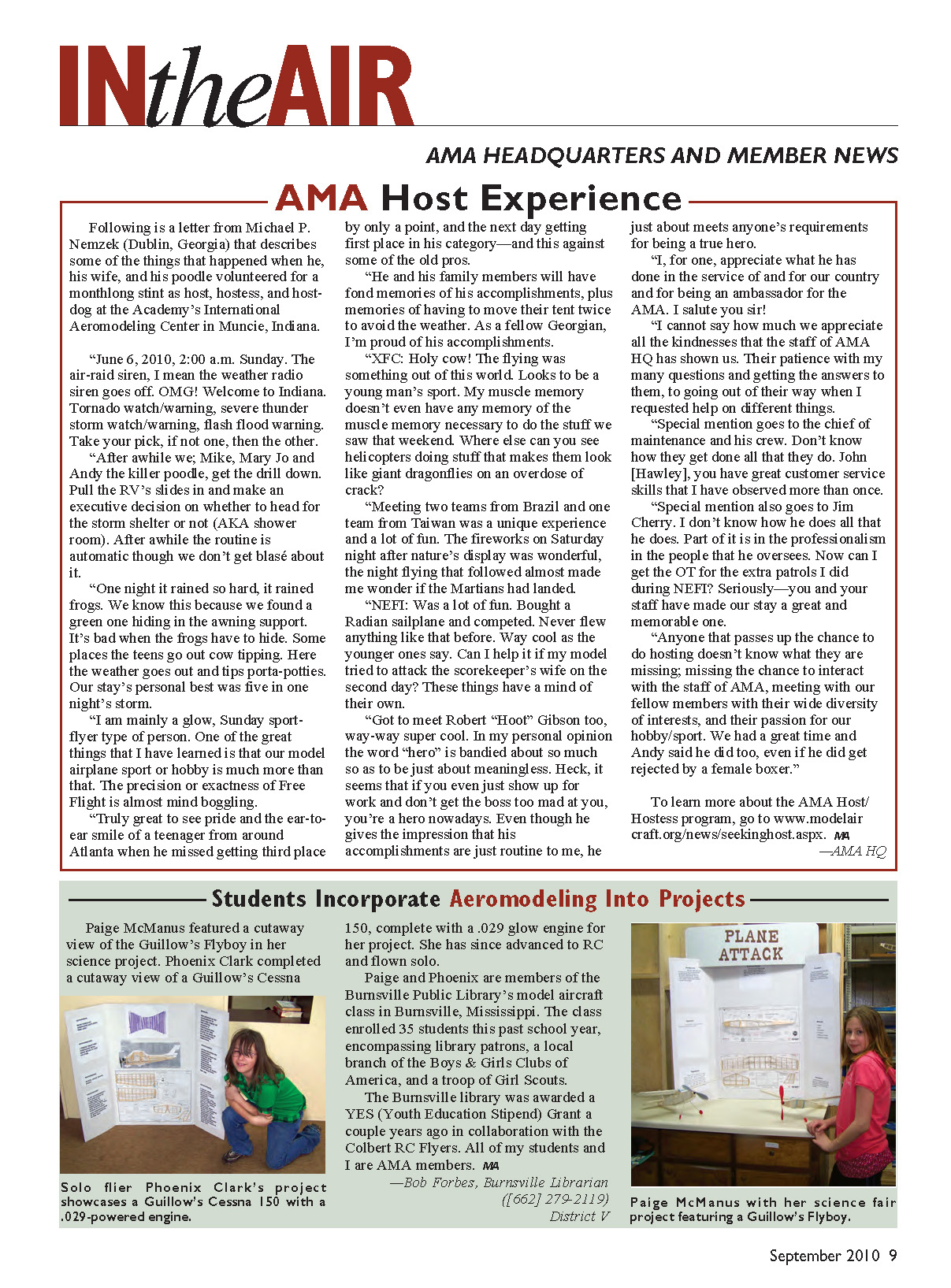
This CL model usually confuses people. Called a “Which-a-Way,” the name echoes the puzzlement people commonly feel when they ask which way it flies. It's easy to see why this question arises; the horizontal surfaces at both the fore and aft make this aircraft look simultaneously like a pusher and a tractor.
For the record, the model flies as a tractor—an old modeling term meaning with the engine up front, pulling the airplane through the air.
The airplane's Fox .35 is mounted sideways. This, combined with its dual stabilizers and opposing elevators, allows the model to hover when flown vertically to the ground. Walt Williamson, who designed and built the Which-a-Way, used the hovering trick to pop balloons.
It is unknown when Walt designed this airplane, but according to a short paragraph in the November 1959 American Modeler magazine, Al Lewis remembered seeing Walt fly it at the National Capitol Contest in 1948.
Walt continued to build and fly the aircraft until at least 1961, when plans for it were published in the June–July Flying Models. The version in the museum, with its clear MonoKote wing covering and checked-balsa inlay, does not match the photographs of the design featured in either magazine and might have been built later in Walt's life.
He was a well-known member of the Norfolk Aeromodelers and was well liked in his hometown of Norfolk, Virginia, where he attended Norview High School in the late 1940s. Walt did not enjoy his high school experience and apparently especially disliked his English class. His mother described situations in which “he'd have that English book open and it'd have model airplanes inside.”
He eventually quit high school and worked in a factory for 20 years before getting laid off in 1972. He then devoted his time to “his mother, his garden, his model airplanes and Norview High School,” according to a newspaper article about him.
Walt was a great photographer, as several images that accompanied the Which-a-Way when it arrived at the museum show. However, it was his love of photography and his volunteer work at the high school that led to his death in 1984.
While photographing a junior varsity football game, Walt was accidentally tackled by players who strayed out of bounds following the ball. The resulting collision fractured his skull in several places and caused fatal brain injury.
Even after Walt's death, his enjoyment of model airplanes is evident; his family listed his membership in the AMA in his obituary. Two years later, Walt's mother donated the Which-a-Way to the museum at the prompting of the Norfolk Aeromodelers.
—Maria VanVreede Museum Registrar
A Lifetime Spent Promoting Aviation
Since receiving his first model airplane at age 4, Mike Markowski has been using his love of aviation to accomplish great things. In addition to designing, building, and flying models, he designed and built wind/smoke tunnels and ran cutting-edge experiments on model wings as science-fair projects. He received numerous awards and recognition, including a four-year scholarship.
Completing Penn State's aerospace engineering curriculum in three years, Mike earned his degree in 1968. After four years of designing wind-tunnel models for Douglas, Sikorsky, and NASA, and studying for a master's in engineering management, he pursued his flying dreams by becoming an aviation entrepreneur, innovator, and pioneer.
In 1971, Mike designed, built, and taught himself to fly a hang glider, co-founding the first two hang glider companies on the East Coast. He also taught hang gliding and aviation at the adult-education level and co-owned and ran a hang-gliding flight school.
In promoting the sport, Mike garnered national coverage on TV and in newspapers and magazines. He acquired his private pilot's license in 1972.
Through Mike's company, Aeronautical Publishers, he distributes the only comprehensive series of books about ultralights and books about home-builts, aviation history, airplane mechanics, and model airplanes.
The FAA used his fourth book, Ultralight Aircraft, to help develop FAR 103—The Ultralight Rule. Mike's Possibility Press company publishes a line of books on success.
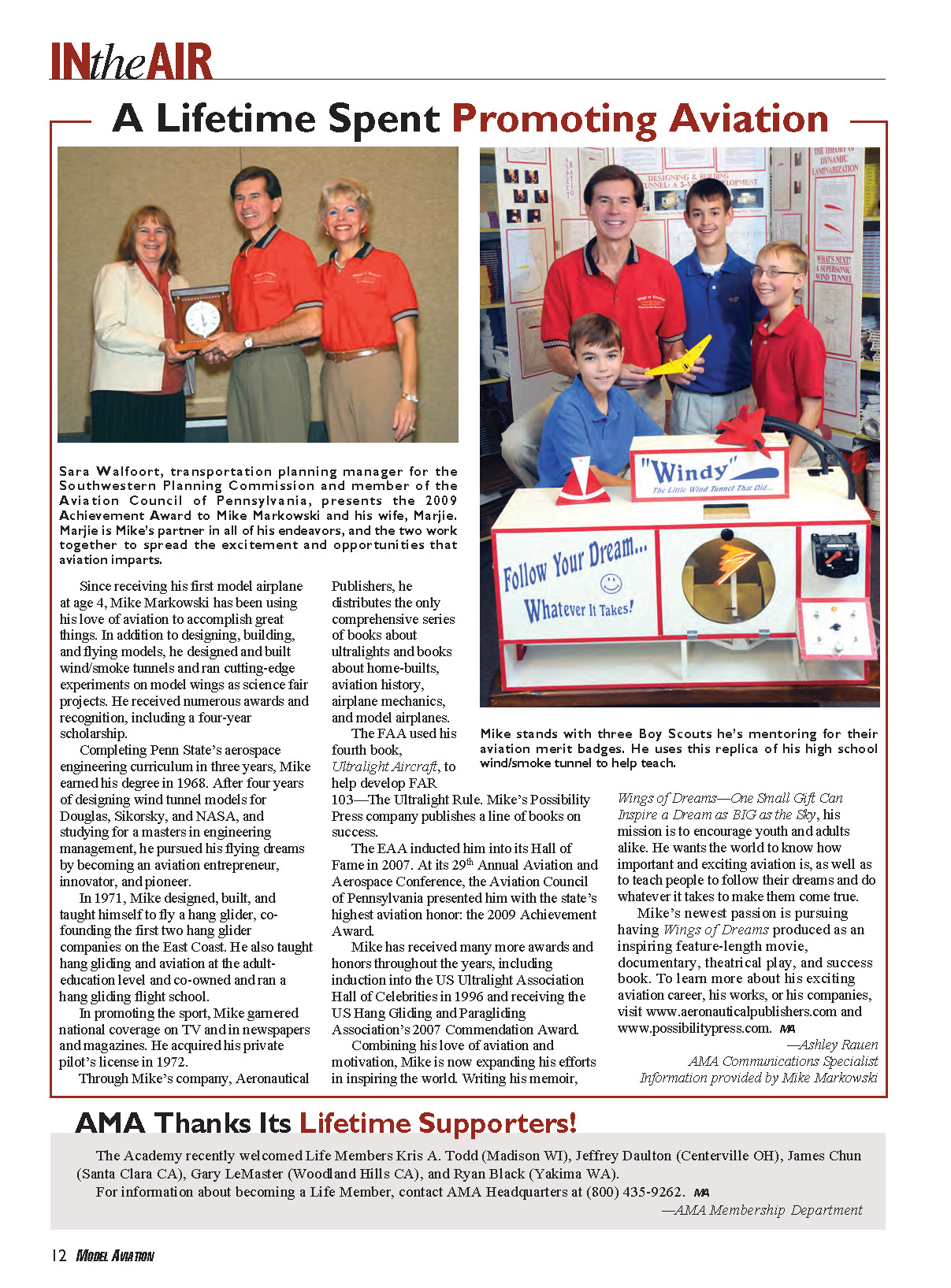
The EAA inducted him into its Hall of Fame in 2007. At its 29th Annual Aviation and Aerospace Conference, the Aviation Council of Pennsylvania presented him with the state's highest aviation honor: the 2009 Achievement Award.
Mike has received many more awards and honors throughout the years, including induction into the US Ultralight Association Hall of Celebrities in 1996 and receiving the US Hang Gliding and Paragliding Association's 2007 Commendation Award.
Combining his love of aviation and motivation, Mike is now expanding his efforts in inspiring the world. Writing his memoir, Wings of Dreams—One Small Gift Can Inspire a Dream as BIG as the Sky, his mission is to encourage youth and adults alike. He wants the world to know how important and exciting aviation is, as well as to teach people to follow their dreams and do whatever it takes to make them come true.
Mike's newest passion is pursuing having Wings of Dreams produced as an inspiring feature-length movie, documentary, theatrical play, and success book. To learn more about his exciting aviation career, his works, or his companies, visit www.aeronauticalpublishers.com and www.possibilitypress.com.
—Ashley Rauen AMA Communications Specialist Information provided by Mike Markowski
Transcribed from original scans by AI. Minor OCR errors may remain.

