
Gear Up for AMA Convention 2008!
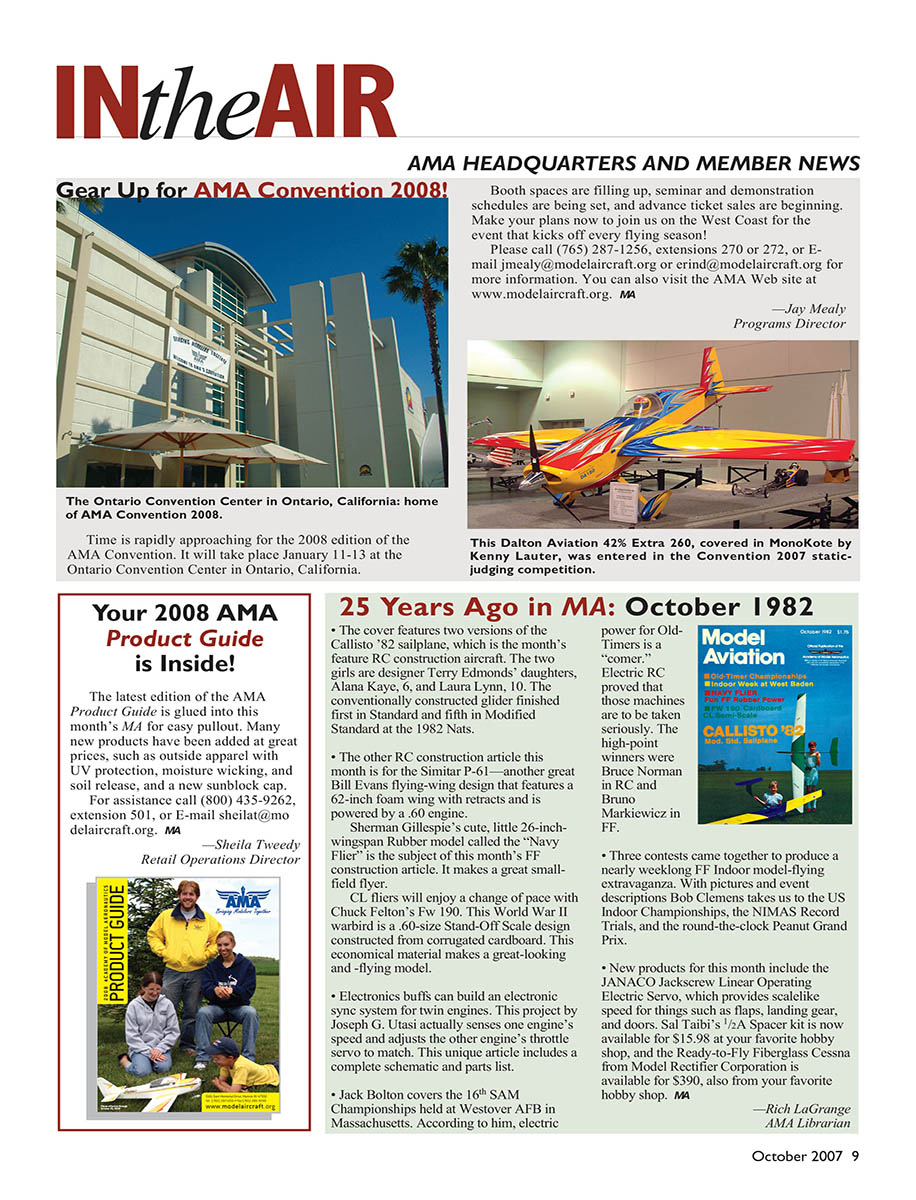
Time is rapidly approaching for the 2008 edition of the AMA Convention. It will take place January 11–13 at the Ontario Convention Center in Ontario, California.
Booth spaces are filling up, seminar and demonstration schedules are being set, and advance ticket sales are beginning. Make your plans now to join us on the West Coast for the event that kicks off every flying season!
For more information:
- Call (765) 287-1256, extensions 270 or 272
- E-mail [email protected] or [email protected]
- Visit the AMA website at www.modelaircraft.org
MA — Jay Mealy, Programs Director
US Team Takes Third at Jet World Masters
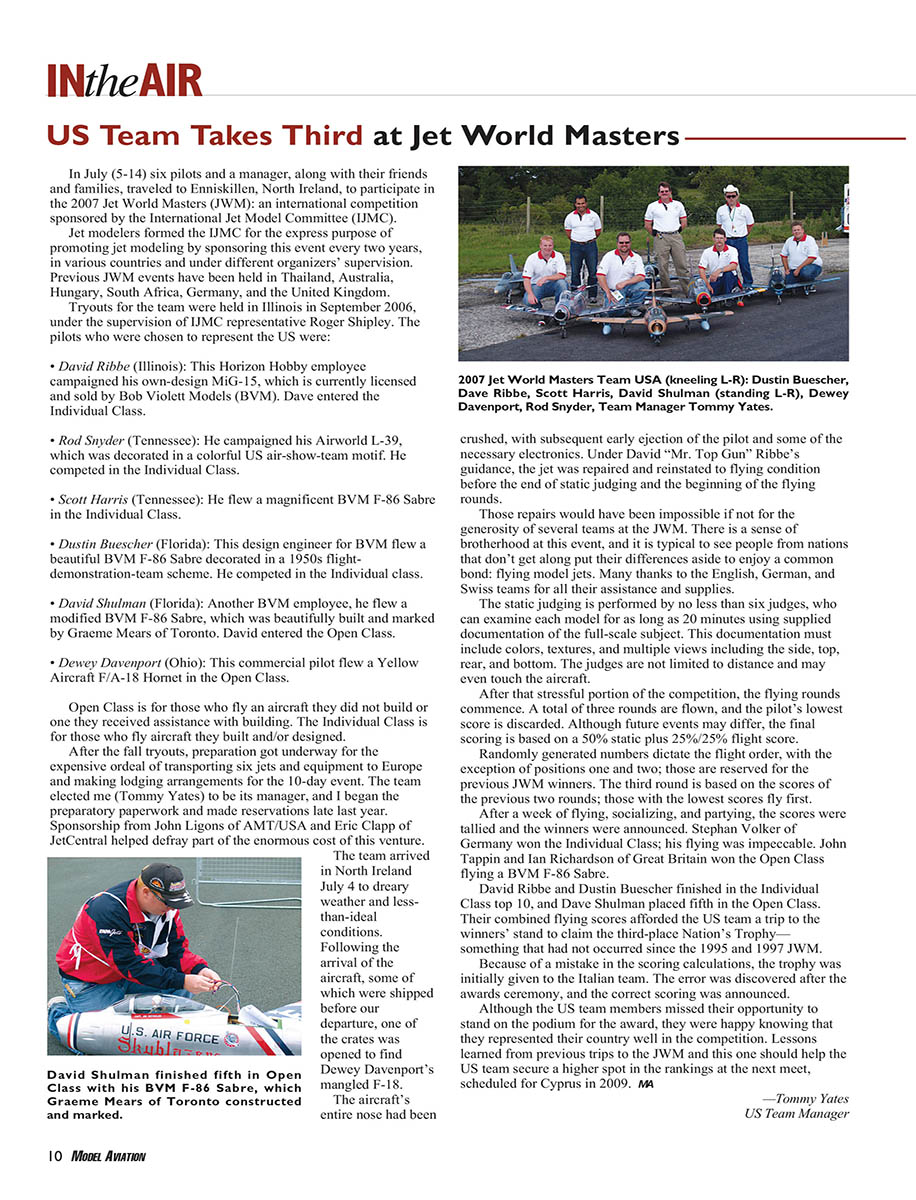
In July (5–14) six pilots and a manager, along with their friends and families, traveled to Enniskillen, Northern Ireland, to participate in the 2007 Jet World Masters (JWM), an international competition sponsored by the International Jet Model Committee (IJMC).
Jet modelers formed the IJMC to promote jet modeling by sponsoring this event every two years in various countries under different organizers' supervision. Previous JWM events have been held in Thailand, Australia, Hungary, South Africa, Germany, and the United Kingdom.
Team selection and members
Tryouts for the team were held in Illinois in September 2006 under the supervision of IJMC representative Roger Shipley. The pilots chosen to represent the US were:
- David Ribbe (Illinois): A Horizon Hobby employee, he campaigned his own-design MiG-15, which is currently licensed and sold by Bob Viollett Models (BVM). Dave entered the Individual Class.
- Rod Snyder (Tennessee): He campaigned his Airworld L-39, decorated in a colorful US air-show-team motif. He competed in the Individual Class.
- Scott Harris (Tennessee): He flew a magnificent BVM F-86 Sabre in the Individual Class.
- Dustin Buescher (Florida): A design engineer for BVM, he flew a beautiful BVM F-86 Sabre decorated in a 1950s flight-demonstration-team scheme. He competed in the Individual Class.
- David Shulman (Florida): Another BVM employee, he flew a modified BVM F-86 Sabre, built and marked by Graeme Mears of Toronto. David entered the Open Class.
- Dewey Davenport (Ohio): A commercial pilot, he flew a Yellow Aircraft F/A-18 Hornet in the Open Class.
Open Class is for those who fly an aircraft they did not build or one they received assistance building. The Individual Class is for those who fly aircraft they built and/or designed.
Preparation and travel
After the fly tryouts, preparation began for the costly task of transporting six jets and equipment to Europe and arranging lodging for the 10-day event. The team elected me (Tommy Yates) as manager, and I handled the preparatory paperwork and reservations late last year. Sponsorship from John Ligon of AMT/USA and Eric Clapp of JetCentral helped defray part of the expense.
The team arrived in Northern Ireland on July 4 to dreary weather and less-than-ideal conditions. Following the arrival of the aircraft—some shipped before our departure—one crate was opened to find Dewey Davenport’s mangled F‑18. The aircraft’s entire nose had been crushed, with early ejection of the pilot and some necessary electronics. Under David “Mr. Top Gun” Ribbe’s guidance, the jet was repaired and returned to flying condition before the end of static judging and the start of the flying rounds.
Those repairs would have been impossible without the generosity of several teams at the JWM. There is a sense of brotherhood at this event; it’s typical to see people from nations that don’t get along put differences aside to enjoy a common bond: flying model jets. Many thanks to the English, German, and Swiss teams for their assistance and supplies.
Competition format
Static judging is performed by six judges, who can examine each model for as long as 20 minutes using supplied documentation of the full-scale subject. This documentation must include colors, textures, and multiple views including side, top, rear, and bottom. Judges are not limited to distance and may touch the aircraft.
After the static portion, the flying rounds commence. A total of three rounds are flown; the pilot’s lowest score is discarded. For this event the final scoring was based on 50% static plus 25%/25% for the two flight scores. Flight order is randomly generated, except positions one and two are reserved for the previous JWM winners. The third round order is based on the scores of the previous two rounds; those with the lowest scores fly first.
Results and reflections
After a week of flying, socializing, and partying, the scores were tallied. Stephan Volkner of Germany won the Individual Class with impeccable flying. John Tappin and Ian Richardson of Great Britain won the Open Class flying a BVM F-86 Sabre.
David Ribbe and Dustin Buescher finished in the Individual Class top 10, and Dave Shulman placed fifth in the Open Class. Their combined flying scores earned the US team third place in the Nations' Trophy—something that had not occurred since the 1995 and 1997 JWM.
Because of a mistake in the scoring calculations, the trophy was initially given to the Italian team. The error was discovered after the awards ceremony, and the correct scoring was announced. Although the US team missed the opportunity to stand on the podium during the ceremony, they were proud to have represented their country well. Lessons learned from previous trips and this event should help the US team secure a higher ranking at the next meet, scheduled for Cyprus in 2009.
MA — Tommy Yates, US Team Manager
Oshkosh 2007: AMAers, EAAers, and Others
Much of the year the EAA grounds are a huge, fairly open area punctuated with scattered buildings. But near the end of July it becomes a living, breathing city of airplanes, equipment of every description, and a continuous stream of humanity trudging the length and breadth of the site. It’s AirVenture at the Experimental Aircraft Association's (EAA) Wittman Field home in Oshkosh, Wisconsin.
In the minds of hundreds of thousands who make the trek to the event, the paramount goal is to see the aircraft. Those of us who man booths and coordinate activities often have a different perspective: the greater interest becomes the people and their interaction with one another and the "things" around them.
Parents with toddlers in strollers (often asleep) and seniors in electric carts head past the AMA booth in Hangar A. They pause, look at the display, and amble over. Often we greet them with, "Aha! A modeler!"
Their responses generally follow one of three themes:
- "I was."
- "Yes, I am."
- "I'm about to be."
On occasion an individual will reply, "No, I'm not; I fly real ones." That statement and our friendly chiding, "Yes, so do we," as we point to the display, usually leads to an interesting and productive discussion about similarities and differences between being in the aircraft and being a pilot with our feet on the ground.
In most instances it is virtually impossible to distinguish between the AMAer, the EAAer, and even a member of the general public fascinated with aircraft. Sometimes a badge, a uniform, or the assorted bags they carry will give them away. Normally, however, it's the conversation recounting tales of their past experiences that provides identification. Typically they are partakers of multiple aviation pursuits.
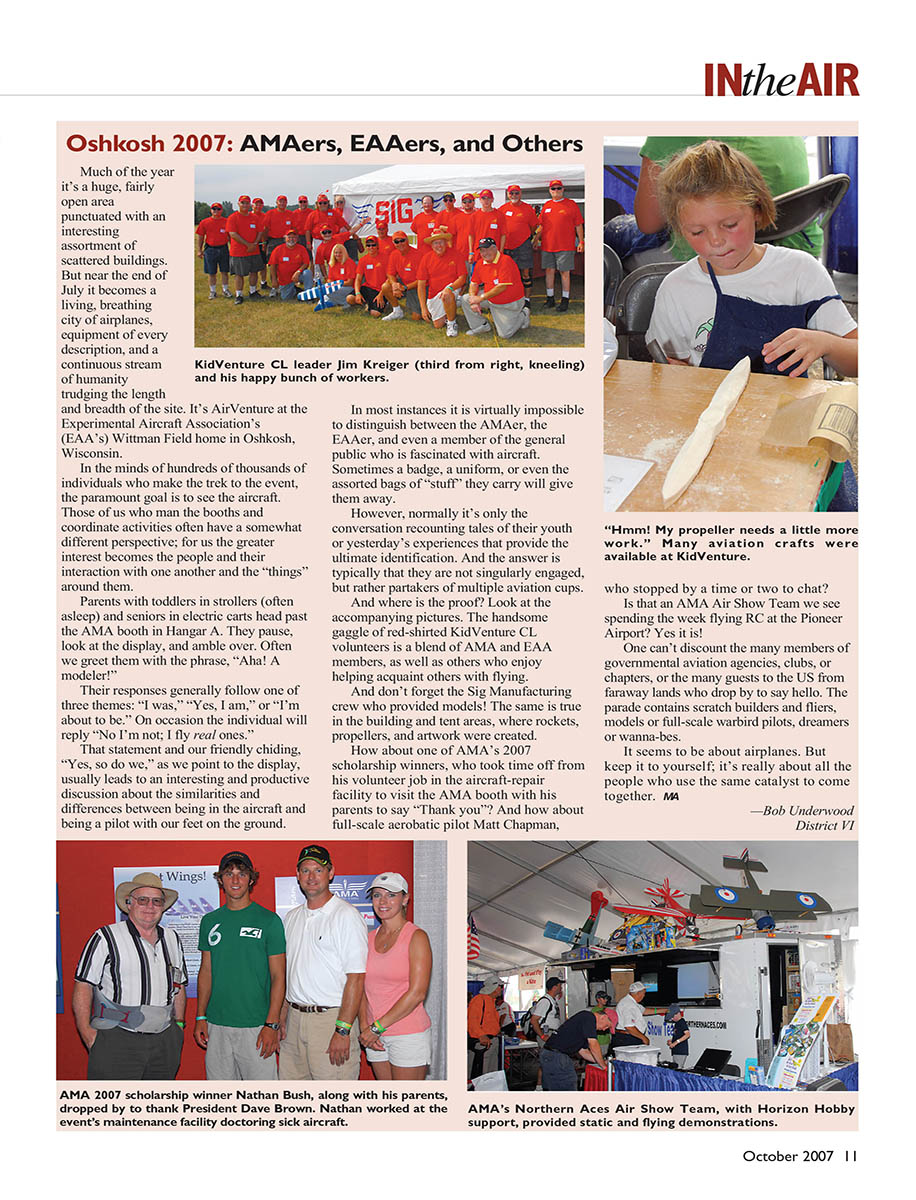
Look at the accompanying pictures: the gaggle of red‑shirted KidVenture CL volunteers is a blend of AMA and EAA members and others who enjoy helping acquaint newcomers with flying. Don’t forget the Sig Manufacturing crew who provided models! The same is true in the building and tent areas, where rockets, propellers, and artwork were created.
One of AMA's 2007 scholarship winners took time off from a volunteer job in the aircraft-repair facility to visit the AMA booth with his parents to say "thank you." Full-scale aerobatic pilot Matt Chapman stopped by a time or two to chat. The AMA Air Show Team spent the week flying RC at the Pioneer Airport.
We also had many members of governmental aviation agencies, clubs, and chapters, as well as guests from faraway lands who dropped by to say hello. The parade includes scratch builders and fliers, model or full-scale warbird pilots, dreamers, and wannabes.
It seems to be about airplanes. But really, it's about all the people who use the same catalyst to come together.
MA — Bob Underwood, District VI
Slope Soaring in Michigan
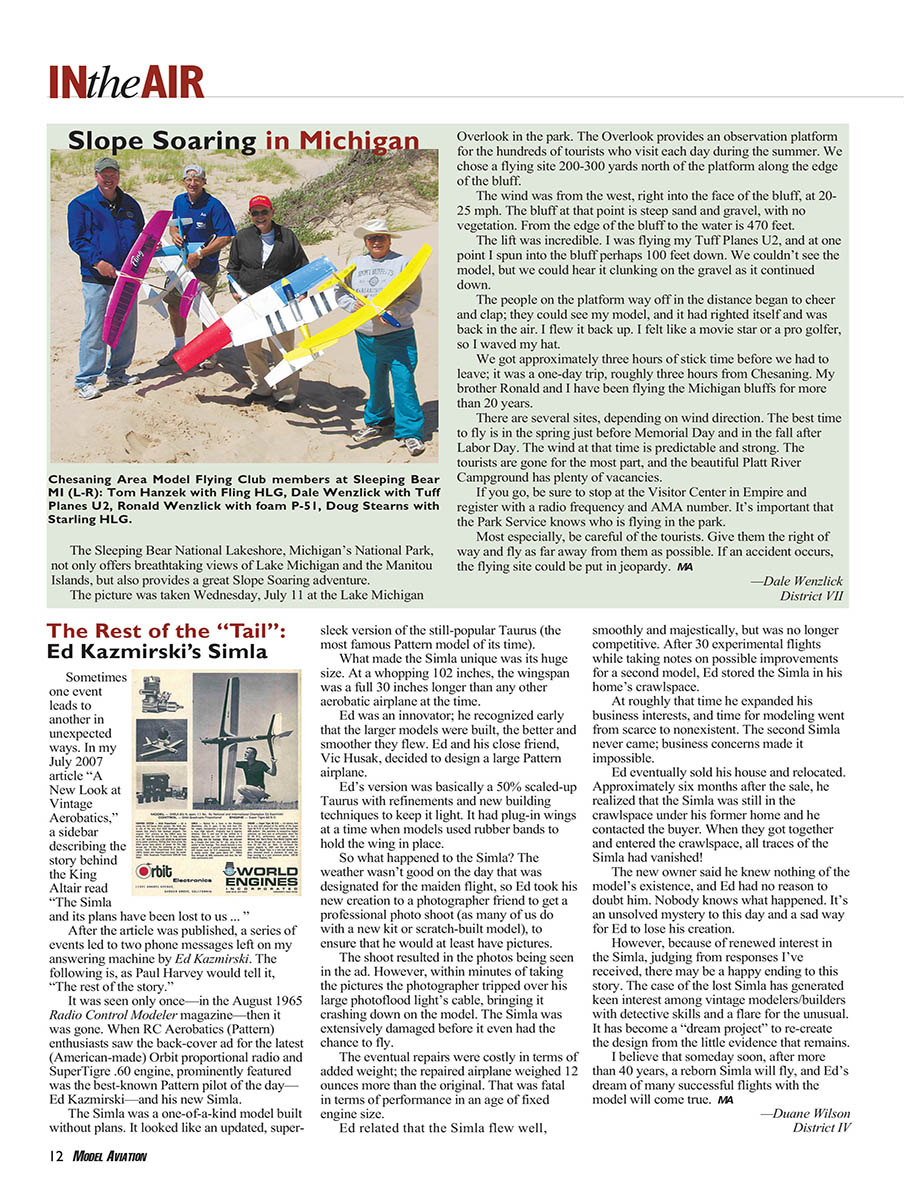
The Sleeping Bear National Lakeshore, Michigan’s national park, not only offers breathtaking views of Lake Michigan and the Manitou Islands, but also provides a great slope‑soaring adventure. The picture was taken Wednesday, July 11 at the Lake Michigan overlook in the park. The overlook provides an observation platform for the hundreds of tourists who visit each day during the summer. We chose a flying site 200–300 yards north of the platform along the edge of the bluff.
The wind was from the west, right into the face of the bluff, at 20–25 mph. The bluff at that point is steep sand and gravel, with no vegetation. From the edge of the bluff to the water is 470 feet.
The lift was incredible. I was flying my Tuff Planes U2, and at one point it spun into the bluff perhaps 100 feet down. We couldn’t see the model, but we could hear it clunking on the gravel as it continued downward. The people on the platform way off in the distance began to cheer and clap; they could see my model, and it had righted itself and was back in the air. I flew it back up, felt like a movie star or a pro golfer, and waved my hat.
We got approximately three hours of stick time before we had to leave; it was a one-day trip, roughly three hours from Chesaning. My brother Ronald and I have been flying the Michigan bluffs for more than 20 years.
There are several sites, depending on wind direction. The best time to fly is in the spring just before Memorial Day and in the fall after Labor Day. The wind at those times is predictable and strong. The tourists are mostly gone, and the beautiful Platte River Campground has plenty of vacancies.
If you go, be sure to stop at the Visitor Center in Empire and register with a radio frequency and AMA number. It’s important that the Park Service knows who is flying in the park.
Most especially, be careful of the tourists. Give them the right of way and fly as far away from them as possible. If an accident occurs, the flying site could be put in jeopardy.
MA — Dale Wenzlick, District VII
Transcribed from original scans by AI. Minor OCR errors may remain.

