
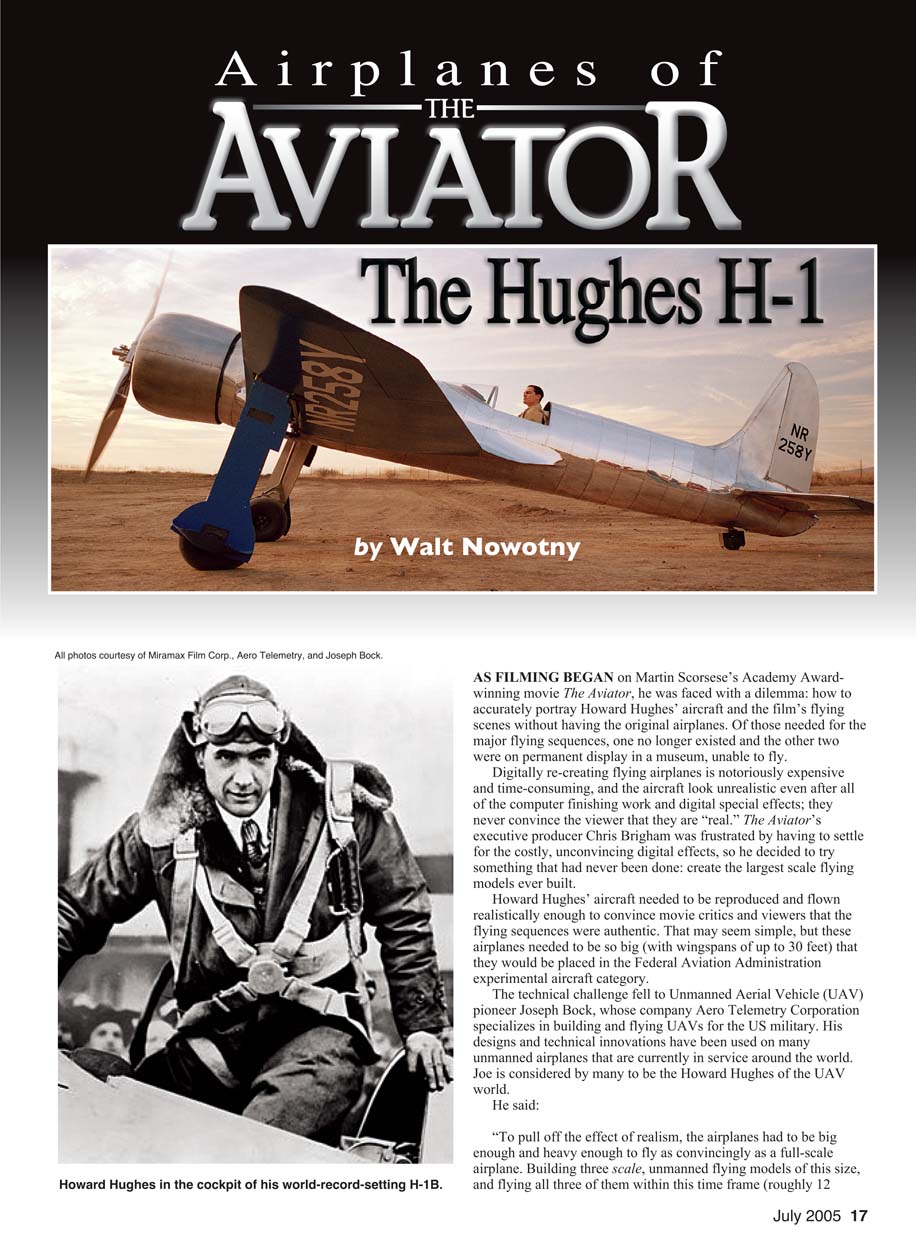
Airplanes of The Aviator: The Hughes H-1
by Walt Nowotny
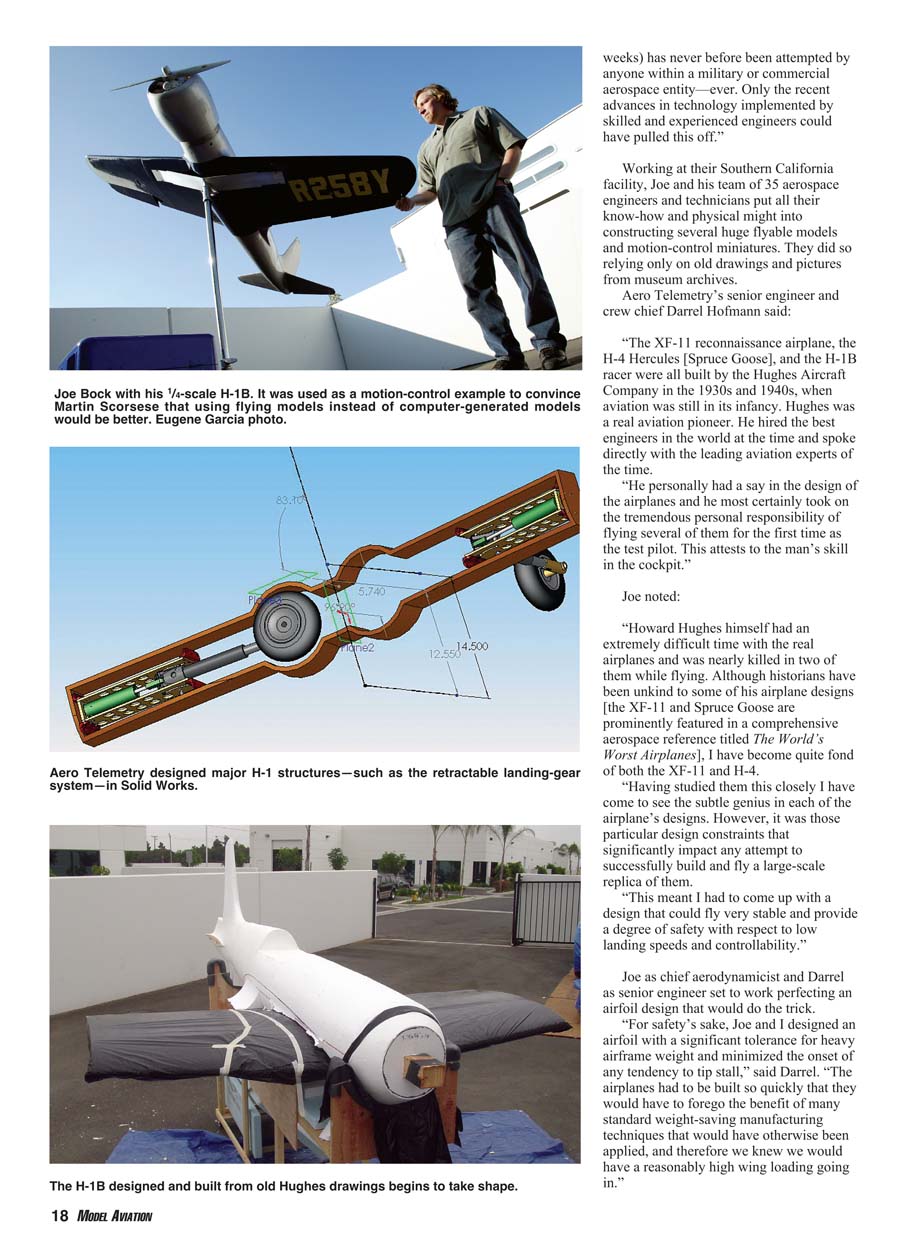
AS FILMING BEGAN on Martin Scorsese's Academy Award–winning movie The Aviator, he was faced with a dilemma: how to accurately portray Howard Hughes' aircraft and the film's flying scenes without having the original airplanes. Of those needed for the major flying sequences, one no longer existed and the other two were on permanent display in a museum, unable to fly.
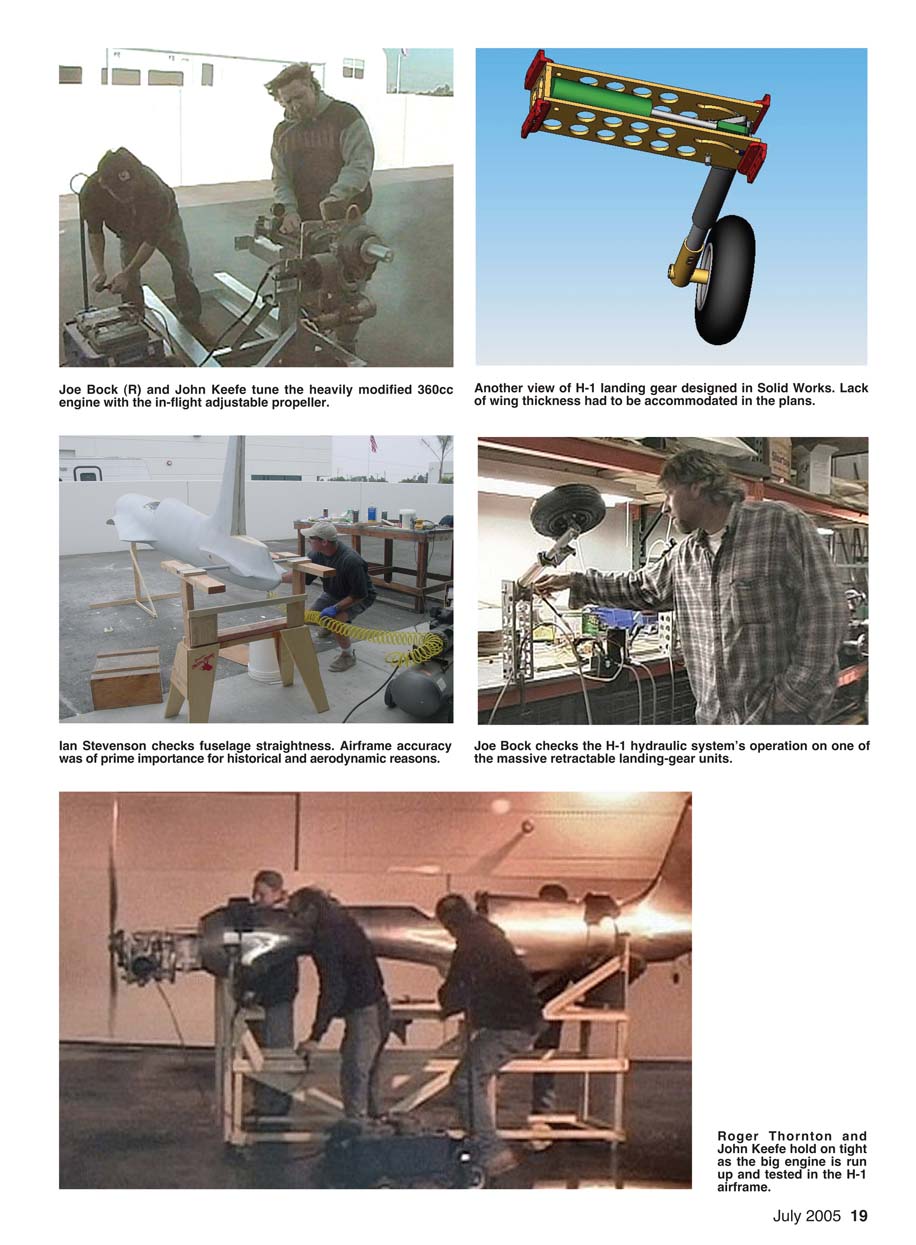
Digitally re-creating flying airplanes is notoriously expensive and time-consuming, and the aircraft look unrealistic even after all of the computer finishing work and digital special effects; they never convince the viewer that they are "real." The Aviator's executive producer Chris Brigham was frustrated by having to settle for the costly, unconvincing digital effects, so he decided to try something that had never been done: create the largest scale flying models ever built.
Howard Hughes' aircraft needed to be reproduced and flown realistically enough to convince movie critics and viewers that the flying sequences were authentic. That may seem simple, but these airplanes needed to be so big (with wingspans of up to 30 feet) that they would be placed in the Federal Aviation Administration experimental aircraft category.
The technical challenge fell to Unmanned Aerial Vehicle (UAV) pioneer Joseph Bock, whose company Aero Telemetry Corporation specializes in building and flying UAVs for the US military. His designs and technical innovations have been used on many unmanned airplanes that are currently in service around the world. Joe is considered by many to be the Howard Hughes of the UAV world.
He said:
“To pull off the effect of realism, the airplanes had to be big enough and heavy enough to fly as convincingly as a full-scale airplane. Building three scale, unmanned flying models of this size, and flying all three of them within this time frame (roughly 12 weeks) has never before been attempted by anyone within a military or commercial aerospace entity—ever. Only the recent advances in technology implemented by skilled and experienced engineers could have pulled this off.”
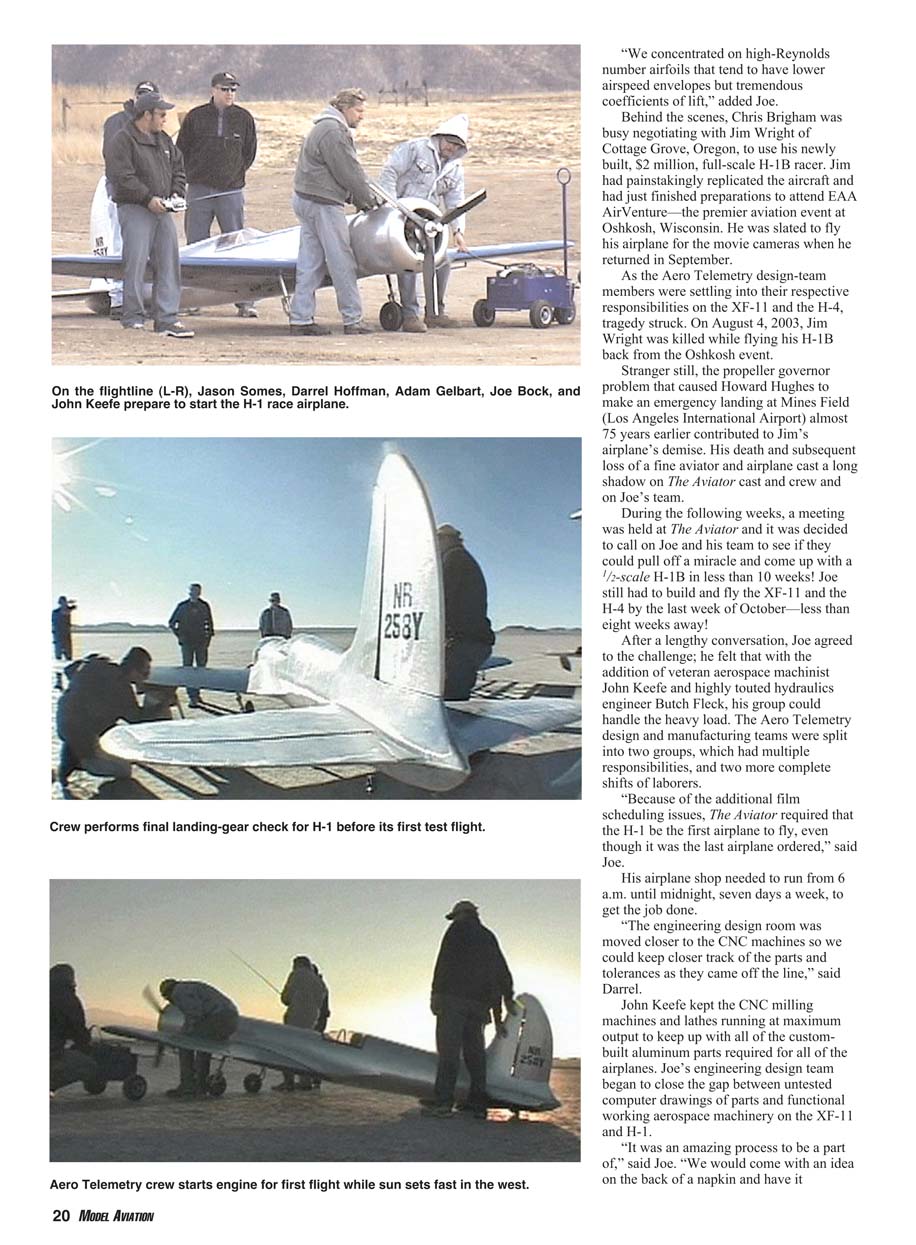
Working at their Southern California facility, Joe and his team of 35 aerospace engineers and technicians put all their know-how and physical might into constructing several huge flyable models and motion-control miniatures. They did so relying only on old drawings and pictures from museum archives.
Aero Telemetry’s senior engineer and crew chief Darrel Hofmann said:
“The XF-11 reconnaissance airplane, the H-4 Hercules [Spruce Goose], and the H-1B racer were all built by the Hughes Aircraft Company in the 1930s and 1940s, when aviation was still in its infancy. Hughes was a real aviation pioneer. He hired the best engineers in the world at the time and spoke directly with the leading aviation experts of the time.
“He personally had a say in the design of the airplanes and he most certainly took on the tremendous personal responsibility of flying several of them for the first time as the test pilot. This attests to the man’s skill in the cockpit.”
Joe noted:
“Howard Hughes himself had an extremely difficult time with the real airplanes and was nearly killed in two of them while flying. Although historians have been unkind to some of his airplane designs (the XF-11 and Spruce Goose are prominently featured in a comprehensive aerospace reference titled The World’s Worst Airplanes), I have become quite fond of both the XF-11 and the H-4.
“Having studied them this closely I have come to see the subtle genius in each of the airplane’s designs. However, it was those particular design constraints that significantly impact any attempt to successfully build and fly a large-scale replica of them.
“This meant I had to come up with a design that could fly very stable and provide a degree of safety with respect to low landing speeds and controllability.”
Joe as chief aerodynamicist and Darrel as senior engineer set to work perfecting an airfoil design that would do the trick.
“For safety’s sake, Joe and I designed an airfoil with a significant tolerance for heavy airframe weight and minimized the onset of any tendency to tip stall,” said Darrel. “The airplanes had to be built so quickly that they would have to forego the benefit of many standard weight-saving manufacturing techniques that would have otherwise been applied, and therefore we knew we would have a reasonably high wing loading going in.”
“We concentrated on high-Reynolds number airfoils that tend to have lower airspeed envelopes but tremendous coefficients of lift,” added Joe.
Behind the scenes, Chris Brigham was busy negotiating with Jim Wright of Cottage Grove, Oregon, to use his newly built, $2 million, full-scale H-1B racer. Jim had painstakingly replicated the aircraft and had just finished preparations to attend EAA AirVenture—the premier aviation event at Oshkosh, Wisconsin. He was slated to fly his airplane for the movie cameras when he returned in September.
As the Aero Telemetry design-team members were settling into their respective responsibilities on the XF-11 and the H-4, tragedy struck. On August 4, 2003, Jim Wright was killed while flying his H-1B back from the Oshkosh event.
Stranger still, the propeller governor problem that caused Howard Hughes to make an emergency landing at Mines Field (Los Angeles International Airport) almost 75 years earlier contributed to Jim’s airplane’s demise. His death and subsequent loss of a fine aviator and airplane cast a long shadow on The Aviator cast and crew and on Joe’s team.
During the following weeks, a meeting was held at The Aviator and it was decided to call on Joe and his team to see if they could pull off a miracle and come up with a 1/2-scale H-1B in less than 10 weeks! Joe still had to build and fly the XF-11 and the H-4 by the last week of October—less than eight weeks away!
After a lengthy conversation, Joe agreed to the challenge; he felt that with the addition of veteran aerospace machinist John Keefe and highly touted hydraulics engineer Butch Fleck, his group could handle the heavy load. The Aero Telemetry design and manufacturing teams were split into two groups, which had multiple responsibilities, and two more complete shifts of laborers.
“Because of the additional film scheduling issues, The Aviator required that the H-1 be the first airplane to fly, even though it was the last airplane ordered,” said Joe.
His airplane shop needed to run from 6 a.m. until midnight, seven days a week, to get the job done.
“The engineering design room was moved closer to the CNC machines so we could keep closer track of the parts and tolerances as they came off the line,” said Darrel.
John Keefe kept the CNC milling machines and lathes running at maximum output to keep up with all of the custom-built aluminum parts required for all of the airplanes. Joe’s engineering design team began to close the gap between untested computer drawings of parts and functional working aerospace machinery on the XF-11 and H-1.
“It was an amazing process to be a part of,” said Joe. “We would come with an idea on the back of a napkin and have it and varying ratios of fuel and oil until the right combination provided the required horsepower at a safe cylinder-head temperature. Integration of the Aero Telemetry AT-DRV-3000 Telemetry and Data Acquisition System would later substantiate the preliminary ground-test data with actual airborne-test data.
Between the deafening engine test runs and the scream of hydraulic pumps throughout the shop, Aero Telemetry’s scale-detail expert Adam Gelbart and the rest of the team were putting the finishing touches on the airplanes coming down the production line.
“These airplanes were being used for close-up film-camera work, so we had to make the airplanes look as good as they flew,” said Adam.
By October 25 — the week originally scheduled for filming the H-1B — the fires in Los Angeles had decimated The Aviator set, rendering it unusable. The accompanying heavy smoke made it almost impossible to breathe, much less film, so all outside shots were postponed for two weeks. This break in the action gave Joe and his team the respite they sorely needed to continue.
They performed static load testing and CG tests, and the final finishing touches were added to the H-1’s cowl and fuselage. The engine, hydraulics, linear servo controls, Aero’s onboard telemetry system, and fuel-supply system were retested and secured for flight. By this time the entire crew had been working two-and-a-half shifts since September 16, and they were exhausted.
“And we hadn’t even started the flight-testing portion of the project yet!” exclaimed Joe.
First Flight Test: November 4, 2003 — the day for the H-1’s first flight — had arrived. The team was nervous, and Joe was concerned because they had been unable to test-fly the airplane first. All things considered, safety was the foremost issue.
When the crew arrived at Santa Clarita, California’s famous Mystery Mesa (a location just north of Los Angeles, long favored by Hollywood as a unique film setting), they found a full movie set with more than 500 people milling about. Service trucks and vehicles were everywhere, and there was only a crowded dirt road for a takeoff area. Above it all, the set was directly on a windy mountaintop surrounded by extremely treacherous terrain, with no place to land in case of an in-flight emergency.
“The area was completely untenable for aircraft, to say the least,” Joe remarked. “Any problem with a critical component on an airplane this big and fast that might cause loss of control would spell certain disaster for the airplane and probably death or serious injury to anyone if it came into the crowded film set area.”
Besides the safety and liability issues for Joe, crashing the model was not an option at this critical point in the project. If the H-1 were to be destroyed during testing, there would be neither enough time nor resources to build another to fit into the filming schedule, and its flying scenes would be deleted from the script.
A crash at this early stage would likely result in the cancellation of the entire project, including the XF-11 and H-4 which were already under construction. The visual-effects producer indicated that if Joe failed, the other models would be too risky, expensive, and dangerous to try. So this single flight would have serious consequences for the team; everything they had worked on up to this point was at risk.
The combination of all these issues created such liability, pressure, and anxiety within the team that Joe declined to fly at that location and time. It was decided that a proper flight test in a safe place was needed.
The entire flight crew set off for a location roughly two hours away known as El Mirage Dry Lake, which is located closer to Edwards Air Force Base and in the high-desert area of California. The lakebed is known as one of the flattest places on earth—perfect for airplane testing.
The crew arrived tired from the early morning at Mystery Mesa but relieved to be in a safe, remote area. After assembling the H-1, the team started final preparations for the flight. The hydraulic landing gears needed finishing adjustments, as did the big military drone engine; the altitude was roughly 2,700 feet above sea level, and increased altitude decreases engine performance.
To help with the power loss, it was decided to remove the mufflers from the engine to get every last bit of power it had. Although this increased power, it made working around the running engine almost unbearable; the exhaust noise sounded more like a 20mm machine gun than an engine!
In an eerie coincidence, the in-flight adjustable-propeller-pitch mechanism was not going to cooperate. This was the same type of problem encountered by Howard Hughes (forcing his emergency landing at Mines Field) and Jim Wright (ultimately causing his crash). A temporary fix was installed, and the crew proceeded with a fixed-pitch propeller.
“We would try to keep the airplane climbing as fast as possible without over-revving the engine,” said John Keefe. “When the airplane got to a cruising altitude, the pilot could reduce power and try to see if the airplane would stay in level flight so we could get some real aerodynamic data from our H-1.”
With the major telemetry checks showing green, the only other problem was that the sun was setting fast in the west. With only minutes of good flying conditions left, Joe gave the launch signal, and the arming switches were turned on the engine, a multitude of airborne electronic systems, and the Aero Telemetry UHF uplink transmitter.
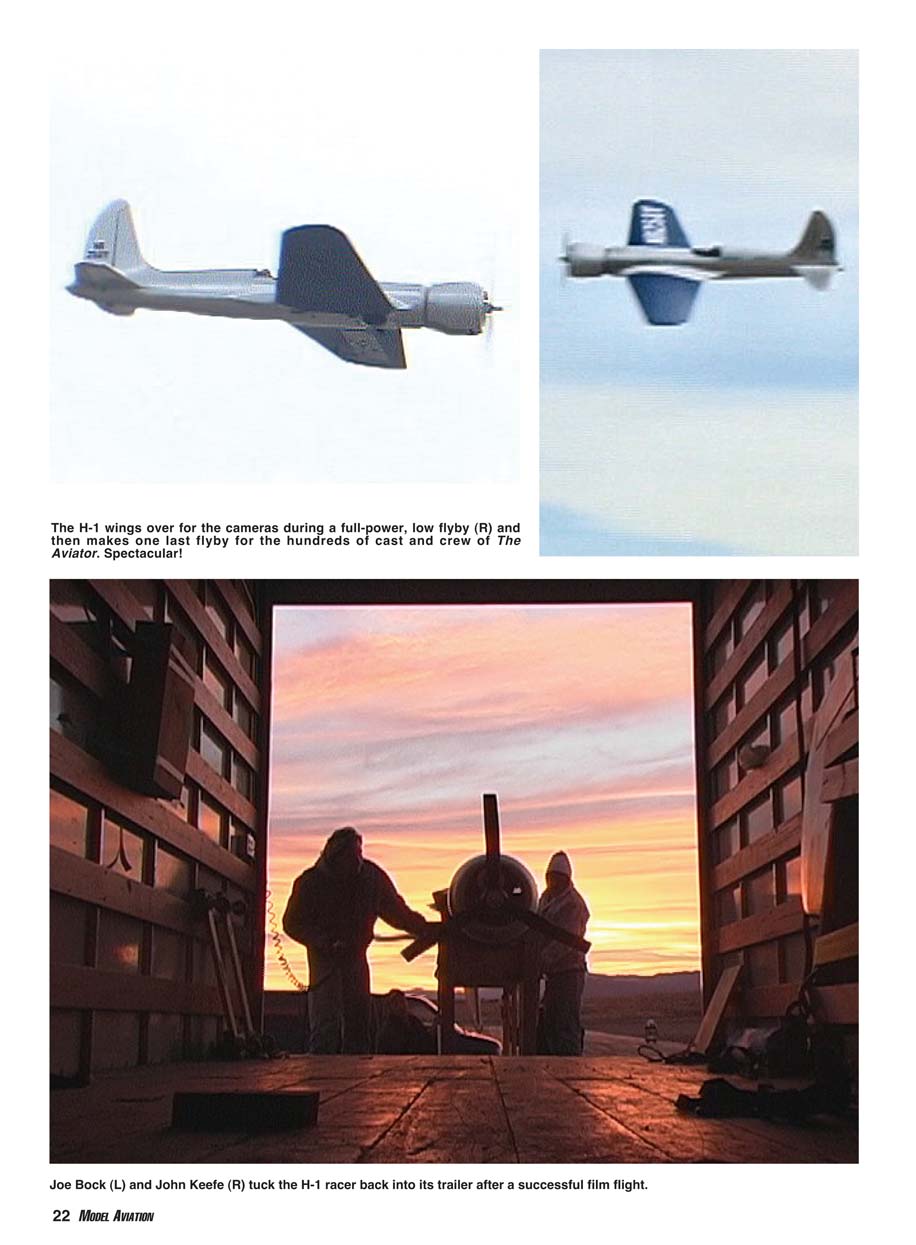
Seasoned RC pilot Jason Somes pushed the throttle forward, and, with a final push from Joe, the H-1 headed off for its date with destiny. It picked up speed, and after what seemed like forever, with the engine running at full throttle, its tail lifted and it started skyward. Cheers from the crew overpowered the sound of the engine.
Jason climbed the H-1 in a relatively flat left-hand turn that brought it back around toward the crew so they could get a visual on the landing gear and control surfaces.
Everything looked good, so he throttled back and the airplane settled in a little, moving in an oval racetrack pattern probably within roughly a mile of the ground control.
Trim adjustments were made to the elevator for pitch stability, and it was time to retract the hydraulic landing gear. The switch was flipped, and the gear disappeared into their wheel wells perfectly.
The H-1 flew better with the gear up, but Jason was beginning to notice a considerable pitch-stability issue. Whenever he slowed the model with the engine throttle, it tried to pitch up. This is a deadly condition when combined with the over-running-propeller problem.
Joe called for more altitude, and the H-1 responded with a smooth climbout before making another pass in front of the crew. It was time to come home.
Jason lowered the landing gear on the downwind leg; as the airplane made its base turn to final approach, those present stood still and held their breath for the setup to landing. Jason leveled the wings for the final time and held the model in a nose-level attitude while reducing the engine’s power settings to the point of nearly shutting it off.
The H-1 descended quickly with the big three-blade propeller windmilling out in front, and it became deathly quiet in the desert; no one spoke as all eyes were glued to the aluminum fuselage as it flashed in front of the crew and the model began to settle into a condition known as “ground effect.” This is a buffeting that occurs as an airplane’s wing nears the ground, preventing it from touching the earth while riding on a pillow of air.
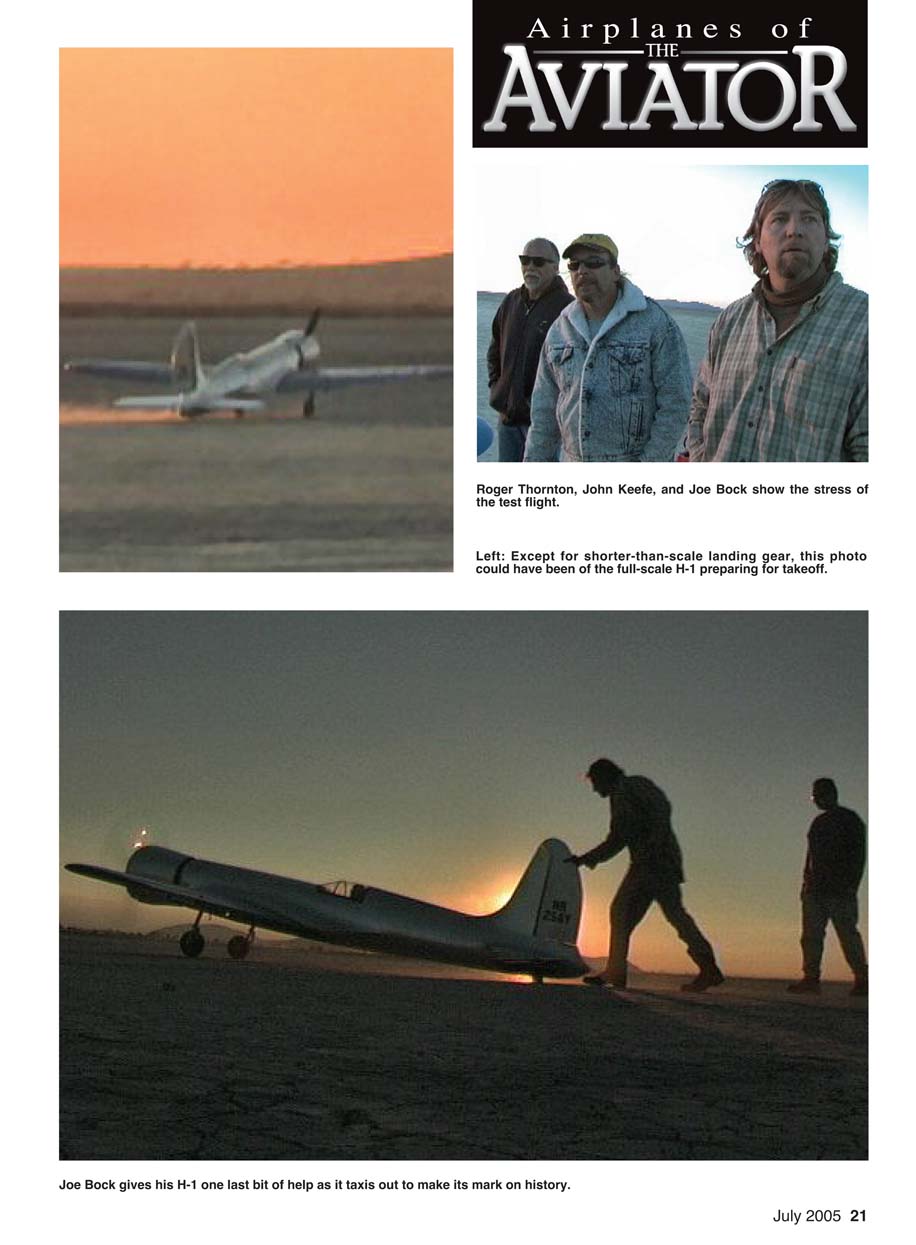
As the aircraft’s nose pitched up a few feet off the ground, a tremendous roar went up from those present. It touched down in a perfect three-point landing, skidding slightly to the right while sending up a rooster tail of dirt and sand from the fixed tail-skid assembly, signifying that the H-1 had made its way into aviation history and would live to fly again.
With pride in his voice, Joe said:
“The pressure of the flight, its schedule, and long hours of engineering manifested themselves in some tears of joy from many of those who had just witnessed the amazing flight of the largest unmanned H-1B racer in the world.
“The flight was significant insofar as it proved many of the design innovations that we [Aero Telemetry] brought to the project.
As the principal filming finished at Mystery Mesa, the producers bulldozed and rolled flat a perfect runway. In addition, there would be a minimal number of people in the area to minimize safety hazards during the flight.
The Aero Telemetry crew arrived in the dark at 4:30 a.m., and by 7 a.m. the engine was started and returned for the location’s altitude. After a lengthy safety meeting, the cast and crew prepared for an attempt. Two fire trucks, an ambulance, and emergency personnel stood at the ready.
Joe explained:
“We installed a new 48‑inch‑diameter, three‑blade, in‑flight adjustable propeller and was prepared to adjust it for the maximum pitch of around 54 inches when we got ready to cut the engine loose.
“The larger propeller required that the pilot take off and land the Hughes racer in the three‑point position or risk the chance of hitting the prop blades on the runway. Therefore, the high angle of attack made the takeoffs and landings very nerve‑racking.”
With Jason Somes back at the controls, Joe gave the order for the takeoff run; the military engine roared to life as the H‑1 rolled out on its first flight of the day. The takeoff did have its issues; the model got “a little sideways” from the engine torque and the huge three‑blade propeller turning at a full 54 inches of pitch.
Although the runway was perfect, the airplane was so large that it was the width of the runway wingtip to wingtip. For the film effect, several old cars and trucks and vintage airfield equipment lined both sides of the runway, making it a challenge not to hit anything with the model on takeoff or landing.
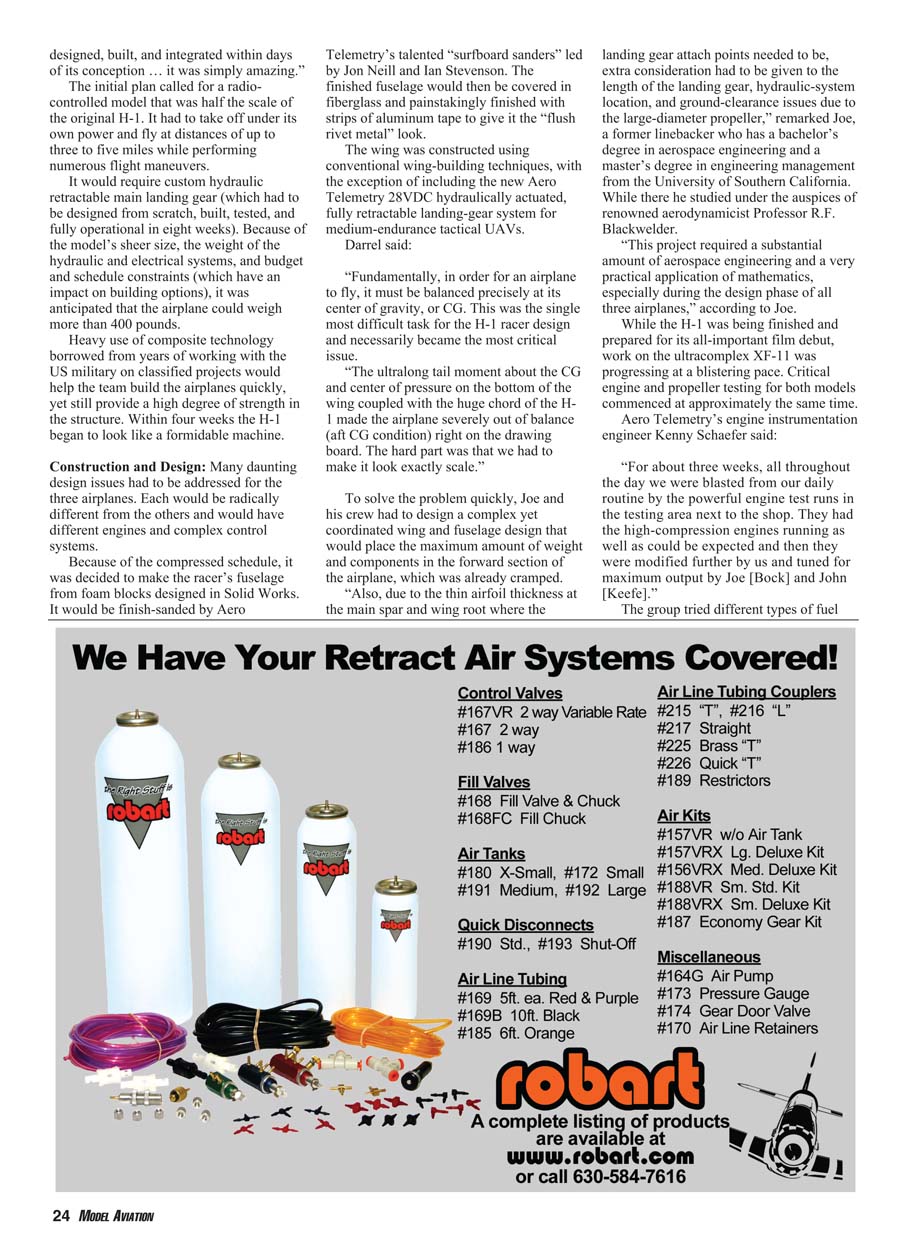
The H‑1 climbed out steadily, much to the amazement of the film crew and emergency personnel, who had never witnessed such a spectacle. When the airplane began its first pass over the film set in a diving left‑hand turn, the roughly 200 spectators looked gripped by fascination. As the gear retracted and the airplane picked up speed, it seemed to transform into Howard Hughes flying the H‑1 as he had more than 75 years ago.
At nearly the time Jason was getting more comfortable with the airplane’s handling characteristics, it came time to land and refuel. He shot a perfect approach to the top of the mountain and three‑pointed the aircraft right on the money. The several hundred film personnel and spectators cheered wildly as it settled in and slowed to a stop, using every inch of the bumpy runway.
Before the cheering had stopped, the Aero Telemetry ground crew was in action downfield, trying its best to ensure the H‑1’s quick recovery and turnaround. But it was discovered that the rough runway coupled with the heavy down‑force on the empennage had destroyed the tail on landing.
Crew chief Darrel Hoffman immediately set about fabricating a fully functional replacement tail‑skid assembly that not only worked perfectly for maintaining directional stability for the big racer, but remained out of sight for the movie cameras during the next flight.
“There wasn’t a machine shop available out there, so it became a race with time for me to come up with a tail‑skid assembly that would be functional and strong enough to withstand the weight of the airplane, and I only had about 20 minutes to do it!” he exclaimed.
While the movie crew busily reloaded ground cameras and made final adjustments to the aerial coordinator’s helicopter film cameras for the next flight, John Keefe and Roger Thornton quickly refueled the H‑1, and Joe adjusted the engine for maximum power. He said:
“1/4 turn of the high speed needle put the big drone engine at a full military power setting. For the film sequences of Howard Hughes’ world‑speed‑record attempt, we not only tried to re‑create something very special for Martin Scorsese and Chris Brigham, but also we were attempting to own the world speed record for the fastest 1/2‑scale airplane manned or unmanned, and I think we did it on this flight!
“We were clocked going downhill at somewhere around 150 knots [172 mph], and it was an utterly amazing sight to behold.”
The next flight had an escort in the sky: a manned helicopter used for aerial filming. The H‑1’s three‑point takeoff was perfect, and the landing gear were retracted before the airplane had even turned crosswind as it climbed out in a beautiful arc across the sky.
As the aircraft was brought out of the diving turn, the throttle was pushed full forward and the giant propeller turned at maximum pitch. The model’s incredible sound echoed throughout the canyons surrounding the set. When they brought the airplane in at full throttle through the pylons only 20 feet from the ground, it sounded like a freight train and was indistinguishable from the real thing ... it just literally shook the ground around us as it flew past.”
The aircraft’s rock‑steady flight characteristics, high speed, and detailed finish combined with the vintage‑airfield setting at Mystery Mesa was realistic and convincing, even for the spectators. The Aviator Executive Producer Chris Brigham, who had witnessed the flight from the vantage point of the helicopter, told Joe that “the airplane was simply breathtaking to watch from up there.”
After several passes through the mock speed course, the H‑1 was ready to land. Before it did, though, Joe told Jason to perform an unscripted maneuver as a fitting salute to Howard Hughes and those who were there that day to witness his H‑1B’s record‑setting flight.
As the model flew past the crew at full throttle, “the H‑1 did the most beautiful slow roll you’ve ever seen,” said Joe. “Probably something that Howard would have done too. The record‑setting performance of our H‑1 racer was absolutely breathtaking to witness, and it was done under some of the most extreme circumstances imaginable.”
Of the day, he said:
“The incredible effort of the team during these last few weeks cannot be overstated. The airplane flew perfectly and provided the cameras with some of the most amazing aerial footage of the H‑1 racer that could have only been had if Howard Hughes himself were here to do it ... in some ways I really think he may have been ...”
MA Walt Nowotny
(Editor’s note: Next month learn how Joe and the Aero Telemetry team designed, built, and flew the world’s largest and fastest Hughes XF‑11 scale model for Martin Scorsese and The Aviator.)
Transcribed from original scans by AI. Minor OCR errors may remain.

