
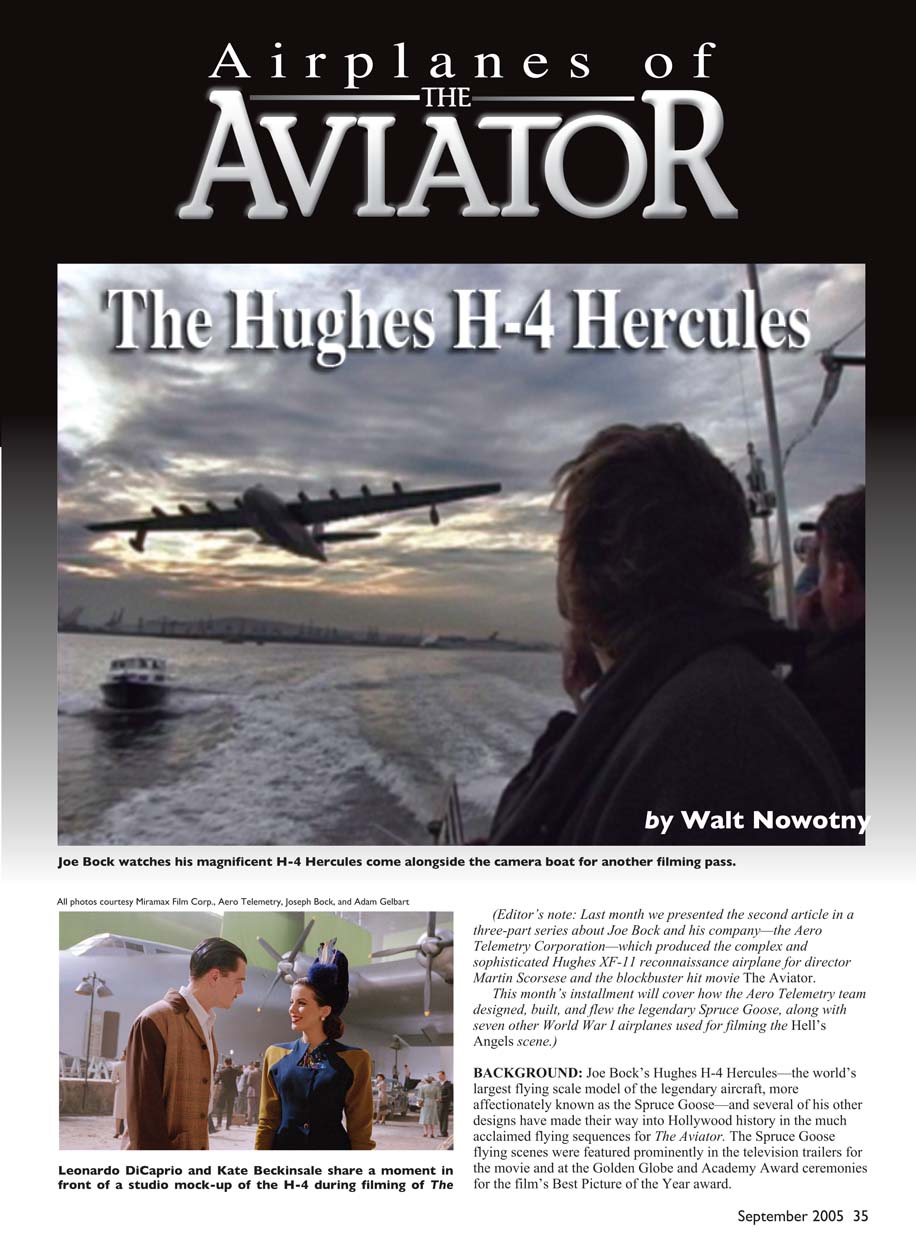
The Hughes H-4 Hercules
by Walt Nowotny
(Editor's note: Last month we presented the second article in a three-part series about Joe Bock and his company—the Aero Telemetry Corporation—which produced the complex and sophisticated Hughes XF-11 reconnaissance airplane for director Martin Scorsese and the blockbuster hit movie The Aviator.
This month's installment will cover how the Aero Telemetry team designed, built, and flew the legendary Spruce Goose, along with seven other World War I airplanes used for filming the Hell's Angels scene.)
BACKGROUND:
Joe Bock's Hughes H-4 Hercules—the world's largest flying scale model of the legendary aircraft, more affectionately known as the Spruce Goose—and several of his other designs have made their way into Hollywood history in the much acclaimed flying sequences for The Aviator. The Spruce Goose flying scenes were featured prominently in the television trailers for the movie and at the Golden Globe and Academy Award ceremonies for the film's Best Picture of the Year award.
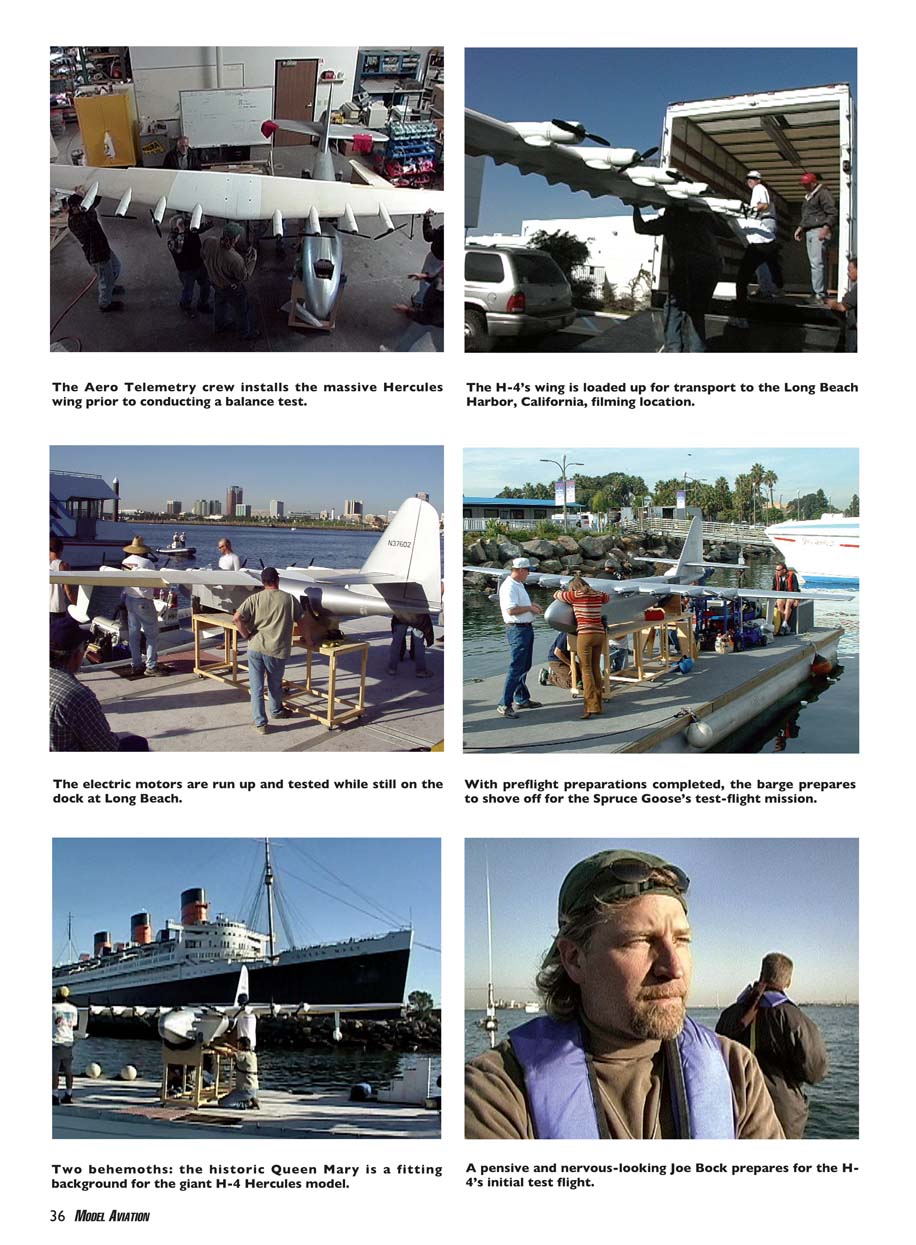
The Aero Telemetry crew installs the massive Hercules wing prior to conducting a balance test.
The H-4's wing is loaded up for transport to the Long Beach Harbor, California, filming location.
The electric motors are run up and tested while still on the dock at Long Beach.
With preflight preparations completed, the barge prepares to shove off for the Spruce Goose's test-flight mission.
Two behemoths: the historic Queen Mary is a fitting background for the giant H-4 Hercules model.
A pensive and nervous-looking Joe Bock prepares for the H-4's initial test flight.
Airplanes of The Aviator: The Hughes H-4 Hercules
Walt Nowotny
Within days of completing the flights of the XF-11 and H-1B racer, in what was one of the most amazing demonstrations of unmanned-air-vehicle technology for a Hollywood movie, Joe and his team were preparing for what was to become the most rewarding and renowned radio-control airplane in history: the world's largest flyable model of the Hughes H-4 Hercules.
During the month of November 2003, Aero Telemetry had been busy working for The Aviator. At that point the team had successfully designed and flown a single-engine, 1/2-scale H-1B racer; an extremely complex twin-engine, 30-foot-wingspan XF-11; and several smaller World War I biplanes, such as British S.E.5s and Fokker D.VIIs, for the Hell's Angels scene in the movie.
Howard Hughes built the original Spruce Goose in the 1940s, and it was intended to be a troop transport for the US military. It weighed more than 300,000 pounds and spanned approximately 320 feet, making it the largest airplane in the world. The Hercules was powered by eight Pratt & Whitney R-4360 engines making 3,500 horsepower each.
The film version would be roughly 1/16 scale of the original, spanning almost 25 feet. It would weigh 375 pounds and be powered by eight motors. Its primary mission would be to take off from the Pacific Ocean and fly around the outer Long Beach Harbor area, where Howard Hughes and his beloved airplane preceded it by almost 60 years.
The model would have to be able to safely fly at distances of up to two miles while performing basically what Howard Hughes did: fly within ground effect over the water with wings level.
That all sounds simple enough, but with such a compressed schedule—the model had to be constructed in roughly four weeks—and several other airplanes coming down the line, the Aero Telemetry aerial-effects team would have its hands full.
Design and Construction:
Work on the Spruce Goose proceeded alongside the other airplanes. However, because of scheduling, final details required for flight were pushed off until the week before the filming date.
Only two days after the stressful XF-11 flights, the exhausted Aero Telemetry crew had to shift gears one more time and prepare a flight plan for an airplane that would be totally different from the other two they had finished.
Joe said:
"By designing a multiengine seaplane, we covered three separate categories of general-aviation airplanes since all three of the primary models were radically different from each other. It was a real engineering challenge to shift gears midstride and keep them all working perfectly.
From a design standpoint, the H-4 Hercules was a much simpler airplane to build and fly for movie cameras. It didn't require landing gear, hydraulics, fuel tanks, or a complicated control system.
This Spruce Goose would use electric motors due to constraints with cowling size and scale appearance for the cameras. Gas engines couldn't be used for this application because the cylinder heads would protrude from the cowls, giving away the actual size of the model."
Joe wasn't entirely sold on using electric power for such a big airplane, so he contacted motor experts Don Holfeldt and Walt Cloer. They suggested employing eight motors driving two-blade propellers with reduction gears and assembled the battery packs with approximately 20 3.3 Ah NiMH cells for each motor.
"Don, Walt, and George Peters assisted with the testing of the motors prior to the flight and were responsible for the charging of the batteries during the flights in the Long Beach Harbor," said Joe. "They played a big part in the success of the motors for our H-4."
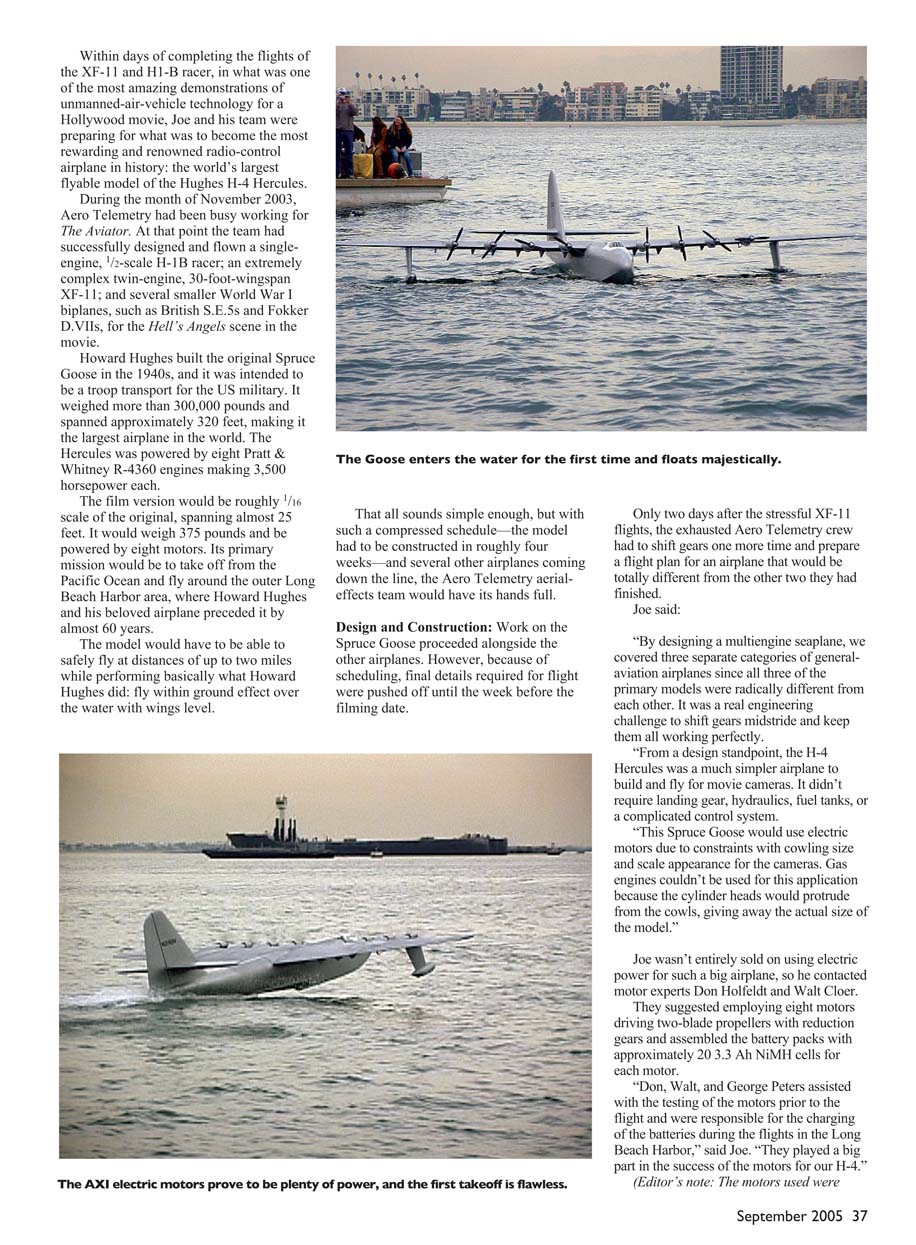
(Editor's note: The motors used were eight AXI 4120/18 units imported by Hobby Lobby. Joe Zingali of Zinger Products custom-made the propellers, four of which were left-handed and four of which were right-handed. The motors on the either side of the fuselage were set up to turn in opposite directions.)
Joe and H-4 Crew Chief Darrel Hoffman designed an airfoil shape for the Spruce Goose wing that would allow for a tremendous amount of lift at high angles of attack. It would also have excellent stability about the roll axis. This greatly contributed to the success of the flights.
A removable, watertight forward battery compartment was added. The batteries' weight actually helped make the model easy to balance.
The H-4 also featured starboard engines turning clockwise and port-wing engines running counterclockwise for directional stability during flight and while taxiing. An Aero Telemetry uplink controller system was used as the primary radio-frequency control. This increased the model's operational range and the margin of safety with respect to flying in the crowded airspace around Los Angeles.
First Test Flight:
The weather on November 23, 2003, was perfect. The Aero Telemetry flight crew was under extreme pressure to test-fly the H-4 and still have it sufficiently detailed for the following day's filming. The Los Angeles Port Authority had cleared the Long Beach Harbor in that area in preparation for the flight, which provided additional stress.
There would be hundreds of people standing by waiting and watching the Spruce Goose's first flight, many of whom were there in an official capacity, such as the Coast Guard, Harbor Patrol, safety personnel, rescue divers, and other movie staff. Joe said:
"Anyone who has flown an airplane for the first time can appreciate the tremendous anxiety that exists just prior to a first flight. Multiply that by 100 and that's what we had.
"We only had about four weeks to make sure our aerodynamic designs, structural components, electrical systems, and avionics were absolutely perfect on the H-4. With an airplane this large built from scratch in only a few weeks, that is a daunting task.
"As usual, there was a zero margin for error for us. Everything had to work perfectly right off the board. Any mistake out in the ocean and it would have been a disaster. The Aviator producers had tied up millions of dollars in scheduling the equipment and personnel for the filming.
"Anything that would have caused a problem for us or the Spruce Goose or in any way impacted the ability for the airplane to fly and perform the following day would have caused serious financial upset; it only added to our resolve to succeed."
Veteran pilot Bill Hempel and Joe as flight leader discussed details of the takeoff area based mostly on wind and water conditions. Before we knew it, the Goose was being lowered into the water; in no time it was on its takeoff run.
Darrel Hofmann said:
"Because of the choppy water in the harbor, [the Spruce Goose] was taking a lot of water into the engines; that's what I remember most. I figured if it was going to be taking on so much water, then we may as well get it into the air and see if we could keep some fresh air going through there as well!"
Not knowing for sure if the model was going to take off or just plow through the water, the flight crew of approximately 18 people was breathless. John Keefe said:
"As the Goose started forward, she hit a couple of the ocean swells, and by about the third one she shot out of the water. All at once a tremendous cheer went up from all of the Aero Telemetry crew—even the Coast Guard personnel got into it! The H-4 looked as though it had been shot out of a cannon into the air!"
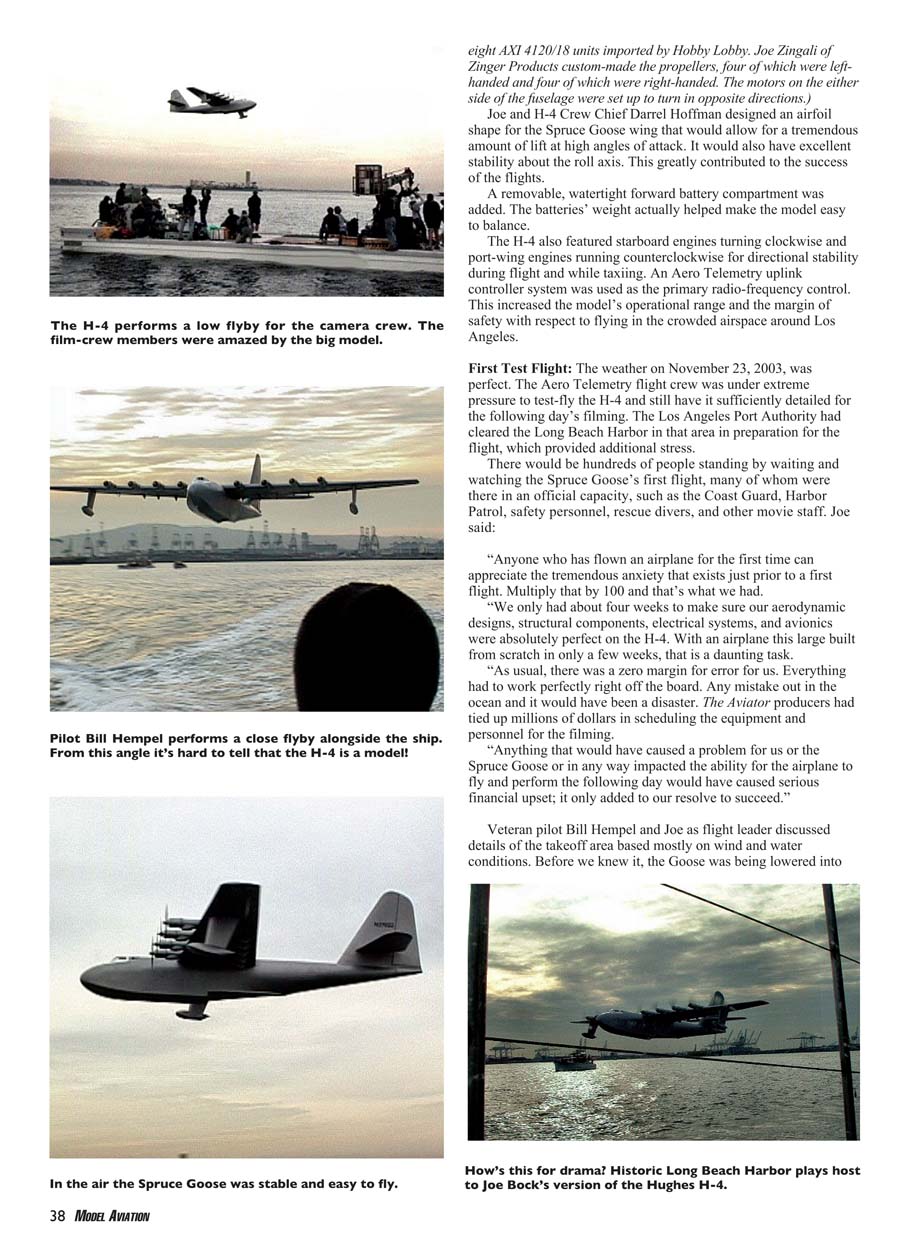
The Spruce Goose's almost 400 pounds went hurtling out of the water and increased its angle of attack to roughly 35°, climbing out under full power! The crew gasped. Bill kept it under control and brought it around for a few high-altitude passes to check out the trims. No additional trims were added to the controls on the first flight; they were all right on the money.
He handed the controls to Joe, who was still barking out additional orders and details to the crew. To the other engineers' relief, the orders stopped immediately while Joe concentrated on flying the model for a while. It handled like a trainer and was smooth on the controls.
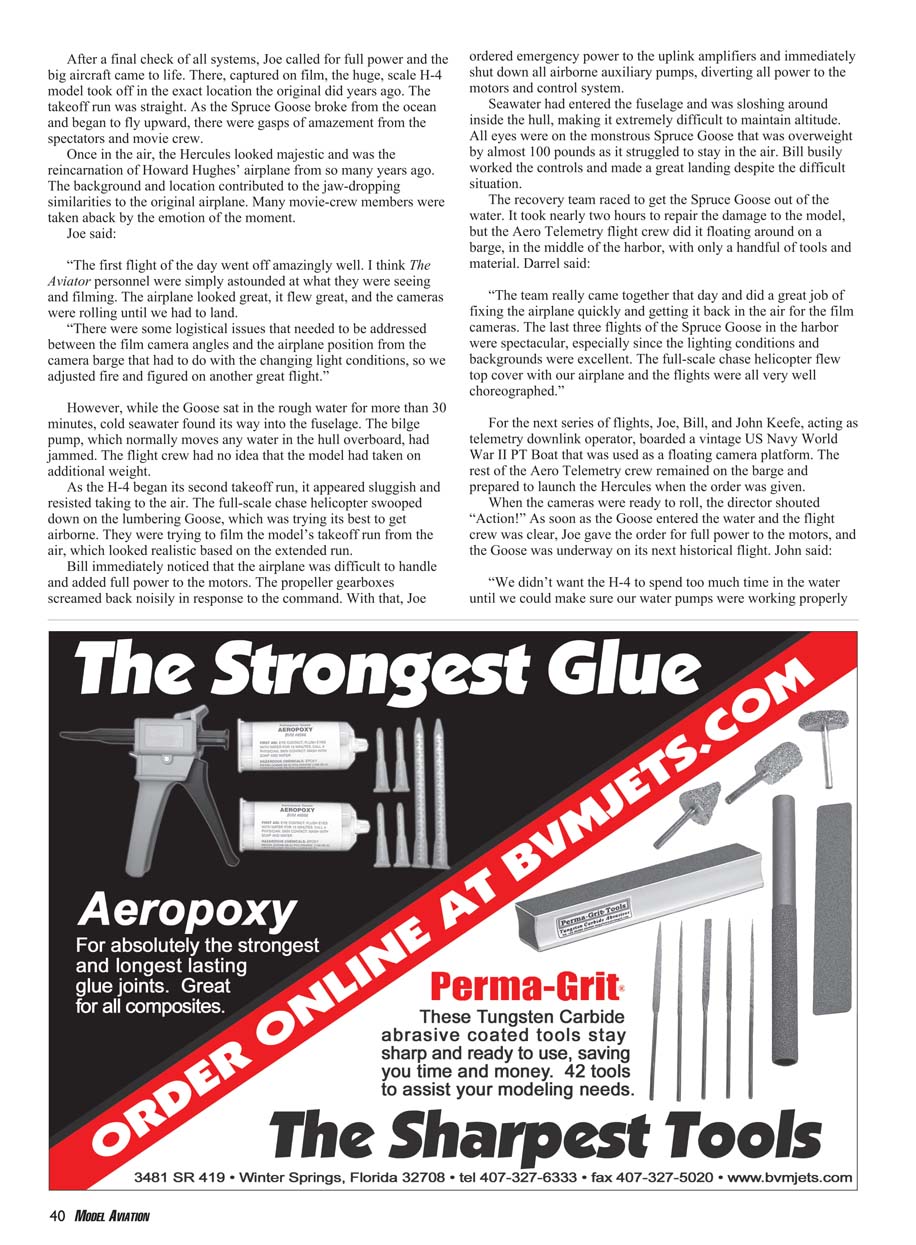
Joe handed the radio back to Bill, who set up for a perfect approach into a 10-knot headwind and landed the H-4 with a hint of a forward bounce. A cheer went up from all who had just witnessed the most amazing flight of the largest electric-powered flying boat in the world. Aero Telemetry's H-4 was flown close to where Howard Hughes flew his airplane almost 57 years to the day before.
Film Flights:
The Aero Telemetry flight crew arrived at Long Beach Harbor early on November 24, 2003, after spending the night repainting the H-4 and installing additional avionics. After a previsualization meeting with the director and a check of all systems, Joe's Hercules was ready for its historical film debut.
The airplane was loaded onto a barge and moved into a location that put it south of the Queen Mary. Once in position it was lowered into the ocean, and the eight motors were started in sequence until all of them turned in unison.
There was a short, nervous delay in the Spruce Goose's first launch as several of the vintage Navy boats were moved into a position that would align them with the camera and the model's anticipated flight path. Hundreds of people gathered on the nearby ships and shoreline of Long Beach to witness the spectacle.
After a final check of all systems, Joe called for full power and the big aircraft came to life. There, captured on film, the huge, scale H-4 model took off in the exact location the original did years ago. The takeoff run was straight. As the Spruce Goose broke from the ocean and began to fly upward, there were gasps of amazement from the spectators and movie crew.
Once in the air, the Hercules looked majestic and was the reincarnation of Howard Hughes' airplane from so many years ago. The background and location contributed to the jaw-dropping similarities to the original airplane. Many movie-crew members were taken aback by the emotion of the moment.
Joe said:
"The first flight of the day went off amazingly well. I think The Aviator personnel were simply astounded at what they were seeing and filming. The airplane looked great, it flew great, and the cameras were rolling when we had to land.
"There were some logistical issues that needed to be addressed between the film camera angles and the airplane position from the camera barge that had to do with the changing light conditions, so we adjusted fire and figured on another great flight."
However, while the Goose sat in the rough water for more than 30 minutes, cold seawater found its way into the fuselage. The bilge pump, which normally moves any water in the hull overboard, had jammed. The flight crew had no idea that the model had taken on additional weight.
As the H-4 began its second takeoff run, it appeared sluggish and resisted taking to the air. The full-scale chase helicopter swooped down on the lumbering Goose, which was trying its best to get airborne. They were trying to film the model's takeoff run from the air, which looked realistic based on the extended run.
Bill immediately noticed that the airplane was difficult to handle and added full power to the motors. The propeller gearboxes screamed back noisily in response to the command. With that, Joe ordered emergency power to the uplink amplifiers and immediately shut down all airborne auxiliary pumps, diverting all power to the motors and control system.
Seawater had entered the fuselage and was sloshing around inside the hull, making it extremely difficult to maintain altitude. All eyes were on the monstrous Spruce Goose that was overweight by almost 100 pounds as it struggled to stay in the air. Bill busily worked the controls and made a great landing despite the difficult situation.
The recovery team raced to get the Spruce Goose out of the water. It took nearly two hours to repair the damage to the model, but the Aero Telemetry flight crew did it floating around on a barge, in the middle of the harbor, with only a handful of tools and material. Darrel said:
"The team really came together that day and did a great job of fixing the airplane quickly and getting it back in the air for the film cameras. The last three flights of the Spruce Goose in the harbor were spectacular, especially since the lighting conditions and backgrounds were excellent. The full-scale chase helicopter flew top cover with our airplane and the flights were all very well choreographed."
For the next series of flights, Joe, Bill, and John Keefe, acting as telemetry downlink operator, boarded a vintage US Navy World War II PT Boat that was used as a floating camera platform. The rest of the Aero Telemetry crew remained on the barge and prepared to launch the Hercules when the order was given.
When the cameras were ready to roll, the director shouted "Action!" As soon as the Goose entered the water and the flight crew was clear, Joe gave the order for full power to the motors, and the Goose was underway on its next historical flight. John said:
"We didn't want the H-4 to spend too much time in the water until we could make sure our water pumps were working properly"
After the repairs. The final three flights were hugely successful, and the airplane was able to cruise for more than 15 minutes on a set of batteries.
"The Spruce Goose was flown alongside the vintage PT Boat we were on, and it was making about 20 knots. They had an actor on a film camera on the back of the boat re-enacting the famous original newsreel footage of the Spruce Goose taxiing and taking off.
"We were re-creating exactly what the news camera crew had done almost 57 years ago when they filmed the original Spruce Goose on its one and only flight. The angle of the camera in relation to the position and speed of the airplane as it flew by the actors made it look just like the real one."
The model performed on cue for the remaining flights and did several impressive low passes for the film cast and crew. It was flown far out into the harbor that day, and just as the sun began to set low on the ocean, the sky lit up with an impressive array of colors. The H-4 made one more low pass for the film camera and then made its final turnout into the orange sky.
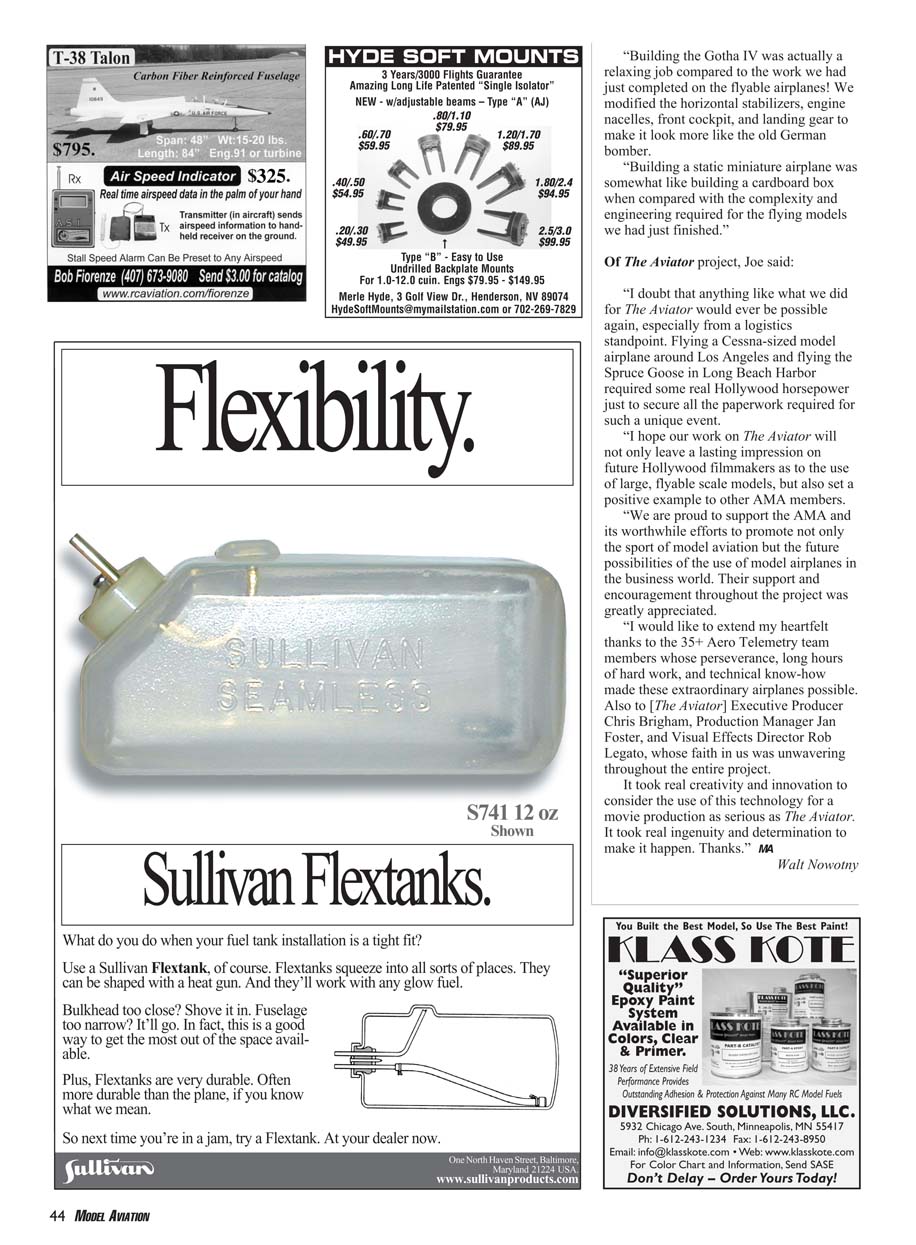
As the PT Boat's engines slowed to an idle, so did the legendary Spruce Goose's eight motors. It came about one last time with its wings level, quietly gliding over the waves and finally settling down into the Pacific Ocean.
Joe said:
"Each and every flight of the Hercules created an extraordinary excitement and tension that culminated in some of the most convincing flying sequences ever put on film. The flight of the Spruce Goose was a truly significant event not only to The Aviator production but to aviation history and the legacy of Howard Hughes himself, and we were thrilled to be a part of it. You could tell from the look on people's faces that the flight of the Spruce Goose in Long Beach Harbor had really evoked some emotions in them.
"To be able to re-create history with such detail and accuracy was really exciting for all of us. I think if Howard Hughes could have seen the H-4 today, he would have been very proud of us."
Hell's Angels Airplanes:
Many models were used to accurately portray the World War I aircraft that Howard Hughes used to film his epic movie Hell's Angels. He used 87 vintage airplanes to film the thrilling aerial battle scenes, and three airmen were killed during the flying sequences.
The Aviator's director Martin Scorsese decided to re-create these dangerous flying scenes digitally, and film personnel contracted Aero Telemetry to provide several of the miniatures used for compositing and computer regeneration.
To re-create the ground sequences at the airfield for the Hell's Angels scene, 13 privately owned World War I replica aircraft were filmed. Aero Telemetry provided several 1/5-scale, flyable radio-control miniatures, including British S.E.5s, German Fokker D.VIIs, and a de Havilland D.H.4, flown by AMA members Adam Gelbart and Jason Somes.
Aero Telemetry provided background visual effects of airplanes flying around the airfield while the first unit was filming Leonardo DiCaprio—starring as Howard Hughes—and the supporting actors. Joe's team also provided the motion control model of the Sikorsky S-38 amphibious seaplane and a 13.5-foot-wingspan Gotha G.IV biplane bomber for use as Howard's camera airplane during the Hell's Angels flight sequences.
The Aero Telemetry Gotha G.IV bomber project was headed by Darrel Hofmann and Butch Fleck after the flights of the three primary Hughes airplanes.
"Darrel did an amazing job transforming the big bomber into the model that was used for the motion control work of Leonardo in the cockpit re-enacting the filming of the Hell's Angels scenes," said Joe. "It was brilliant."
The Gotha G.IV was featured extensively in the movie, and most of the footage was done with close-up camera work, computer graphics, and green screens. Even though the script called for a "Gotha-IV camera plane," in reality Howard Hughes had originally converted a Sikorsky S-29 to look like a German World War I bomber.
Darrel said: "Building the Gotha IV was actually a relaxing job compared to the work we had just completed on the flyable airplanes! We modified the horizontal stabilizers, engine nacelles, front cockpit, and landing gear to make it look more like the old German bomber.
"Building a static miniature airplane was somewhat like building a cardboard box when compared with the complexity and engineering required for the flying models we had just finished."
Of The Aviator project, Joe said:
"I doubt that anything like what we did for The Aviator would ever be possible again, especially from a logistics standpoint. Flying a Cessna-sized model airplane around Los Angeles and flying the Spruce Goose in Long Beach Harbor required some real Hollywood horsepower just to secure all the paperwork required for such a unique event.
"I hope our work on The Aviator will not only leave a lasting impression on future Hollywood filmmakers as to the use of large, flyable scale models, but also set a positive example to other AMA members.
"We are proud to support the AMA and its worthwhile efforts to promote not only the sport of model aviation but the future possibilities of the use of model airplanes in the business world. Their support and encouragement throughout the project was greatly appreciated.
"I would like to extend my heartfelt thanks to the 35+ Aero Telemetry team members whose perseverance, long hours of hard work, and technical know-how made these extraordinary airplanes possible. Also to [The Aviator] Executive Producer Chris Brigham, Production Manager Jan Foster, and Visual Effects Director Rob Legato, whose faith in us was unwavering throughout the entire project.
It took real creativity and innovation to consider the use of this technology for a movie production as serious as The Aviator. It took real ingenuity and determination to make it happen. Thanks." MA
Walt Nowotny
Transcribed from original scans by AI. Minor OCR errors may remain.

