
Airplanes of THE AVIATOR
The Hughes XF-11
by Walt Nowotny
(Editor's note: Last month we presented the first article in a three-part series about how Joe Bock and his company Aero Telemetry produced the model Hughes H-1 racer for director Martin Scorsese and the blockbuster hit movie The Aviator. This month we'll present the story behind the XF-11 that was made for film. The following is composed of excerpts from Walt Nowotny's upcoming book about Joe Bock.)
Background: Joe Bock's XF-11—the world's largest and fastest scale model of the aircraft—and nine other airplanes he built for The Aviator have made their way into Hollywood history in the film's much-acclaimed flight sequences, and they were featured prominently in the TV trailers for the movie.
Just days after completing what was, at the time, the most strenuous and difficult part of the project—the flight of the H-1 racer—Joe and his team were preparing for what was to become the most challenging and renowned radio-control-airplane project in history: building and flying a Cessna-sized XF-11 reconnaissance aircraft.
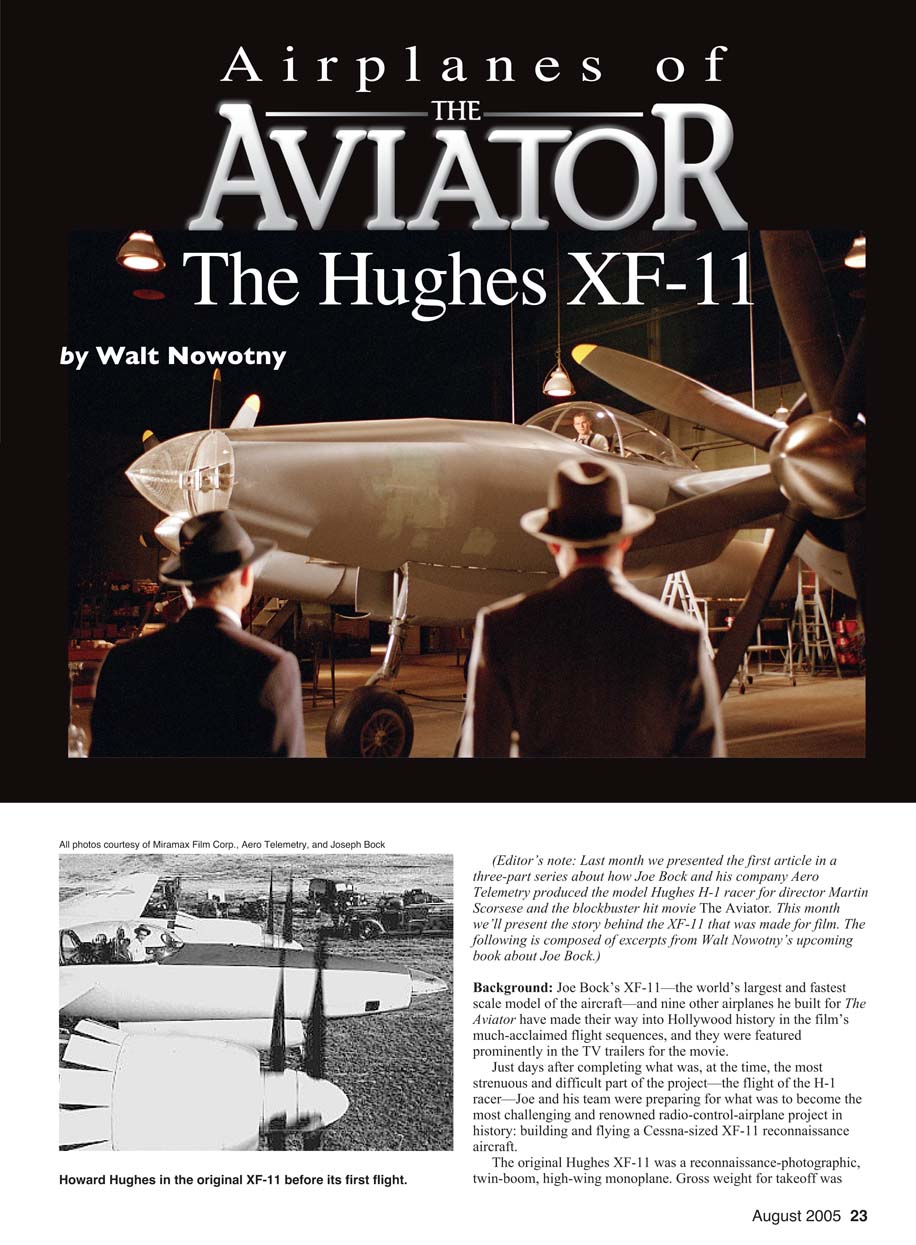
The original Hughes XF-11 was a reconnaissance-photographic, twin-boom, high-wing monoplane. Gross weight for takeoff was roughly 58,000 pounds, and the aircraft spanned approximately 101 feet.
Power for the first XF-11 was provided by two Pratt & Whitney R-4360 28-cylinder engines turning 14-foot-diameter Hamilton-Standard eight-blade, contrarotating propellers. The nose area carried several cameras, and four more were located in the rear of the twin fuselages. The XF-11 had a ceiling of more than 44,000 feet, with a range of 5,000-plus miles and a speed well in excess of 450 mph.
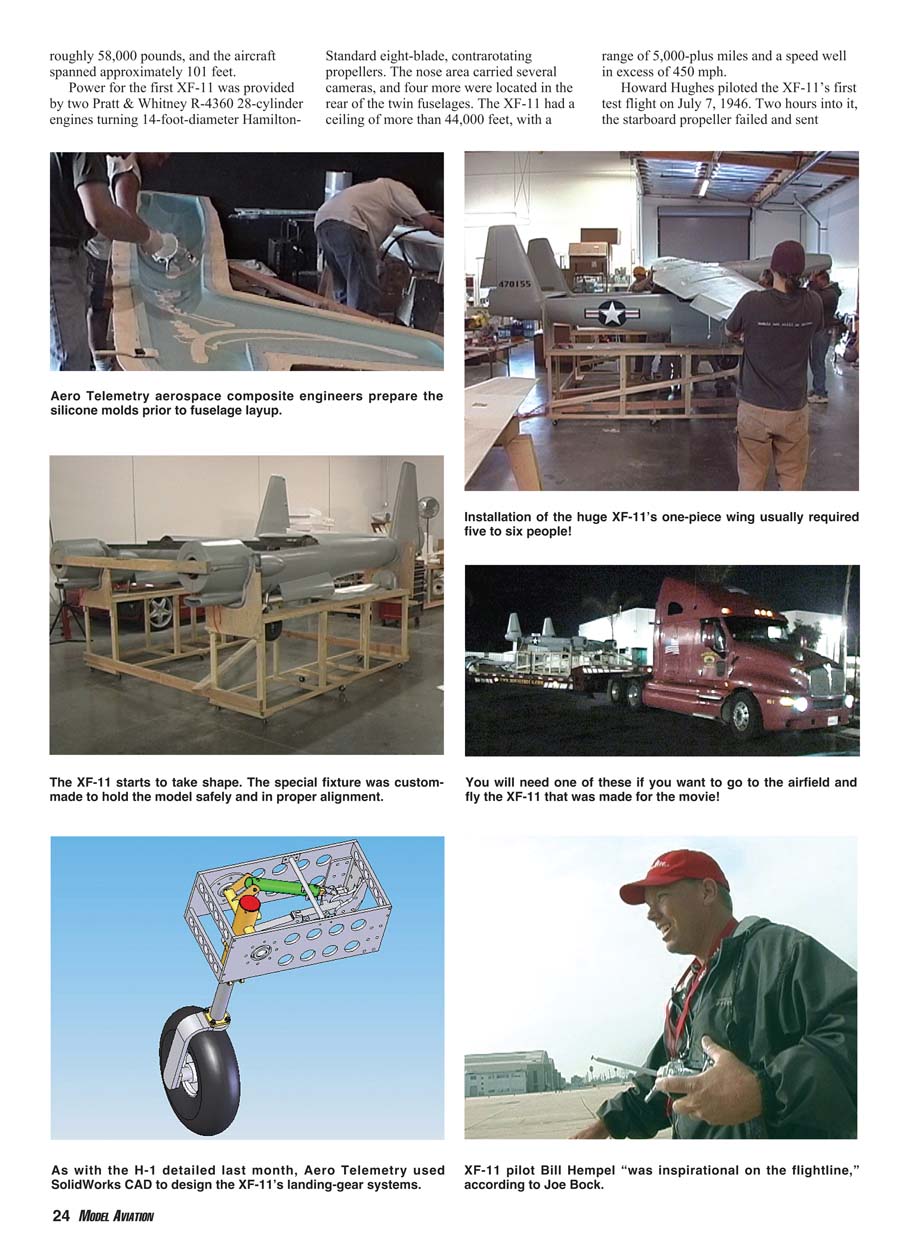
Howard Hughes piloted the XF-11's first test flight on July 7, 1946. Two hours into it, the starboard propeller failed and sent Hughes careening into a residential area in Beverly Hills, California. The crash was devastating and nearly killed him. Some say he never really recovered from this accident.
Although the crash had debilitating effects on Hughes' health for the rest of his life, it never deterred his courage and pioneering spirit. Within a year—on August 5, 1947—he took to the air again as the test pilot for the second XF-11. This flight went as planned, and he was pleased with his new airplane's performance.
The Aviator Executive Producer Chris Brigham and Academy Award–winning visual-effects director Rob Legato turned to Joseph Bock and his company, the Aero Telemetry Corporation. Their mission was to design, build, and fly one of the largest RC scale airplanes ever to be filmed for a Hollywood epic movie.
The biggest challenge was to provide a flyable model that was large enough to realistically simulate the flight characteristics of the full-scale Hughes XF-11 while maintaining an unprecedented margin of safety in the design.
Joe, a former linebacker for the University of Southern California who has a bachelor's degree in aerospace engineering and a master's degree in engineering, explained:
"The XF-11 was a very difficult airplane to design, duplicate, and scale down. From a reliability and operational standpoint, it was off the chart in terms of challenging.
"We had to come up with entirely new ways of building custom hydraulic landing gear, coordinating complex flight-control systems, and integrating all of them seamlessly to overcome the aerodynamic stresses of high speed and heavy payload. In addition, it had to look perfect through the film camera lens."
Aero Telemetry's initial job was to create a roughly 1/4-scale, flyable, historically accurate version of the original XF-11. It would have to span more than 25 feet, take off under its own power, and fly as far as seven to 10 miles while performing many different flight maneuvers. It would require designing a heavy-duty custom hydraulic retractable main landing gear and a steerable nose wheel that would also retract.
All of these components had to be designed, built, tested, and fully operational in less than 12 weeks!
Design, Construction, and Flights:
Because of the airplane's sheer size, the weight of the hydraulic and electrical systems, and budget and schedule constraints which have an impact on building options, it was anticipated that the XF-11 model could weigh more than 700 pounds. Aero Telemetry composite expert Rob Hartz recalled:
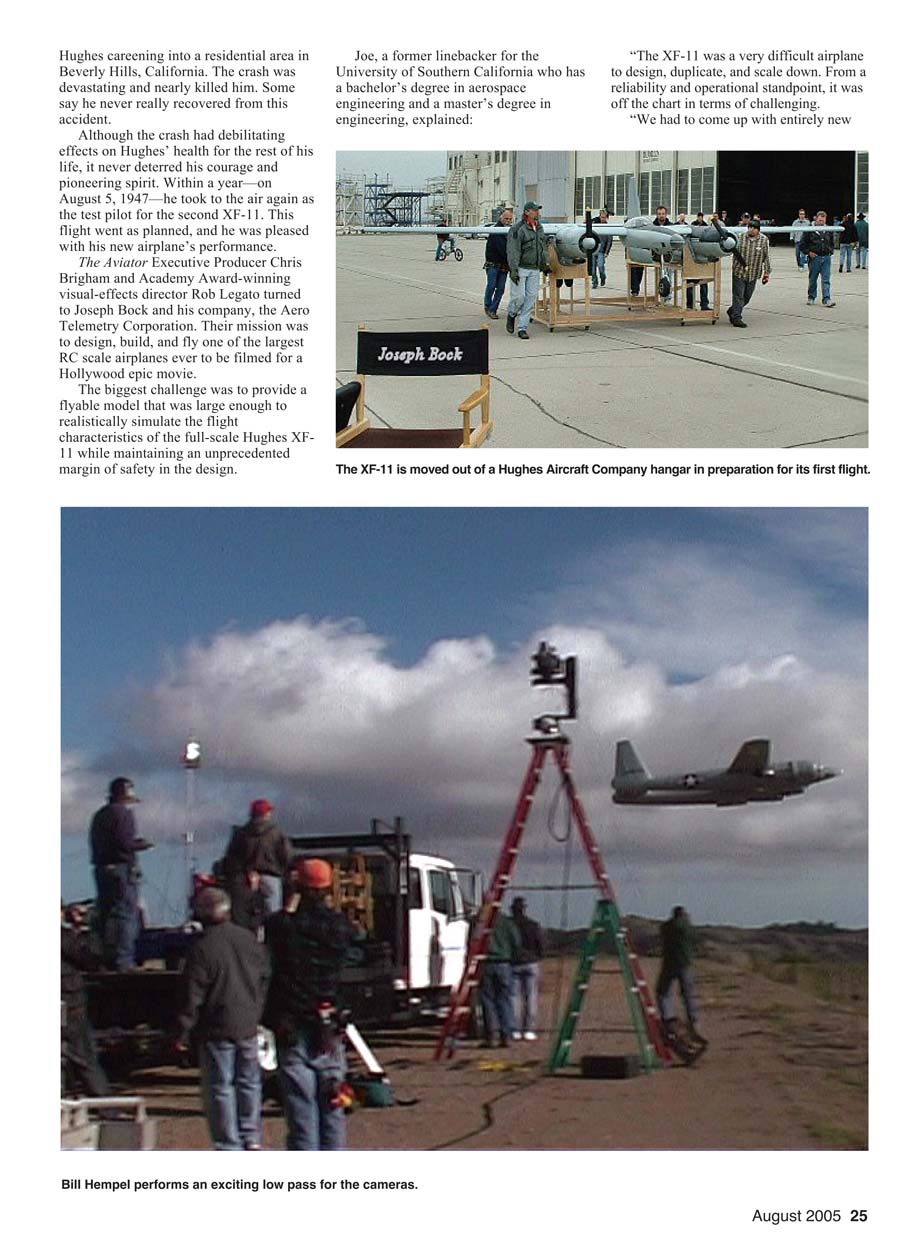
"Extensive use of composites would help us to build the airplanes quickly and still provide a high degree of strength in the structure. We started with silicone molds and laid up a composite structure that comprised carbon fiber, Hexcell, aerospace resin, and unidirectional fiberglass. For the smaller, nonstructural components of the airplanes we opted to vacuum-bag them to make them as finished and light as possible."
Engine mounts were fabricated from 6061 aluminum alloy thick-wall tubing. They were fabricated and welded into the fuselage and tied into the landing-gear mounts. They included provisions for quick exchange in case the need arose to replace an engine on location between flights.
While the large airframe and wings were being built, the Aero Telemetry engine shop was in full gear. The engines were given first priority for testing. The location where the XF-11 would be flown necessitated that it have as much power as possible to climb out under full load at higher-than-normal density altitudes.
The density altitude is the pressure altitude corrected for nonstandard variations; that is, the density altitude affects the takeoff distance and the rate of climb. From a design standpoint for the XF-11, it was important to factor that into the engine and propeller integration.
Joe explained:
"Based on our load calculations we knew where the airframe was going to see the most of its stress. Because of the sheer size and anticipated weight of the payload, I made sure to take extra care in certain areas so we wouldn't have to come back later and add heavy internal structures to keep the airplane strong.
"I decided early to forego some of the smaller weight-saving issues in favor of an airplane that would be very strong. It would be flying over hundreds of peoples' heads and millions of dollars of equipment. Safety was my primary concern throughout this entire project."
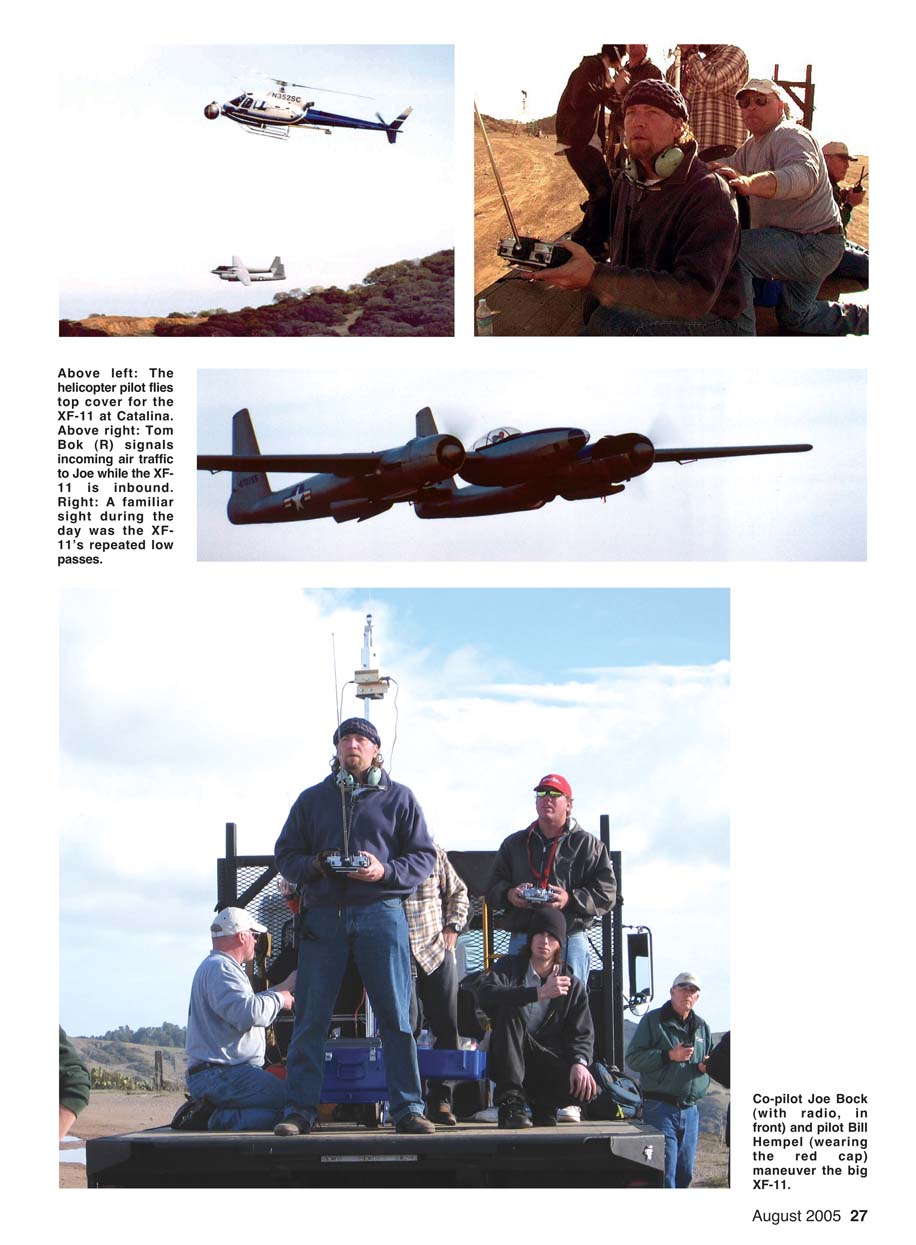
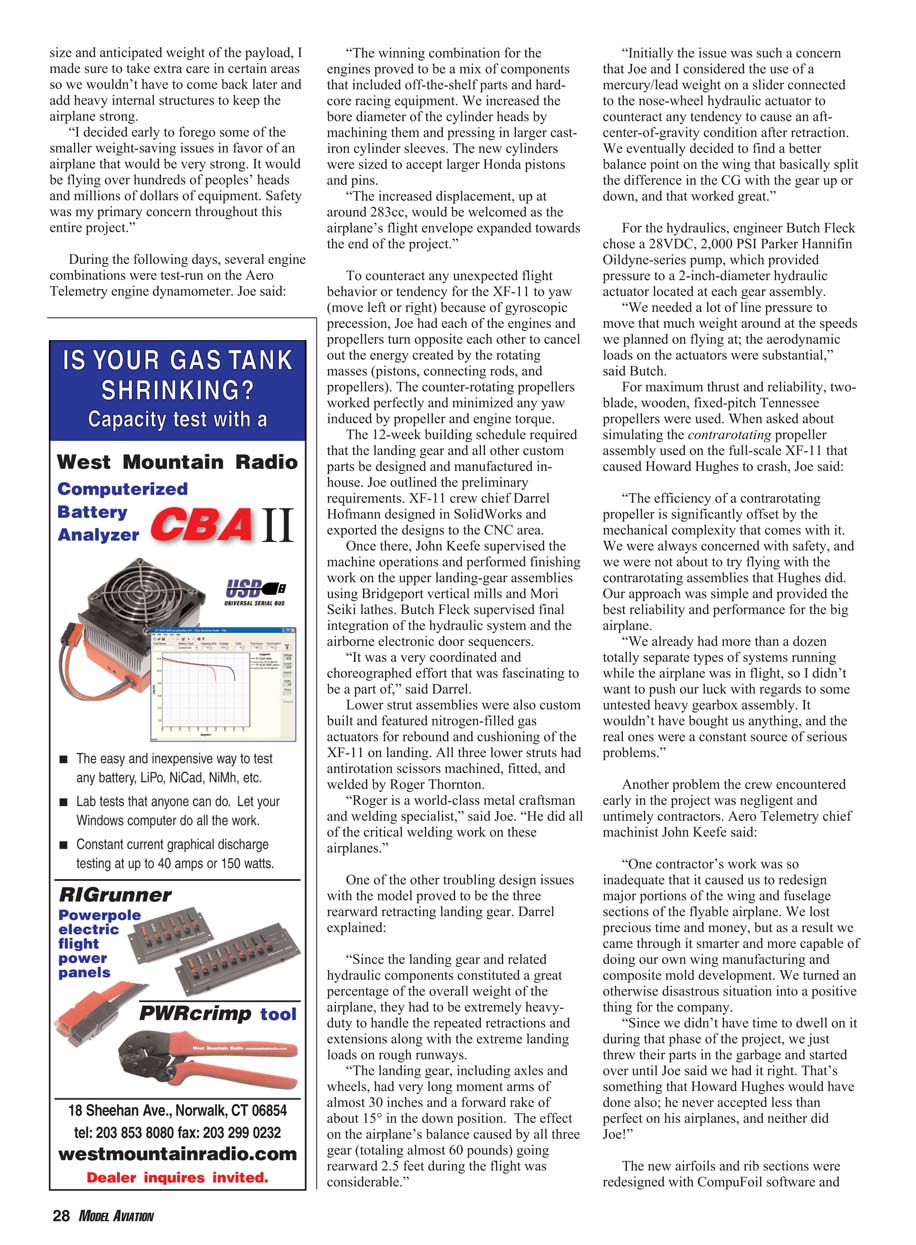
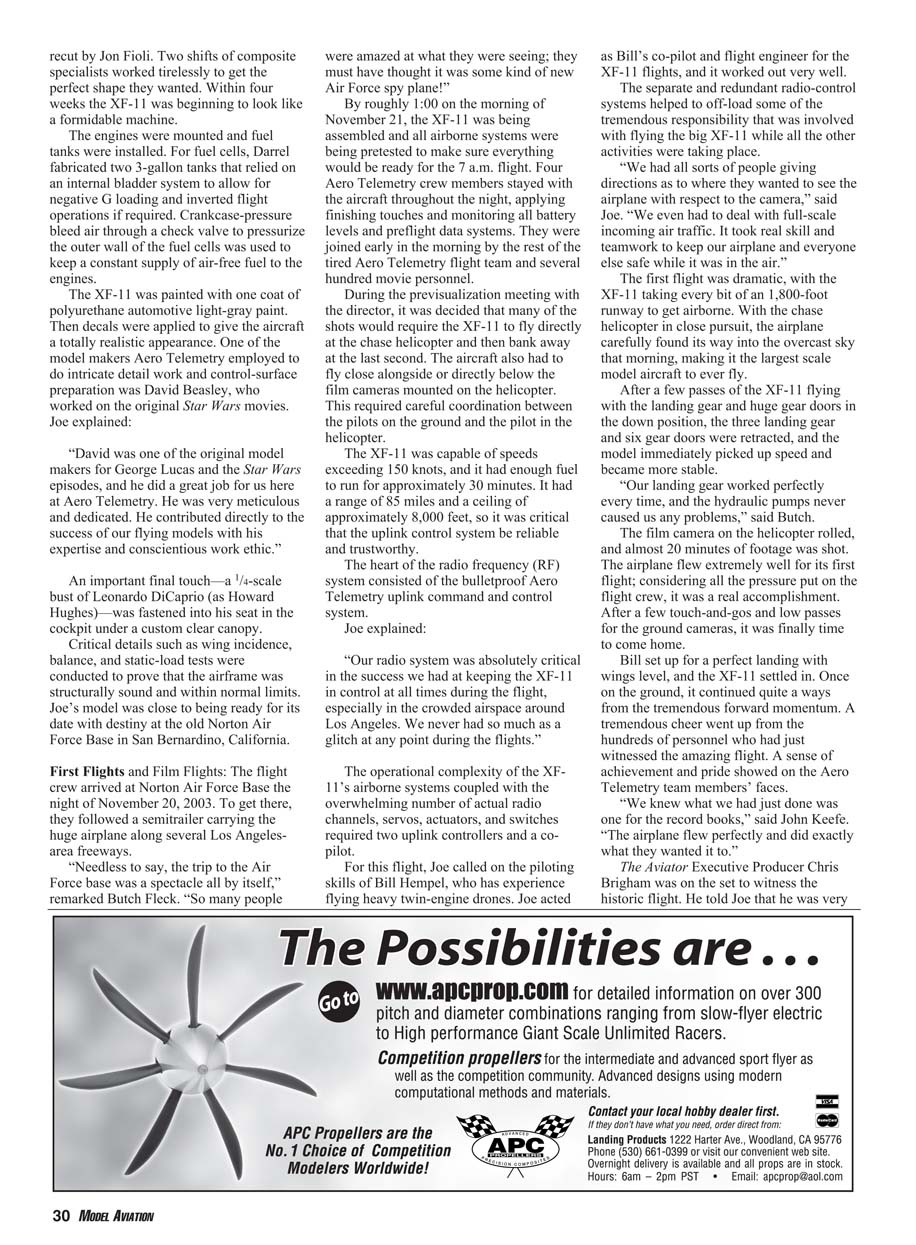
Above left: The helicopter pilot flies top cover for the XF-11 at Catalina. Above right: Tom Bock (R) signals incoming air traffic to Joe while the XF-11 is inbound. Right: A familiar sight during the day was the XF-11's repeated low passes.
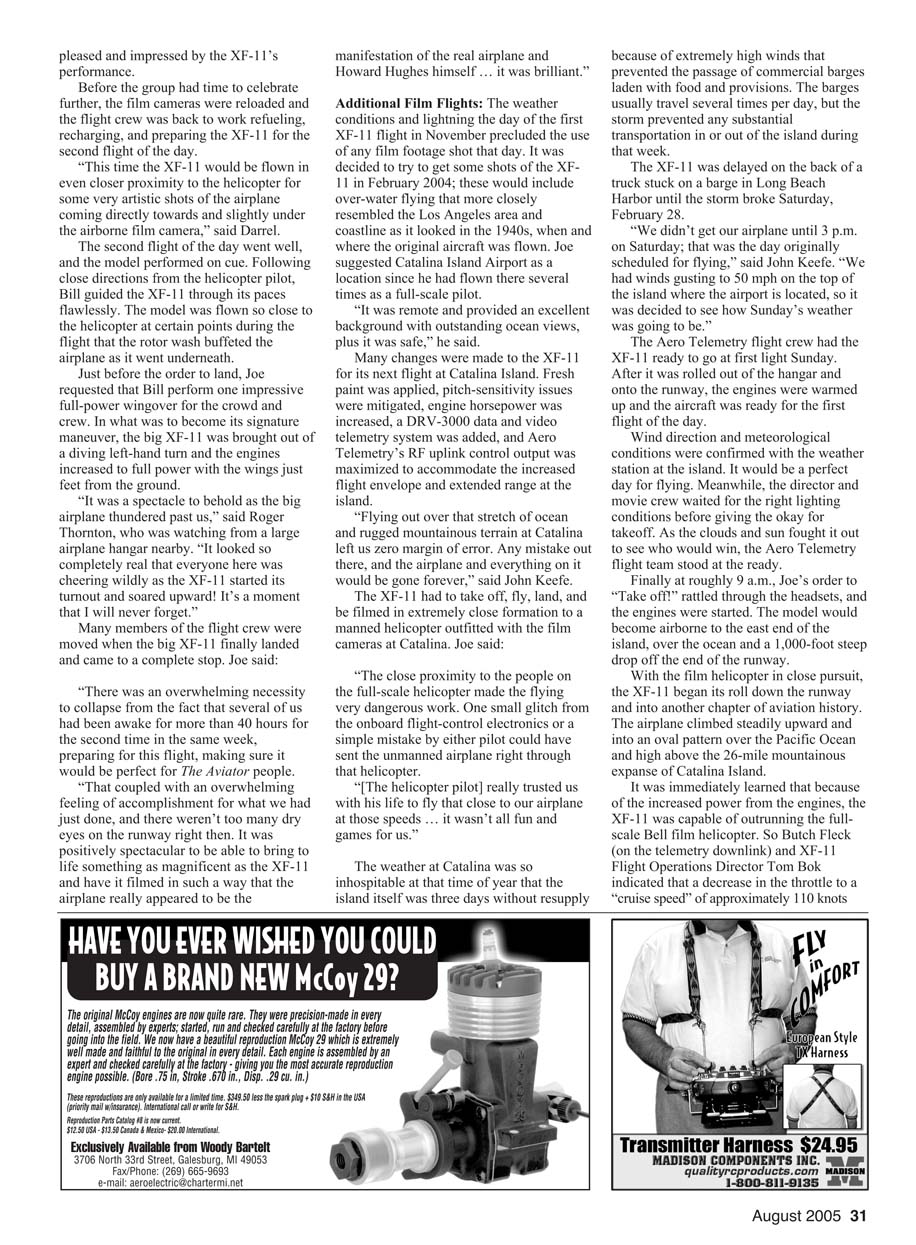
Co-pilot Joe Bock (with radio, in front) and pilot Bill Hempel (wearing the red cap) maneuver the big XF-11.
During the following days, several engine combinations were test-run on the Aero Telemetry engine dynamometer. Joe said:
"The winning combination for the engines proved to be a mix of components that included off-the-shelf parts and hardcore racing equipment. We increased the bore diameter of the cylinder heads by machining them and pressing in larger cast-iron cylinder sleeves. The new cylinders were sized to accept larger Honda pistons and pins.
"The increased displacement, up at around 283cc, would be welcomed as the airplane's flight envelope expanded towards the end of the project."
To counteract any unexpected flight behavior or tendency for the XF-11 to yaw (move left or right) because of gyroscopic precession, Joe had each of the engines and propellers turn opposite each other to cancel out the energy created by the rotating masses (pistons, connecting rods, and propellers). The counter-rotating propellers worked perfectly and minimized any yaw induced by propeller and engine torque.
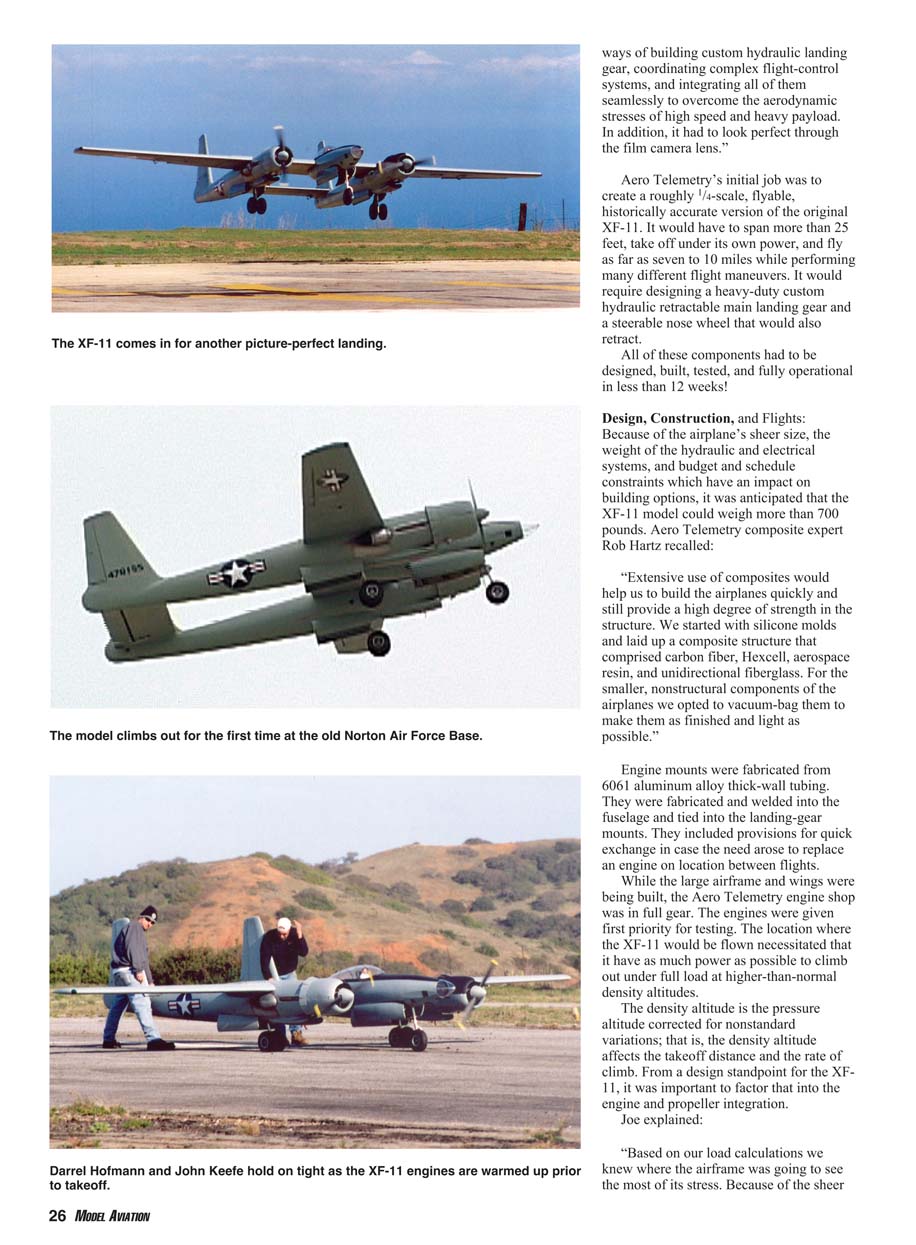
The 12-week building schedule required that the landing gear and all other custom parts be designed and manufactured in-house. Joe outlined the preliminary requirements. XF-11 crew chief Darrel Hofmann designed in SolidWorks and exported the designs to the CNC area.
Once there, John Keefe supervised the machine operations and performed finishing work on the upper landing-gear assemblies using Bridgeport vertical mills and Mori Seiki lathes. Butch Fleck supervised final integration of the hydraulic system and the airborne electronic door sequencers.
"It was a very coordinated and choreographed effort that was fascinating to be a part of," said Darrel.
Lower strut assemblies were also custom built and featured nitrogen-filled gas actuators for rebound and cushioning of the XF-11 on landing. All three lower struts had antirotation scissors machined, fitted, and welded by Roger Thornton.
"Roger is a world-class metal craftsman and welding specialist," said Joe. "He did all of the critical welding work on these airplanes."
One of the other troubling design issues with the model proved to be the three rearward retracting landing gear. Darrel explained:
"Since the landing gear and related hydraulic components constituted a great percentage of the overall weight of the airplane, they had to be extremely heavy-duty to handle the repeated retractions and extensions along with the extreme landing loads on rough runways.
"The landing gear, including axles and wheels, had very long moment arms of almost 30 inches and a forward rake of about 15° in the down position. The effect on the airplane's balance caused by all three gear (totaling almost 60 pounds) going rearward 2.5 feet during the flight was considerable.
"Initially the issue was such a concern that Joe and I considered the use of a mercury/lead weight on a slider connected to the nose-wheel hydraulic actuator to counteract any tendency to cause an aft-center-of-gravity condition after retraction. We eventually decided to find a better balance point on the wing that basically split the difference in the CG with the gear up or down, and that worked great."
For the hydraulics, engineer Butch Fleck chose a 28VDC, 2,000 PSI Parker Hannifin Oildyne-series pump, which provided pressure to a 2-inch-diameter hydraulic actuator located at each gear assembly.
"We needed a lot of line pressure to move that much weight around at the speeds we planned on flying at; the aerodynamic loads on the actuators were substantial," said Butch.
For maximum thrust and reliability, two-blade, wooden, fixed-pitch Tennessee propellers were used. When asked about simulating the contra-rotating propeller assembly used on the full-scale XF-11 that caused Howard Hughes to crash, Joe said:
"The efficiency of a contrarotating propeller is significantly offset by the mechanical complexity that comes with it. We were always concerned with safety, and we were not about to try flying with the contrarotating assemblies that Hughes did. Our approach was simple and provided the best reliability and performance for the big airplane.
"We already had more than a dozen totally separate types of systems running while the airplane was in flight, so I didn't want to push our luck with regards to some untested heavy gearbox assembly. It wouldn't have bought us anything, and the real ones were a constant source of serious problems."
Another problem the crew encountered early in the project was negligent and untimely contractors. Aero Telemetry chief machinist John Keefe said:
"One contractor's work was so inadequate that it caused us to redesign major portions of the wing and fuselage sections of the flyable airplane. We lost precious time and money, but as a result we came through it smarter and more capable of doing our own wing manufacturing and composite mold development. We turned an otherwise disastrous situation into a positive thing for the company.
"Since we didn't have time to dwell on it during that phase of the project, we just threw their parts in the garbage and started over until Joe said we had it right. That's something that Howard Hughes would have done also; he never accepted less than perfection on his airplanes, and neither did Joe!"
The new airfoils and rib sections were redesigned with CompuFoil software and recut by Jon Fioli. Two shifts of composite specialists worked tirelessly to get the perfect shape they wanted. Within four weeks the XF-11 was beginning to look like a formidable machine.
The engines were mounted and fuel tanks were installed. For fuel cells, Darrell fabricated two 3-gallon tanks that relied on an internal bladder system to allow for negative G loading and inverted flight operations if required. Crankcase-pressure bleed air through a check valve to pressurize the outer wall of the fuel cells was used to keep a constant supply of air-free fuel to the engines.
The XF-11 was painted with one coat of polyurethane automotive light-gray paint. Then decals were applied to give the aircraft a totally realistic appearance. One of the model makers Aero Telemetry employed to do intricate detail work and control-surface preparations was David Beasley, who worked on the original Star Wars movies. Joe explained:
"David was one of the original model makers for George Lucas and the Star Wars episodes, and he did a great job for us here at Aero Telemetry. He was very meticulous and dedicated. He contributed directly to the success of our flying models with his expertise and conscientious work ethic."
An important final touch—a 1/4-scale bust of Leonardo DiCaprio (as Howard Hughes)—was fastened into his seat in the cockpit under a custom clear canopy.
Critical details such as wing incidence, balance, and static-load tests were conducted to prove that the airframe was structurally sound and within normal limits. Joe’s model was close to being ready for its date with destiny at the old Norton Air Force Base in San Bernardino, California.
First Flights and Film Flights:
The flight crew arrived at Norton Air Force Base the night of November 20, 2003. To get there, they followed a semitrailer carrying the huge airplane along several Los Angeles–area freeways.
"Needless to say, the trip to the Air Force base was a spectacle all by itself," remarked Butch Fleck. "So many people were amazed at what they were seeing; they must have thought it was some kind of new Air Force spy plane!"
By roughly 1:00 on the morning of November 21, the XF-11 was being assembled and all airborne systems were being pretested to make sure everything would be ready for the 7 a.m. flight. Four Aero Telemetry crew members stayed with the aircraft throughout the night, applying finishing touches and monitoring all battery levels and preflight data systems. They were joined early in the morning by the rest of the tired Aero Telemetry flight team and several hundred movie personnel.
During the previsualization meeting with the director, it was decided that many of the shots would require the XF-11 to fly directly at the chase helicopter and then bank away at the last second. The aircraft also had to fly close alongside or directly below the film cameras mounted on the helicopter. This required careful coordination between the pilots on the ground and the pilot in the helicopter.
The XF-11 was capable of speeds exceeding 150 knots, and it had enough fuel to run for approximately 30 minutes. It had a range of 85 miles and a ceiling of approximately 8,000 feet, so it was critical that the flight control system be reliable and trustworthy.
The heart of the radio frequency (RF) system consisted of the bulletproof Aero Telemetry uplink command and control system.
Joe explained:
"Our radio system was absolutely critical in the success we had at keeping the XF-11 in control at all times during the flight, especially in the crowded airspace around Los Angeles. We never had so much as a glitch at any point during the flights."
The operational complexity of the XF-11’s airborne systems coupled with the overwhelming number of actual radio channels, servos, actuators, and switches required two uplink controllers and a co-pilot.
For this flight, Joe called on the piloting skills of Bill Hempel, who has experience flying heavy twin-engine drones. Joe acted as Bill’s co-pilot and flight engineer for the XF-11 flights, and it worked out very well.
The separate and redundant radio-control systems helped to off-load some of the tremendous responsibility that was involved with flying the big XF-11 while all the other activities were taking place.
"We had all sorts of people giving directions as to where they wanted to see the airplane with respect to the camera," said Joe. "We even had to deal with full-scale incoming air traffic. It took real skill and teamwork to keep our airplane and everyone else safe while it was in the air."
The first flight was dramatic, with the XF-11 taking every bit of an 1,800-foot runway to get airborne. With the chase helicopter in close pursuit, the airplane carefully found its way into the overcast sky that morning, making it the largest scale model aircraft to ever fly.
After a few passes of the XF-11 flying with the landing gear and huge gear doors in the down position, the three landing gear and six gear doors were retracted, and the model immediately picked up speed and became more stable.
"Our landing gear worked perfectly every time, and the hydraulic pumps never caused us any problems," said Butch.
The film camera on the helicopter rolled, and almost 20 minutes of footage was shot. The airplane flew extremely well for its first flight; considering all the pressure put on the flight crew, it was a real accomplishment. After a few touch-and-goes and low passes for the ground cameras, it was finally time to come home.
Bill set up for a perfect landing with wings level, and the XF-11 settled in. Once on the ground, it continued quite a ways from the tremendous forward momentum. A tremendous cheer went up from the hundreds of personnel who had just witnessed the amazing flight. A sense of achievement and pride showed on the Aero Telemetry team members’ faces.
"We knew what we had just done was one for the record books," said John Keefe. "The airplane flew perfectly and did exactly what they wanted it to."
The Aviator Executive Producer Chris Brigham was on the set to witness the historic flight. He told Joe that he was very pleased and impressed by the XF-11’s performance.
Before the group had time to celebrate further, the film cameras were reloaded and the flight crew was back to work refueling, recharging, and preparing the XF-11 for the second flight of the day.
"This time the XF-11 would be flown in even closer proximity to the helicopter for some very artistic shots of the airplane coming directly towards and slightly under the airborne film camera," said Darrel.
The second flight of the day went well, and the model performed on cue. Following close directions from the helicopter pilot, Bill guided the XF-11 through its paces flawlessly. The model was flown so close to the helicopter at certain points during the flight that the rotor wash buffeted the airplane as it went underneath.
Just before the order to land, Joe requested that Bill perform one impressive full-power wingover for the crowd and crew. In what was to become its signature maneuver, the big XF-11 was brought out of a diving left-hand turn and the engines increased to full power with the wings just feet from the ground.
"It was a spectacle to behold as the big airplane thundered past us," said Roger Thornton, who was watching from a large airplane hangar nearby. "It looked so completely real that everyone here was cheering wildly as the XF-11 started its turn and soared upward! It’s a moment that I will never forget."
Many members of the flight crew were moved when the big XF-11 finally landed and came to a complete stop. Joe said:
"There was an overwhelming necessity to collapse from the fact that several of us had been awake for more than 40 hours for the second time in the same week, preparing for this flight, making sure it would be perfect for The Aviator people.
"That coupled with an overwhelming feeling of accomplishment for what we had just done, and there weren’t too many dry eyes on the runway right then. It was positively spectacular to be able to bring to life something as magnificent as the XF-11 and have it filmed in such a way that the airplane really appeared to be the manifestation of the real airplane and Howard Hughes himself … it was brilliant."
Additional Film Flights: The weather conditions and lightning the day of the first XF-11 flight in November precluded the use of any film footage shot that day. It was decided to try to get some shots of the XF-11 in February 2004; these would include over-water flying that more closely resembled the Los Angeles area and coastline as it looked in the 1940s, when and where the original aircraft was flown. Joe suggested Catalina Island Airport as a location since he had flown there several times as a full-scale pilot.
"It was remote and provided an excellent background with outstanding ocean views, plus it was safe," he said.
Many changes were made to the XF-11 for its next flight at Catalina Island. Fresh paint was applied, pitch-sensitivity issues were mitigated, engine horsepower was increased, a DRV-3000 data and video telemetry system was added, and Aero Telemetry’s RF uplink control output was maximized to accommodate the increased flight envelope and extended range at the island.
"Flying out over that stretch of ocean and rugged mountainous terrain at Catalina left us zero margin of error. Any mistake out there, and the airplane and everything on it would be gone forever," said John Keefe.
The XF-11 had to take off, fly, land, and be filmed in extremely close formation to a manned helicopter outfitted with the film cameras at Catalina. Joe said:
"The close proximity to the people on the full-scale helicopter made the flying very dangerous work. One small glitch from the onboard flight-control electronics or a simple mistake by either pilot could have sent the unmanned airplane right through that helicopter.
"[The helicopter pilot] really trusted us with his life to fly that close to our airplane at those speeds … it wasn’t all fun and games for us."
The weather at Catalina was so inhospitable at that time of year that the island itself was three days without resupply because of extremely high winds that prevented the passage of commercial barges laden with food and provisions. The barges usually travel several times per day, but the storm prevented any substantial transportation in or out of the island during that week.
The XF-11 was delayed on the back of a truck stuck on a barge in Long Beach Harbor until the storm broke Saturday, February 28.
"We didn’t get our airplane until 3 p.m. on Saturday; that was the day originally scheduled for flying," said John Keefe. "We had winds gusting to 50 mph on the top of the island where the airport is located, so it was decided to see how Sunday’s weather was going to be."
The Aero Telemetry flight crew had the XF-11 ready to go at first light Sunday. After it was rolled out of the hangar and onto the runway, the engines were warmed up and the aircraft was ready for the first flight of the day.
Wind direction and meteorological conditions were confirmed with the weather station at the island. It would be a perfect day for filming. Meanwhile, the director and movie crew waited for the right lighting conditions before giving the okay for takeoff. As the clouds and sun fought it out to see who would win, the Aero Telemetry flight team stood at the ready.
Finally at roughly 9 a.m., Joe’s order to "Take off!" rattled through the headsets, and the engines were started. The model would become airborne to the east end of the island, over the ocean and a 1,000-foot steep drop off the end of the runway.
With the film helicopter in close pursuit, the XF-11 began its roll down the runway and into another chapter of aviation history. The airplane climbed steadily upward and into an oval pattern over the Pacific Ocean and high above the 26-mile mountainous expanse of Catalina Island.
It was immediately learned that because of the increased power from the engines, the XF-11 was capable of outrunning the full-scale Bell film helicopter. So Butch Fleck (on the telemetry downlink) and XF-11 Flight Operations Director Tom Bok indicated that a decrease in the throttle to a "cruise speed" of approximately 110 knots was perfect for filming. It also provided the crew with extended flight times, owing to minimized fuel consumption.
The XF-11 responded perfectly, and the cameras started rolling once the cruising speed was established.
"The director shouted 'Action!' and for the next eight hours that is exactly what we had!" said Joe. "Our XF-11 performed very well under the conditions up there at Catalina."
The airplane made several flights that day and flew over several miles of scenic ocean coastline and rugged mountainous terrain. The helicopter camera got great footage, as did the ground cameras.
As a dramatic maneuver for the XF-11's last flight, Joe called for the mandatory "low pass for the home folks." The model was brought around in a shallow dive toward a position below the runway. Bill kept the airplane roughly 20 feet off the side of the steep slope while flying at full power directly toward the film cameras located at the edge of the cliff.
Approaching at high-speed and at roughly ground level, the sight of the tremendous XF-11 made everyone brace themselves. Some even crouched on the ground in anticipation of the rapidly approaching behemoth. All eyes were glued to the shadowy figure homing in on the cameras at the top of the hill. Tom Bok explained:
"The big XF-11 came over our heads so close—moving so fast—that you could actually hear the air moving out in front of it. The entire area just shook around us as it flew past. Because of the tremendous noise coming from the engines, airframe, and propeller noise, it really looked and sounded like the real thing."
(This last shot of the XF-11 coming up the side of that hill at full power was the one featured in the film and in several of the movie trailers and TV commercials.) A loud cheer came up from everyone present, and it was a wrap! It was time to come home for good.
"The platform we flew from was turned around and we headed back to position at the beginning of the runway so the pilot would have a better look," said Tom. "The last landing of the XF-11 was right on the white line of the runway. Bill even kept the nose wheel off until the wings stalled; it was picture-perfect."
The big model rolled for quite a ways before it stopped, and the film helicopter landed noisily nearby. Joe and his exhausted crew looked back at the XF-11. Its canopy and pilot were silhouetted by the orange sun that was beginning its final descent into the calm Pacific Ocean. They remarked that they had never seen anything quite as impressive and exciting as the flights of their XF-11 that day.
Joe said:
"As the sun began to set, everyone stopped for a moment to reflect on the days' events. We realized what an amazing experience it was to have been a part of aviation history as well as contributing a great deal to the overall success of the film. The entire Aero Telemetry flight crew was proud to have accomplished this last mission with the Hughes XF-11 on Catalina."
"In terms of the movie, our work on The Aviator was groundbreaking. By delivering safe, reliable, and convincing scale model airplanes on schedule and within budget, I know we provided The Aviator with the best possible and most cost-effective solution to delivering special effects that are really believable by and credible with their audiences.
"The proof is in the movie and in the rave reviews for the flight sequences. People need to go and see the movie and try to tell our models from the real thing ... I'll bet you can't tell the difference." MA
Walt Nowotny
(Next month find out about how Joe Bock and the Aero Telemetry team designed, built, and flew the world's largest flyable scale model of the legendary Hughes H-4 Hercules (Spruce Goose) and seven other World War I airplanes for the Hell's Angels scene for Martin Scorsese's The Aviator.)
Transcribed from original scans by AI. Minor OCR errors may remain.

