
AJ AIRCRAFT LASER 230Z
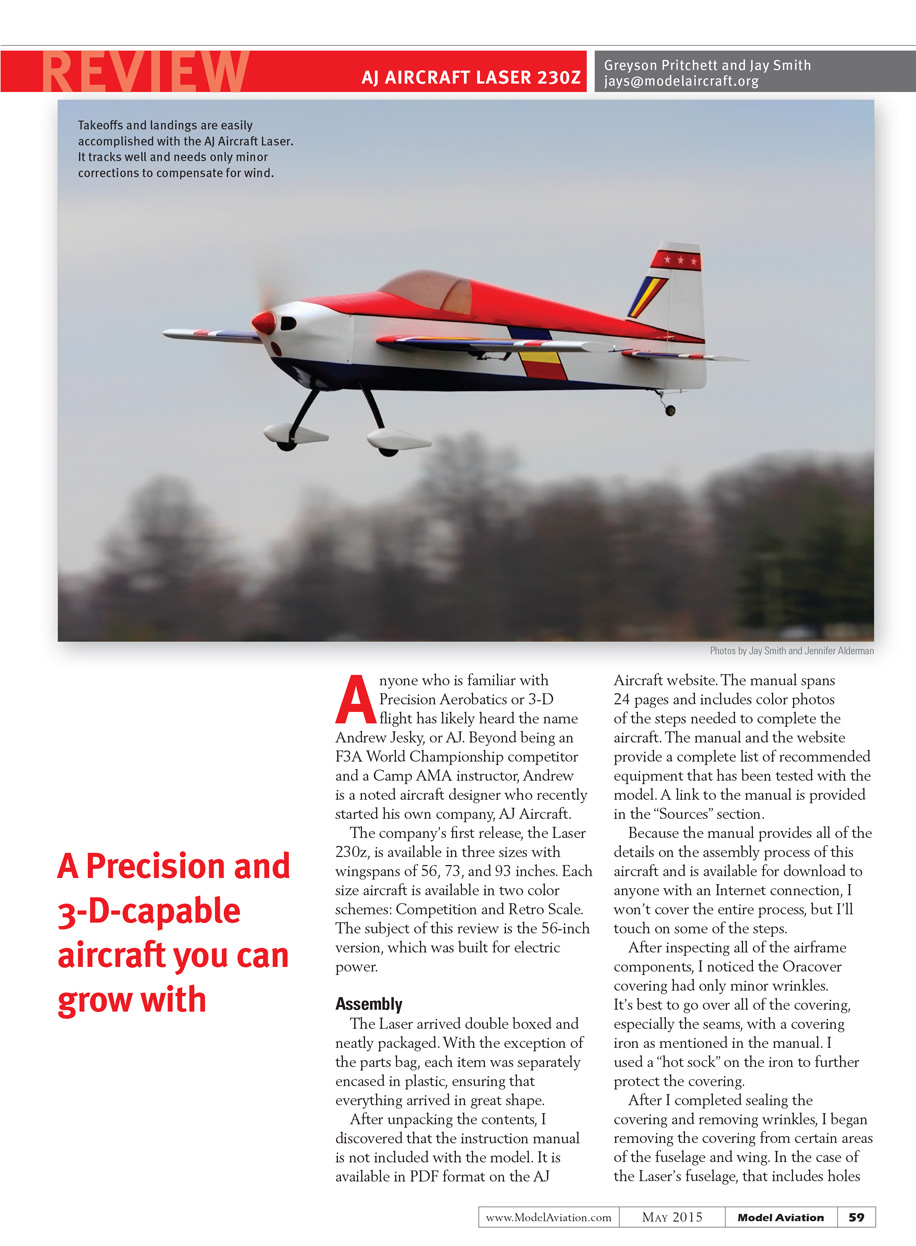
Anyone familiar with Precision Aerobatics or 3‑D flight has likely heard the name Andrew Jesky (AJ). Beyond being an F3A World Championship competitor and a Camp AMA instructor, Andrew is a noted aircraft designer who recently started his own company, AJ Aircraft.
The company’s first release, the Laser 230z, is available in three sizes and two color schemes:
- Sizes: 56 in, 73 in, and 93 in wingspans
- Color schemes: Competition and Retro Scale
This review covers the 56‑inch, electric‑powered version.
Assembly
Packaging and manual
The Laser arrived double boxed and neatly packaged. With the exception of the parts bag, each item was separately encased in plastic, so everything arrived in great shape.
The instruction manual is not included in the box; it is available as a 24‑page PDF on the AJ Aircraft website and includes color photos of the assembly steps and a complete list of recommended, tested equipment. Because the manual covers the full assembly in detail, only key steps and observations are summarized here.
Covering and prep
The Oracover covering had only minor wrinkles. It’s best to go over all of the covering, especially the seams, with a covering iron as noted in the manual; I used a “hot sock” on the iron to further protect the covering.
Remove covering from areas that require openings or hardware, including:
- Fuselage: holes for antirotation pins, wing tube, aileron extensions, and wing capture bolts; horizontal stabilizer slot on each side; hole for the elevator servo at the rear of the fuselage
- Wing: servo pockets
Use a sharp hobby knife or a covering iron with a small head. After cutting, confirm the covering is still securely adhered around the openings.
Landing gear and wheels
Getting the Laser on its wheels requires drilling two holes on the bottom of the fuselage to mount the tailwheel assembly. The main gear is bolted to the fuselage using the supplied hardware. A wood filler block between the landing gear and the underside of the fuselage hides the screws and gives the model a finished look.
To aid in mounting the wheel pants, mount the wheels and wheel pants on the axles before bolting the landing gear to the fuselage.
Tail and control surfaces
When installing the horizontal stabilizer, elevator halves with joiner, and rudder, take your time and closely follow the instructions. Although none of these steps is difficult, alignment is important — I took extra care to get the horizontal stabilizer perfectly aligned and parallel with the wing.
Epoxy the elevator halves together by working through the stabilizer slot in the fuselage. Use the clamping method described in the manual to ensure both sides are perfectly even.
The ailerons, elevator, and rudder are prehinged and glued to one side of each respective control surface while the other side is left for the builder to glue. Inspect each hinge and, when satisfied, glue the other side with thin CA adhesive.
Power system and electronics
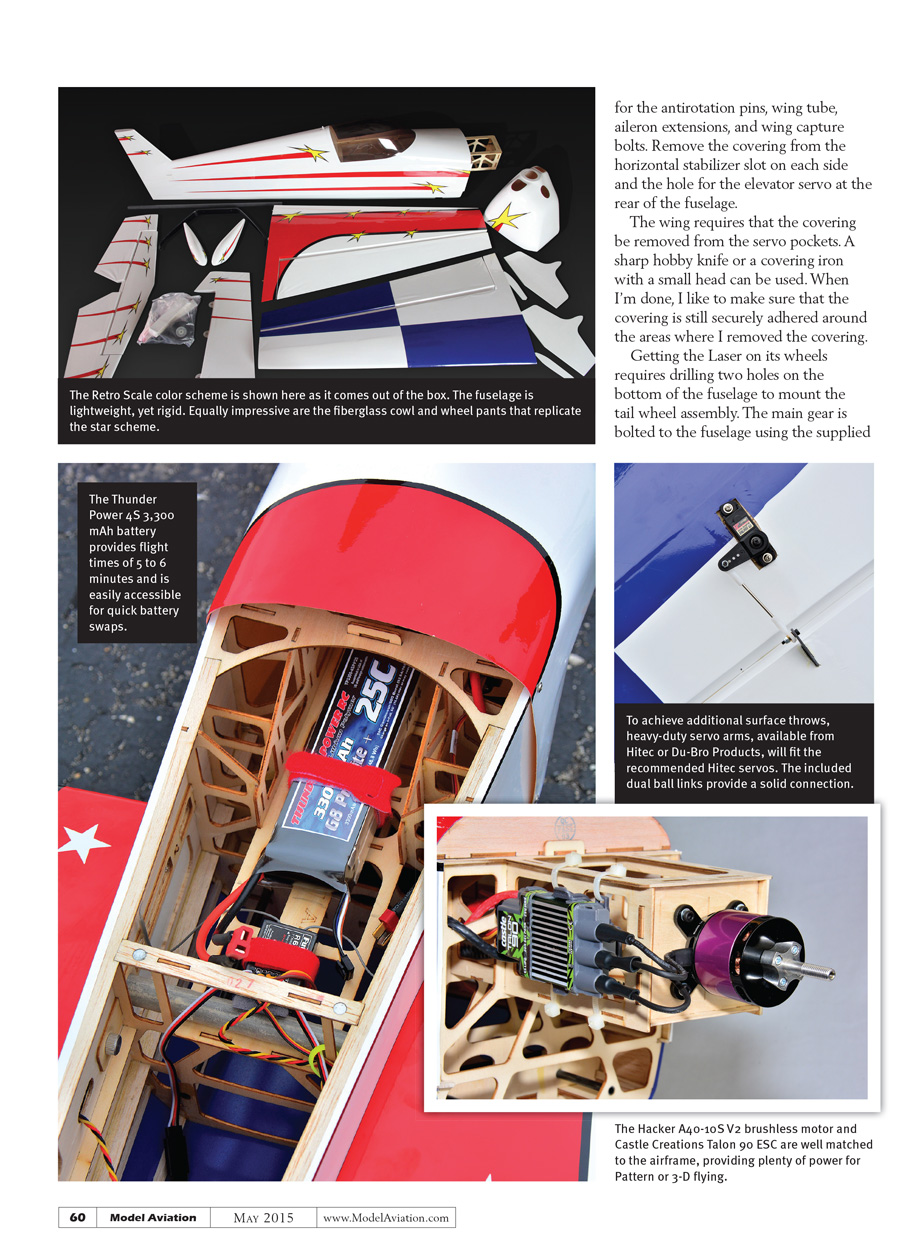
Using the recommended power system helps ensure good performance and simplifies installation. The review model used:
- Hacker A40‑10S brushless motor (bolt pattern matched preinstalled blind nuts on the firewall)
- Castle Talon 90 ESC secured with its mounting bracket and nylon zip ties to the side of the motor box
- Thunder Power 4S 3300 mAh LiPo battery (fits the battery tray, held with Velcro and a strap)
- Xoar 14 x 7 PJN propeller mounted to a 2‑inch Gator‑RC Flow‑Thru spinner
Mounting the cowl was straightforward using a 3 x 5 card as a guide; the cowl's trim scheme nicely matched the fuselage.
This setup achieved the proper center of gravity (CG): 95 mm to 103 mm behind the wing's leading edge near the root. No relocation of equipment or added ballast was necessary.
Flying
Greyson Pritchett piloted the AJ Aircraft Laser 230z and offered these impressions:
“This airplane flies great! It can do Precision Aerobatics (Pattern) and extreme 3‑D that a lot of people want. If you already have some successful stick time on a trainer, this could be your second or third go‑to airplane. The Laser is very good and capable of doing any maneuver I can do and then some, making it a model I can grow with.
“My first flight on this aircraft required no trim at all! The entire setup was exactly as suggested in the instructions including CG, surface throw, and exponential. The model took off and landed smoothly in the wind with just a little rudder input. It is also very smooth in the air.
“The first thing that I liked was that it was so easy to fly straight and level. It never searches for a straight line like many 3‑D airplanes do. My first flight was made in very windy conditions and the Laser could not have been any more stable or tracked better.
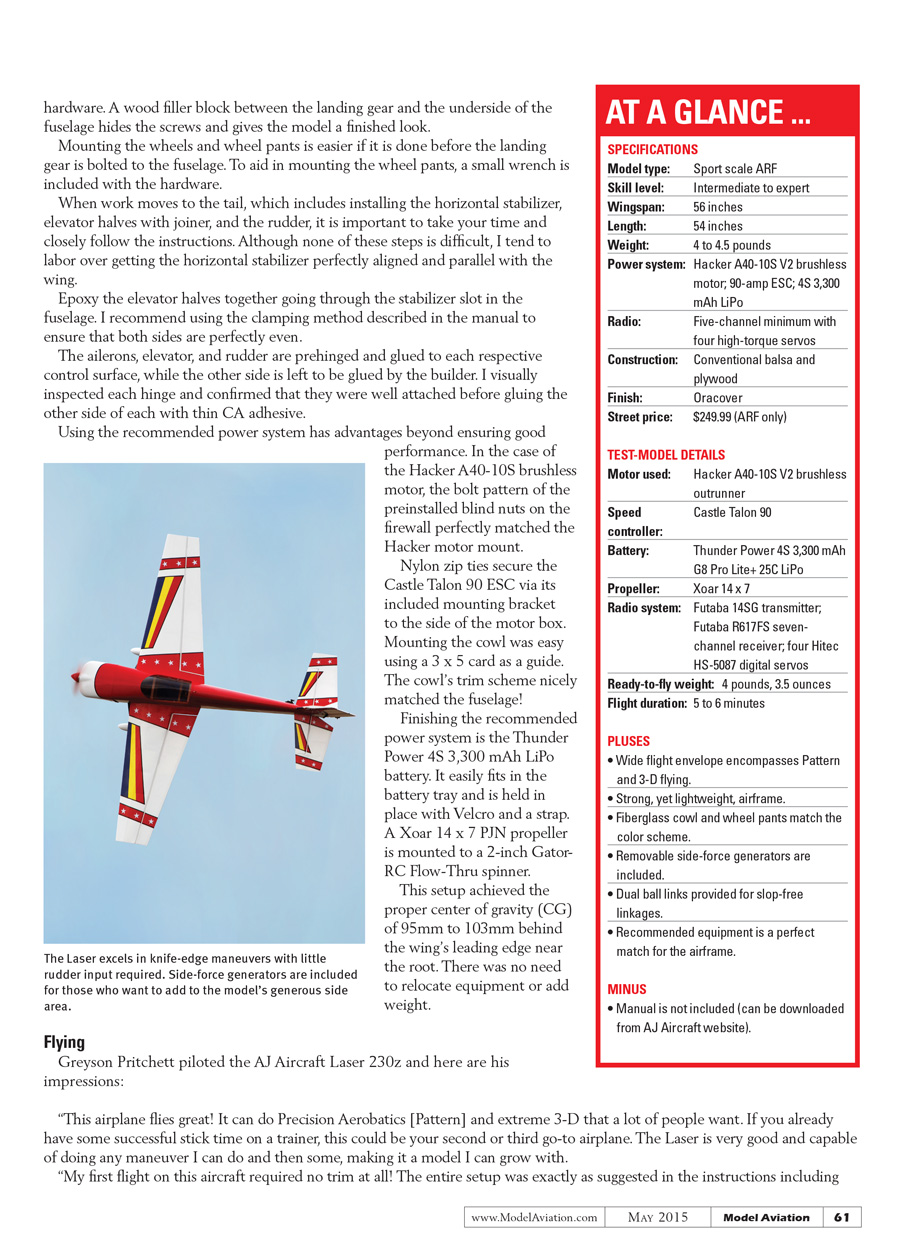
“The Laser feels like a bigger airplane than it is. It rolls fast, loops fast, and snaps even faster! Knife‑edge flight is easy, as are snaps from knife‑edge, and I can nail them every time. Back‑and‑forth 1½ snaps from knife‑edge look great. Harrier flight is also stable and enjoyable with the Laser.
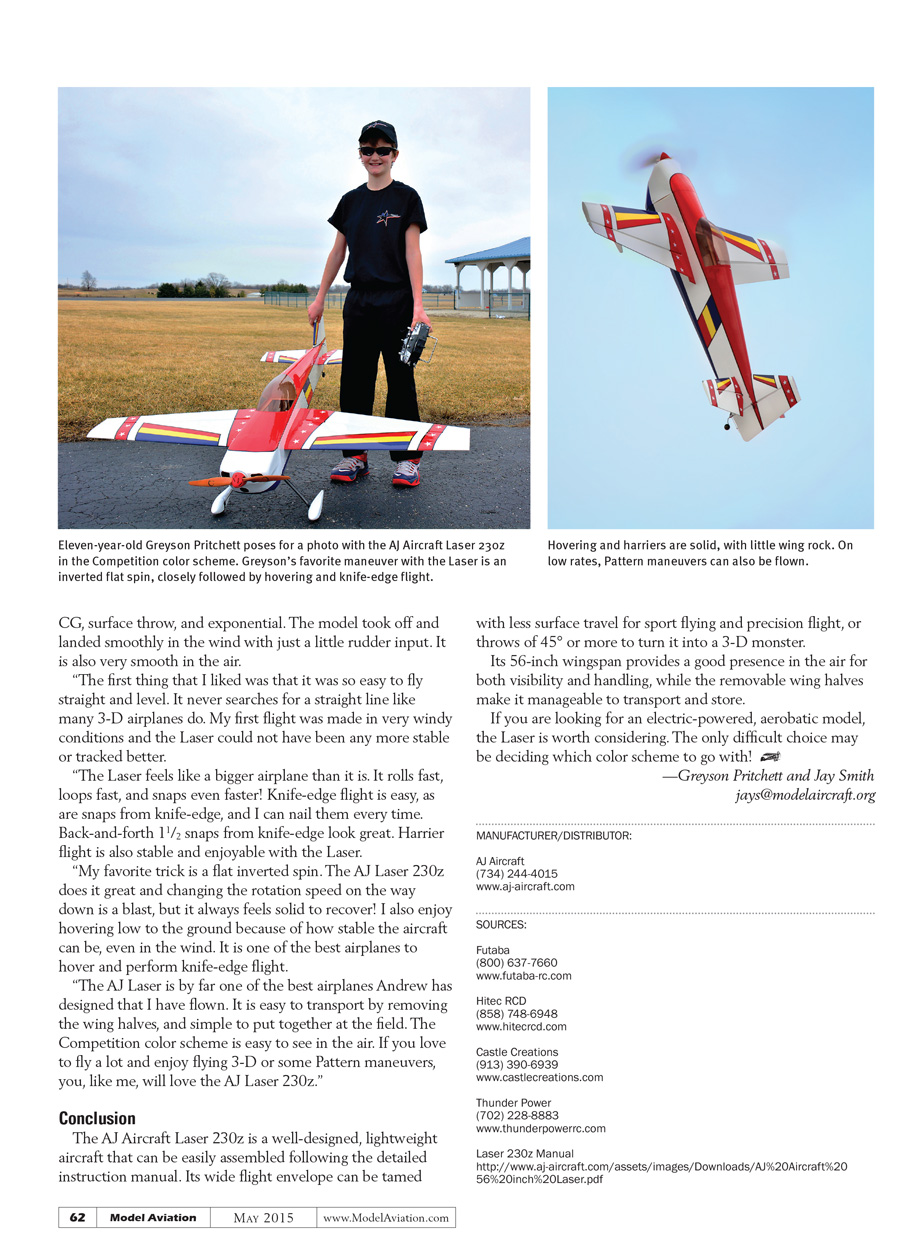
“My favorite trick is a flat inverted spin. The AJ Laser 230z does it great and changing the rotation speed on the way down is a blast, but it always feels solid to recover! I also enjoy hovering low to the ground because of how stable the aircraft can be, even in the wind. It is one of the best airplanes to hover and perform knife‑edge flight.
“The AJ Laser is by far one of the best airplanes Andrew has designed that I have flown. It is easy to transport by removing the wing halves, and simple to put together at the field. The Competition color scheme is easy to see in the air. If you love to fly a lot and enjoy flying 3‑D or some Pattern maneuvers, you, like me, will love the AJ Laser 230z.”
Conclusion
The AJ Aircraft Laser 230z is a well‑designed, lightweight aircraft that can be easily assembled following the detailed instruction manual. Its wide flight envelope can be tamed with reduced surface travel for sport and precision flying, or increased (45° or more) throws to turn it into a 3‑D performer.
The 56‑inch wingspan provides good presence in the air for visibility and handling, while the removable wing halves make transport and storage manageable.
If you are looking for an electric‑powered, aerobatic model, the Laser is worth considering. The only difficult choice may be deciding which color scheme to pick.
— Greyson Pritchett and Jay Smith [email protected]
MANUFACTURER/DISTRIBUTOR
AJ Aircraft
- Phone: (734) 244‑4015
- Website: www.aj‑aircraft.com
SOURCES
- Futaba — (800) 637‑7660 — www.futaba‑rc.com
- Hitec RCD — (858) 748‑6948 — www.hitecrcd.com
- Castle Creations — (913) 390‑6939 — www.castlecreations.com
- Thunder Power — (702) 228‑8883 — www.thunderpowerrc.com
- Laser 230z Manual — http://www.aj-aircraft.com/assets/images/Downloads/AJ%20Aircraft%2056%20...
Transcribed from original scans by AI. Minor OCR errors may remain.

