
Alien Aircraft Taylorcraft 72
Jerry Smith
See bonus build and flight photos in the app and online at www.ModelAviation.com/alienairtaylorcraft72.
The Taylorcraft is a 1940s classic light aircraft designed by C. Gilbert Taylor, who started the Taylor Brothers Aircraft Corporation in 1929. Production began with the Taylor E-2 Cub, with production ceasing in 1936 after a run of approximately 350 aircraft.
In 1935, improvements to the E-2 led to the J-2 Cub, the forerunner to the Piper J-3 Cub developed in 1937. By 1936, Gilbert had been forced out of the Piper Aircraft Company and began working on a new design. He moved his company to Alliance, Ohio, to produce his new Taylorcraft airplanes.
You can nearly guess how long an individual has been aware of late 1940s classics by the amount of awe in his or her voice when seeing a pristine, restored BC-12 Taylorcraft. This is because the image many have in their minds is of a Taylorcraft setting lopsided on the back tie-down line, with one flat tire, a bird’s nest apartment in the cowling, and mice running inside the rotting fabric.
Cubs and Champs never slid downhill as quickly as the Taylorcraft breed.
Although pilots at the airports likely recognized that Taylorcrafts were faster than the rest of the 65 hp group (with the possible exception of Luscombe 8As), the airport black sheep was likely a Taylorcraft.
The A-65 Continental engine is the standard by which all small reciprocating engines are measured. It’s reliable, user friendly, and easy to maintain. Parts are still available and overhauls are relatively inexpensive when measured against modern engines. If the magneto coils are good and the timing is remotely right, the engines will catch on the first or second blade every time.
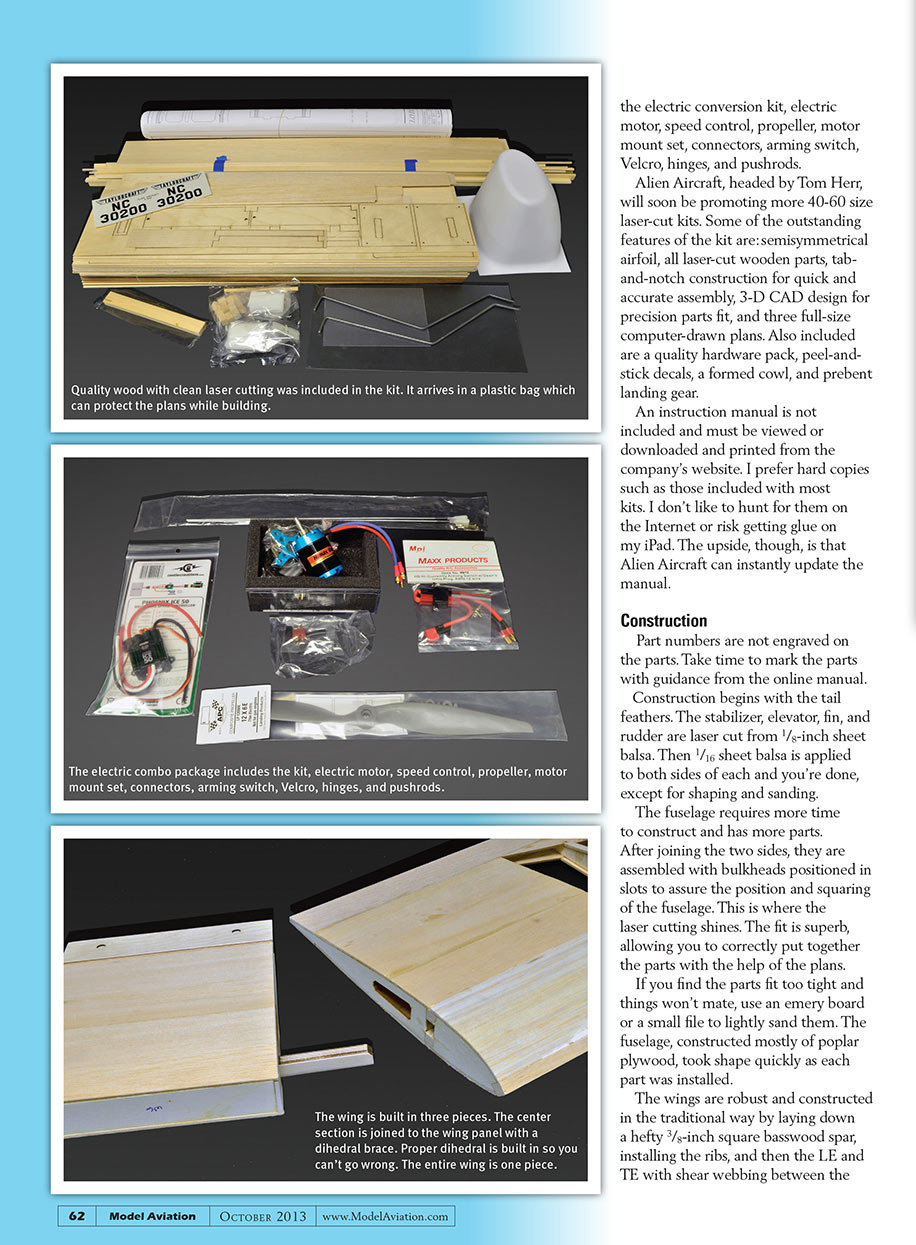
The Alien Aircraft laser-cut model aircraft kit appears to be fashioned after the model BC-12D-1 Taylorcraft—the bottom line, budget version of the airplane with Sport/Scale in mind. It can be purchased as a glow- or electric-powered kit. The electric version requires an electric conversion kit, which is sold separately. It can also be purchased as an Electric Deluxe Combo which includes the Taylorcraft 72 kit, the electric conversion kit, electric motor, speed control, propeller, motor mount set, connectors, arming switch, Velcro, hinges, and pushrods.
Alien Aircraft, headed by Tom Herr, will soon be promoting more 40-60 size laser-cut kits. Some of the outstanding features of the kit are: semisymmetrical airfoil, all laser-cut wooden parts, tab-and-notch construction for quick and accurate assembly, 3-D CAD design for precision parts fit, and three full-size computer-drawn plans. Also included are a quality hardware pack, peel-and-stick decals, a formed cowl, and pre-bent landing gear.
An instruction manual is not included and must be viewed or downloaded and printed from the company's website. I prefer hard copies such as those included with most kits. I don't like to hunt for them on the Internet or risk getting glue on my iPad. The upside, though, is that Alien Aircraft can instantly update the manual.
Construction
Part numbers are not engraved on the parts. Take time to mark the parts with guidance from the online manual.
Construction begins with the tail feathers. The stabilizer, elevator, fin, and rudder are laser cut from 1/8-inch sheet balsa. Then 1/16 sheet balsa is applied to both sides of each and you're done, except for shaping and sanding.
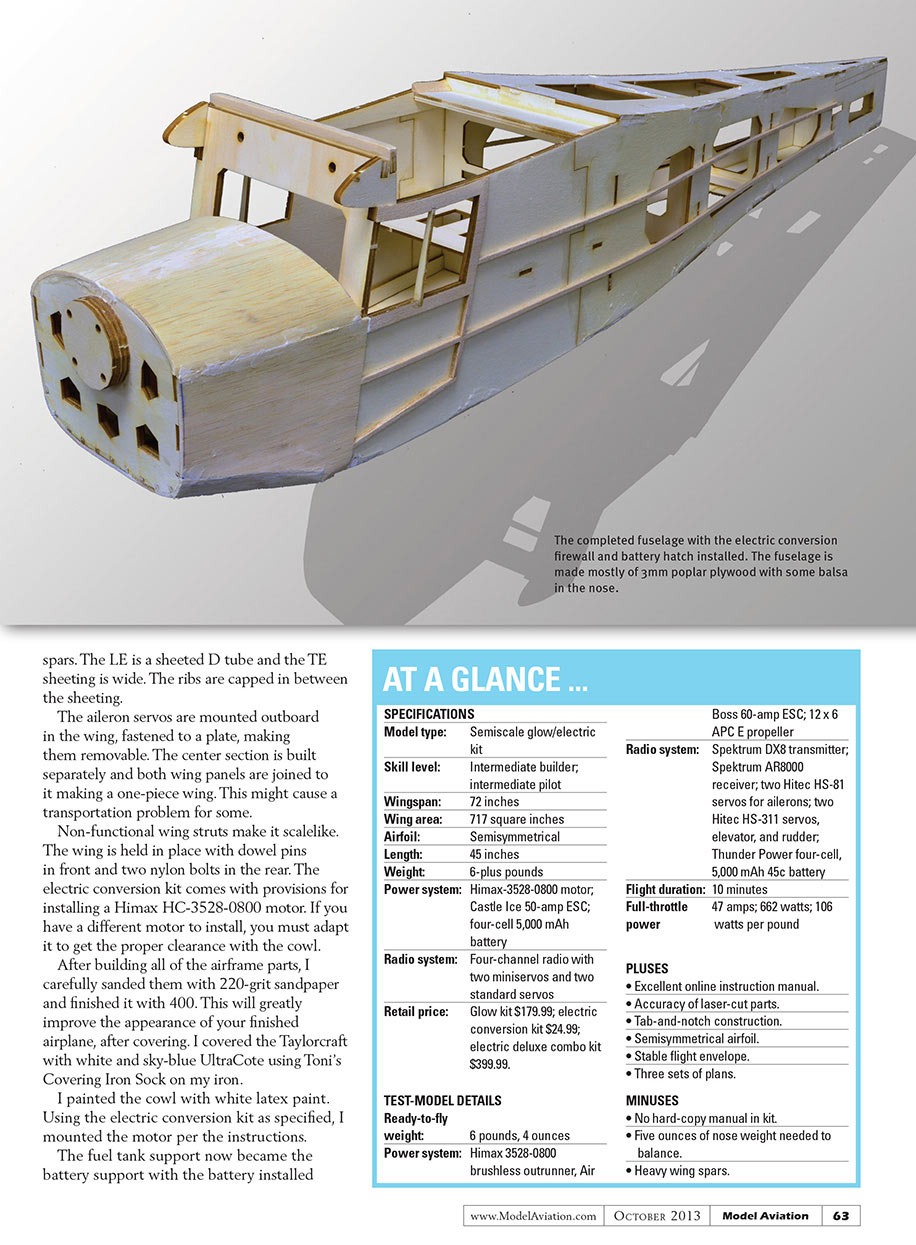
The fuselage requires more time to construct and has more parts. After joining the two sides, they are assembled with bulkheads positioned in slots to assure the position and squaring of the fuselage. This is where the laser cutting shines. The fit is superb, allowing you to correctly put together the parts with the help of the plans.
If you find the parts fit too tight and things won't mate, use an emery board or a small file to lightly sand them. The fuselage, constructed mostly of poplar plywood, took shape quickly as each part was installed.
The wings are robust and constructed in the traditional way by laying down a hefty 3/8-inch square basswood spar, installing the ribs, and then the LE and TE with shear webbing between the spars. The LE is a sheeted D tube and the TE sheeting is wide. The ribs are capped in between the sheeting.
The aileron servos are mounted outboard in the wing, fastened to a plate, making them removable. The center section is built separately and both wing panels are joined to it making a one-piece wing. This might cause a transportation problem for some.
Non-functional wing struts make it scalelike. The wing is held in place with dowel pins in front and two nylon bolts in the rear. The electric conversion kit comes with provisions for installing a Himax HC-3528-0800 motor. If you have a different motor to install, you must adapt it to get the proper clearance with the cowl.
After building all of the airframe parts, I carefully sanded them with 220-grit sandpaper and finished it with 400. This will greatly improve the appearance of your finished airplane, after covering. I covered the Taylorcraft with white and sky-blue UltraCote using Toni’s Covering Iron Sock on my iron.
I painted the cowl with white latex paint. Using the electric conversion kit as specified, I mounted the motor per the instructions.
The fuel tank support now became the battery support with the battery installed under the hatch through a hatch in the bottom. Instructions for latching the hatch were not supplied. Why not provide a way for those who may be unsure and let the builder decide? I used a magnet to latch the hatch, allowing quick access to the battery.
Testing the power system, I found that it drew 47 amps on a 12 x 6 APC E propeller. I was concerned about pushing the Castle 50-amp ESC too hard so I installed a 60-amp Air Boss instead. The power system provides 106 watts per pound, so using a smaller propeller is another option.
Flying
I am always anxious when it comes to a maiden flight, likely because of the unknowns in terms of what will happen and how the airplane will react. After I get the flight in and it is all over, my anxiety is gone.
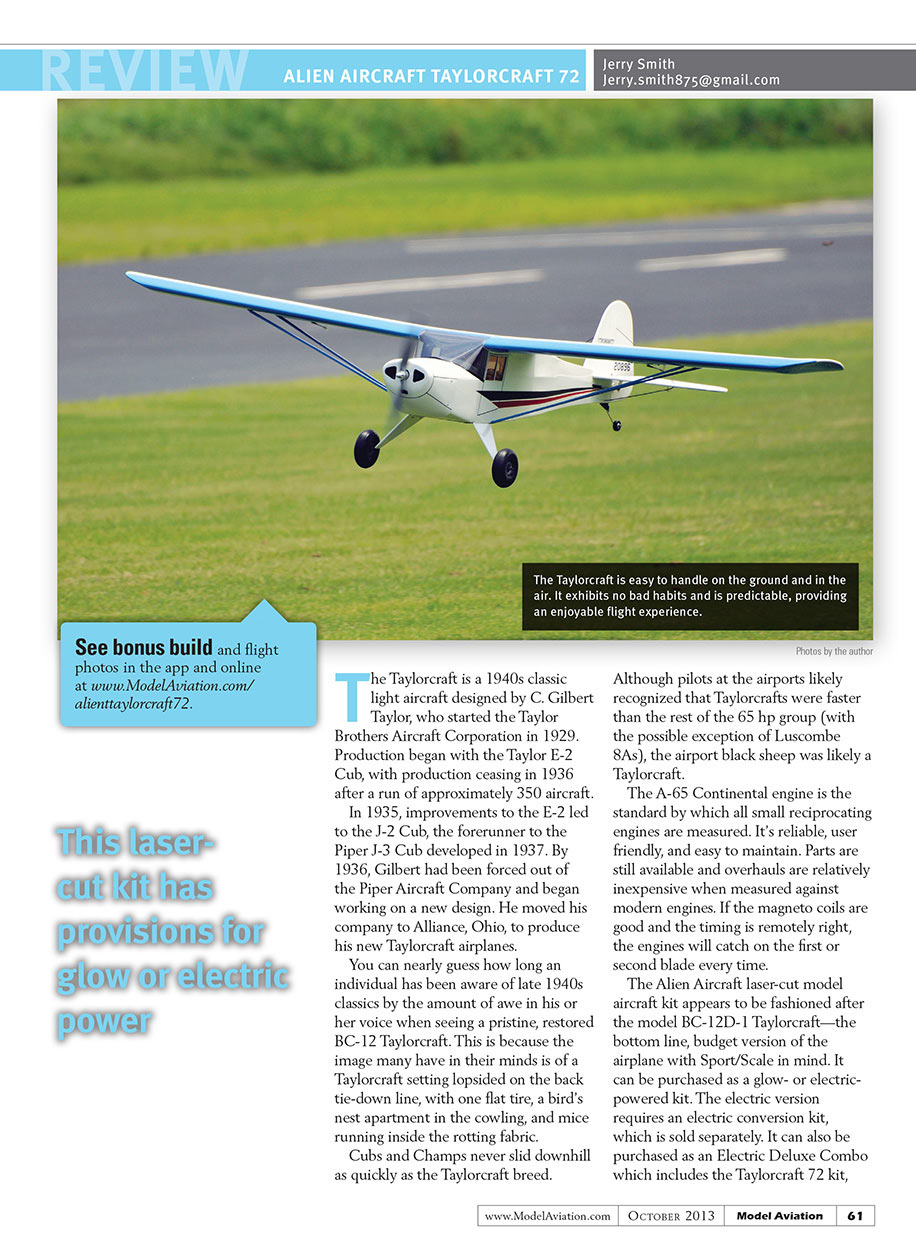
It was a beautiful day with no wind. With the battery fully charged, and a check of the CG and control travel, I was ready. Advancing the throttle, the model slowly lifted off at slightly more than half throttle in approximately 100 feet, with no ground-looping tendency. Gaining some altitude and leveling off required a couple clicks of up-elevator and some right rudder to fly hands off.
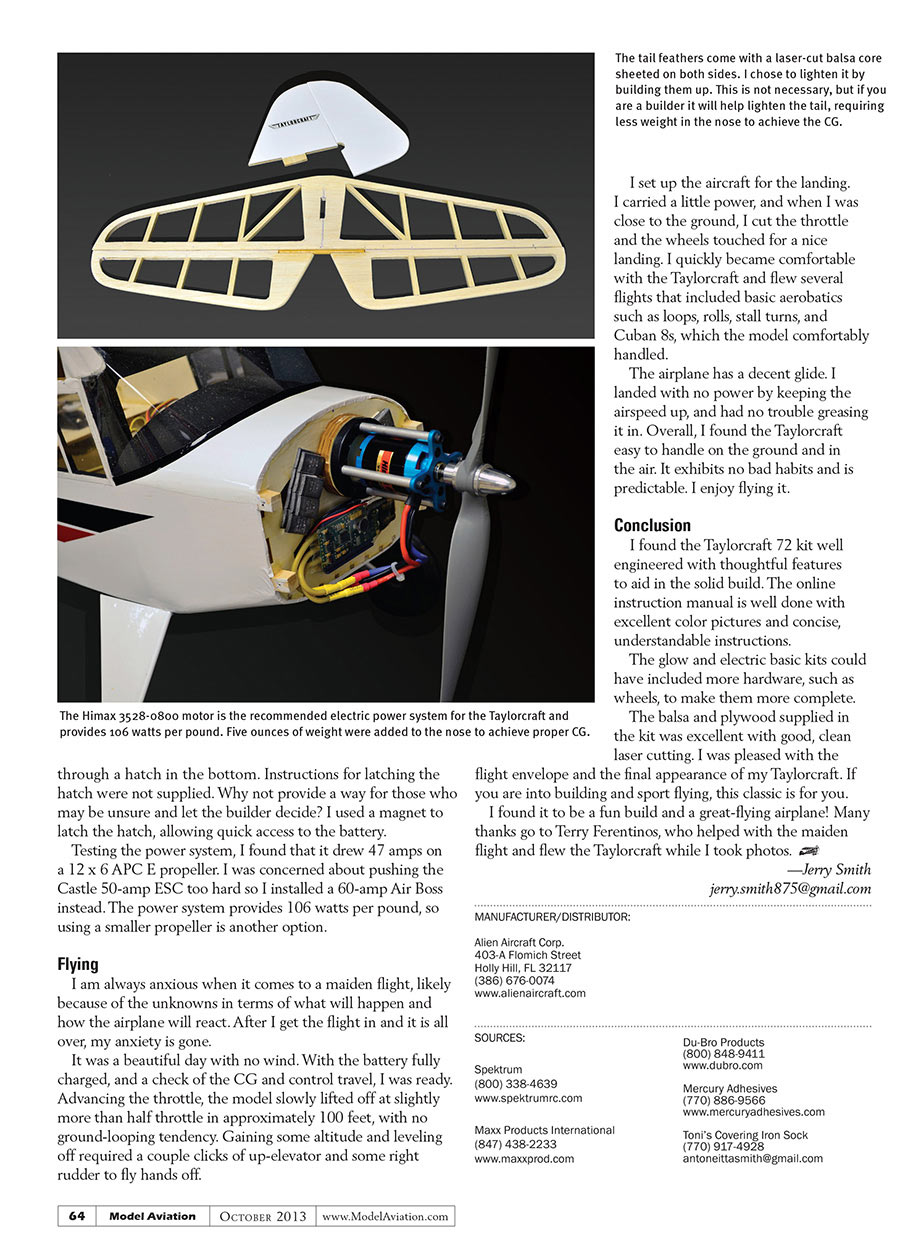
The tail feathers come with a laser-cut balsa core sheeted on both sides. I chose to lighten it by building them up. This is not necessary, but if you are a builder it will help lighten the tail, requiring less weight in the nose to achieve the CG.
I set up the aircraft for the landing. I carried a little power, and when I was close to the ground, I cut the throttle and the wheels touched for a nice landing. I quickly became comfortable with the Taylorcraft and flew several flights that included basic aerobatics such as loops, rolls, stall turns, and Cuban 8s, which the model comfortably handled.
The airplane has a decent glide. I landed with no power by keeping the airspeed up, and had no trouble greasing it in. Overall, I found the Taylorcraft easy to handle on the ground and in the air. It exhibits no bad habits and is predictable. I enjoy flying it.
Conclusion
I found the Taylorcraft 72 kit well engineered with thoughtful features to aid in the solid build. The online instruction manual is well done with excellent color pictures and concise, understandable instructions.
The glow and electric basic kits could have included more hardware, such as wheels, to make them more complete.
The balsa and plywood supplied in the kit was excellent with good, clean laser cutting. I was pleased with the flight envelope and the final appearance of my Taylorcraft. If you are into building and sport flying, this classic is for you.
I found it to be a fun build and a great-flying airplane! Many thanks go to Terry Ferentinos, who helped with the maiden flight and flew the Taylorcraft while I took photos.
—Jerry Smith [email protected]
MANUFACTURER/DISTRIBUTOR:
Alien Aircraft Corp. 403-A Flomich Street Holly Hill, FL 32117 (386) 676-0074 www.alienaircraft.com
SOURCES:
- Spektrum
(800) 338-4639 www.spektrumrc.com
- Maxx Products International
(847) 438-2233 www.maxxprod.com
- Du-Bro Products
(800) 848-9411 www.dubro.com
- Mercury Adhesives
(770) 886-9566 www.mercuryadhesives.com
- Toni’s Covering Iron Sock
(770) 917-4928 [email protected]
Transcribed from original scans by AI. Minor OCR errors may remain.

