
AMA in Action 2013/07
Aeromodeling restrictions remain in effect in Washington, D.C.
Following the terrorist attacks of September 11, 2001, concern regarding national security resulted in heightened security measures across the country. The airspace around Washington, D.C., underwent a number of changes designed to tighten control and restrict flying near the nation's capital.
In 2003, a Temporary Flight Rules area was created and named the Washington D.C. Air Defense Identification Zone (ADIZ). An ADIZ is an area around U.S. territories comprising airspace over land or water in which the ready identification, location, and control of civil aircraft is required in the interest of national security.
The Washington D.C. ADIZ was created by the FAA in response to recommendations made by a multiagency group known as the National Capital Region Coordination Center. Congress has never legitimized the restrictions created by this group; however, any thoughts of opposing the Executive Branch's actions diminished following two mishaps that led to the evacuation of the Capitol.
One incident involved an airplane carrying the governor of Kentucky, and the other involved a Cessna 150 flown by a student pilot unfamiliar with the ADIZ rules.
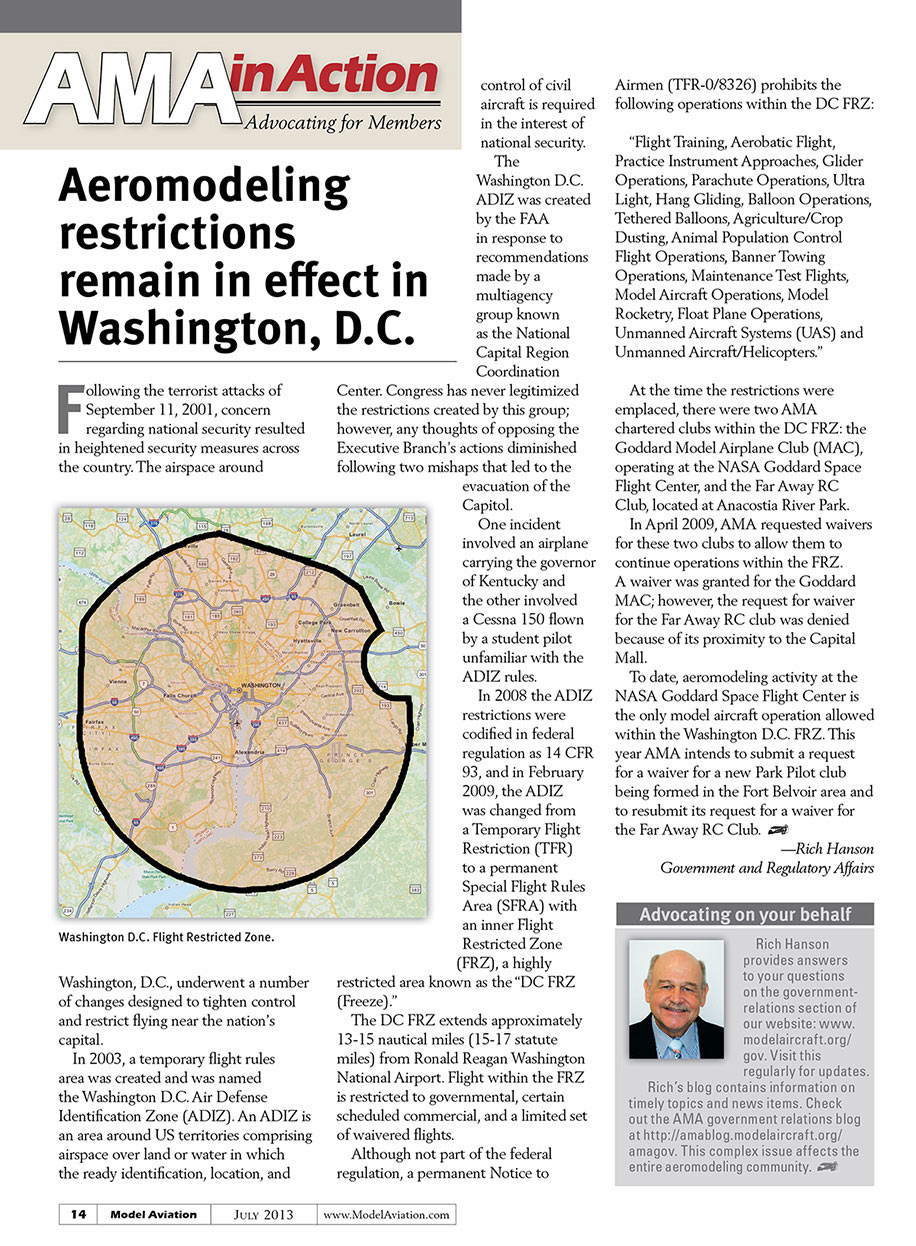
In 2008 the ADIZ restrictions were codified in federal regulation as 14 CFR 93. In February 2009, the ADIZ was changed from a Temporary Flight Restriction (TFR) to a permanent Special Flight Rules Area (SFRA) with an inner Flight Restricted Zone (FRZ), a highly restricted area often called the "DC FRZ (Freeze)."
The DC FRZ extends approximately 13–15 nautical miles (15–17 statute miles) from Ronald Reagan Washington National Airport. Flight within the FRZ is restricted to governmental, certain scheduled commercial, and a limited set of waivered flights.
Although not part of the federal regulation, a permanent Notice to Airmen (TFR-0/8326) prohibits the following operations within the DC FRZ:
- Flight training
- Aerobatic flight
- Practice instrument approaches
- Glider operations
- Parachute operations
- Ultralight operations
- Hang gliding
- Balloon operations
- Tethered balloons
- Agriculture/crop dusting
- Animal population control flight operations
- Banner towing operations
- Maintenance test flights
- Model aircraft operations
- Model rocketry
- Float plane operations
- Unmanned Aircraft Systems (UAS) and unmanned aircraft/helicopters
At the time the restrictions were emplaced, there were two AMA-chartered clubs within the DC FRZ: the Goddard Model Airplane Club (MAC), operating at the NASA Goddard Space Flight Center, and the Far Away RC Club, located at Anacostia River Park.
In April 2009, AMA requested waivers for these two clubs to allow them to continue operations within the FRZ. A waiver was granted for the Goddard MAC; however, the request for a waiver for the Far Away RC Club was denied because of its proximity to the Capitol Mall.
To date, aeromodeling activity at the NASA Goddard Space Flight Center is the only model aircraft operation allowed within the Washington D.C. FRZ. AMA intends to submit a request for a waiver this year for a new Park Pilot club being formed in the Fort Belvoir area and to resubmit its request for a waiver for the Far Away RC Club.
Author
Rich Hanson Government and Regulatory Affairs
Transcribed from original scans by AI. Minor OCR errors may remain.

