
FPV: friend or foe?
Seldom has model aviation received as much attention from the media, lawmakers, or regulatory agencies as it has in the past year—a fact owed to the advent of First-Person View (FPV) flying.
Mainstream hobbyists have been ambivalent to the rise of FPV, and many have been openly hostile. This reaction is understandable, given the negative publicity and the threat of increased regulation that have accompanied its entry into RC flying. However, the emergence of FPV has also led to a surge of interest in the hobby and has brought many into model aviation who would otherwise have never picked up a radio.
Will FPV make the hobby stronger by increasing its ranks and expanding its frontiers, or will it bring more bad press, scrutiny, and regulation?
A Historical Perspective
When a new technological innovation has been introduced to model aviation, it has met resistance. Helicopters, turbines, and Giant Scale aircraft were all initially dismissed as unreliable and dangerous by established hobbyists. Each brought new challenges and required the AMA to adopt new standards to oversee their safe operation. Also, there were mishaps, especially while these technologies were maturing into the reliable and widely accepted facets of model aviation that they are today.
FPV undeniably “feels” different from any of these previous advancements. It’s more ominous and threatening. This sense can be traced to two separate factors: the specific moment in history when it emerged and the unique route that many of the individuals who pioneered FPV took to get their start in RC flying.
Society has become increasingly uneasy with the military’s use of drone aircraft to carry out strike missions overseas. They are perceived as silent, invisible, airborne killing machines with near-magical powers to identify and track individuals on the ground and eavesdrop on their conversations.
The public is concerned that this same technology will be deployed in the US by a government bent on invading its privacy—a perception only reinforced by recent revelations about the National Security Administration’s domestic-surveillance programs. It is in this emotionally charged environment that FPV flying first broke through into the public consciousness. Many early practitioners even referred to their systems as “drones,” perhaps not fully realizing the depth of public angst conjured by this term.
This past winter, the AMA witnessed an onslaught of bills introduced in state legislatures that sought to regulate drones and often swept up FPV flying along with other forms of RC aviation in the category.
Despite a few notable exceptions, the worst elements of these laws were blunted or turned back with AMA’s support. However, this experience confirmed what many traditional aeromodelers already suspected: FPV could only mean trouble for the hobby that they love.
In the Wilderness
Beyond the negative attention it has received from the public and lawmakers, FPV seemed alien to the established RC flying community because it evolved outside the channels that helped shape generations of safe, skilled pilots.
From the beginning of the hobby, when novices decided that they wanted to learn how to fly, their first stop was the local hobby shop. There they were able to acquire the necessary equipment, but also suggestions about getting started and connections to local flying clubs.
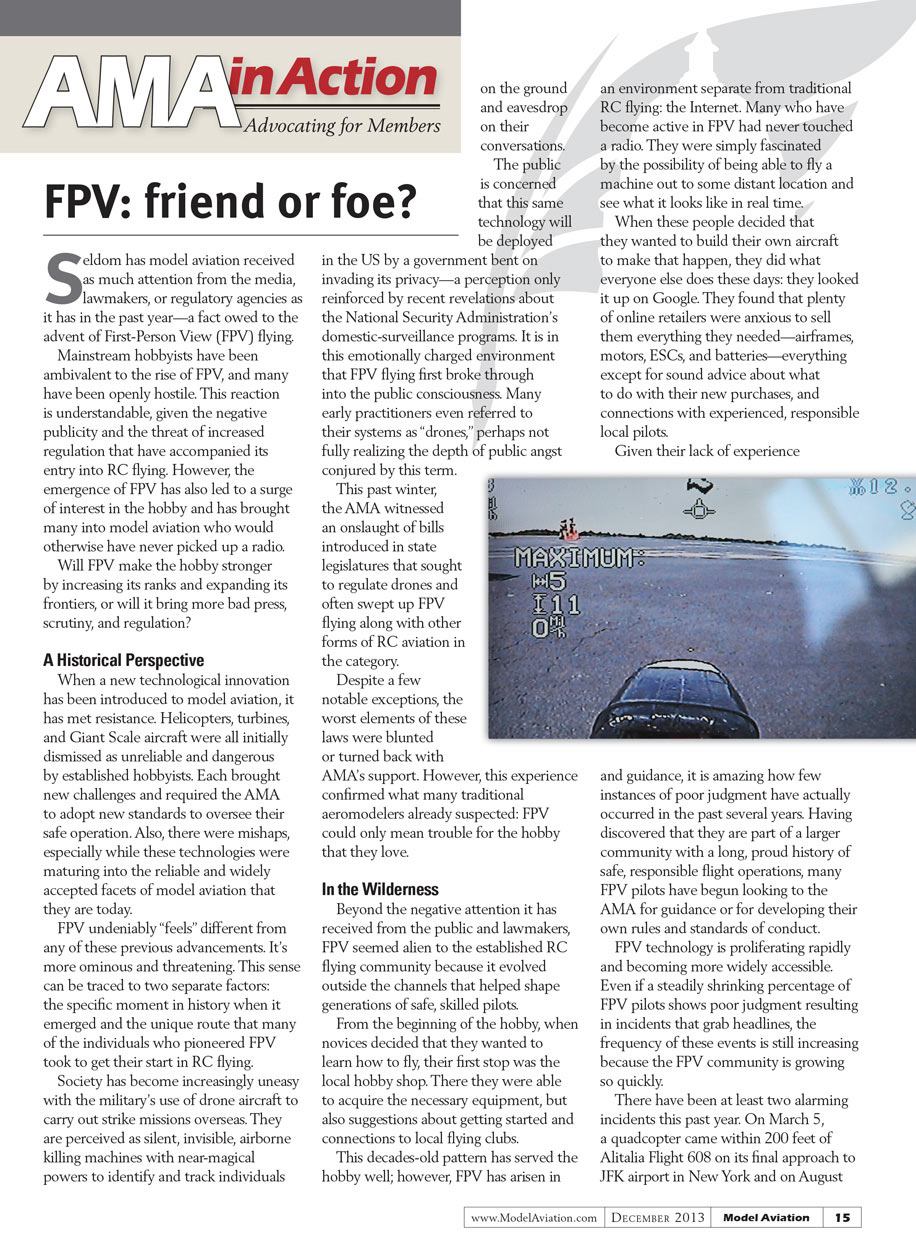
This decades-old pattern has served the hobby well; however, FPV has arisen in an environment separate from traditional RC flying: the Internet. Many who have become active in FPV had never touched a radio. They were simply fascinated by the possibility of being able to fly a machine out to some distant location and see what it looks like in real time.
When these people decided that they wanted to build their own aircraft to make that happen, they did what everyone else does these days: they looked it up on Google. They found that plenty of online retailers were anxious to sell them everything they needed—airframes, motors, ESCs, and batteries—everything except for sound advice about what to do with their new purchases, and connections with experienced, responsible local pilots.
Given their lack of experience and guidance, it is amazing how few instances of poor judgment have actually occurred in the past several years. Having discovered that they are part of a larger community with a long, proud history of safe, responsible flight operations, many FPV pilots have begun looking to the AMA for guidance or for developing their own rules and standards of conduct.
FPV technology is proliferating rapidly and becoming more widely accessible. Even if a steadily shrinking percentage of FPV pilots shows poor judgment resulting in incidents that grab headlines, the frequency of these events will still increase because the FPV community is growing so quickly.
There have been at least two alarming incidents this past year. On March 5, a quadcopter came within 200 feet of Alitalia Flight 608 on its final approach to JFK airport in New York and on August 24, a multirotor aerial camera platform crashed into the stands at an event at the Virginia Motorsports Park.
A Simple Choice
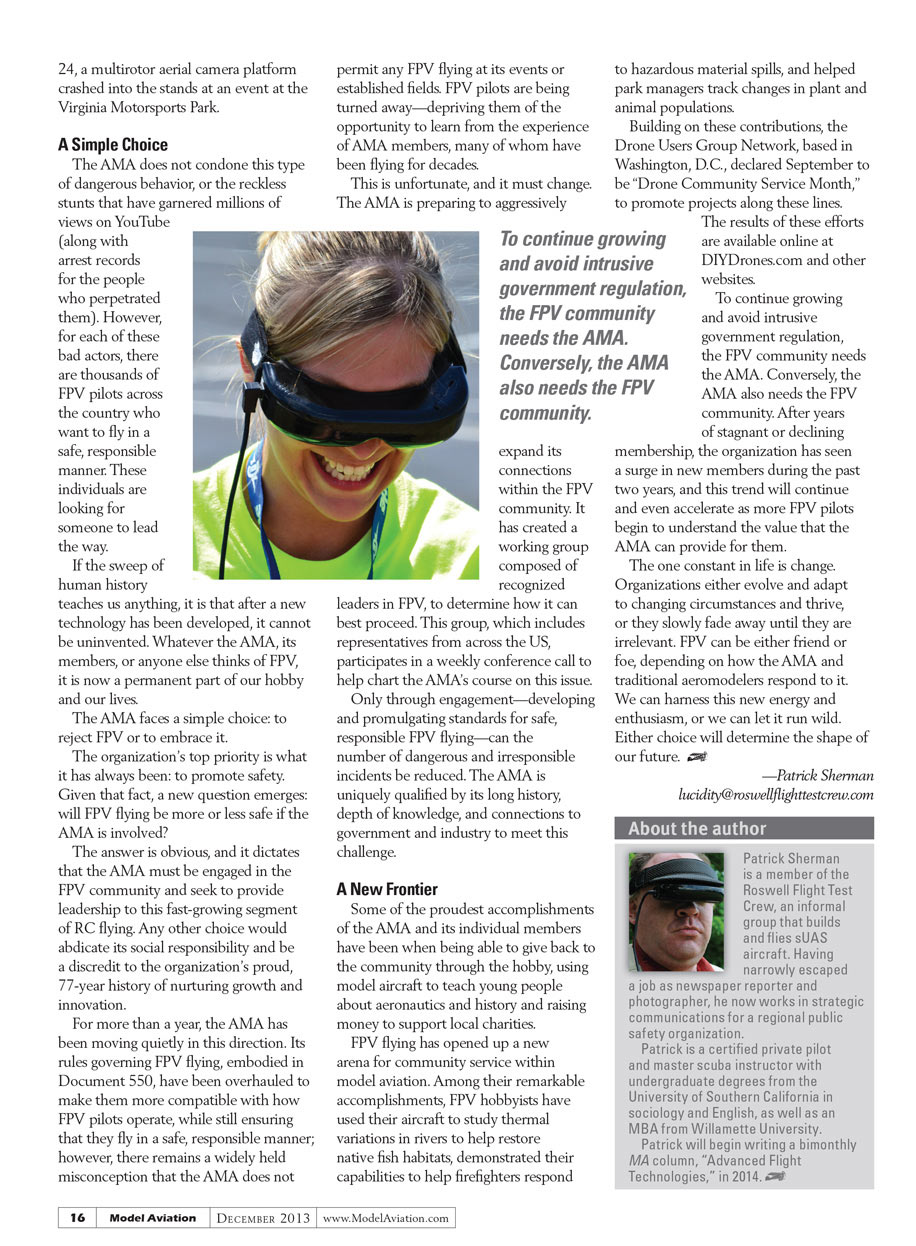
The AMA does not condone this type of dangerous behavior, or the reckless stunts that have garnered millions of views on YouTube (along with arrest records for the people who perpetrated them). However, for each of these bad actors, there are thousands of FPV pilots across the country who want to fly in a safe, responsible manner. These individuals are looking for someone to lead the way.
If the sweep of human history teaches us anything, it is that after a new technology has been developed, it cannot be uninvented. Whatever the AMA, its members, or anyone else thinks of FPV, it is now a permanent part of our hobby and our lives.
The AMA faces a simple choice: to reject FPV or to embrace it.
The organization's top priority is what it has always been: to promote safety. Given that fact, a new question emerges: will FPV flying be more or less safe if the AMA is involved?
The answer is obvious, and it dictates that the AMA must be engaged in the FPV community and seek to provide leadership to this fast-growing segment of RC flying. Any other choice would abdicate its social responsibility and be a discredit to the organization's proud, 77-year history of nurturing growth and innovation.
For more than a year, the AMA has been moving quietly in this direction. Its rules governing FPV flying, embodied in Document 550, have been overhauled to make them more compatible with how FPV pilots operate, while still ensuring that they fly in a safe, responsible manner; however, there remains a widely held misconception that the AMA does not permit any FPV flying at its events or established fields. FPV pilots are being turned away—depriving them of the opportunity to learn from the experience of AMA members, many of whom have been flying for decades.
This is unfortunate, and it must change. The AMA is preparing to aggressively expand its connections within the FPV community. It has created a working group composed of recognized leaders in FPV, to determine how it can best proceed. This group, which includes representatives from across the US, participates in a weekly conference call to help chart the AMA's course on this issue.
Only through engagement—developing and promulgating standards for safe, responsible FPV flying—can the number of dangerous and irresponsible incidents be reduced. The AMA is uniquely qualified by its long history, depth of knowledge, and connections to government and industry to meet this challenge.
A New Frontier
Some of the proudest accomplishments of the AMA and its individual members have been when being able to give back to the community through the hobby, using model aircraft to teach young people about aeronautics and history and raising money to support local charities.
FPV flying has opened up a new arena for community service within model aviation. Among their remarkable accomplishments, FPV hobbyists have used their aircraft to study thermal variations in rivers to help restore native fish habitats, demonstrated their capabilities to help firefighters respond to hazardous material spills, and helped park managers track changes in plant and animal populations.
Building on these contributions, the Drone Users Group Network, based in Washington, D.C., declared September to be "Drone Community Service Month," to promote projects along these lines.
The results of these efforts are available online at DIYDrones.com and other websites.
To continue growing and avoid intrusive government regulation, the FPV community needs the AMA. Conversely, the AMA also needs the FPV community. After years of stagnant or declining membership, the organization has seen a surge in new members during the past two years, and this trend will continue and even accelerate as more FPV pilots begin to understand the value that the AMA can provide for them.
The one constant in life is change. Organizations either evolve and adapt to changing circumstances and thrive, or they slowly fade away until they are irrelevant. FPV can be either friend or foe, depending on how the AMA and traditional aeromodelers respond to it. We can harness this new energy and enthusiasm, or we can let it run wild. Either choice will determine the shape of our future.
—Patrick Sherman <REDACTED>
Transcribed from original scans by AI. Minor OCR errors may remain.

