
AMA Convention 2005
by Bob Hunt
Background
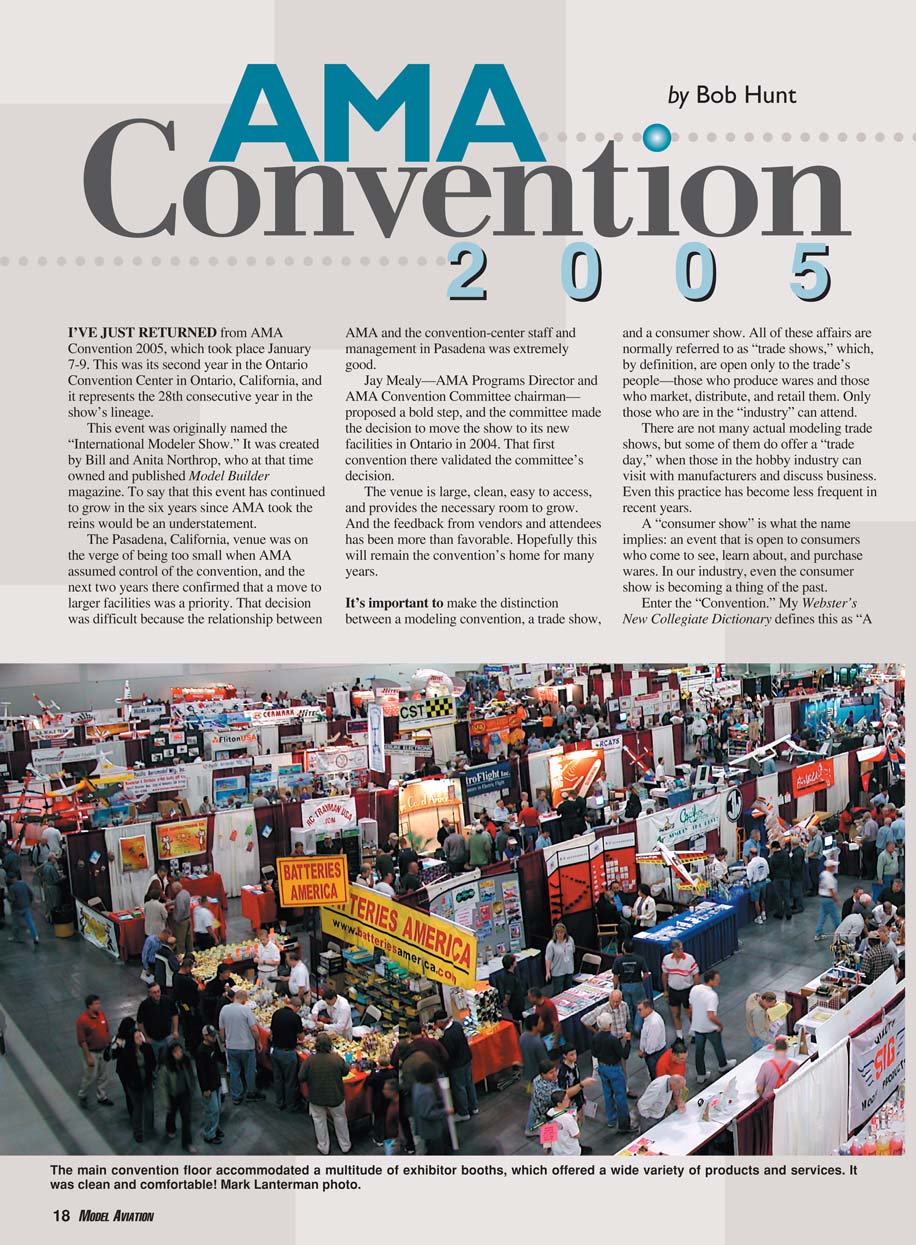
I’ve just returned from AMA Convention 2005, which took place January 7–9. This was its second year in the Ontario Convention Center in Ontario, California, and it represents the 28th consecutive year in the show’s lineage.
The event was originally named the "International Modeler Show." It was created by Bill and Anita Northrop, who at that time owned and published Model Builder magazine. To say this event has continued to grow in the six years since AMA took the reins would be an understatement.
The Pasadena venue was on the verge of being too small when AMA assumed control of the convention, and the next two years there confirmed that a move to larger facilities was a priority. That decision was difficult because the relationship between AMA and the convention-center staff and management in Pasadena was extremely good.
Jay Mealy—AMA Programs Director and AMA Convention Committee chairman—proposed a bold step, and the committee made the decision to move the show to its new facilities in Ontario in 2004. That first convention there validated the committee’s decision: the venue is large, clean, easy to access, and provides the necessary room to grow. Feedback from vendors and attendees has been favorable, and hopefully this will remain the convention’s home for many years.
Convention, trade, and consumer shows
It’s important to distinguish between a modeling convention, a trade show, and a consumer show.
- A trade show is typically open only to industry professionals—those who produce, market, distribute, and retail wares. Some modeling trade shows offer a "trade day" for business discussions, but that practice has become less frequent.
- A consumer show is open to the public who come to see, learn about, and purchase wares. Even consumer shows in our industry are becoming rarer.
- A convention (Webster’s: “A body of delegates, representatives, members, or the like, periodically convened for a common purpose”) fits what the AMA is doing in Ontario each year. The main attraction is information about new products and the ability to see them in person. Attendees can speak directly with manufacturers, get immediate answers, and often provide feedback that leads to better products.
For the most part, manufacturers in our hobby are modelers themselves, and they enjoy seeing modelers’ reactions to their latest products. The component of personal contact and discussion is invaluable both ways, and it fits the description of a convention: a common purpose of seeing, showing, and discussing new products.
Exhibitors
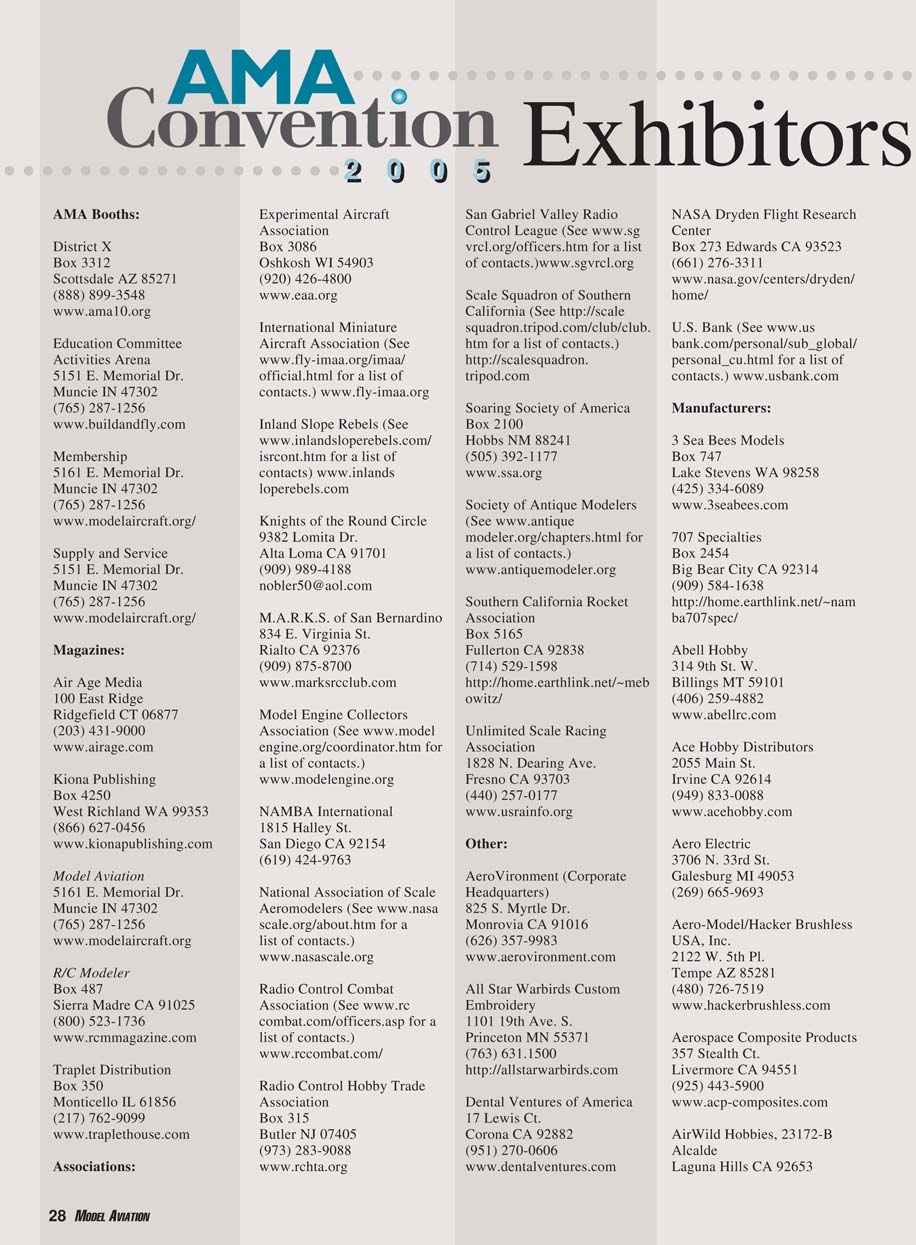
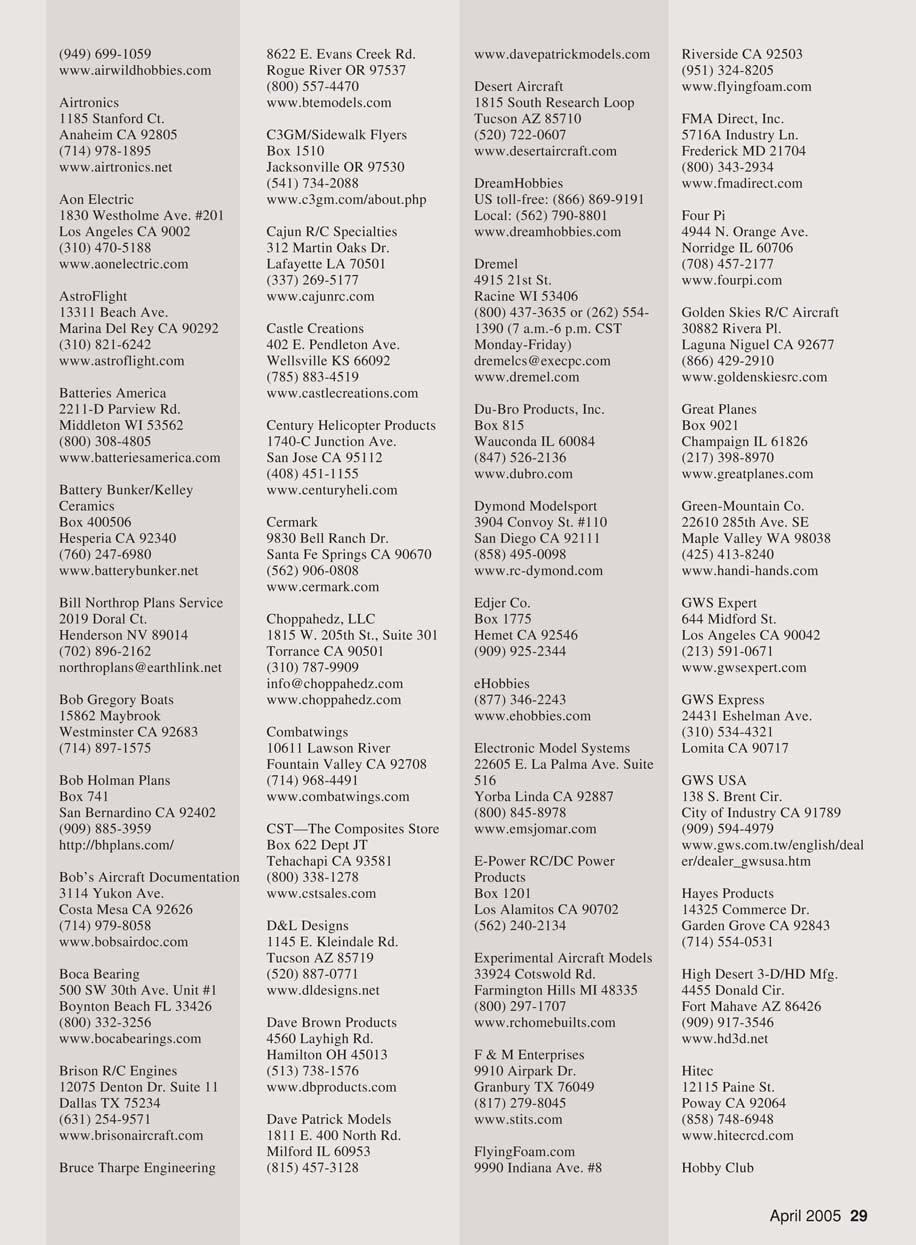
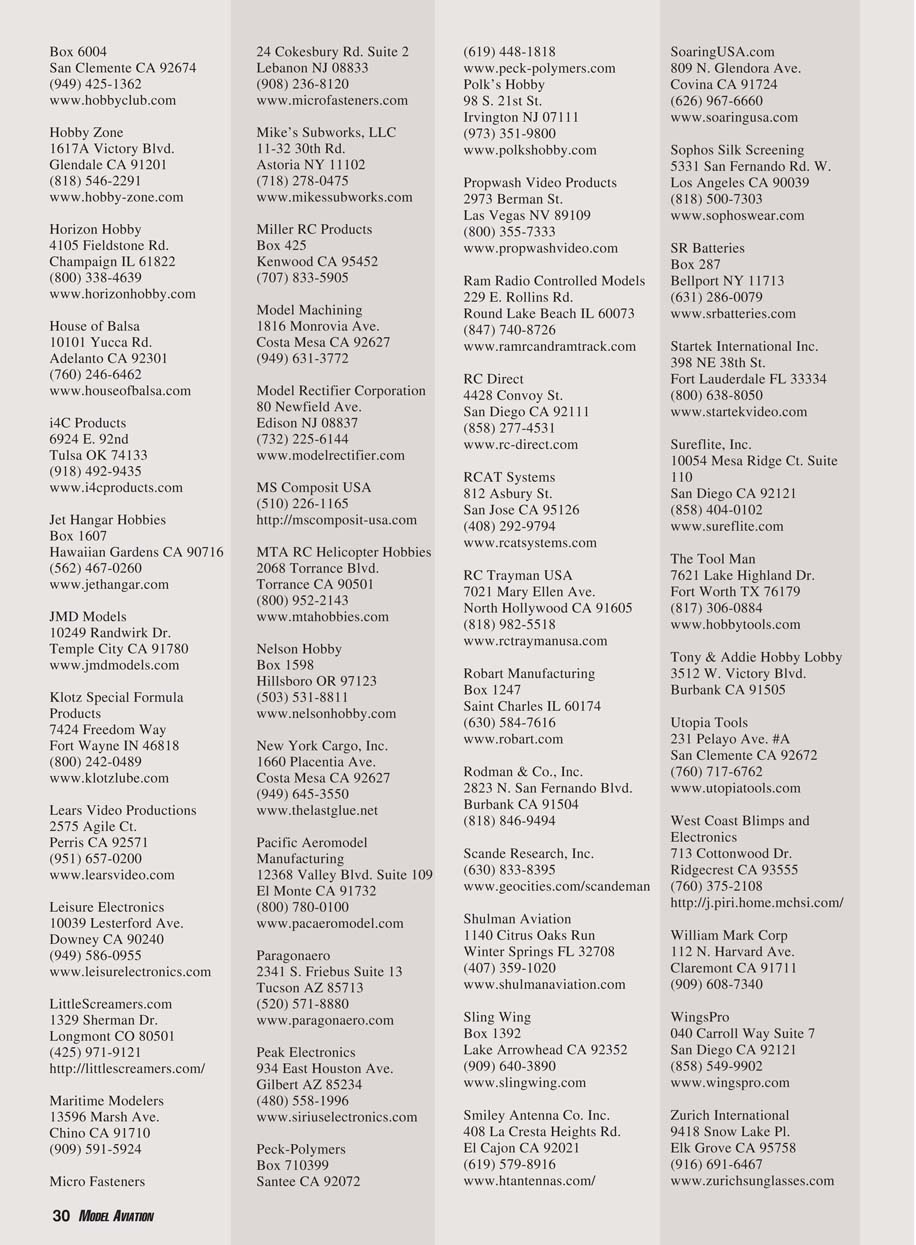
At this year’s convention, 141 exhibitors occupied a total of 256 booths for attendees to visit. The largest group of exhibitors was made up of manufacturers offering products and services across the modeling spectrum. For those who could not attend, the convention included a list of exhibitors and their contact information so people could follow up afterward.
Symposiums and special presentations
Most modeling shows now feature symposiums and organizational meetings, and this year’s convention took that aspect to a new level with a wide variety of symposiums during the three days. Many attendees reported the symposiums were the deciding factor in whether they would attend.
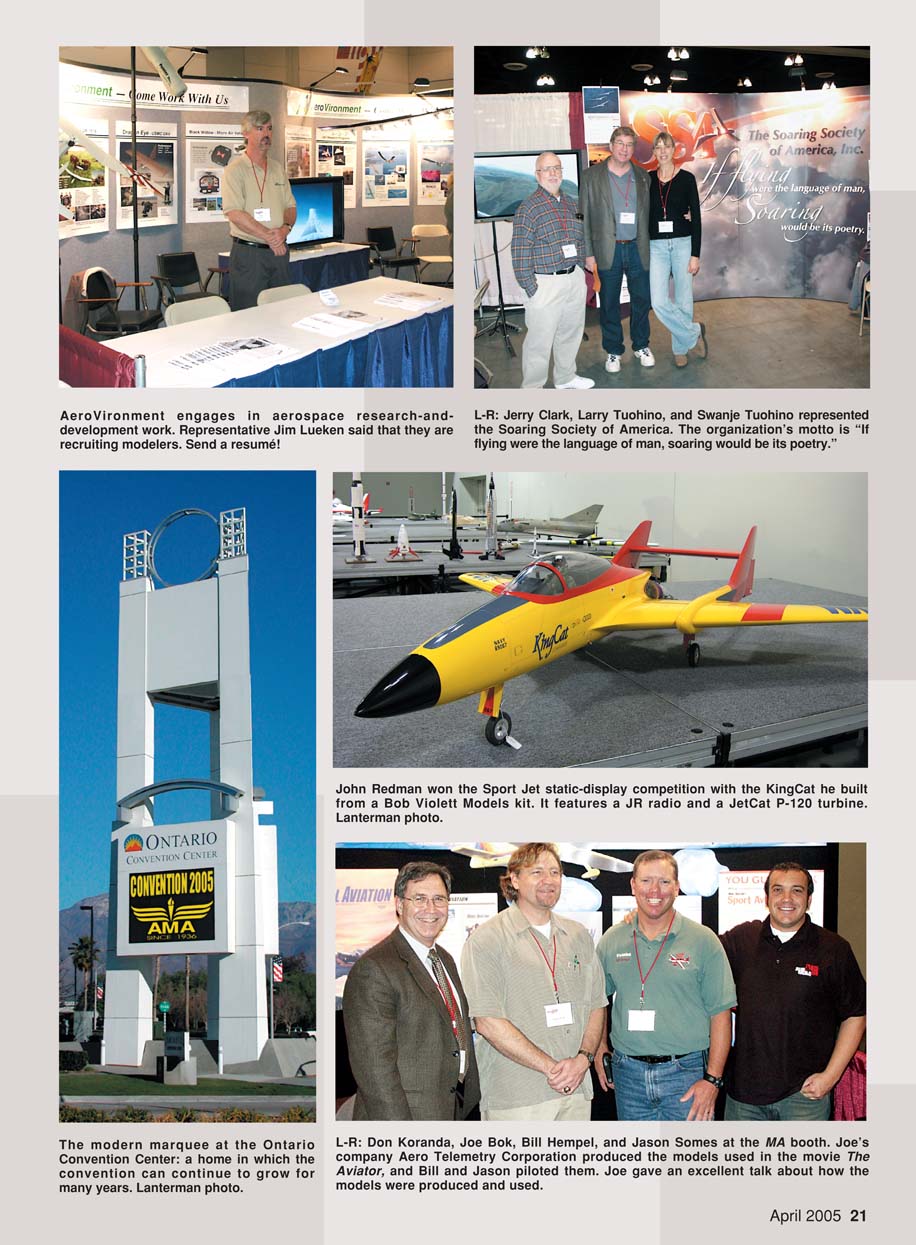
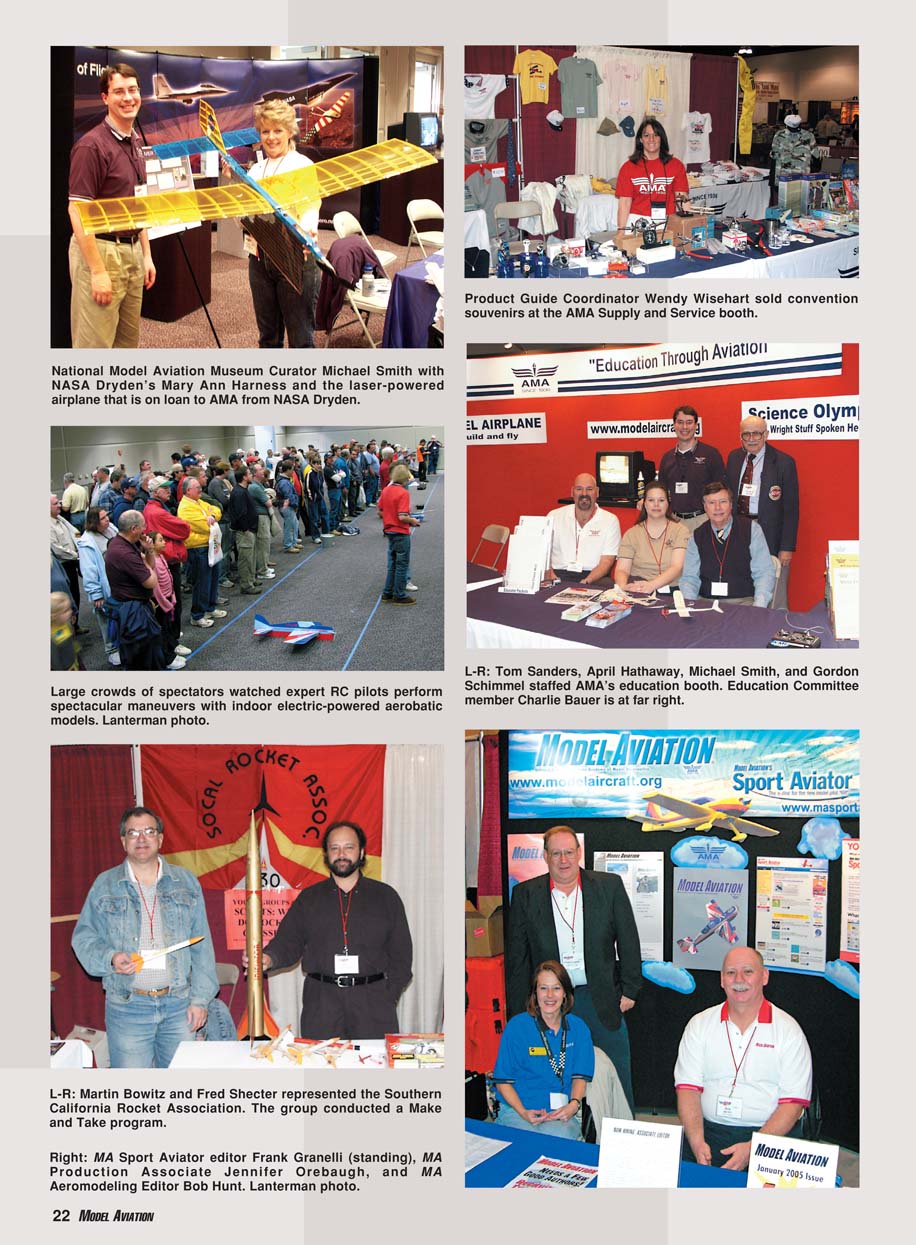
Highlighting the program was a presentation by Aero Telemetry CEO Joe Bok. Joe and his company were recently involved with the remotely piloted vehicle (RPV)-type craft used in filming the multiple-Academy-Award-nominated film The Aviator. Joe spoke for an hour about the project, its time pressures, and technical aspects of the aircraft. He showed still photos and video depicting the construction of three airplanes at his facility: the Hughes H-1, the Hughes XF-11, and the Hughes H-4 Hercules (commonly referred to as the Spruce Goose).
Bill Hempel and Jason Somes, who piloted the craft for filming, also spoke and provided a modeler’s viewpoint of making the airplanes perform on cue according to the director’s wishes. Their presentation drew a standing-room-only crowd. AMA is planning a series of articles about the entire project in the near future.
Other symposium topics included building and finishing techniques, safe battery usage, and many other informative modeling subjects. Meeting rooms also hosted several organizational meetings, an AMA general membership meeting, and a District X meeting.
AMA leadership and safety
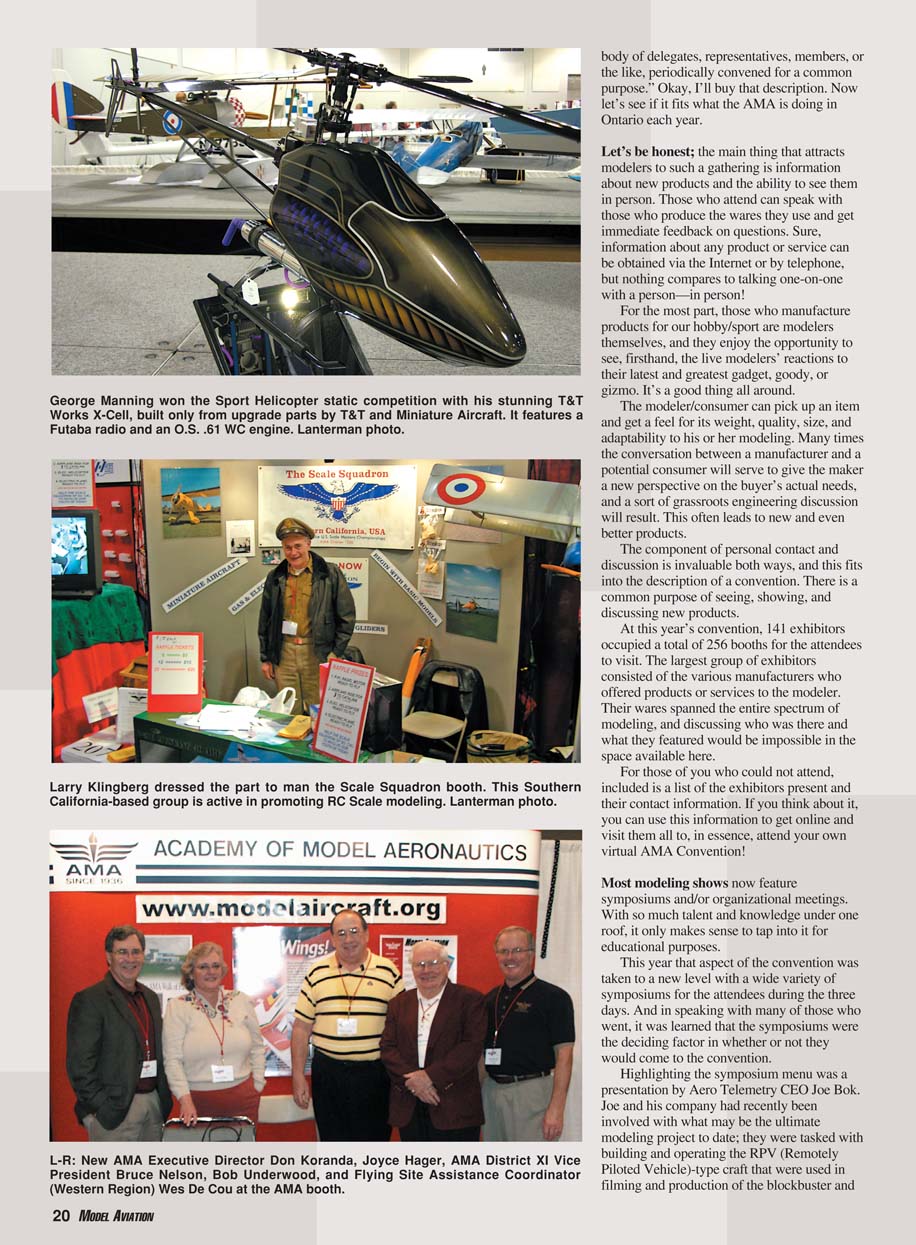
New AMA Executive Director Don Koranda attended the District X meeting, giving western AMA members an opportunity to meet him. Don emphasized safety education and awareness as a main concern and goal for AMA members. He spent much of his time at the convention at the AMA booth, answering members’ questions and listening to feedback.
On the subject of safety, AMA Special Services Director Carl Maroney and Larry Johnson—president of AMA’s insurance broker, FirstLine Insurance—gave a comprehensive presentation on flightline safety. These symposiums are popular and needed, and the plan is to make them an even more integral part of the convention in coming years.
AMA education booth and new-modeler activities
AMA is more than an organization; it’s also an academy—a place of training. Training and teaching should be paramount, and the AMA education booth demonstrated this well. Dedicated teaching professionals staffed the education area with materials and hands-on modeling learning aids that were well received by both modelers and curious nonmodelers.
The RCAD (Radio Control Aircraft Demonstrator), developed by AMA Education Director Jack Frost and AMA National Model Aviation Museum Curator Michael Smith, lets newcomers move the sticks on a transmitter and see how inputs control a typical four-channel model. The gimbal-mounted model responds appropriately in attitude on its articulated base, reinforcing control/response relationships.
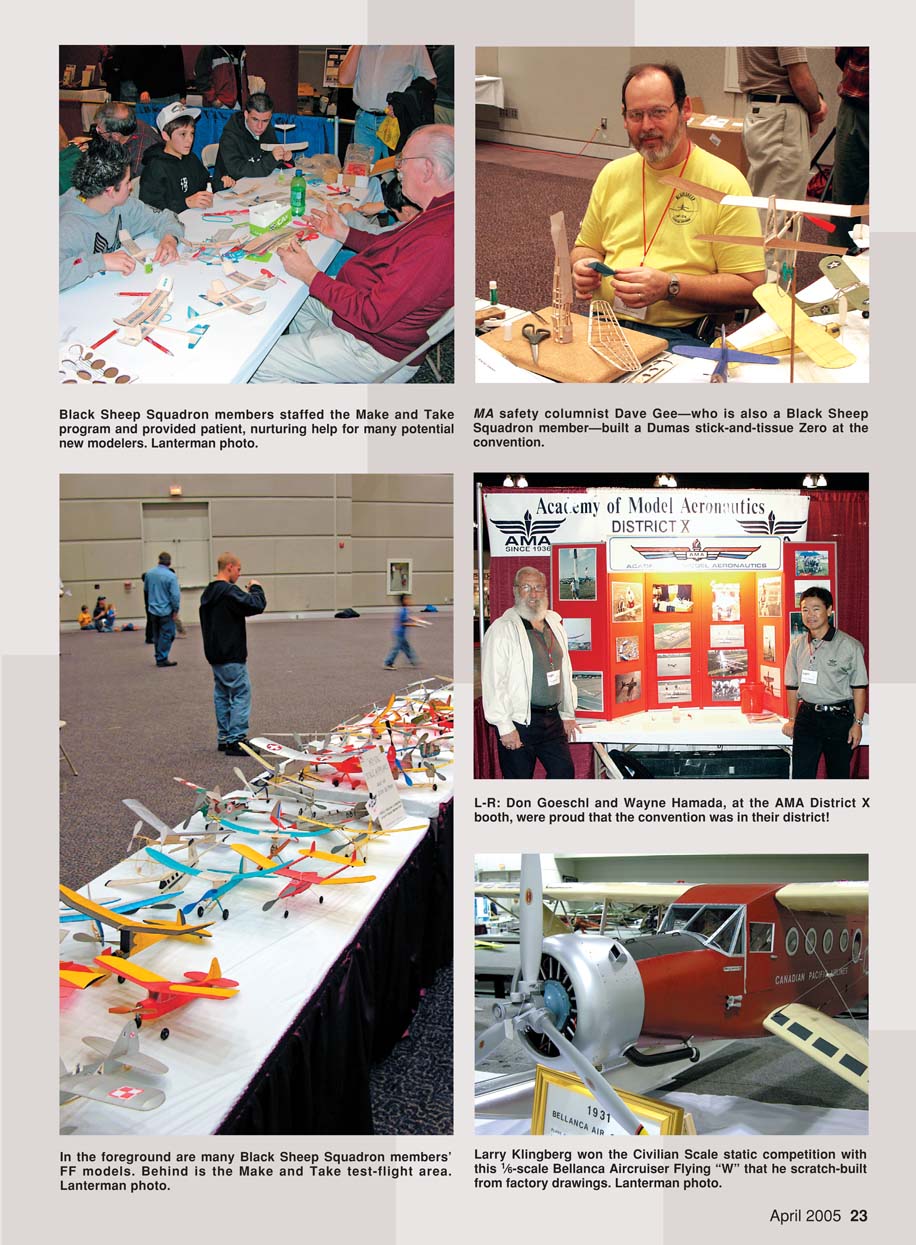
After this introduction, newcomers used a computer simulator for virtual flight training, then attended hands-on building lessons staffed by members of the Black Sheep Squadron, a very active beginner-aware group from Southern California. MA safety columnist Dave Gee helped instruct and built a fairly complex stick-and-tissue model as attendees watched.
Students assembled a simple sheet-balsa, rubber-powered model in the "Make and Take" area under supervision, then wound the rubber and flew their creations in a spacious indoor flying area. Models often needed trim work, and Black Sheep members were on hand to instruct. The newcomers also experienced competition via a mass-launch contest: models launched together and the last airplane flying won. In roughly an hour, participants went through theory, simulation, building, trimming, and flying—a complete and rewarding introduction to modeling.
Thanks to the AMA education-booth staffers and the Black Sheep Squadron members who helped in the education, activity, and Make and Take areas.
NASA Dryden and model rocketry
The NASA Dryden booth in the education area featured a proof-of-concept, laser-powered model called the Moth, currently on loan to AMA and soon to be on display in the museum along with Dryden’s X-33 radio-controlled drop-test model and the radio-controlled Mother Ship. The Mother Ship has served for more than 30 years, releasing drop-test models for NASA. The booth demonstrated how modeling can lead to a career in aviation and aerospace.
On the other end of the convention floor, another Make and Take area featured model rockets, staffed by members of the Southern California Rocket Association.
Flight demonstrations and action
Flight-demonstration and activity areas were separated from the main convention floor for safety, and there was continuous action as well-known modelers demonstrated their skills with popular sheet-foam, 3-D-type, electric-powered airplanes. If you haven’t seen this type of model fly, you’re missing one of the most entertaining developments in our hobby/sport in many years.
These simple and relatively inexpensive airplanes are capable of remarkable maneuvers and are a strong selling point for modeling, especially for younger people interested in "extreme" activities. Electric 3-D flying could be a catalyst to bring younger members to modeling and to AMA in significant numbers.
Static competition and raffle
The convention also featured a static-competition area where modelers displayed airplanes, boats, and cars showcasing craftsmanship and finishing skills. This year’s entries were notable for their quantity and diversity. A favorite mentioned was Larry Klingberg’s Bellanca Aircruiser, which won top honors in the Scale Civilian class. Details of many static models appear in this month’s RC Scale column by Stan Alexander.
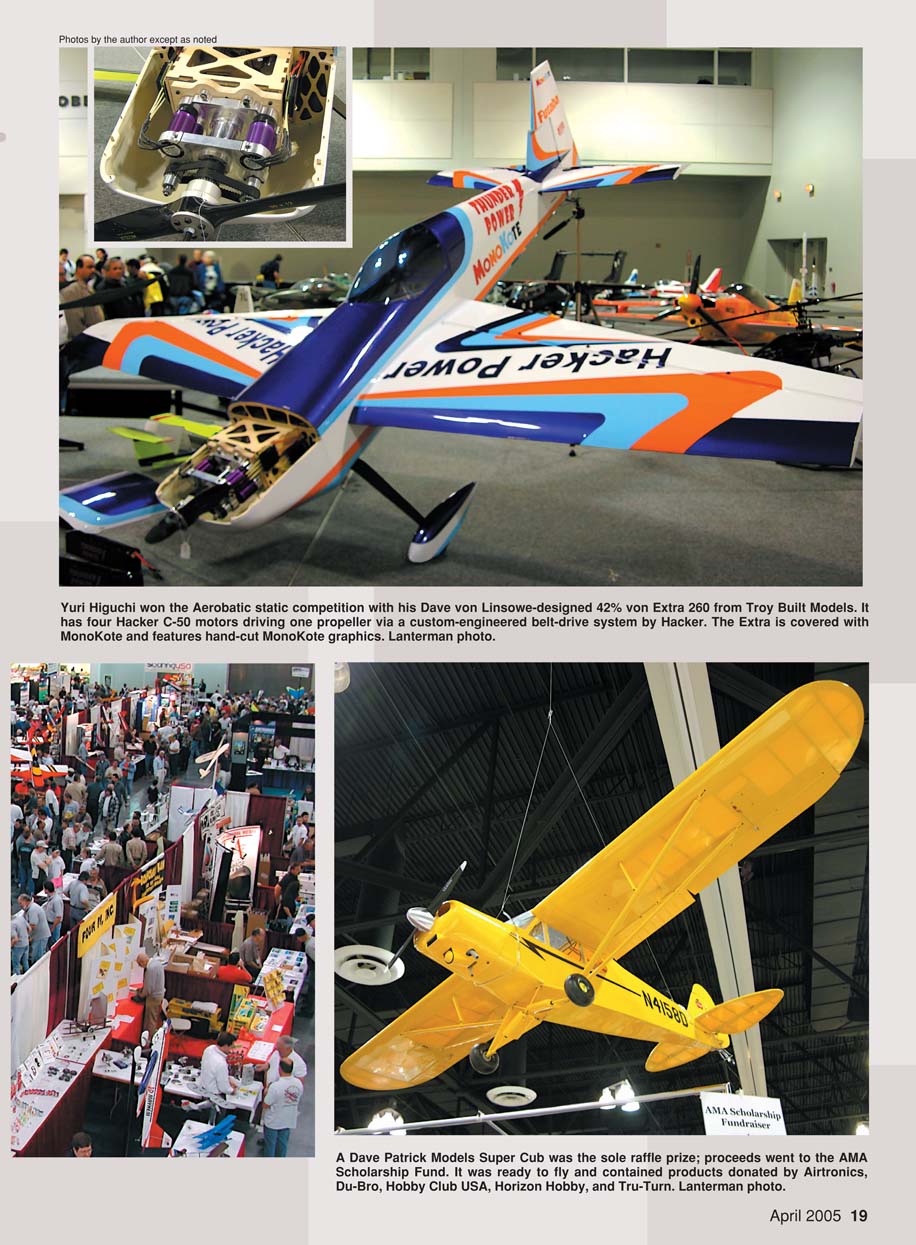
Several companies were acknowledged for donating products used in the model raffled to support the AMA Scholarship Fund. Thanks to:
- Airtronics — radio-control system
- Dave Patrick Models — fully assembled Super Cub ARF
- Du-Bro Products — scale Cub wheels, control horns, and miscellaneous hardware items
- Hobby Club USA — glue, propeller, and various small items
- Horizon Hobby — Saito 120 engine
- Tru-Turn — spinner and spinner adapter
Conclusion
By definition, we had an AMA Convention proper. AMA continues to learn from members who attend each year about how the convention can be improved to serve their needs and desires. If only the weather will cooperate next year and yield some sunshine instead of rain (this was Southern California, right?), the event might approach perfection.
Bob Hunt
Transcribed from original scans by AI. Minor OCR errors may remain.

