
AMA-EPA Superfund Site Success Story
By Jeff Welliver
APRIL 26, 2006, at 2:16 p.m. the first flight lifted off from our club’s new flying site. It’s a simple enough statement, but as Paul Harvey says, “Now let me tell you the rest of the story.”
Did you ever have the feeling that things were going too well? The year 2005 had been that kind of year for the Minneapolis Piston Poppers in Minnesota, with a few small bumps in the road but many good things happening. At the top of that list were many great flying sessions at our meticulously groomed flying site. For the first time in years the local police had no noise complaints—something that had been an ongoing challenge. It was the last day of September and all was right with the world.
Then the phone rang. It was Keith Sandberg, our club’s site coordinator for the old flying field. He had just gotten a letter from the college where our site was located. “This letter is to serve as 30 days notice,” it read. Just like that our facility of 14 years would be gone. The only good part was that flying in Minnesota after the end of October is an uncommon activity.
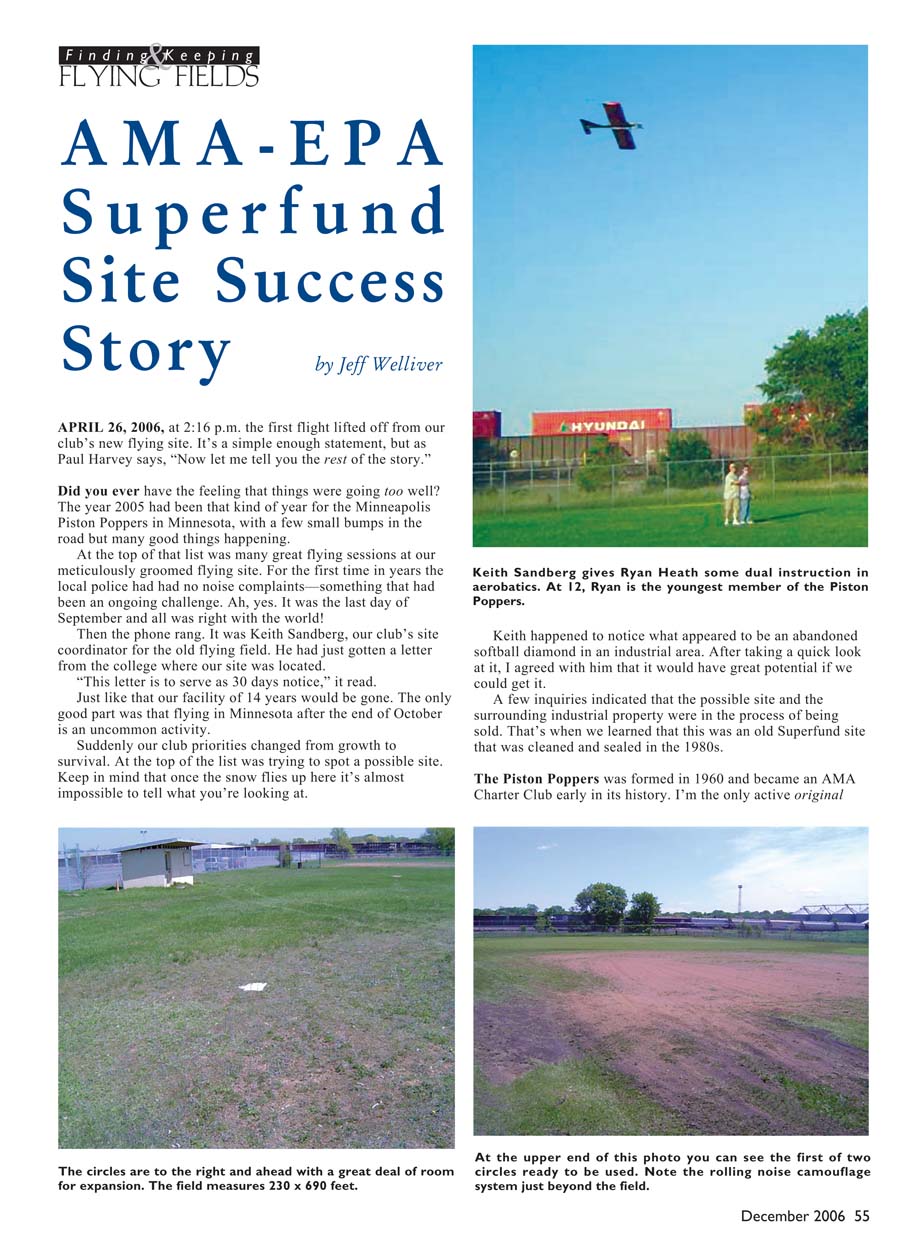
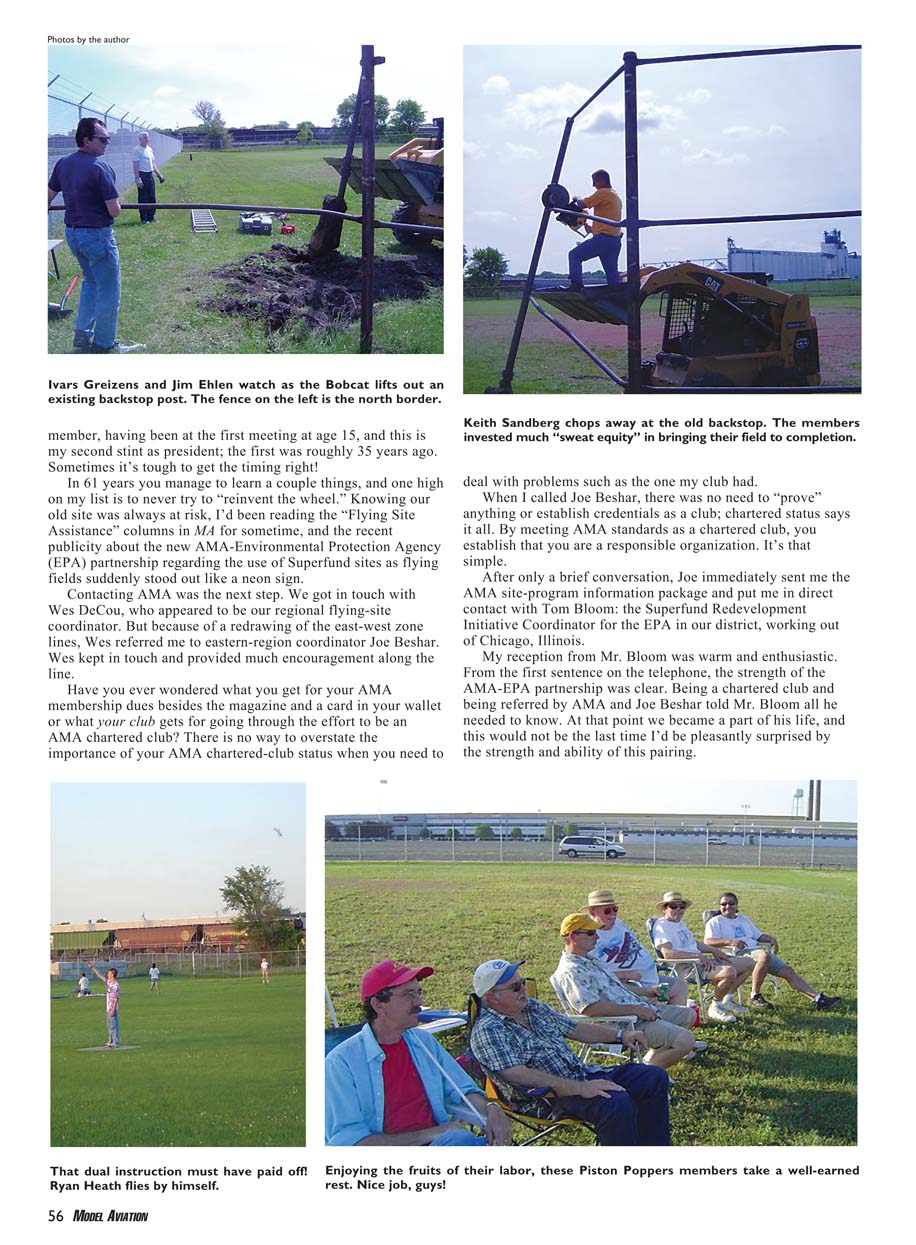
Suddenly our club priorities changed from growth to survival. At the top of the list was trying to spot a possible site. Keep in mind that once the snow flies up here it’s almost impossible to tell what you’re looking at. Keith happened to notice what appeared to be an abandoned softball diamond in an industrial area. After taking a quick look at it, I agreed with him that it would have great potential if we could get it.
A few inquiries indicated that the possible site and the surrounding industrial property were in the process of being sold. That’s when we learned that this was an old Superfund site that was cleaned and sealed in the 1980s.
The Piston Poppers were formed in 1960 and became an AMA charter club early in their history. I’m the only active original member, having been at the first meeting at age 15, and this is my second stint as president; the first was roughly 35 years ago. In 61 years you manage to learn a couple things, and one high on my list is to never try to “reinvent the wheel.”
Knowing our old site was always at risk, I’d been reading the “Flying Site Assistance” columns in MA for some time, and the recent publicity about the new AMA–Environmental Protection Agency (EPA) partnership regarding the use of Superfund sites as flying fields suddenly stood out like a neon sign. Contacting AMA was the next step.
We got in touch with Wes DeCou, who appeared to be our regional flying-site coordinator. Because of a redrawing of the east–west zone lines, Wes referred me to eastern-region coordinator Joe Beshar. Wes kept in touch and provided much encouragement along the way.
Have you ever wondered what you get for your AMA membership dues besides the magazine and a card in your wallet—or what your club gets for being an AMA-chartered club? There is no way to overstate the importance of your AMA charter when you need to deal with problems such as the one my club had. When I called Joe Beshar, there was no need to “prove” anything or establish credentials as a club; chartered status says it all. By meeting AMA standards as a chartered club, you establish that you are a responsible organization. It's that simple.
After only a brief conversation, Joe immediately sent me the AMA site-program information package and put me in direct contact with Tom Bloom, the Superfund Redevelopment Initiative Coordinator for the EPA in our district, working out of Chicago, Illinois. My reception from Mr. Bloom was warm and enthusiastic. From the first sentence on the telephone, the strength of the AMA–EPA partnership was clear. Being a chartered club and being referred by AMA and Joe Beshar told Mr. Bloom all he needed to know. At that point we became a part of his life, and this would not be the last time I'd be pleasantly surprised by the strength and ability of this pairing.
One of the most impressive things about the Superfund program was that Mr. Bloom clearly had access to good information about aeromodeling and flying-site requirements. Ours was the first CL (control-line) club he had dealt with, yet he was almost instantly up to speed on our special requirements.
The Superfund site in question was surrounded on three sides by secured property including a defense plant, a railroad yard, and the fenced Superfund burial vault area, so any kind of departure of a model from the site might have created major problems. It was unusable for RC or FF, but it was perfect for CL. Another bit of good fortune was that Mr. Bloom had been closely involved in the original Superfund cleanup program on this site and remembered it in detail. Things were starting to look up as we headed into winter.
At this point it was decided that the best approach would be for Mr. Bloom to determine who the best contacts would be and likely also make the first call. We discovered that the site and the entire plant adjoining it were being sold, so contact with the owner would have to wait until the dust cleared on the property sale.
Meanwhile, Joe Beshar kept in contact, provided encouragement, and monitored progress. Mr. Bloom cleared the way with the various federal and state personnel involved with the site so that there would be no obstacles when the sale was completed. On our end, contact was made with the city to make sure about ordinances and noise requirements. It is impossible to overstate the impact of the AMA–EPA partnership when looking for a site. Simply mentioning this relationship to anyone in local government establishes your respectability and legitimacy.
At this point the club gave me the authority to speak and negotiate for it, meaning that I could make decisions so we could move forward quickly. This is critical in person-to-person negotiations with busy business people.
The land involved was zoned Heavy Industrial. In the city involved that means in case of a noise complaint all we have to do is be less than 75 decibels at the property line of the person complaining. To the east the closest homes are approximately 1,700 feet from the site, with the railroad yard in between. To the west, about 1,600 feet away, the nearest homes have a major freeway adjoining their back yards and a park full of trees plus the Mississippi River and another noisy four-lane road between us.
Although we won’t try it, a Dynajet-powered model probably wouldn’t exceed the noise standards. What a relief after consistently monitoring (with written logs) 90 decibels at 9 feet at the old site for 14 years, where back yards were just 300 feet away from the circle.
The property sale was finally completed in late February of this year. After allowing a bit of time for the new owners to settle in (and for my trip to the Vintage Stunt Championships contest in Tucson, Arizona, in March), it was time to establish contact. By this time Mr. Bloom had determined who the new owners were and the proper person to contact; it was the vice president/chief operating officer of the company. Mr. Bloom got in touch with him, explained who he was and who we were, explained the AMA–EPA partnership and what we sought, and then got the okay for me to approach him directly.
Stop and think about that. You have just bought a large piece of property with a Superfund site attached, and the EPA calls and suggests a great use for some of that land. That is my idea of a strong introduction!
At that point all those involved—AMA, the EPA, the club, and the property owner—were pulling in the same direction. Since the site had been a baseball diamond and soccer field, and was actually being maintained although rarely used, it was capable of accommodating two circles exactly as it sat. It was the club’s turn to take action.
Negotiations and the Letter of Authorization
I have some suggestions covering what worked well for us during our search-and-negotiation process.
- Be patient. These processes develop a kind of rhythm. Keep in touch but don’t nag, and always follow through on your promises. Try to establish a positive working relationship.
- Study the AMA flying-site package thoroughly. At first the 80-plus pages of material ranging from letters and articles to copies of site agreements will look overwhelming. It is not. It is, indeed, logically sequenced, and provides priceless insight and information from years of solving the same kinds of problems that face you.
- Do your homework as a club. Take the time, as a club, to understand your needs, goals, capabilities, and limitations. Spell these out clearly so your site committee and spokesperson know what they have to work with.
- Make one person the contact and voice of the club, and provide him or her with a small support committee of two or three people. Provide the representative with the authority to speak and negotiate for the club.
As the process continues, make members understand that not all of us get all we want. Encourage them to let their spokespeople do their jobs. Our club was incredibly good about this, and it made a world of difference.
As club contact, I had two other committee members backing me up. Even now most of the principal people involved have never spoken to or been in any kind of direct contact with anyone else from the club. This is not some kind of ego issue; it's good business and simplifies the process of working things out. Choose someone in your club who can make decisions and then set things up so he or she can do so.
It happened that my first call to the site owner was during a meeting. Since he had already spoken to Mr. Bloom and saw it was me on caller ID, he interrupted the meeting to talk to me. That gives you some idea of the strength of an EPA referral. We quickly agreed that I would provide him with written details via e-mail and then call him in 10 days when he got back from a trip out of town.
What I sent him was a couple pages long and briefly explained what we sought. It also explained what I call the “triangular relationship.” Picture Mr. Bloom and the EPA at the top, acting as the point. As you drop down, the next level widens to the AMA–EPA partnership. Dropping down to the even wider next line shows AMA, the Charter Club program, and requirements for the clubs, including legal structure, safety, individual AMA membership requirements, and, of prime importance, site-owner’s insurance coverage.
At the bottom, the widest line of the triangle, is the broad base of roughly 160,000 AMA members, including your own club members. That first call to Mr. Bloom could not have occurred had it not been for all these components.
By carefully emphasizing the interlocking relationship in which each level of the triangle must meet standards to be a part of the whole, the site owner can see a logical assurance of proper protection for him from liabilities and that his property will be used in an appropriate manner.
For us to provide him with that Certificate of Insurance he knows that our club and its members meet certain standards, and that in order to offer site-owner coverage to clubs, AMA must maintain and enforce those standards. And the site owner knows that the EPA would certainly not enter a partnership with AMA and its members if it were not fully confident that all those standards were being met on an ongoing basis.
The site owner can be assured that his copy of the Certificate of Insurance is also his guarantee that we, the people who will be on his property, are meeting those standards. Last, he is promised that if that status changes and the insurance is canceled, he will be notified promptly. In reality, we are adding the prestige and reputation of AMA and the EPA to our own.
The site-owner's board saw this concept and agreed to move forward on that basis. On his return we set up our first face-to-face meeting. After only a few minutes of discussion in the office we went out onto the site and talked about what our needs would be.
To simplify matters I offered to draw up a simple agreement in the form of a Letter of Authorization for the use of the site. This is a simple two-page document showing what each party's obligations and rights would be.
The Letter of Authorization for the land use specifies that the Piston Poppers remain an AMA-chartered club and provide the insurance certificate, requires that we operate within applicable laws, stipulates what changes we can make to the site itself, and lists our obligations regarding maintenance. A review by a club member who is an attorney indicated no problems with the Letter of Authorization. It is not a lease and no money changed hands. It is simple and straightforward. A copy will be available through AMA and will probably become part of the flying-site packet.
After our member/attorney quickly ran the document past his legal department, it was just a matter of our getting together, working out a few minor details, and signing it. We had gone ahead and activated site insurance a few days before so we could use the site right away.
One of the few hitches was that the insurance broker had mailed the certificate to our club secretary, who was out of town at the time. A call was made to Club Secretary Lois Pierce at AMA Headquarters, and in less than 10 minutes she had gotten a copy of the letter from the broker and faxed it to the site owner. I've dealt with Lois several times, and there's no way to say enough about her willingness to help. It would be nice if every organization could provide the kind of service that seems to be the standard at AMA Headquarters.
A few minutes after 1 p.m. on April 26, 2006, and just more than an hour after the certificate was sent, I had the pleasure of lifting the first model off of our new flying site!
Establishing and Using the New Site
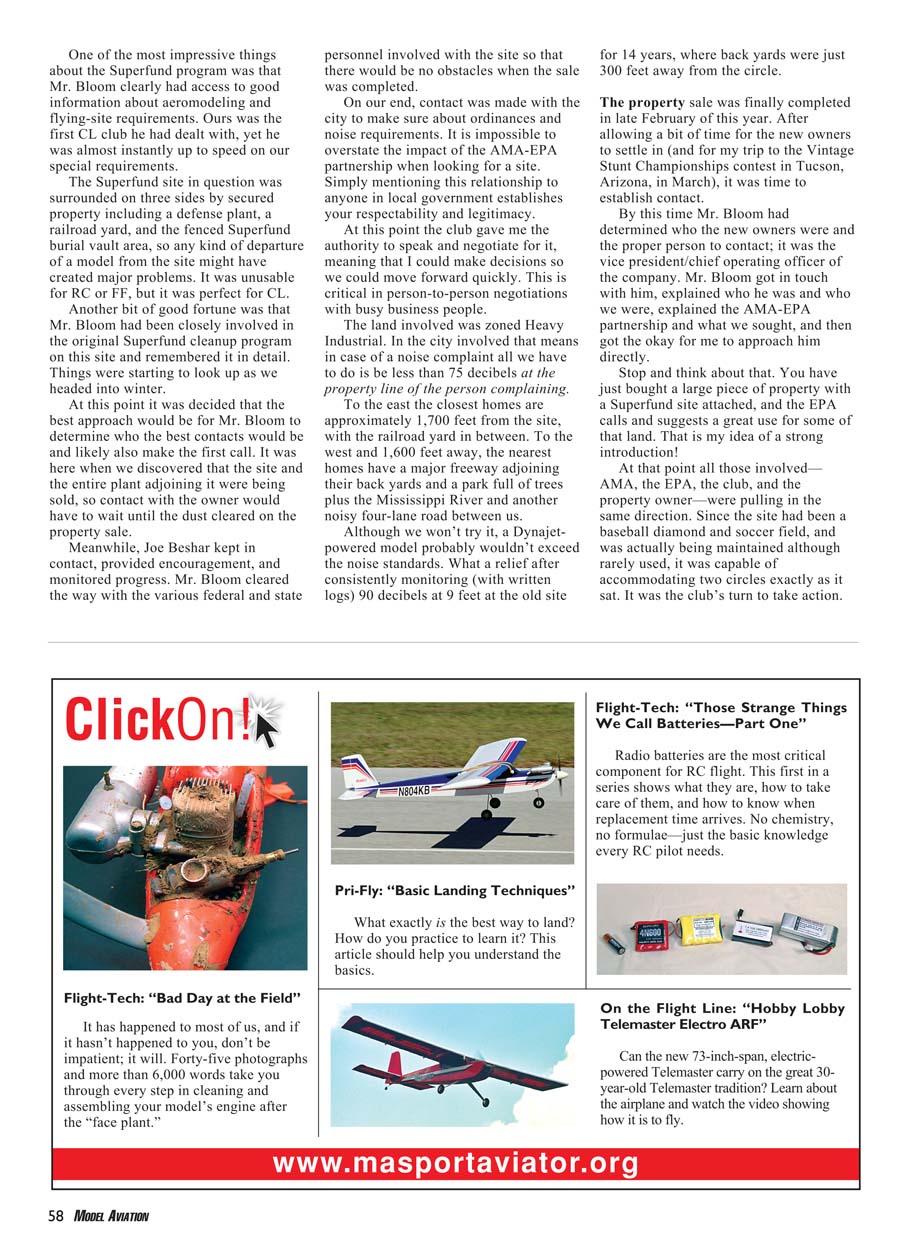
As you can see in the pictures, the club removed the old baseball backstop and did some basic cleanup. The owner provided a dumpster and hauled away the rubble. We mowed and maintained the grass on the site and did our best to keep it neat.
We moved the circle center pads from the old site to the new facility. They are 5-foot-diameter, 5-inch-thick concrete slabs and were a challenge to move safely since they weigh probably 600 pounds each. Still, it was easier than pouring new ones.
Was it all worth it? You bet! The former site was nice, but we could use it only on Sundays and after 4 p.m. on Wednesdays. Worse yet, we could never allow more than two engines to run at once and always needed someone to keep an activity log with noise readings.
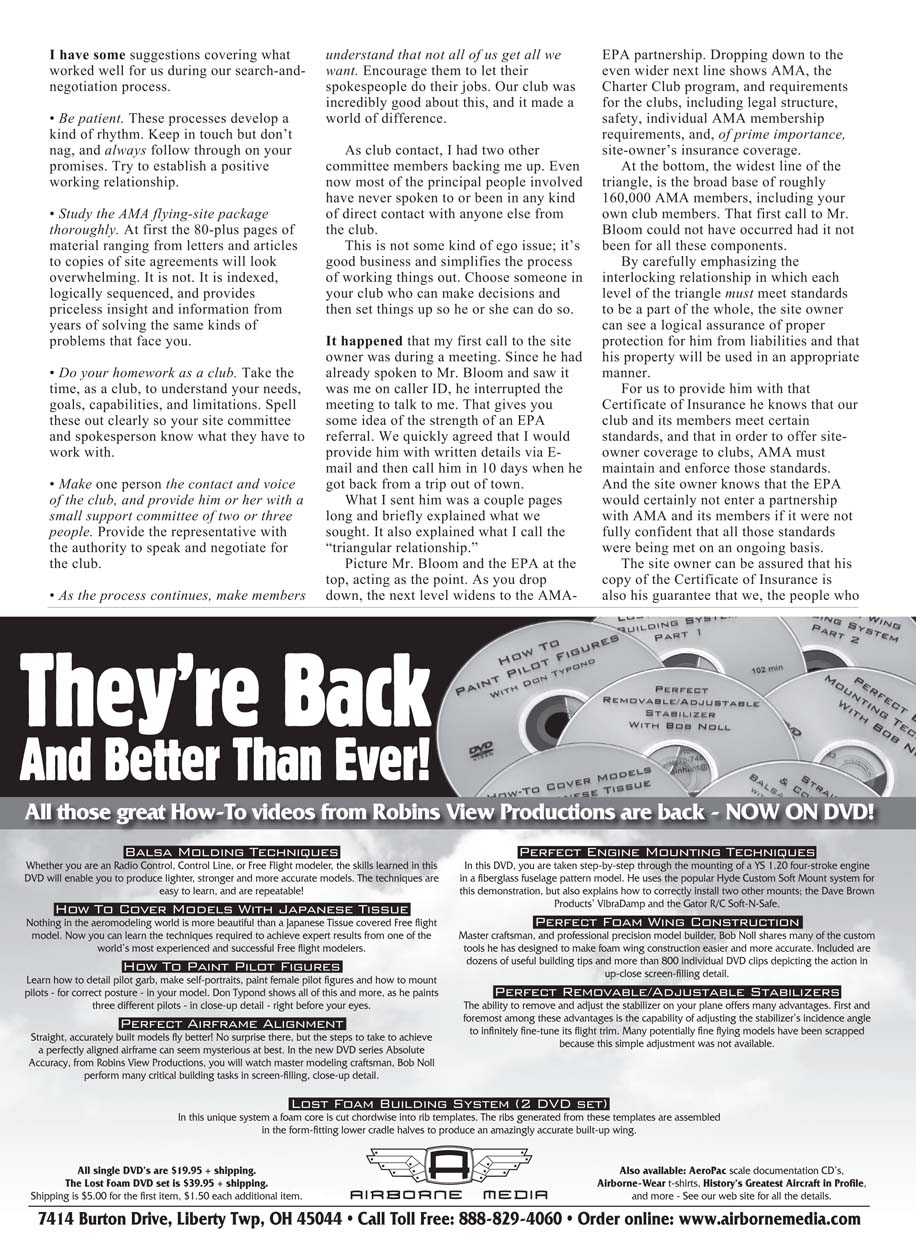
Now we fly any day after 10 a.m., run as many engines as we want, and only check the noise level periodically. At the homes nearest our site the club's noise meters don't even twitch, and both start at 50 decibels. It is almost impossible to hear our activities at all near any of the homes in either direction; there is only a rare buzz for a second or so.
Obtaining this field was not only a big deal for our club, but it was an important EPA milestone. This site is the first success story generated by the AMA–EPA partnership. The EPA felt that it was important enough to memorialize this event by taking photographs of the site and our flying and meeting and interviewing the people involved. With the help of great weather and enthusiastic club members, the EPA personnel had a great and educational time, including a little dual time on the handle.
This material will be used internally by EPA as part of the partnership and shared with other AMA clubs and local communities that can benefit from our experience. It may also be used for press releases when appropriate.
Thanks and Acknowledgments
First of all, thanks to Joe Beshar, Lois Pierce, Wes DeCou, and all other AMA people who made this success possible through their work with us on this project and the long-term growth and refinement of AMA's Flying Site Assistance Program.
I can't say enough thanks to the EPA's Tom Bloom for his tireless efforts on our behalf and to our site owner, whose open-minded attitude allowed it all to come together. Thanks also to each of you as individual AMA members. Without your loyalty and continuing support of AMA—our organization—programs such as the AMA–EPA partnership would be impossible.
Finally, thanks to the Piston Poppers members for your patience and confidence during the process, and thanks for the time since then for your hard work to make it into a great place to fly.
That is “the rest of the story.”
MA Jeff Welliver [email protected]
Transcribed from original scans by AI. Minor OCR errors may remain.

